

AI Startups Are Pricing for a World That No Longer Exists
Software founders were trained to chase one number above all: usage.
More sessions, more depth, more people back tomorrow, and the economics took care of themselves, because the next interaction cost almost nothing to serve. That reflex built the modern software industry.
Right now, it is also one of the quickest ways to bankrupt an AI company.
Every prompt carries a real bill from someone’s hardware, so the exact behavior founders spent two decades maximizing is now the behavior draining the business. Pricing is suddenly a revenue-survival problem, and the smartest operators are rebuilding both halves of the equation: what they charge, and the agents that run revenue itself.
together with Hard Skill Exchange:
That second half is exactly what this is about. Everyone has heard about autonomous agents. Few have seen them run in production.
On July 30, the executives deploying Autonomous Revenue Agents across the full customer lifecycle show how, live:

▫️ 30-minute sessions from the leaders at Gainsight, 1mind, Vivun, and Dialpad
▫️ The methods, harnesses, and governance behind revenue-critical agents you can actually trust
▫️ The 8 emerging ARA categories, from autonomous discovery and prospecting to deal execution and monetization
▫️ How AI-native GTM operating models compare, so you can find the fit for your own team
Free and virtual:
Table of Contents
1. Software Stopped Being Free to Run
2. Flat Pricing Is Right at Exactly One Point
3. Not Every AI Startup Has the Same Problem
4. What You Charge For Beats How You Charge
5. Price for Where Costs Are Going, Not Where They Are
6. The Part Nobody Wants to Hear
1. Software Stopped Being Free to Run
The thing that made software such a beautiful business was never really the software. It was the cost structure underneath it.
Build the product once and serving the millionth user looked almost identical to serving the first.
That property is gone for anything built on top of large models and most of the confusion in AI pricing traces back to founders who have not fully accepted that it is gone.
The Economics That Built Software
Classic software ran on near-zero marginal cost. Once the code existed, an extra user added almost nothing to the bill.
A customer who logged in fifty times a day cost about the same as one who logged in twice a week. Engagement was pure upside, with no downside attached to it.
That one fact explains nearly every habit the industry still carries.
Generous free tiers made sense, because free users were cheap to keep around.
Chasing daily active usage made sense, because activity predicted retention and cost nothing to fuel.
Margin was a setting you locked in early and rarely looked at again.
None of it demanded any discipline about how much an individual person used the product. No meter ran inside the experience, so there was nothing to watch and nothing to fear.

Where the Money Leaks Now
AI removes the zero.
Every inference is metered compute, billed by your own machines or by a provider’s invoice and it scales with the precise behavior you are trying to encourage.
Cost stops being a property of acquiring a customer. It becomes a property of each separate thing that customer does.
That moves the margin from the top of the funnel to the inside of the product and it inverts the oldest reflex in the business.
More usage now means more cost, in real time, on every active account.
The free tier that used to be a cheap growth engine turns into a way to fund strangers who burn compute and leave before they ever pay a cent.
Founders who keep optimizing for raw engagement without watching the meter are not growing the company.
They are speeding up the rate at which it loses money, then calling the result traction.

2. Flat Pricing Is Right at Exactly One Point
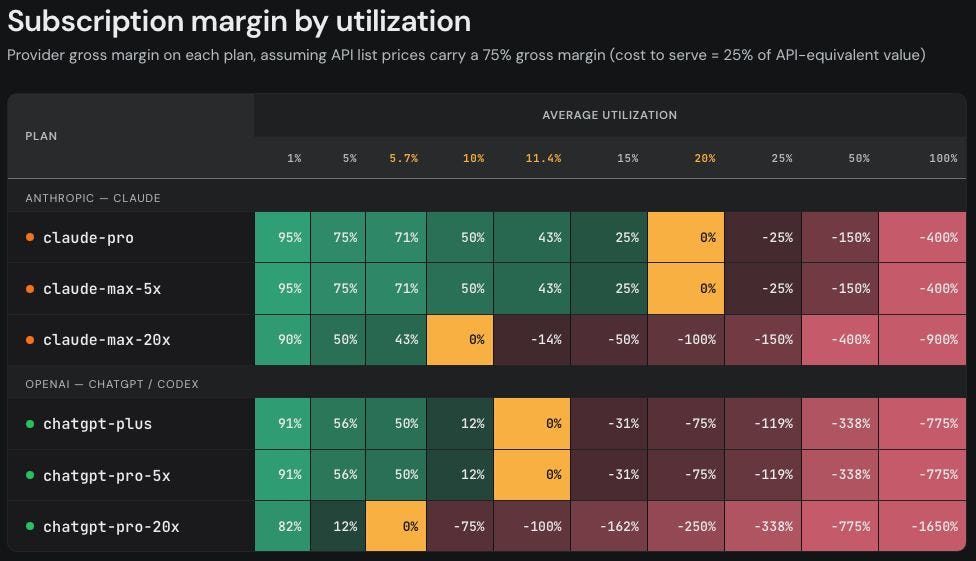
Under any flat price, customers never behave like the average. They spread across a wide range of usage and that spread is where the damage hides.
A single monthly number can only be correct at one level of consumption and almost everyone paying it sits somewhere other than that point.
The Light User and the Heavy User
Picture two customers paying the same flat fee. One barely opens the product.
The other runs it all day, pushing long, expensive requests through the most capable model on offer.
The light user is wildly profitable. The heavy user can cost several times what they pay.
Between them sits a break-even level of usage, the single point where the flat price exactly covers the cost to serve.
Below it, the customer is paying for capacity they never touch. Above it, they are pulling out more value than they hand over.
The further a heavy user climbs past that line, the deeper the loss buried in their account.
The cruel part is that the heavy user feels like the best customer in the building.
They adore the product. They recommend it to everyone they meet.
They are also the one quietly bleeding the margin and the more they love it, the worse the math behind them gets.
Two Complaints That Are Both True
A flat plan manages to be mispriced in two directions at the same time.
To the light user it looks expensive, because they are paying for headroom they never use.
To the heavy user it looks like a gift, because they are getting far more than they pay for. Both of them are correct.
Every argument about subscription versus usage that skips this point is debating in the dark.

The real choice was never about which model sounds fairer in a pitch. It is about where you allow that break-even line to fall and which side of it your most valuable customers come to rest on.
Get the line wrong and no amount of elegant packaging rescues you.
You either price out the casual users you needed for reach, or you quietly subsidize the power users who are eating the business alive.
3. Not Every AI Startup Has the Same Problem
Most pricing advice treats AI companies as one undifferentiated group, which is exactly why so much of it is useless.
The right model depends on a question that comes before pricing at all.
Where does the compute bill actually land and how much of your value is the model itself versus everything wrapped around it?
Owning the Intelligence Versus Renting It
If you train or host the models yourself, the compute bill lands on you at full strength.
Cost tracks usage almost linearly and a maxed-out account on a flat plan costs several times its price with no provider to absorb the difference.
From here, flat pricing for heavy use is a structural loser and the pull toward metering is close to gravitational.
If instead you build on top of someone else’s API, their price quietly becomes your cost of goods.
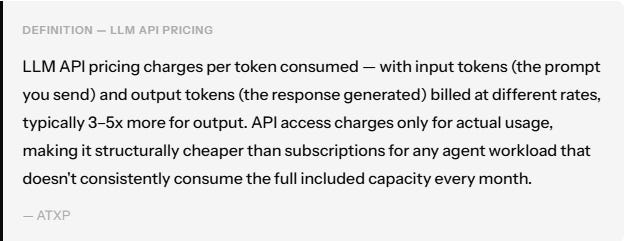
You have inherited the variable-cost problem without much control over the economics underneath it.
This is the most crowded position in all of AI and the most dangerous, because founders walk into it carrying old software instincts that the new math no longer rewards.
The defenses in both positions rhyme.
Send easy work to cheaper models.
Reuse outputs instead of paying twice for the same answer. Put your most expensive operations behind tiers that can carry their own cost.
The one real difference is that a model host defends a margin it owns, while a reseller defends a margin it is only passing through.
When AI Is a Small Part of the Bill
There is a third position and it is by far the most comfortable.
The intelligence is real, but it is a thin slice of what the customer is paying for.
The rest is workflow, data, integrations, distribution and trust, the slow durable assets a competitor cannot copy over a weekend.
Here the variable AI cost is a few percent of revenue, the old margins mostly survive and you get to price on the value of the outcome rather than the cost of the tokens.
A great deal of the smartest work in the field is a quiet effort to reach this position, to make the model a swappable ingredient sitting inside a moat that is not the model.
This is also the honest reply to the wrapper insult.
A product that has folded a model into a real workflow and priced for the result is a business.
A product selling raw model access with a markup on top is renting someone else’s advantage and competing on a number that keeps falling out from under it.
4. What You Charge For Beats How You Charge
Founders burn weeks agonizing over subscription versus usage and almost no time on the decision sitting directly beneath it.
The model is downstream of the metric.
Before you choose how to bill, you have to choose what unit you are billing for and that quiet choice decides whether you ever capture the value you create.

Cost Metrics Keep You Safe and Poor
Tokens, requests, compute hours and seats are all measures of what you spend.
Pricing on any of them is the safe, lazy move.
It guards your margin almost on its own, because the thing you charge for is the thing you pay for and it also guarantees you leave value on the table, because cost and value are different things that only sometimes travel together.
Worse, a cost metric chains the customer’s bill to your own inefficiency.
Every wasted token, every clumsy retry, every bloated response becomes something they can see and resent. You have turned your sloppiness into their line item.
Ten cheap calls that settle a major decision are worth far more than ten thousand expensive ones that change nothing.
A token meter charges the opposite way, paying you for waste and punishing precision, which runs exactly backward to how value behaves in the real world.
Finding a Unit That Tracks Value
The craft that separates a durable AI business from a thin reseller is the search for a value metric.
A unit that rises with the customer’s benefit and loosely follows your cost, so that when someone pays more they are also getting more and you are also spending more, with all three moving the same direction.
When those three lines travel together, customer value, your price and your cost, the choice of business model almost stops being the thing that decides your fate.
Nearly any mechanism works once everything points the same way.
When they pull apart, every pricing decision turns into a tax on either your margin or your customer’s trust and you spend forever patching the seam between them.
This is the real work and most teams skip it because it is hard.
A strong value metric rarely falls out of the technical architecture on its own.
It comes from understanding what the customer truly came to buy, then charging for that and leaving the tokens where they belong, on your cost sheet and out of the customer’s sight.
5. Price for Where Costs Are Going, Not Where They Are
AI pricing carries a property no other software pricing has. A short half-life.
The cost of any given capability falls quickly and keeps on falling, while the frontier of what is possible keeps climbing higher and reaching further.
Build a model tuned to today’s numbers and you will be unwinding it, in front of irritated customers, inside of a year.
Two Clocks Moving Against Each Other
One clock is the falling cost of intelligence.
As inference gets cheaper, the band of usage you can profitably serve under a flat price grows wider and yesterday’s premium capability becomes something you can hand out for a commodity monthly fee.
Watch only this clock and you would bet on flat subscriptions winning everywhere.
The second clock never stops either.

The newest and most capable model is always the expensive one, because the frontier re-prices itself with every release.
The likely settling point is where the two clocks meet.
Mature, cheap-to-serve capability goes flat. New, expensive-to-serve capability gets metered, or held back from the cheap plans altogether.
This is why the signal worth watching is placement.
When a provider ships a new flagship capability, notice whether you can reach it from the cheap flat plan or only through the meter.
That one decision quietly reveals where they believe the curve is heading and they are usually right.
Someone Has to Hold the Variance
Strip the labels off every pricing model and they each answer the same question. When usage swings without warning, who absorbs the swing?
A subscription means the vendor holds it. Pure usage means the customer holds it. A base fee with metered overage means the two of them split it, which is most of the reason hybrid keeps quietly winning.
Read this way, the model tells you who it was built for.
A buyer who cannot stomach surprises, an enterprise locked to a fixed annual budget or a public body that must state a final number years ahead, will pay a real premium for the vendor to carry the risk.
For them, predictability is the whole reason they are buying in the first place.
The opposite failure is the one that kills without making a sound.
A customer who expected a modest bill, runs one unusual spike and opens an invoice several times larger than anything they braced for will not absorb it calmly.
They dispute the charge, they lose trust and they walk, often even after a refund clears.
Real-time visibility and spending caps are what separate a variable model that works from one that quietly detonates.
6. The Part Nobody Wants to Hear
For most of software’s history, margin was a number you set once and then forgot.
In AI it is something you design, on purpose, into every layer of the product, from which model answers a given request to whether the customer can watch the bill climbing in real time.
The companies that survive will not be the ones that guessed the perfect plan on launch day. They will be the ones that built the machinery to keep changing it.
Which means the boring work is the work that decides everything.
Measuring every request, every model, every feature, from the first day, long before you know what you will charge for, because you cannot price retroactively for data you never bothered to capture.
The fun part is the product. The part that determines whether there is a business sitting under the product is the meter you were too busy to build.
Serving a customer costs real money again.
Pricing is part of the product now, woven into every model call and every line of the invoice.
Treat it as an afterthought and the math will come find you on a long enough timeline, no matter how good the demo looked on the day you shipped it.
@ruben the "cost moved from top of funnel to inside the product" line is such a clean way to put it. are founders actually re-pricing fast enough or mostly still stuck on old habits?
Do you think value metrics ever become usage pricing with prettier labels?