The AI Corner

The AI Corner

Anthropic Just Showed Us Which Jobs AI Is Actually Replacing

75% of programming tasks. 67% of data entry. Their own usage data tells the story.

Ruben Dominguez's avatar
Ruben Dominguez
Mar 06, 2026
∙ Paid

Anthropic released something unusual yesterday: a report using their own data to measure which jobs are being automated right now.
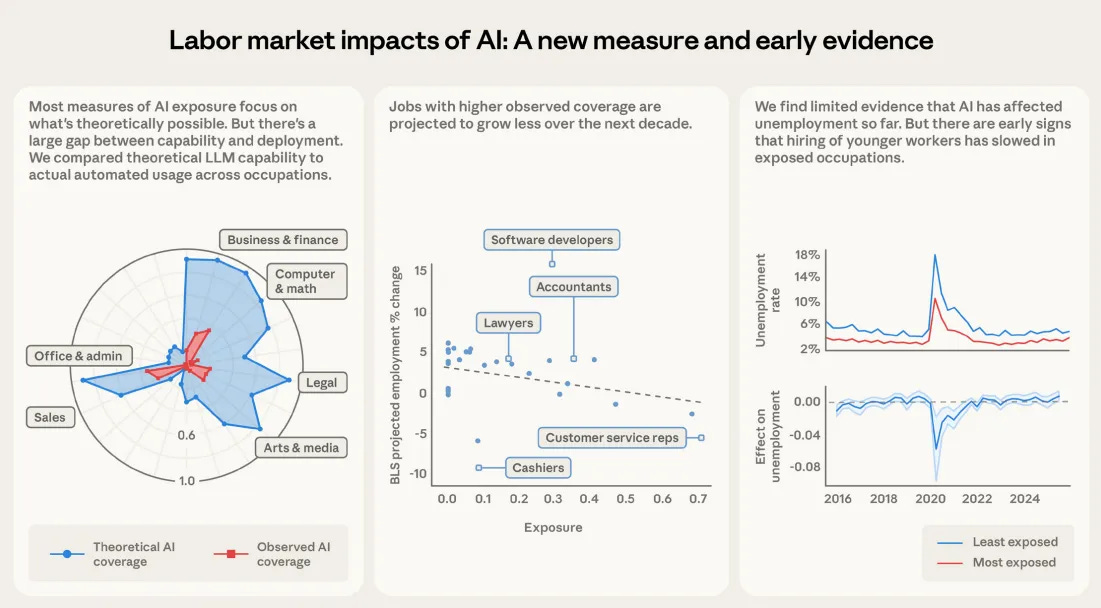
Three-panel infographic from Anthropic's Labor Market Impacts of AI report. Left panel shows a radar chart comparing theoretical AI coverage (blue area) versus observed AI coverage (red area) across occupational categories including Business & Finance, Computer & Math, Legal, Arts & Media, Sales, and Office & Admin. The blue theoretical area extends much further than the red observed area, showing a large gap between what AI could automate and what is actually being automated. Middle panel shows a scatter plot of BLS projected employment change versus AI exposure, with Software Developers showing positive growth around 15%, Accountants and Lawyers showing moderate growth around 5-10%, and Customer Service Reps and Cashiers showing negative growth around -5% to -10% at higher exposure levels. A downward sloping trend line indicates jobs with higher AI exposure are projected to grow less. Right panel shows two time series from 2016-2024: the top chart shows unemployment rates for least exposed (blue) and most exposed (red) workers tracking similarly around 2-6% with a COVID spike to 14-18% in 2020; the bottom chart shows the effect on unemployment hovering near zero with no significant divergence since 2022.
Anthropic's key findings in one image. Left: the gap between what AI could do (blue) and what it's actually doing (red). Center: higher AI exposure correlates with weaker job growth projections. Right: unemployment shows nothing yet, but hiring of young workers has slowed in exposed occupations. Source: Anthropic Labor Market Impacts of AI Report, March 2026

Most AI jobs research is theoretical. Researchers guess which tasks AI could do and publish scary headlines. Anthropic did the opposite. They looked at what people actually use Claude for at work, weighted fully automated uses more heavily than human-assisted ones, and tracked it against 800 occupations.

The findings:

  1. Computer Programmers: 75% of tasks now covered by AI

  2. Customer Service Representatives: High coverage through API automation

  3. Data Entry Keyers: 67% of tasks automated

  4. 30% of workers: Zero coverage. Their jobs remain untouched.

Here’s the part that surprised me: the most exposed workers are more likely to be female, more educated, and higher-paid. This wave is hitting knowledge workers first.
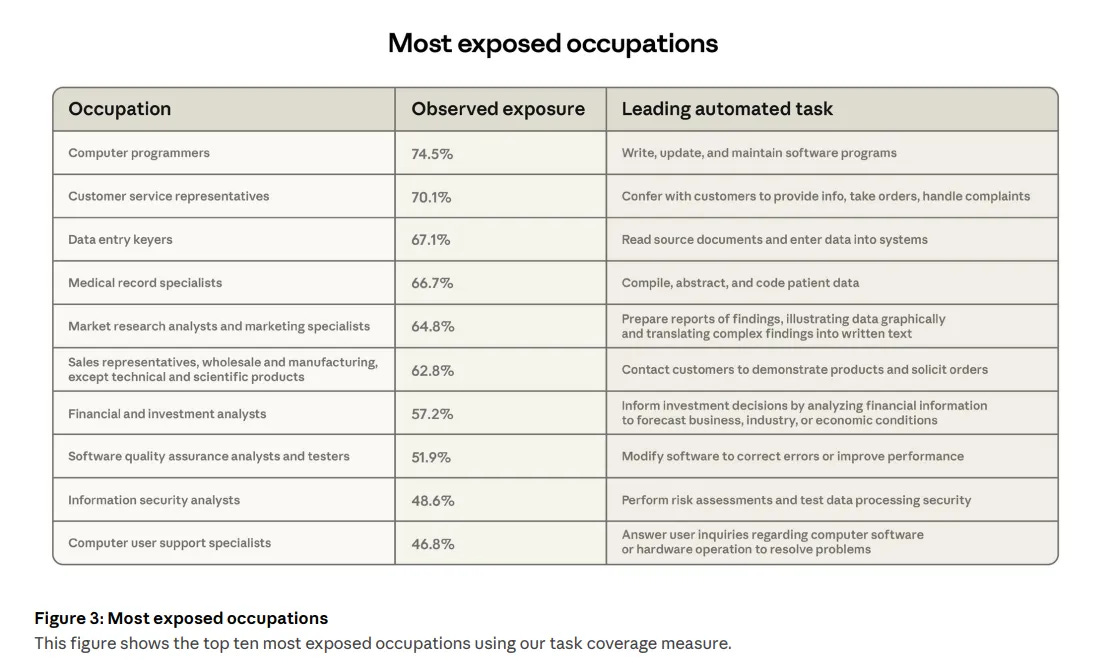
Horizontal bar chart showing the 10 occupations with highest AI task coverage. Computer Programmers lead at 75% coverage. Customer Service Representatives at approximately 70%. Data Entry Keyers at 67%. Financial Analysts at 60%. Technical Writers at 55%. Market Research Analysts at 50%. Paralegals at 45%. Accountants at 40%. Administrative Assistants at 38%. Editors at 35%.
Computer Programmers have 75% of their tasks covered by AI usage. Customer Service and Data Entry follow closely. These are the jobs seeing automation right now. Source: Anthropic Labor Market Report, March 2026.

The Chart That Matters

Blue area: what AI could theoretically do.

Red area: what people are actually using it for.
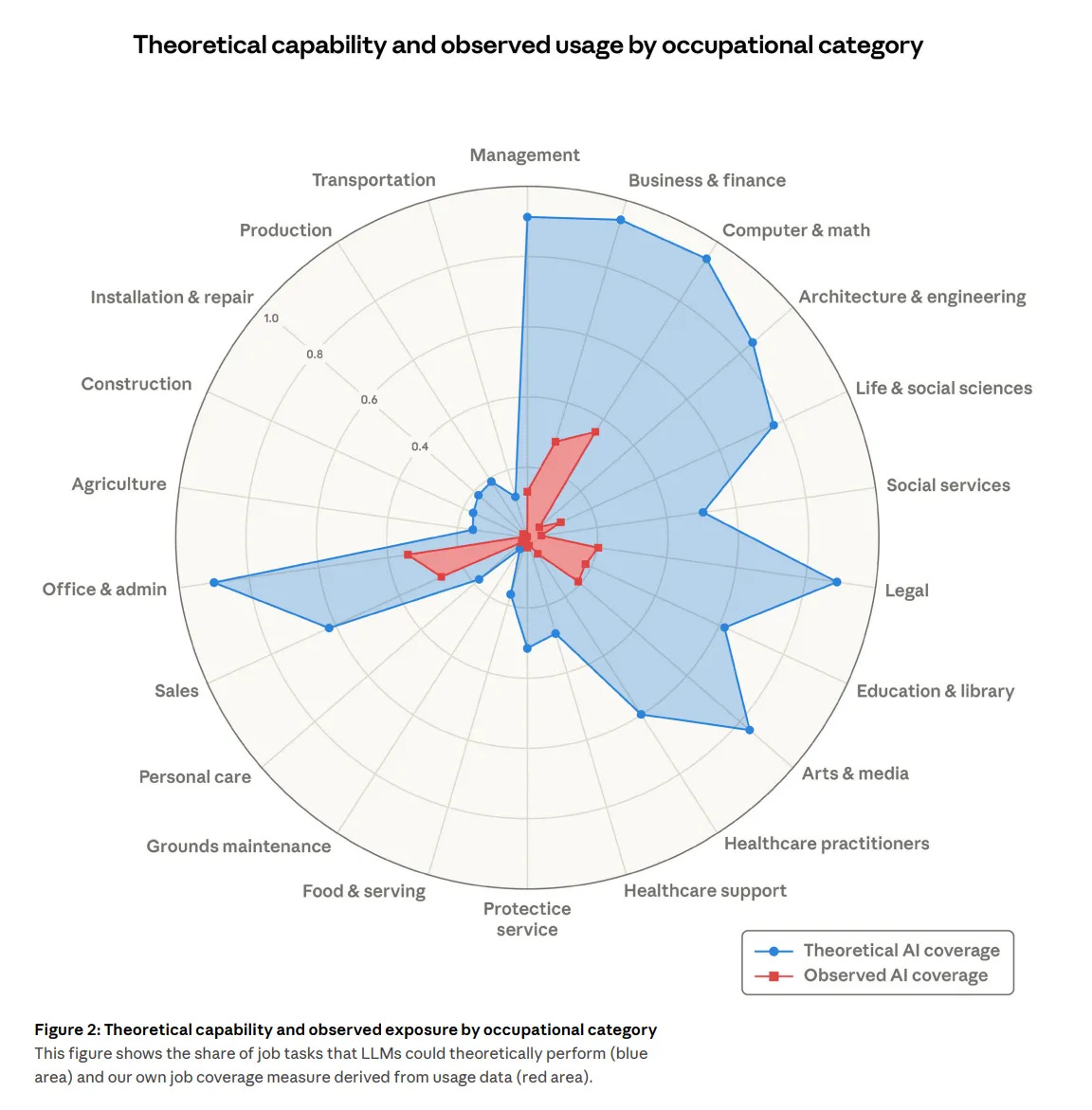
Dual bar chart comparing theoretical AI capability (blue) versus actual observed AI coverage (red) across occupational categories. Computer and Math shows 94% theoretical but only 33% observed. Office and Admin shows 90% theoretical and 25% observed. Business and Financial shows 85% theoretical and 20% observed. Legal shows 80% theoretical and 15% observed. Healthcare Support shows 40% theoretical and 5% observed. Construction shows 15% theoretical and 2% observed. The gap between blue and red represents untapped automation potential.

Computer and Math occupations have 94% theoretical exposure but only 33% actual coverage. The gap is enormous. And it’s closing every month.

The speed at which that red area grows determines how much time you have to adapt.


What You Get Inside The Full Article

The Report (Explained Simply)

The methodology, the numbers, the 10 most exposed jobs, who’s actually at risk. Everything from the 14-page report translated into plain language with the charts that matter.

The Career Audit

A framework to calculate your own exposure score. Task-by-task. Which of your skills are appreciating, which are losing value, and how fast.

15 Career Moves by Exposure Level

Specific pivots depending on where you fall. What to do if you’re at 75% exposure vs. 25% exposure. The skills that compound with AI instead of competing against it.

The Founder’s Map

Eight sectors with high theoretical exposure and low actual coverage. Where the market opportunity sits. What AI-native companies do differently to hit 300% higher revenue per employee.

The Investor’s Dashboard

Leading indicators to track monthly. How to evaluate AI companies using this framework. The portfolio positioning that follows from the data.

The Quarterly Template

A review system to track your own exposure over time. Update it every quarter. Adjust your position before the data catches up.


  • 7-day free trial available. Cancel anytime.

  • First subscribers get 50% off forever. Price locks in permanently.


Here’s the full breakdown:

Anthropic’s AI Jobs Report: Full Analysis + Playbooks

Part 1: The Report in Plain Language

Get 50% off forever

Keep reading with a 7-day free trial

Subscribe to The AI Corner to keep reading this post and get 7 days of free access to the full post archives.

Already a paid subscriber? Sign in
© 2026 The AI Corner · Privacy ∙ Terms ∙ Collection notice
Start your SubstackGet the app
Substack is the home for great culture