

Every founder claims curiosity. Almost none can defend it as a strategy.
Aravind Srinivas can.
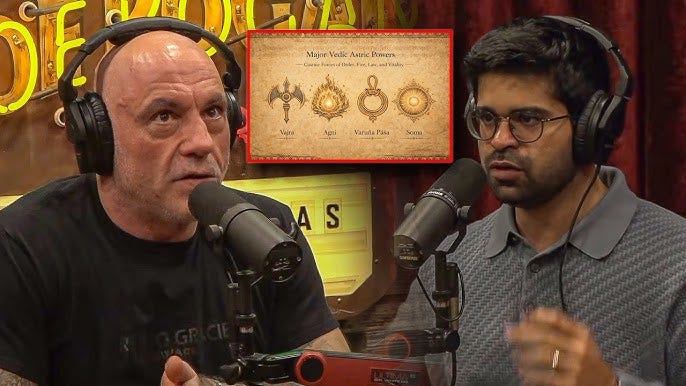
Build a search engine and you talk traffic and retention. Srinivas built one, then pointed that same instinct at the Mahabharata, the Rig Veda, and the Fermi paradox for thirty minutes on Rogan. It is the same restless pattern behind every founder worth studying, from Jonathan Ross running the math himself to the mental models the best operators encode. The result is the rarest thing in tech: a founder being publicly, uselessly curious, and it maps straight onto the AI risk models you already work inside.
I watched the whole thing so you can skip it. Here are the 10 that matter.
together with Outskill:
Srinivas built his edge on curiosity.
Here is a free way to feed yours this weekend. The FREE 2-Day Claude AI Mastery Workshop condenses 800+ hours of research into 16 hours:

▫️ Master all 3 modes: Chat, Cowork, and Code
▫️ Set up Skills, Connectors, and plug-ins to automate your files, Notion, and desktop
▫️ Vibe-code apps, plus 10+ AI tools that pair with Claude
Saturday & Sunday, 10 AM to 7 PM EST:
1. The weapon only two warriors on Earth were allowed to touch
Ancient texts rarely come with security clearances. The Mahabharata does.
“It’s described as a weapon of mass destruction, going to annihilate human population. Should not be used at any cost. There’s a moral contract.”
Srinivas calls the Brahmastra the epic’s hydrogen bomb, and the gating is the interesting part. A teacher had to hand the secret directly to a student, like passing a launch code. Only two warriors in the entire war held it: Arjuna, and his teacher’s son Ashwatthama, who got access purely through who his father was. When the teacher died, the son unleashed it out of grief, and Krishna had to step in to stop the world from ending.
That is a succession problem, rather than a battle scene. The failure mode was never the weapon. It was who was allowed to hold it.
Why it matters: every capability you build eventually earns an access problem. Nuclear codes, biology, and frontier AI models all follow the pattern this text describes, which is exactly why Anthropic priced safety ahead of capability and got funded on it. Restriction is what happens right before you learn that access, over capability, was the true risk, the same lesson running through every serious AI app security setup.
2. A self-guided weapon, named before anyone had a word for autonomy
The part that should make you sit up if you build with AI.
“There’s one weapon called the Divyastra where you can just specifically target any particular person or group, and it would just automatically direct itself and do it. Almost like a semi-autonomous weapon.”
Krishna’s discus, the Sudarshan Chakra, releases at a target, finds it, and returns to the wielder on its own. A guided munition with a recovery cycle, in a text older than most modern religions. Srinivas skips claiming ancient drone warfare and points instead at how precisely the language maps to categories you only recently got words for. The same text describes the Vimanas, flying craft he compares directly to modern aircraft.
Why it matters: either this is human imagination arriving twice at the same idea, or it is something stranger. Both deserve attention, especially now that deciding how much autonomy to trust an agent with is a weekly call. The whole self-evolving agent stack is a modern answer to a question this epic asked first: how self-directed should the thing you build actually be. The practical version lives in loop engineering, where you set a goal and a stop condition and hand the wheel over, and in giving that agent its own computer once you trust it to run alone.
3. A multiplication shortcut far ahead of its era
Vedic math is still used to prep for the GRE.
“The Rig Veda is so old. It’s as old as, it’s the oldest sacred text out there. How is it describing computation? That feels very unreal.”
Srinivas describes multiplying 97 by 96 in two moves: subtract from a base, cross-multiply, done. Scholars date the Rig Veda’s oldest layer to roughly 1500-1200 BCE, making it 3,200 to 3,700 years old. Recipes drift. Oral histories drift. Arithmetic, checkable today against numbers people used three millennia ago, holds.
Why it matters: techniques passed down accurately for three thousand years are load-bearing. You preserve what works, over what is merely old, the same filter that separates a durable prompting system from a clever trick that stops working next model release, and the same reason a durable token-cost system outlasts a one-off hack.
4. Every civilization has the same flood story
Noah came second. So did Manu.
“Classic Hindu great flood myth where the righteous King Manu is warned by a divine fish about an imminent deluge that will destroy humanity. He builds a boat, loads it with his family. It’s like Noah and the Ark.”
Same structure as the biblical flood: divine warning, a boat, animals, survival, repopulation. Traditions thousands of miles apart, zero direct contact, arriving at the same story shape.
Why it matters: convergence like this leaves two explanations. Storytelling has a universal grammar for catastrophe, or catastrophe happened and each surviving culture encoded it differently. Neither is comfortable, which is exactly why it is worth asking, and why the founders who ask the uncomfortable question first tend to be the ones building the category, the pattern you can read straight off the decks that raised the first rounds.
5. Even Hindu scholars split on what year you're living in
Here the conversation gets genuinely strange.
“No, we are in Kali Yuga right now. A hundred percent.”
Rogan pushes back, citing a book arguing Kali Yuga ended in the 1900s. Srinivas holds his ground, then admits the disagreement traces to one guru’s interpretation rather than scholarly consensus. A full cycle of four yugas spans 4,320,000 years by traditional count. You are arguing about your place inside a clock built at a scale that makes disagreement nearly guaranteed.
Why it matters: timekeeping this old fractures into competing interpretations even inside one tradition. Long timelines stay fragile no matter who holds them, which is worth remembering the next time a runway forecast or a fund-economics waterfall projects a clean line ten years out.
6. The Fermi paradox has a dark answer, and misaligned AGI is a leading candidate
Where ancient mythology and frontier AI collide directly.
“Almost all civilisations end up advancing technologically a lot. And either a calamity wipes them out, or they build some misaligned AGI and then AGI wipes them out.”
This is the great filter: one answer for why you have found zero alien civilizations. Every advanced civilization eventually builds the thing that ends it, before becoming visible across the galaxy. What primes the idea is the fifteen minutes before it, spent on Sumerian and Egyptian kings said to reign for thousands of years, and on Zep Tepi, an era mainstream archaeology dismisses.
Why it matters: a Perplexity founder floating misaligned AGI as a leading extinction candidate is the same risk model Dario Amodei has mapped for a decade and the one Demis Hassabis dates to the next two to three years, delivered as a podcast instead of a policy paper. You already operate inside this model whether you have named it or not, and the only practical hedge is building agents that stay reliable as they scale.
7. Stone temples carved from one rock, beyond any known toolset
The section that should bother anyone who has ever managed an engineering timeline.
“You have the stuff in Peru, like Saqsayhuaman. When you look at these stones, it looks like they’re melted into place.”
Indian temples carved from a single piece of stone, with interior 3D sculptures reachable only through narrow openings. Rogan’s question lands on the gap: how do you reach in there with a chisel and finish something that clean? Then the pyramids, stones moved 500 miles from the quarry with zero engine or crane. Then Saqsayhuaman, stones up to 900 tonnes fitted with no visible gaps, attributed to a single king’s reign that neither man finds believable at that scale.
Why it matters: you skip believing in lost civilizations and still notice the gap holds. The tools proposed fail to match the precision achieved. That gap is either a hole in archaeology or a hole in your assumptions, the same instinct that makes a good operator audit the number that looks too clean, or pressure-test a valuation instead of trusting it.
8. The curiosity premium: why the most successful people are rarely the smartest
The idea Srinivas has clearly been sitting with for a while.
“The most effective people, the most successful people, have always been the most curious people, the ones who have been good at asking the best questions.”
The claim is specific. You compound advantages by continuing to ask after you have won, rather than by starting smarter. Most people stop asking once they succeed. You have met them. Curious people keep going, and that gap is the whole mechanism behind why some careers keep climbing while others plateau the moment they start defending what they built.
Why it matters: this is a hiring filter dressed as a philosophy lecture. If curiosity compounds and resists decay after success, it should show up in how you evaluate founders three years in, over how they interview. It is also the trait behind every one-person company that keeps finding new leverage while its competitors coast, whether that is building a second brain in ten minutes or your own stock analyst for $20 a month.
9. Every major religious text ranks wisdom above wealth
Short, and it hits harder for it.
“In the Rig Veda, you’re explicitly encouraged to seek wisdom more than wealth. And it’s not just an idea specific to Hinduism. That specific idea exists in the Bible, it exists in the Koran, it exists in the Torah.”
Srinivas is careful: wealth is ranked below wisdom, rather than condemned, and consistently, across traditions that disagree on nearly everything else. That consistency is the point.
Why it matters: when four traditions with different origins independently rank the same value above wealth, notice it. It is a signal about what predicts your long-term outcomes, tested informally for thousands of years before anyone had data to hand you, and the same reason the operators who invest in leverage over status tend to pull away over a decade.
10. The guy everyone called a crackpot keeps getting proven right
Where the episode’s origin story surfaces.
“I remember reading it, and so many of my educated friends were like, that’s horseshit. More and more and more, as time goes on, it’s been proven that he’s correct.”
Rogan is describing Graham Hancock, whose theories about lost ancient civilizations got dismissed for decades. Fingerprints of the Gods landed around 1997 to mockery among Rogan’s own educated friends. Timelines for human civilization keep shifting backward as evidence surfaces, and the man dismissed as a crank became one of the most recurring guests on the biggest podcast in the world.
Why it matters: this is survivorship bias in reverse. People mocked for asking too early are indistinguishable from cranks, right up until the evidence catches up, the exact pattern behind Anthropic’s decade of “too cautious” and Cerebras betting against the GPU before it IPO’d at $56B. That should change how confidently you dismiss the outlier claim in your inbox today, or the fringe idea on a requests-for-startups list everyone else scrolled past.
What this means for you
The thesis under all ten: curiosity that survives success is rarer than intelligence, and it is the trait that actually compounds.
▫️ Founders: treat curiosity as a retention metric, over a personality trait. Audit your last three hires for whether they still ask naive questions eighteen months in.
▫️ Investors: the curiosity premium is a diligence signal hiding in plain sight. Add one question about a founder’s own unresolved curiosities to your next call.
▫️ People in tech: the Fermi conversation is live inside your industry. Write down your own position on misaligned AGI today, then go build the agent that forces you to take a side on autonomy.
▫️ Everyone else: when an explanation fails to match the tools you were told were used, call the gap unresolved instead of forcing a tidy answer.
The five principles to steal:
Restrict access before you restrict use. A relationship gated the Brahmastra, not a rule.
Convergent stories deserve a second look, not automatic dismissal.
Curiosity compounds after success. Most people stop feeding it.
Rank wisdom above wealth. Four unrelated traditions already ran that experiment for you.
Being early looks identical to being wrong, until the evidence lands.
Curiosity is not a soft skill. It is the only trait that keeps compounding after you have already won.
Ask the question anyway.
Keep reading
More masterclass breakdowns
▫️ Demis Hassabis says AGI arrives in 2 to 5 years
▫️ Dario Amodei’s full picture: 10 takeaways
▫️ Jonathan Ross and the $20B NVIDIA deal
Build with the ideas
▫️ Ship your first AI agent in a day
▫️ The Self-Evolving Agent Stack
▫️ What moves the needle with Claude
For founders and investors
▫️ What top VCs look for in 2026
▫️ The AI app security checklist
▫️ The one-person startup operating system
Full podcast:
Founders reach for myth when the roadmap outpaces the evidence - useful signal for reading vendor claims.