The AI Corner

The AI Corner

43 backlinks every founder should chase before AI Overviews eat their traffic

The full list. AEO sources LLMs actually cite, AI directories worth submitting to, premium guest post tiers, and what to actually do with all of it in 90 days.

Ruben Dominguez's avatar
Ruben Dominguez
Apr 27, 2026
∙ Paid

In May 2024, Google rolled out AI Overviews across U.S. search.
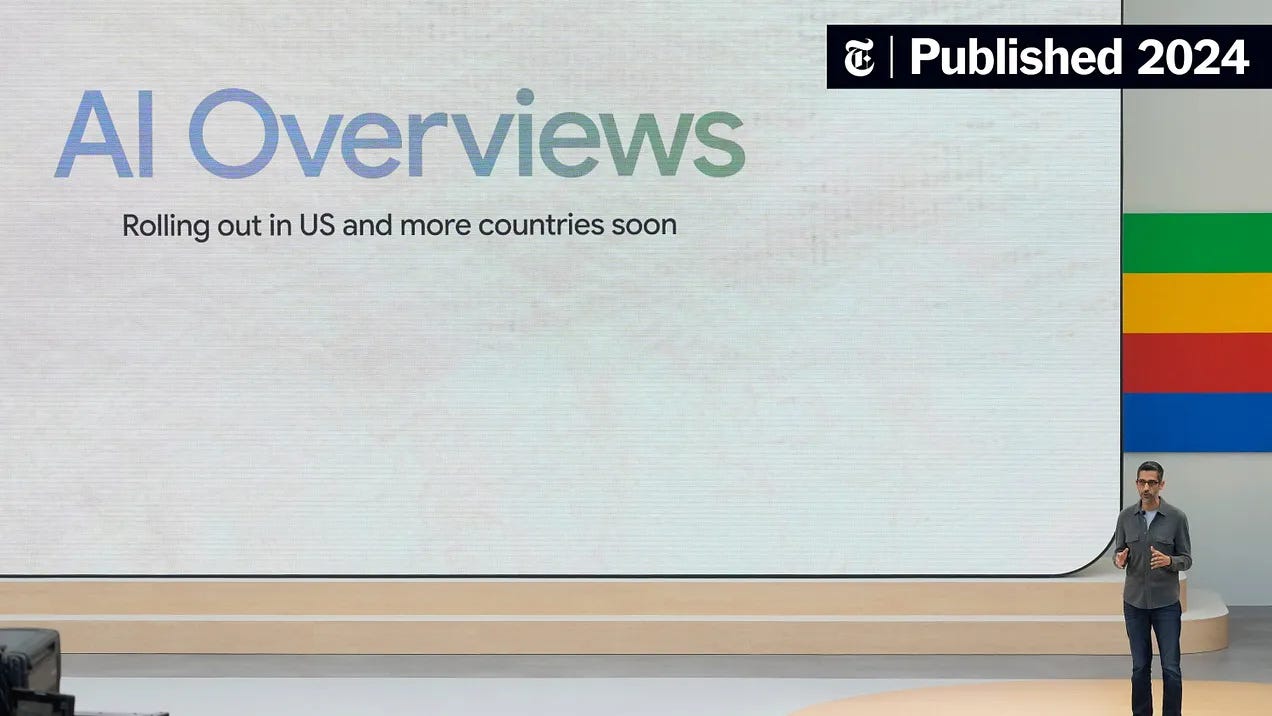
Google CEO Sundar Pichai unveiling AI Overviews on stage at Google I/O 2024 with the slide reading "Rolling out in US and more countries soon," marking the May 2024 launch event that triggered the structural decline of organic traffic to content publishers, the Chegg lawsuit citing AI Overviews directly, and the 28% Stack Overflow staff cut as ChatGPT absorbed technical Q&A search demand.Google CEO Sundar Pichai unveiling AI Overviews on stage at Google I/O 2024 with the slide reading "Rolling out in US and more countries soon," marking the May 2024 launch event that triggered the structural decline of organic traffic to content publishers, the Chegg lawsuit citing AI Overviews directly, and the 28% Stack Overflow staff cut as ChatGPT absorbed technical Q&A search demand.
Google CEO Sundar Pichai launches AI Overviews at Google I/O in May 2024. The product reshaped organic search distribution within 18 months, drove the Chegg lawsuit, and triggered the structural shift toward AEO and GEO that this guide is built around.

18 months later, organic traffic to content publishers had collapsed at a scale that nobody in the SEO industry had modeled. Chegg sued Google directly over it, citing AI Overviews as the reason their stock traded under $1. Stack Overflow cut 28% of staff as ChatGPT absorbed the technical Q&A traffic. Hundreds of mid-tier SaaS companies watched their search-driven pipeline disappear from one quarter to the next, and most of them assumed it was a temporary algorithm shift rather than a structural one.
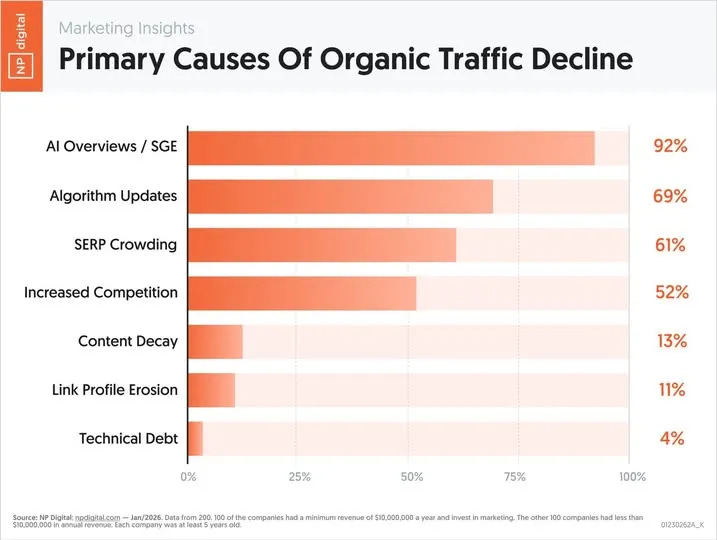
Bar chart from NP Digital's January 2026 Marketing Insights report showing the primary causes of organic traffic decline across 200 companies, ranked by attribution percentage: AI Overviews and SGE at 92%, algorithm updates at 69%, SERP crowding at 61%, increased competition at 52%, content decay at 13%, link profile erosion at 11%, and technical debt at 4%. The data confirms that AI Overviews is the dominant cause of organic traffic collapse for content publishers and SaaS companies in 2026.
NP Digital's January 2026 study of 200 companies (100 spending over $10M annually on marketing, 100 spending under that) found AI Overviews and SGE drive 92% of organic traffic decline. Algorithm updates rank a distant second at 69%. The data confirms that the traffic decline most founders are seeing is structural rather than cyclical. Source: NP Digital, npdigital.com, January 2026.

The replacement is already here, and it lives somewhere completely different from Google.

ChatGPT, Perplexity, Claude, and Gemini are now where founders, operators, and buyers research the products they want to buy. The numbers tell the story clearly enough that ignoring them looks reckless.

Profound’s 680 million citation analysis found that LLMs cite a remarkably narrow set of platforms (Wikipedia, Reddit, Stack Exchange, G2, Capterra, YouTube, LinkedIn) far more often than the open web.

First Page Sage’s 36,000-query buying-intent study found G2 to be the single most-cited domain for B2B software queries inside ChatGPT.

ConvertMate’s 2026 GEO benchmark found that startups with Wikidata presence are cited 2.8 times more often by AI assistants than those without.
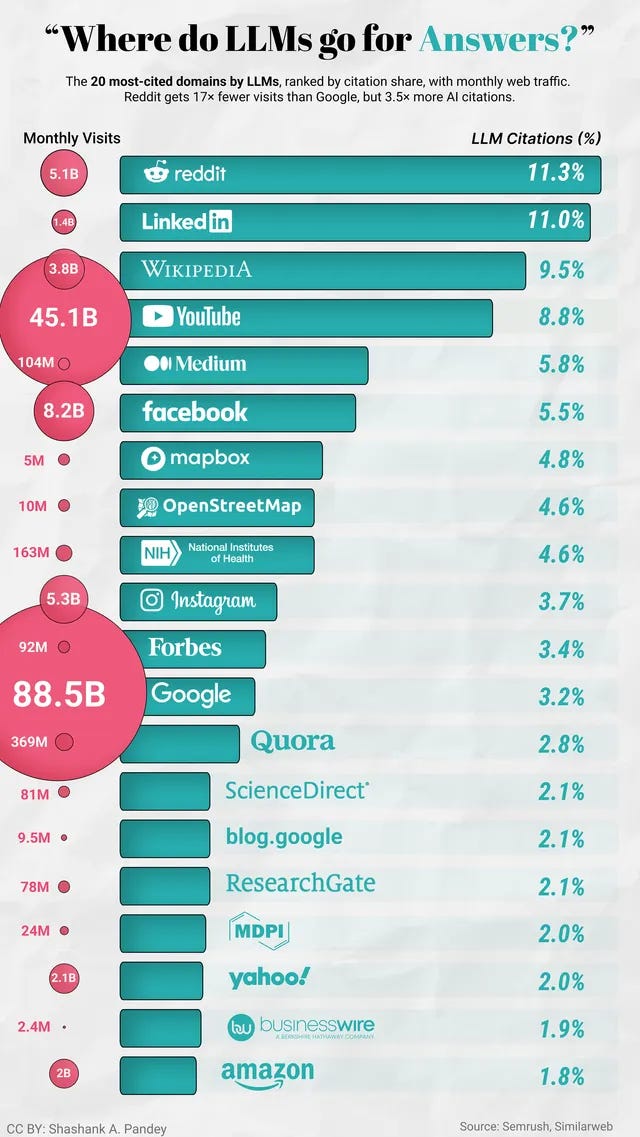
Infographic by Shashank A. Pandey using Semrush and Similarweb data ranking the 20 most-cited domains by large language models in 2026 by citation share percentage: Reddit at 11.3% citation share with 5.1B monthly visits, LinkedIn at 11.0% with 1.4B visits, Wikipedia at 9.5% with 3.8B visits, YouTube at 8.8% with 45.1B visits, Medium at 5.8%, Facebook at 5.5% with 8.2B visits, Mapbox at 4.8%, OpenStreetMap at 4.6%, NIH National Institutes of Health at 4.6%, Instagram at 3.7% with 5.3B visits, Forbes at 3.4%, Google at 3.2% with 88.5B visits, Quora at 2.8%, ScienceDirect at 2.1%, blog.google at 2.1%, ResearchGate at 2.1%, MDPI at 2.0%, Yahoo at 2.0% with 2.1B visits, BusinessWire at 1.9%, and Amazon at 1.8% with 2B visits. Reddit receives 17 times fewer monthly visits than Google but generates 3.5 times more LLM citations, demonstrating that LLM citation share and traditional web traffic are largely uncorrelated metrics.
The 20 most-cited domains by LLMs in 2026, ranked by citation share against monthly web traffic. Reddit gets 17x fewer visits than Google but generates 3.5x more AI citations. LinkedIn punches at 11.0% citation share. Wikipedia, YouTube, and Medium round out the top five. The takeaway: LLM citation share and Google search traffic are different games entirely, and the platforms that win each one barely overlap. Source: Shashank A. Pandey, using Semrush and Similarweb data.

The implication for founders is structural rather than tactical. Backlinks still matter for Google rankings, and that is unlikely to change in the near term. But the AEO and GEO citation graph now drives a meaningful share of actual buyer discovery, and the platforms that influence AI citations look almost nothing like the platforms most founder SEO playbooks tell you to chase.

This guide gives you the full list of 43 verified backlink and citation sources worth your time in 2026, with every URL checked, every Domain Rating triangulated against Ahrefs’s September 2025 algorithm update, and every dofollow versus nofollow distinction flagged so you know which ones move SEO authority and which ones drive traffic and brand signals.

Built for founders who would rather execute themselves than pay an SEO agency a six-month retainer for a list less complete than this one.


What is inside the full guide:

▫️ The 14 AEO and GEO sources LLMs actually cite, with the citation evidence, training-corpus context, and submission URL for each one.

▫️ 23 AI tool directories accepting submissions in 2026, ranked by Domain Rating, dofollow status, and submission cost.

▫️ The full guest post matrix covering which AI publications accept editorial submissions, which are paid-only, and which actually pay you to write for them.

▫️ The newsletter sponsorship tier including TLDR AI, The Rundown, Superhuman, The Neuron, Ben’s Bites, and Mindstream, with audience sizes and submission flows.

▫️ 18 high-DR generalist sources nobody else lists, spanning design galleries, startup launchpads, dev communities, and the premium guest-post tier at Fast Company, Inc, and TechRepublic.

▫️ The dofollow versus nofollow audit so you know exactly where you are wasting time and where the actual SEO juice lives.

▫️ The 7 directories worth submitting to first if you only have a single hour available this week.

▫️ The 3 structural priorities that beat any individual backlink decision in 2026.

Every URL verified. Every DR triangulated. Every cost flagged.

Start your free 7-day trial

Cancel anytime. First subscribers get 50% off forever.

Get 50% off forever


THE FULL BACKLINK PLAYBOOK FOR 2026👇

Keep reading with a 7-day free trial

Subscribe to The AI Corner to keep reading this post and get 7 days of free access to the full post archives.

Already a paid subscriber? Sign in
© 2026 The AI Corner · Privacy ∙ Terms ∙ Collection notice
Start your SubstackGet the app
Substack is the home for great culture