


In most boardrooms currently, careers still sound like balance sheets. Predictable, orderly, and built to grow in straight lines. You start as an analyst, rise to manager, then director, and eventually reach some comfortable plateau called “senior leadership.”
That linear climb has been the measure of success for decades now. But things are starting to look different. The fastest-moving, most fulfilled professionals today aren’t focused on climbing. Their goal is to compound. Their careers bend, switch, loop, and evolve like portfolios that keep rebalancing around new opportunities.
If investors chase alpha in illiquid markets, why shouldn’t people do the same with their careers?
This matters especially in AI right now. The field is moving so fast that linear career paths can't keep up. The person who spent 5 years becoming a "TensorFlow expert" just watched their specialty become table stakes. Meanwhile, the person who moved from research to product to GTM now understands how AI actually ships and scales. In AI, career zigzaggers aren't just winning. They're the only ones who can keep pace.
Work is shifting from stability to volatility, and with it, the definition of smart risk is also changing.
Automation, later retirement and shrinking hierarchies are completely breaking the “safe corporate ladder.” And those who reinvent themselves across roles, industries, and identities, are simply outperforming.
A quick aside that fits this shift perfectly.
One recent example that stuck with me is a small team that went from idea to a live AI-powered UGC platform doing $7K MRR in two weeks.
No dev team. No traditional code. Just shipping, learning, and iterating in real time using Lovable and AI.

They didn't follow a clean, linear path. Their backgrounds were sales, content, and operations. None of them were ML engineers. What gave them an edge was the ability to collapse the distance between insight and execution. AI made the technical work accessible. Their non-linear experience made the product decisions sharp.
I’m genuinely happy to have partnered with Lovable, and I’ve secured an exclusive 20% discount for The AI Corner readers. If you’ve been sitting on an idea you want to actually build, this is a great moment to try it 👇
The “corporate ladder” once defined success. Today, the smartest professionals are stepping off it to explore new career models.
But non-linear career paths aren’t a symptom of drift. They’re what happens when curiosity and strategy meet over time.
The professionals who will create “career alpha” in the future of work are the ones who learn faster than their environment changes, build skill liquidity, and play the long game of reinvention.
Table of Contents
1. The End of the Linear Career Myth
2. What is a Non-Linear Career?
3. Why Non-Linear Careers Create Alpha
4. The Psychology and Strategy of Navigating Non-Linear Careers
5. What Forward-Thinking Organizations Can Learn
6. The Investor and Founder Lens
7. How to Future-Proof Your Career in a Non-Linear World
1. The End of the Linear Career Myth
The idea of a “steady career” was built for a very different economy. When factories and bureaucracies ruled the 20th century, companies needed predictable workers.
Specialize early, stay loyal, move up a hierarchy designed to reward time served. That was the model.
HR systems were structured like assembly lines, built around tenure, credentials, and conformity. It worked when the environment was stable, when technology changed slowly, and most people retired by 60. A career was a product of linear time.
Well, not anymore.
A Model Outgrown by Its World
That predictability is gone. Automation keeps erasing routine work, industries are being rebuilt around software, and hybrid work has collapsed the boundaries between disciplines.
The average professional now faces a sixty-year career but a five-year skill shelf life. The math no longer adds up. You can’t plan a lifelong climb when the ladder itself is being rebuilt every few years.
The real shock isn’t the change itself but how few people have updated their mental models. Schools still teach for credentials, companies still promote by tenure, and too many workers still believe safety lives at the top of a structure that no longer exists.

The Collapse of Career Safety
Even the supposed security of linear progression has eroded. Restructuring and layoffs have become routine, and burnout has replaced loyalty as the dominant story inside corporations.
Long hours no longer guarantee stability, and even elite roles can vanish in a single quarter’s reorganisation. The illusion of permanence has broken, and what remains is the capacity to adapt.
The ladder was built for a predictable world. Today’s economy rewards exploration instead of compliance.
2. What is a Non-Linear Career?
A non-linear career is a working life built as a series of episodes and not a staircase of fixed steps. Each chapter teaches something new, opens a lane, and feeds the next chapter.
The shape looks less like a ladder and more like a portfolio that keeps rebalancing around opportunity.
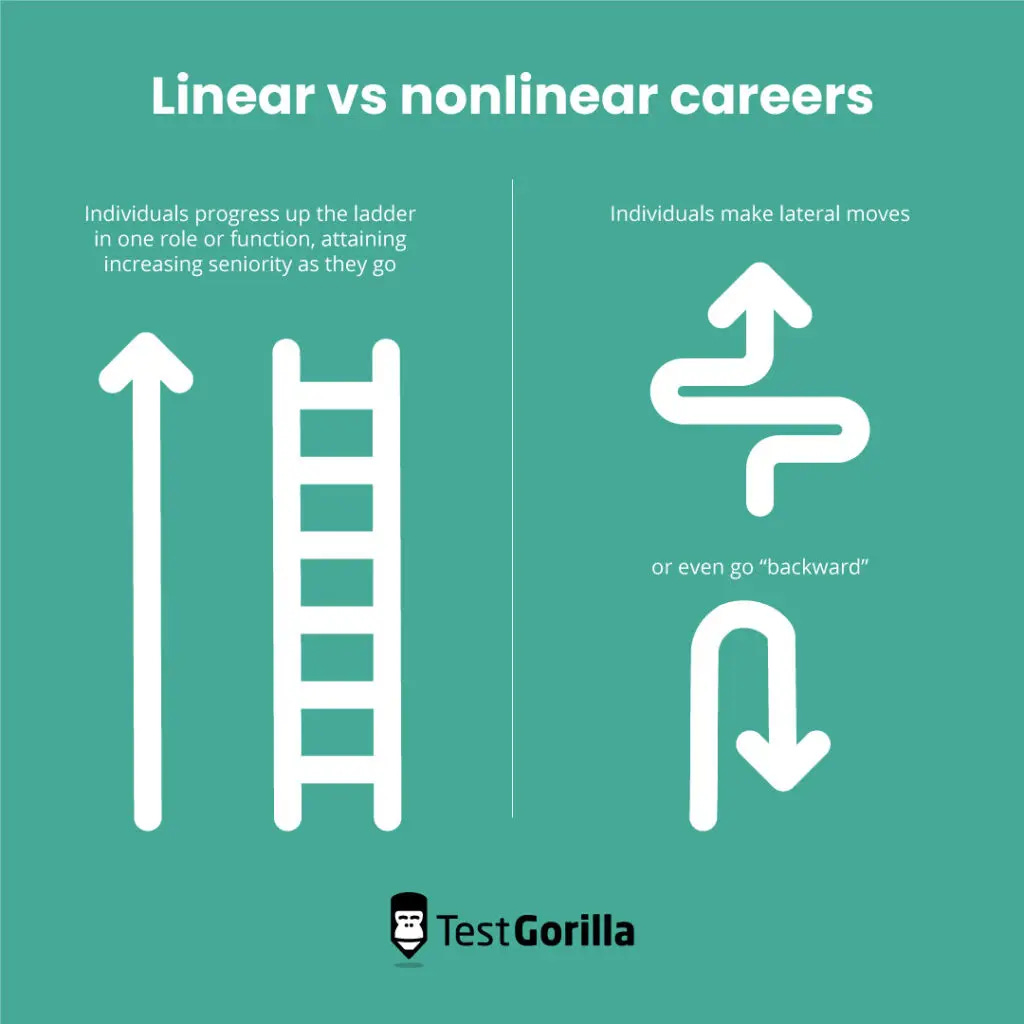
Episodes, not steps
Episodes have beginnings and endings. You ship a product, close a fund, run a turnaround, take a sabbatical to learn AI, then return to lead a data team.
Each episode leaves you with new assets. New skills, relationships, proof of outcomes. Over time those assets compound.
Built with intent
This path is not random. Each pivot is chosen. Non-linear professionals test hypotheses about their strengths, follow a clear theme, and make moves that expand their option set. Curiosity sets the direction, discipline sets the pace.
Multiple identities, one throughline
The strongest profiles hold more than one role over time. Operator, creator, advisor, investor, learner.
You might run growth at a startup, publish a weekly industry note, advise two founders, and angel invest in a space you know well. The throughline ties it all together. It’s a problem you care about, a domain you study deeply, a capability you keep sharpening.
Think of career liquidity as how legible your skill capital is to the market. If a recruiter can quickly understand and price what you do, your skills are liquid. If your value is real but hard to evaluate from a résumé, the skills are illiquid.
Liquidity is influenced by signals you control, such as clear examples of work, measurable outcomes, respected references, and brand proof where it helps. Increase legibility, and you increase tradability without losing the upside of a unique path.
An engineer moves into customer success to learn the voice of the buyer, then returns to product with sharper instincts and ships a category-defining feature.
A policy researcher learns data storytelling, joins a climate tech startup as chief of staff, then steps into partnerships to unlock regulation-aware deals.
A designer builds an audience through teaching, spins up a small studio, and later joins a venture studio to prototype and fund new products.
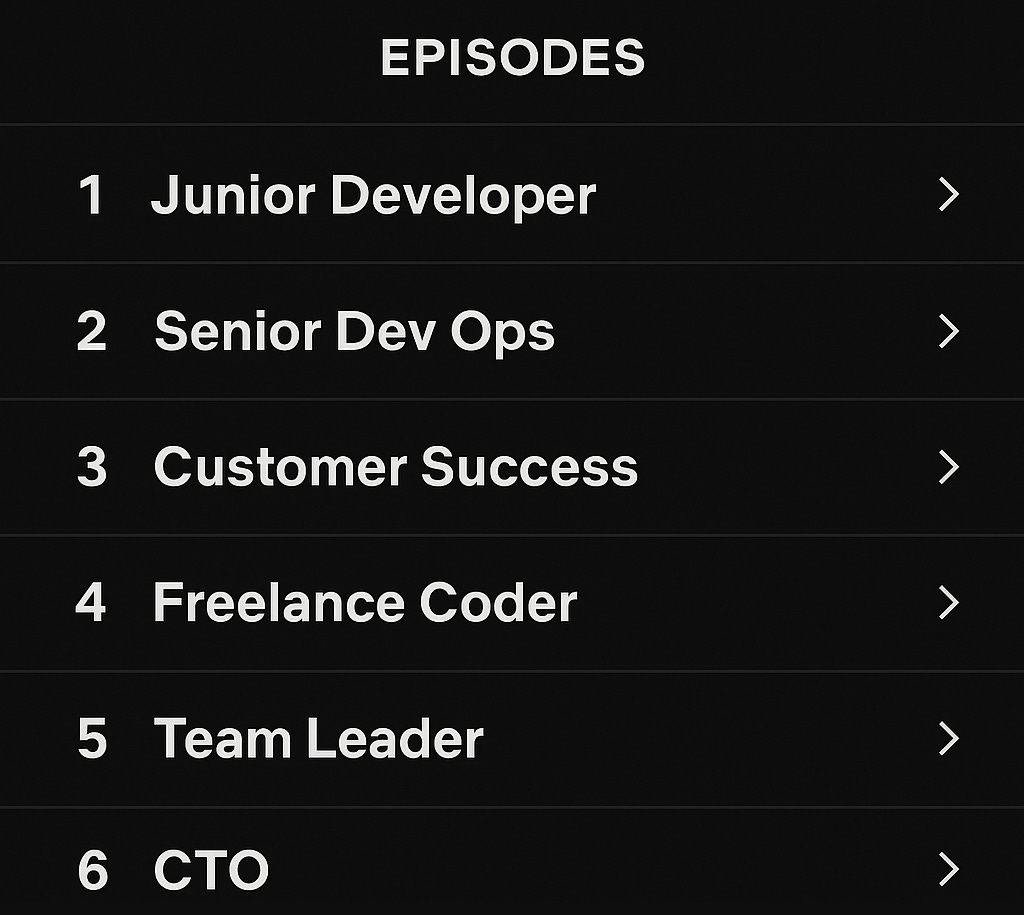
These cannot be considered detours. They are deliberate chapters that build a distinctive stack of skills, relationships, and perspective. Non-linear careers trade sameness for growth. The payoff is adaptability on demand and a profile that gets more valuable with each well-chosen episode.
3. Why Non-Linear Careers Create Alpha
In finance, illiquidity carries both risk and reward. The same is true for human capital. When a career doesn’t fit into a predefined box, it becomes harder to price, but it can produce extraordinary upside for those who know how to navigate it.
Non-linear careers create alpha because they build compound advantages that linear systems overlook.
The Illiquidity Advantage
Illiquid assets are harder to value, which is why they often outperform over the long run. Careers follow the same logic. A conventional résumé is easy to benchmark, while a non-linear one requires more curiosity to decode.
Traditional systems are built to filter quickly, so they tend to undervalue what they can’t measure. That mispricing is where opportunity lives.
Professionals who cultivate rare skill combinations or unconventional experience operate in a market with fewer direct comparables. Their value isn’t defined by a job title, it’s revealed through outcomes, artifacts, and execution.
When they communicate that clearly, they capture a premium. In other words, the payoff goes to those who signal cleanly and deliver consistently. The hard part is staying patient while the market catches up.
The Adaptability Dividend
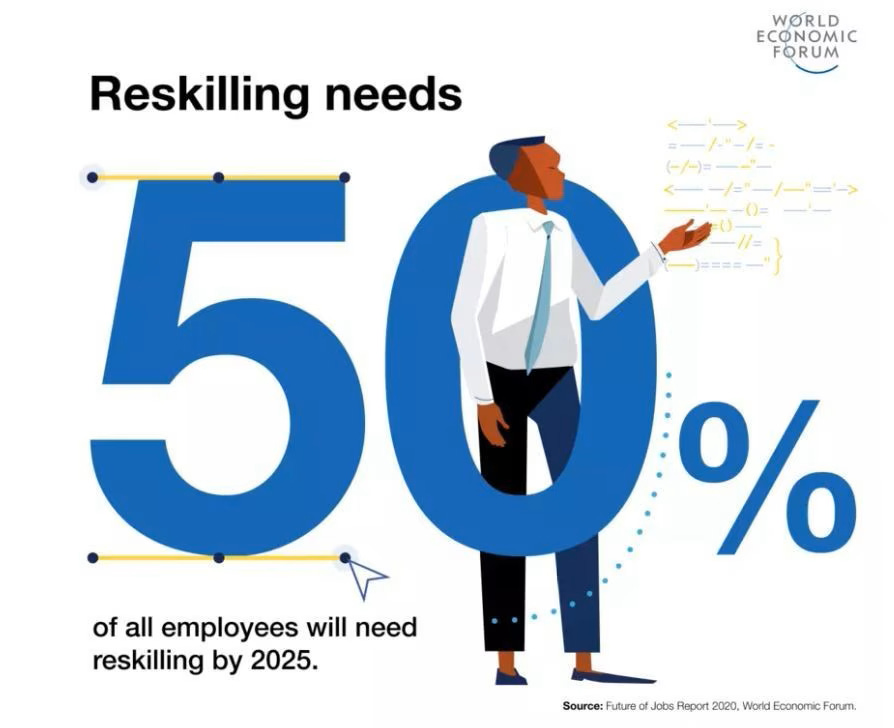
Adaptability has become the most transferable currency in the modern economy. According to the World Economic Forum, half of all employees may need reskilling by 2025, and other research suggests that many technical skills now fade in relevance in just a few years, underscoring how fast the shelf life of what we once considered ‘secure’ expertise is shrinking.
Linear careers struggle with that velocity. Non-linear professionals thrive in it because they’ve trained for change.
Moving across functions or industries builds meta-skills that compound. Skills like pattern recognition, contextual empathy, and the ability to learn under pressure.
This matters more in AI than anywhere else. Someone who has built products, sold to customers, and managed a team has an instinct for how systems connect. They know what customers actually pay for (rarely the tech itself). They understand go-to-market friction (where most AI products die). They can translate between research, product, and revenue.
That range becomes a strategic asset when the environment changes rapidly. Where AI specialists get disrupted by the next model release, adaptable operators reposition and keep moving. They're not attached to a specific architecture. They're attached to solving problems.
The Creativity and Perspective Effect
Creativity is rarely born in a straight line. It comes from cross-pollination; when ideas from one domain collide with problems in another.
Non-linear professionals live in that overlap. A product strategist who once worked in public policy, or an engineer who studied design, brings a way of seeing that siloed teams can’t replicate.
The wider your aperture, the more original your solutions. Studies on innovation repeatedly show that teams with diverse backgrounds generate more breakthroughs because they connect unlinked dots.
In a world drowning in incremental improvement, cross-domain perspective has become the new leverage. The professional who’s seen both art and analytics not only problem-solves better, they also reframe problems.
The Meaning Compounding Effect
Linear careers often trade purpose for predictability, for certainty. It makes sense in the moment moment, but over time, that bargain erodes engagement.
Non-linear careers flip the equation by allowing people to realign their work with evolving values. Each reinvention becomes a form of reinvestment. Of curiosity, motivation, and identity.
When energy compounds, performance follows. Professionals who feel connected to what they’re building bring more focus and resilience. They work from conviction instead of compliance.
And the result goes beyond just career satisfaction. It becomes a form of sustained output. And when it’s renewed deliberately, it transforms into a long-term performance enhancer.
4. The Psychology and Strategy of Navigating Non-Linear Careers
A non-linear path requires you to live with ambiguity. Titles and identity change constantly, and strangers judge you from a résumé that doesn’t fit their template. The uncertainty is real. But so are the wins when you learn to manage it.
Uncertainty taxes attention. You will question timing, fit, and whether a left turn was a mistake. Identity will feel fluid for stretches. Signaling is the hardest part, since much of your value sits in context the market cannot see.
But worry not. This is not a bug; it’s a feature. It is how the terrain should look like. Treat it like an endurance sport by pacing yourself, building recovery habits, and keep measuring progress through outcomes.

Principle 1: Build legibility
Make your value easy to understand. Create visible proof of work that a busy outsider can scan in minutes.
Think launched products with metrics, case studies that show before–after, short write-ups of playbooks you’ve used, code or prototypes, talks, references that speak to specific results.
Then pair those artifacts with a simple translation layer that explains what you did, why it mattered, and what changed.
Keep a quarterly cadence for publishing one durable artifact. Legibility turns a “zigzag résumé” into a portfolio of evidence.
Principle 2: Build optionality
Experiments need runway. Give yourself financial room to maneuver, whether that is a cash buffer, a flexible income stream, or a part-time anchor that covers the basics.
But social runway needs to grow too. Relationships open doors faster than applications do, especially when your path is unusual. Keep showing up for your network, make small deposits of help, ask clear questions when you need a bridge.
Optionality is the ability to try a move without betting the company.
Principle 3: Build narrative coherence
Your story connects episodes into a throughline. Choose a theme you can say in one sentence.
For example: “I build zero-to-one systems,” or “I solve messy go-to-market problems,” or “I translate policy constraints into product strategy.”
Tie each chapter to that theme with a few crisp outcomes. Keep a private “story bank” of moments that prove your claims, then reuse them in interviews, bios, and intros. Narrative coherence reduces friction for the people deciding in your favor.

Think like a portfolio manager
Treat roles and projects as positions with different profiles. Hold a few high-liquidity assets that keep your market value legible and your cash flow steady.
Place selective illiquid bets where upside is real, learning is steep, and the signal you will create is worth the risk. Rebalance when a position stops serving the thesis.
And don’t forget to manage risk by setting simple guardrails. One major experiment at a time, a clear stop if the learning stalls, a review every quarter to decide whether to double down or exit.
Non-linear careers reward those who make the invisible visible, protect their downside, and keep a coherent story while they explore. Do that consistently, and uncertainty will become your unfair advantage.
5. What Forward-Thinking Organizations Can Learn
Most companies still treat non-linear careers like warning signs. A résumé that zigzags triggers questions about loyalty or focus.
But that mindset belongs to a slower era. In environments defined by volatility, people who’ve already embraced change should be seen as assets, not anomalies. The organizations that recognize this early will hire better, move faster, and retain longer.
Non-Linearity as Strategy
Every company now operates under constant reinvention. Technology, markets, and business models reset faster than org charts can adapt.
Teams built only from linear résumés inherit the same fragility as the old ladder they came from. That means too specialized, too rigid, too slow to retool.
By contrast, non-linear professionals bring built-in adaptability. They’ve led through ambiguity, learned under pressure, and stitched together patterns from different domains. That mix makes them valuable in moments of uncertainty, which is increasingly most moments.
Career Trajectory Diversity
Diversity of experience is as powerful as diversity of background. A company that values career trajectory diversity gains more creative collisions and better leadership empathy.
People who’ve worked across industries or functions tend to listen differently, coach better, and see blind spots sooner. They humanize leadership because they’ve lived more than one side of the table. A product lead who’s done customer service, or a CFO who’s worked in operations, understands the system as a whole and not just their slice of it.
Practical Shifts That Build the Edge
Skill-Based Hiring: Turn attention from pedigree to capability. Define roles by skills and measurable outcomes rather than linear experience. Ask what a candidate can learn from here, not only what they’ve done before.
Internal Mobility: Create lattices instead of ladders. Encourage lateral or rotational moves so people can explore new roles without leaving the company. Retention goes up when curiosity doesn’t lead to an exit.
Bias Training: Re-educate hiring managers to see non-linear backgrounds as range and not as a measure of risk. Evaluate outcomes, not optics. A candidate who had to pivot twice may have twice the learning velocity.
Recognition and Rewards: Celebrate cross-functional achievement the same way you celebrate tenure. Reward breadth that drives innovation by launching a new process, connecting silos, and mentoring across teams.
The Organizational Payoff
Companies that embrace non-linear talent become more resilient and attractive to next-generation workers. Their teams handle complexity with less friction, their leaders empathize across boundaries, and their culture signals openness to evolution.
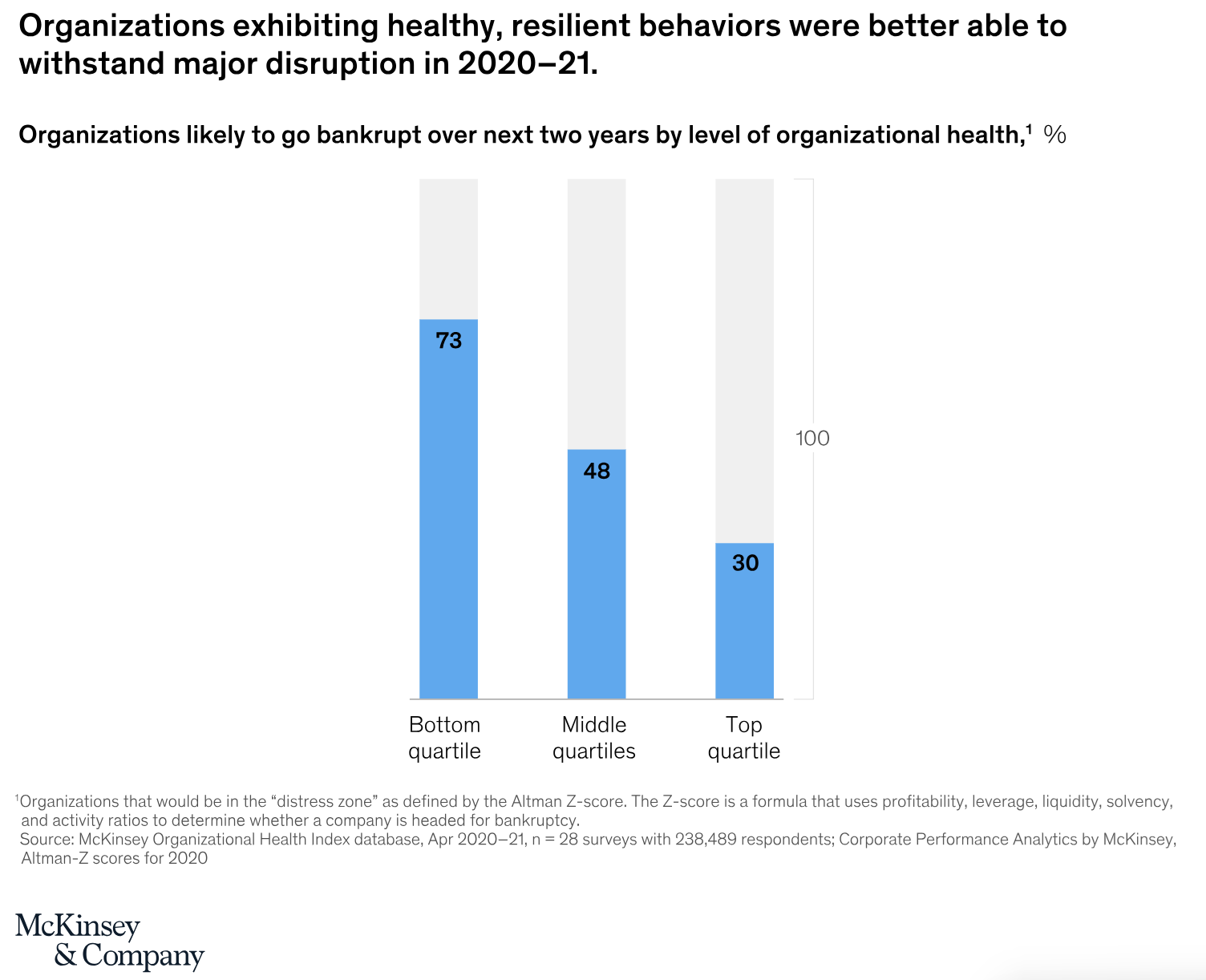
6. The Investor and Founder Lens
Non-linear founders often carry an edge you cannot buy later. Range gives them pattern recognition across markets, a wider surface for luck, and the habit of reframing problems instead of pushing harder on the first idea.
Their networks are not a single guild. They bridge disciplines and communities, which shortens discovery cycles and opens unexpected distribution.
For investors: how to underwrite range
You are pricing learning speed and repeatable judgment, not pedigree. Look for artifacts of execution that travel across contexts such as shipped products with outcomes, hard pivots that improved unit economics, postmortems that led to cleaner strategy.
Test narrative coherence too. Can the founder connect episodes into a clear thesis about what they build and why it works now?
Measure learning rate in weeks instead of quarters. How fast did they close the feedback loop, retire bad hypotheses, and translate insight into design, code, sales, or hires.
When you can underwrite those three signals, you capture alpha others leave on the table because the résumé is not legible at first glance for most venture capital investors.
For founders: design for learning velocity
Building a startup requires a team with diverse backgrounds. Hire for range and rate. Seek people who have succeeded in more than one context and who can show you the receipts.
Give them problems instead of tasks. Run short cycles, publish decisions, keep score with live metrics. Protect a few rotational seats so high-potential operators can collect context without leaving.
Treat recruiting as portfolio construction. Hold some high-liquidity specialists and place selective bets on high-upside generalists. The mix wins.
In a world where every startup fights for edge, the biggest arbitrage left is human.
7. How to Future-Proof Your Career in a Non-Linear World
The future of work won’t hand out playbooks. You’ll have to write your own. That means building a system that compounds over time rather than a résumé that expires with each reorganisation.
Define a theme, not a title
Start by choosing a north star that sits above any single role. It could be a problem you want to solve, a domain you want to master, or an idea you want to keep exploring.
Your theme is the throughline that makes each pivot make sense in hindsight. Roles will change, but the direction holds steady.
Ship visible proof every quarter
Momentum is credibility. Publish, present, prototype.
Whatever makes your work visible and verifiable. A steady stream of small wins signals learning velocity better than a perfect career arc. The market trusts evidence.
Build networks that cross borders
Careers now live at intersections. Stay in touch with people outside your function or industry. A designer who talks to investors, or an engineer who mentors policy students, creates luck faster. Range in relationships builds range in opportunity.
Protect your runway
Optionality needs capital. Save enough to experiment, diversify income where possible, and treat each financial cushion as a freedom fund. The ability to say yes to a bold move without fear is the real career insurance.
Keep the learning loop short
Every new skill should open a new surface area for opportunity. Choose projects that teach something you can reuse. Close feedback loops quickly, measure what stuck, then iterate.
Learning compounds just like capital, but faster.
The long game
Future-proofing isn’t about endless reinvention. It’s about alignment, between what you’re good at, what you care about, and where the world is heading.
The people who thrive in the AI era won't be the ones with the most linear paths or the deepest specialization. They'll be the ones who stay closest to change, move with intent, and keep enough room to grow when the next chapter calls. In AI especially, career zigzaggers aren't just winning. They're writing the playbook everyone else will follow.
I have lived and/living a zig zag career and every insights here is very true.
Thank you for this article — it puts words to what I see every day. Totally agree.