

Over 200 million people open ChatGPT every week and wonder why it feels mildly useful.
That’s not a ChatGPT problem. That’s an interaction problem.
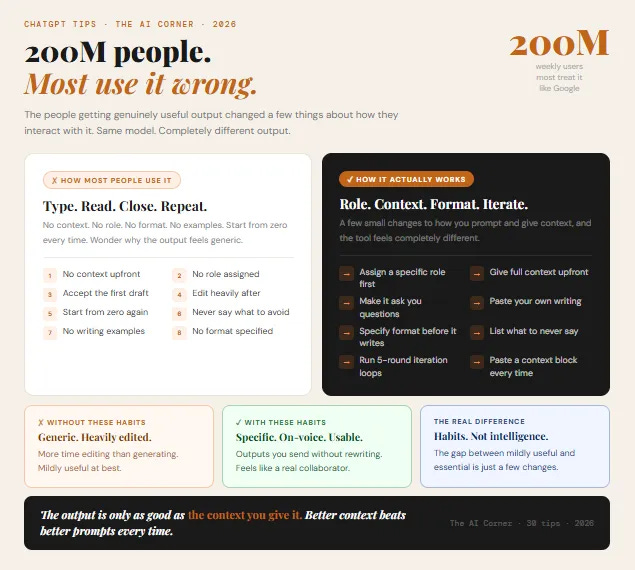
A few small changes to how you prompt and how you give context, and the tool feels completely different. These are the tips I actually use:
1. Give it a role before you give it a task
“You are a senior B2B copywriter who has worked on SaaS product launches. Your writing is direct, specific, and avoids marketing jargon.”
That one sentence changes the voice, the structure, and the vocabulary of everything ChatGPT produces after it. The more specific the role, the more specific the output.
2. Describe what you want to avoid
Add a short list of what it should never do:
“Never use the words leverage, streamline, or cutting-edge. Never open with a question. Never write a list when a paragraph will do.”
This one addition eliminates most of the outputs you’d otherwise spend time editing manually.
3. Paste in examples of your own writing
ChatGPT matches a style it can see. It cannot match a style you describe.
Paste two paragraphs of something you’ve actually written. Then say: “Match the tone, sentence length, and vocabulary of this. Use it as a reference, not something to copy.”
This works better than any description of your voice you could write.
4. Make it ask you questions before it writes anything
“Before you write anything, ask me the five to ten questions that would most improve what you produce. Do not start writing until I have answered them.”
The questions it asks will surface things you forgot to specify. The output after this step is almost always stronger than anything you’d get from a direct prompt.
5. Build a context block you paste every time
Write this once. Paste it at the start of every important conversation.
I am [role]. I work on [what you do].
My audience is [who they are].
My writing style: [3-4 specific words].
Words I never use: [your list].
Format I prefer: [your default].
Every session starts with full context instead of zero. Takes 90 seconds to write once. Saves time forever.
The other 25 are for premium subscribers
The ones below are the prompting patterns that produce the biggest jumps in output quality. Chain-of-thought triggers, steelman prompts, pre-mortem templates, iteration loops, assumption audits, and 20 more.
As a premium sub you also get every issue ever published in The AI Corner. 60+ guides, all of it immediately.
Cancel anytime. First subscribers get 50% off forever.
the premium 25 ChatGPT Tips:
6. The chain-of-thought trigger
Add this to any prompt where you want ChatGPT to reason carefully rather than pattern-match: