


In June, Jeff Dean stood at a University of Washington commencement and told graduates how he “got the itch to join a startup in 1999.” He landed at Google when it had 20 people, in an office above what is now a T-Mobile store in Palo Alto.
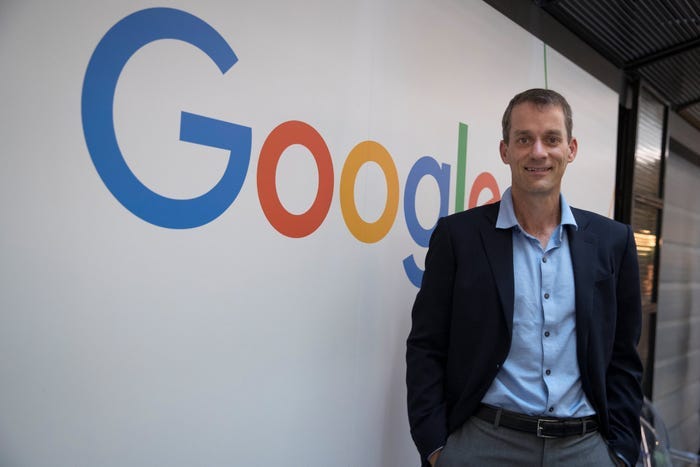
He was employee #30.
Twenty-seven years later, at 58, he has the itch again.
On August 5, Dean walked out of Google with 3 people who between them carry most of modern computing:
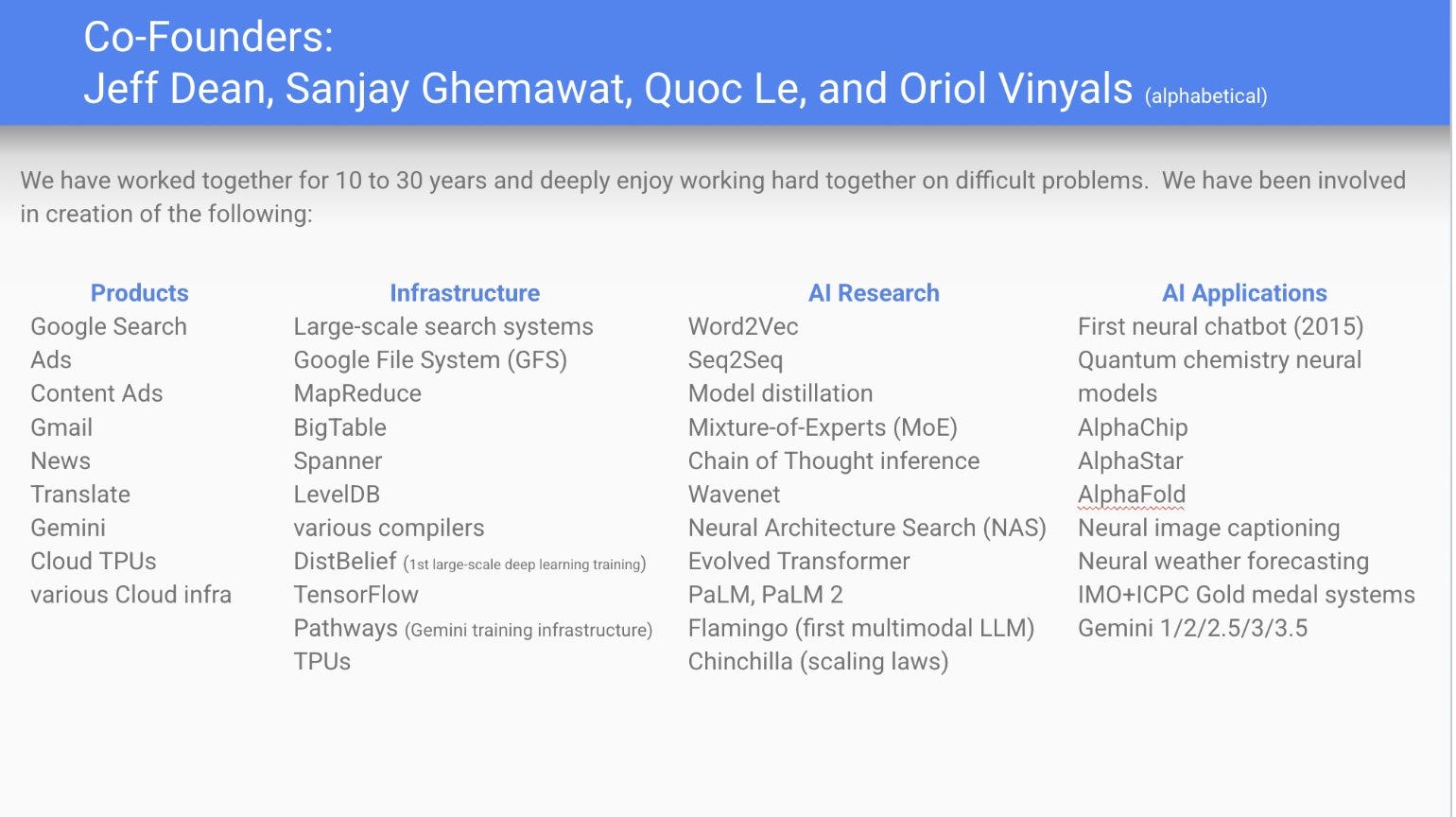
▫️ Sanjay Ghemawat, Senior Fellow, co-creator of MapReduce, Google File System, Bigtable, and Spanner. The infrastructure that made internet-scale computing possible. Dean’s collaborator for over 2 decades.
▫️ Quoc Le, Google Brain founding member, co-inventor of sequence-to-sequence learning with Ilya Sutskever and Oriol Vinyals. The direct architectural ancestor of every model you use today.
▫️ Oriol Vinyals, DeepMind VP of Research, Gemini technical co-lead, the mind behind AlphaStar. Over 100,000 citations.
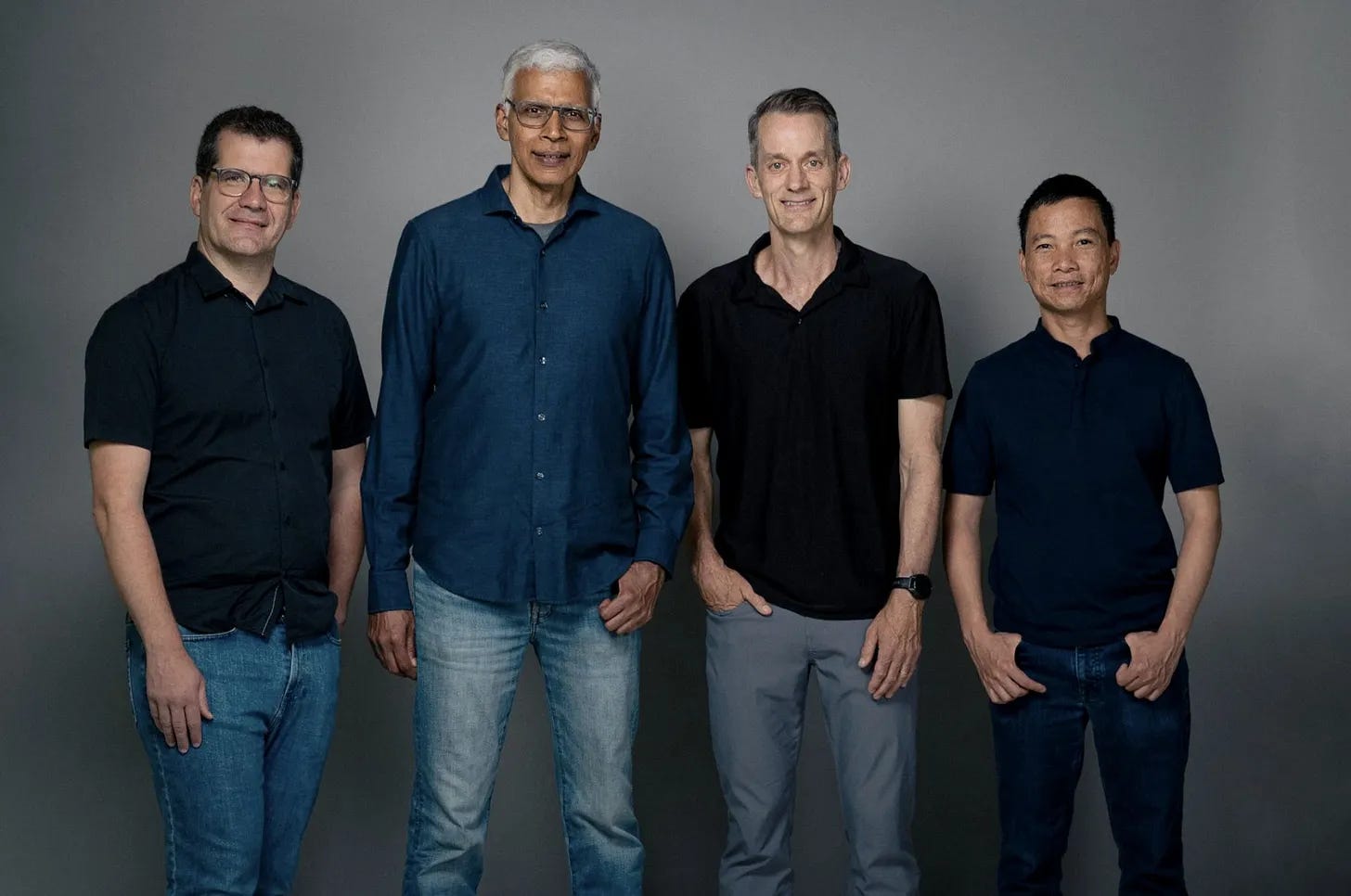
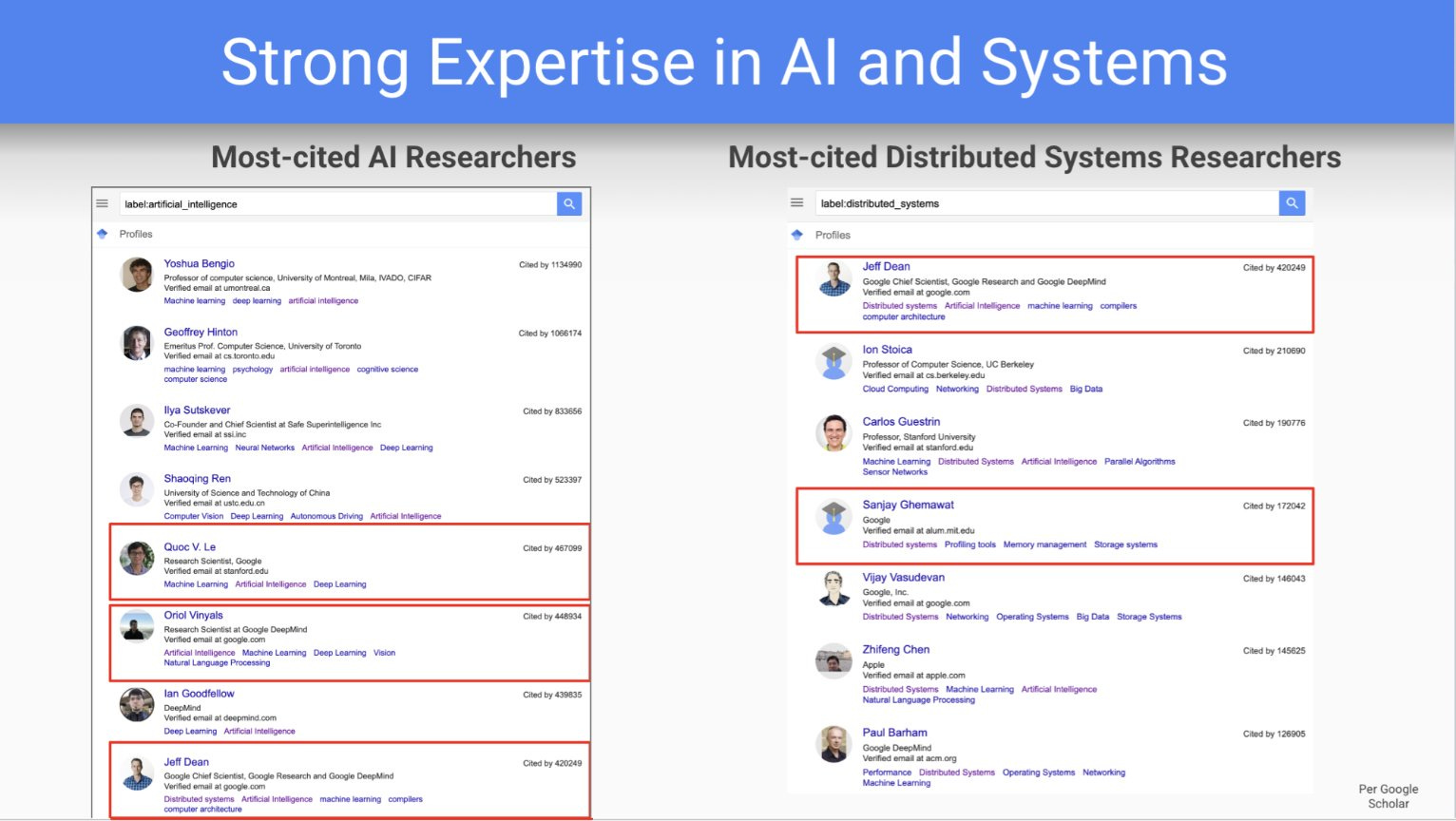
The 4 of them have worked together for 14 to 30 years. Their own site puts it plainly: 3 of the most-cited researchers in AI, and 2 of the most-cited in distributed systems, in one founding team.
The company is Discovery Loop, a Delaware public benefit corporation in Palo Alto. Dean is CEO. The mission fits in a sentence: automate the experimental loop itself.
“Particularly in a lot of domains, you can fully computerize that whole loop.”
Jeff Dean
The slide that explains why Google could not keep them
Dean did something founders almost never do. He published slides from the pitch deck he used to raise.
The one worth studying is titled “Management/Team Building experience.” On its face it is a résumé dump: Dean co-founded and ran Google Brain at its peak of roughly 600 people, then led Google Research and AI teams that grew to about 4,400.
The actual message sits in the list underneath, the people who worked on their teams and went on to found things:
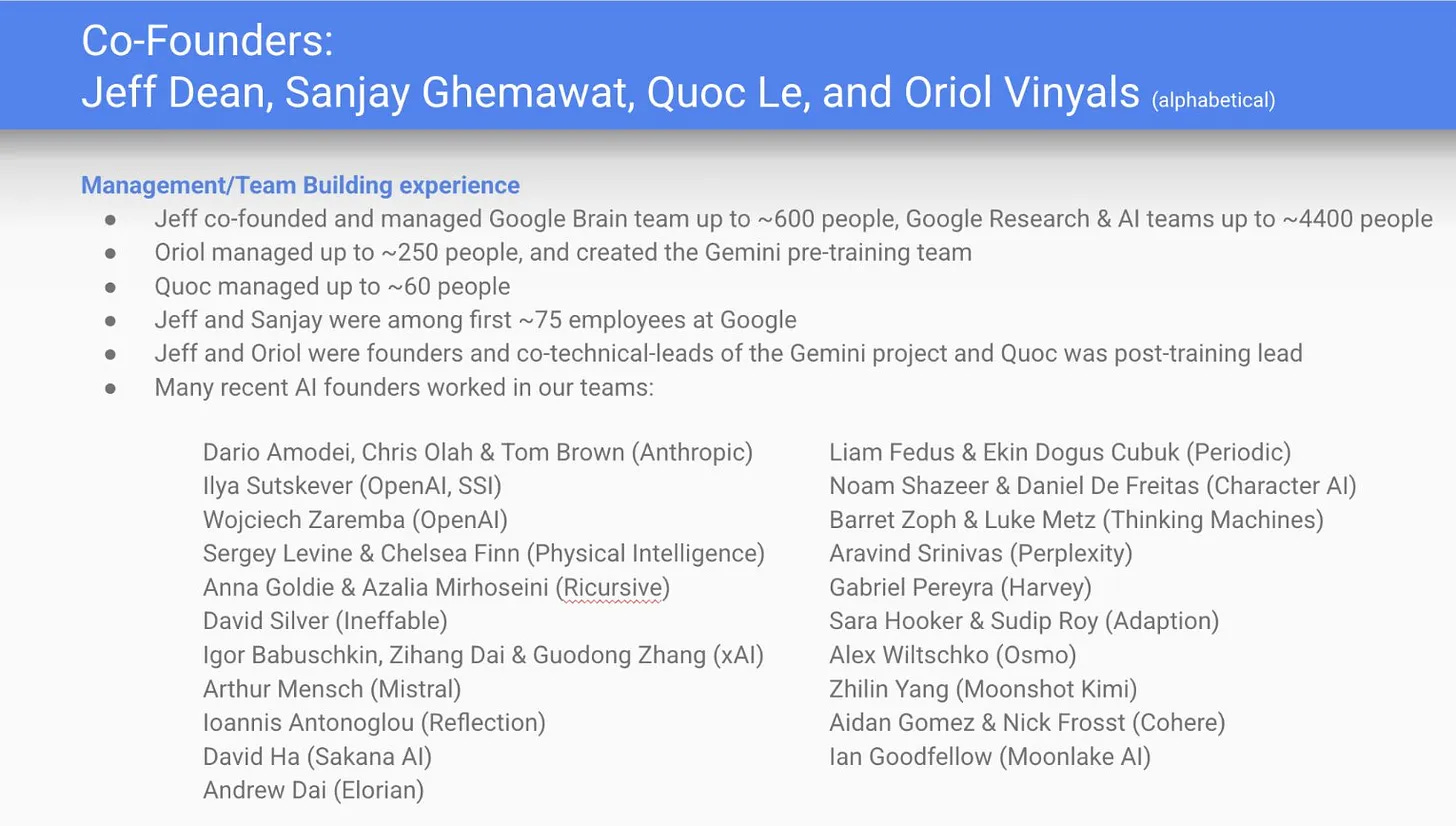
Read the pitch inside the pitch. These 4 built Google’s most important infrastructure over 25 years, and they built the organizations that trained the people now running the rest of the AI industry.
That is the asset an incumbent cannot replace with a counteroffer.
Who is funding it, and the part that should stop you
The seed round is co-led by Radical Ventures and Khosla Ventures, with Lightspeed, Kleiner Perkins, and Doerr Capital participating. Wilson Sonsini is advising. The round was still open at announcement and the valuation stays undisclosed.
Then there is the last name on the cap table.
Alphabet is a founding investor, and is supplying the compute for at least the first year.
Google is bankrolling the company its own legends left to build, and renting it the machines. Sundar Pichai went out of his way to call the exits amicable, saying Dean and Ghemawat “helped drive some of the most significant technology transitions” in Google’s history.
That check makes sense once you see what loop they picked first.
Discovery Loop starts with machine learning research, acting as its own first customer. An AI that proposes experiments, runs them, learns, and iterates, thousands in parallel, aimed at the problem of building better AI. Dean was direct about why: “we’re going to be our own first customers. The rapid feedback from doing that is the way to build something amazing.”
So Alphabet did not fund a competitor. It bought a seat next to the fastest compounding process anyone has attempted, because sitting outside it costs more than the check.
One more detail worth noticing: California bans non-competes. Anthropic, SSI, Thinking Machines, and now Discovery Loop all exist partly because their founders could walk out on a Wednesday and incorporate on a Thursday.
What they are actually automating
The scientific method is the most powerful algorithm we have, and we have always run it by hand. Propose, experiment, read the result, adjust, repeat. Sequential. Slow. Bounded by how many humans you can put on it.
Discovery Loop’s bet is that the loop runs faster once the human steps out of the middle.
The AI proposes the experiment, executes the run, learns from the outcome, and iterates recursively, with thousands of experiments running in parallel where a team would have run them in series.
Their published ambition:
“Imagine a future where a handful of people can conduct scientific research and engineering tasks much more rapidly, and with higher quality, than massive teams of scientists and engineers do today.”
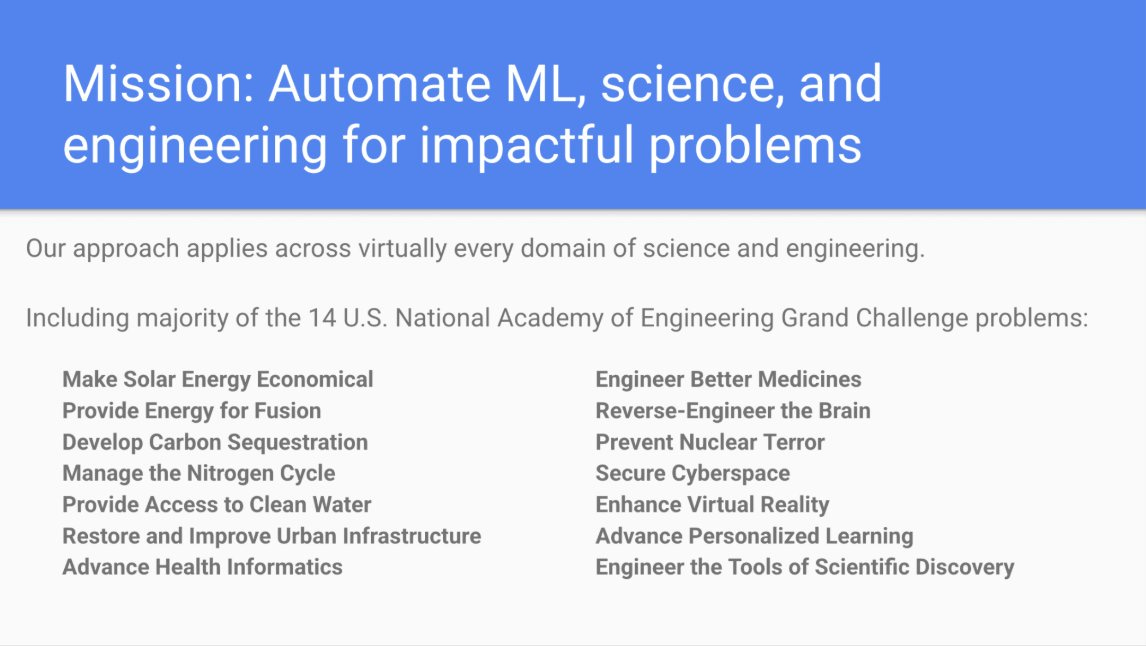
The sequencing tells you they have done this before. ML research and engineering first, because software experiments are cheap, fast, and fully computerizable. Then hardware design, drug discovery, materials, and clean energy. Dean says the approach reaches subproblems in nearly every one of the 14 NAE Grand Challenges.
Here is the part that matters for you.
The loop they are industrializing at frontier scale is the same 4-stage pattern you can run this week, at your scale, with tools you already pay for. Most teams run it by hand and call it iteration. The leverage arrives when you remove yourself from the middle and give it a stop condition.
Below, the full system.
Inside The Discovery Loop Playbook:
▫️ The 4-stage loop architecture, mapped to what you can automate today
▫️ The self-customer rule, how to pick the first target so it compounds
▫️ 4 copy-paste loop prompts, propose, execute, evaluate, iterate-or-stop
▫️ The parallel-experiment system, with the cost formula and the budget guard
▫️ The verification layer, the piece almost everyone skips
▫️ The 5 signals to watch, to know whether this thesis is working
Your subscription opens the full AI Corner archive:
▫️ The AI Tools and Models library, every model, tool, and setup guide
▫️ The AI Agents library, the full agent-building stack, start to finish
▫️ The Prompting and Context Engineering library, the prompts and context systems that actually ship
▫️ The Claude and Anthropic library, every Claude playbook in one place
Plus 3 new premium systems every week.
🔁 The Discovery Loop Playbook
Get the full system below 👇
1. The 4-stage loop
Every automated research loop has 4 stages. Each maps to something you can run now: