

AI has dramatically increased leverage for small teams. A handful of founders can now build products, ship features, and reach customers faster than entire organizations could a few years ago.
But there’s a catch.
As product development accelerates, operations become the bottleneck.
Founders still track fundraising in scattered spreadsheets.
Launch plans live across Slack threads and docs.
Hiring processes get rebuilt from scratch every time the company grows.
That friction compounds quickly, especially for AI-native teams moving at high speed.
So we built something to remove it.
Together with Notion, we’re releasing a free founder templates kit designed to act as a lightweight operating system for startups.

Alongside the workspace, we’re also giving away two resources that founders usually have to piece together on their own:
Access to 10,000+ investor profiles

Early-stage VCs, angels, and accelerators you can actually contact
Up to 6 months of Notion Business + AI, free

The same workspace many top startups already run on:
Why an operating system matters more now
In the past, startups could afford messy operations early on. Execution speed was limited by engineering and distribution anyway.
That’s no longer true.
AI-native teams can:
Build faster
Iterate more often
Run with fewer people
Which means operational debt shows up earlier.
The companies that compound fastest are not the ones with the most tools, but the ones with clear systems that remove decision friction as they grow.
This kit is designed around that idea.
Built around startup stages, not features
The workspace is organized by stage, because the problems founders face change over time:
The kit includes 58 templates, fully customizable:
Each template solves a specific, recurring problem founders run into, rather than trying to cover every edge case:
1. Idea stage: structuring uncertainty
Early-stage startups don’t lack ideas. They lack clarity.
The Idea templates help founders:
Track and compare ideas
Analyze markets and industries
Design business models
Run structured exploratory calls with Notion AI support
The goal is not to overthink. It’s to make decisions with less noise.

2. Launch stage: coordinating parallel work
Launching today means managing many things at once.
The Launch templates help teams:
Plan product launches
Track PR and media
Prepare Product Hunt campaigns
Coordinate announcements using Notion AI
Everything lives in one place, which matters when teams are small and moving quickly.

3. Fundraising stage: turning chaos into process
Fundraising tends to sprawl unless treated as a system.
The Fundraise templates include:
Pitch deck outlines
Investor data rooms
A lightweight investor CRM
Board and investor updates
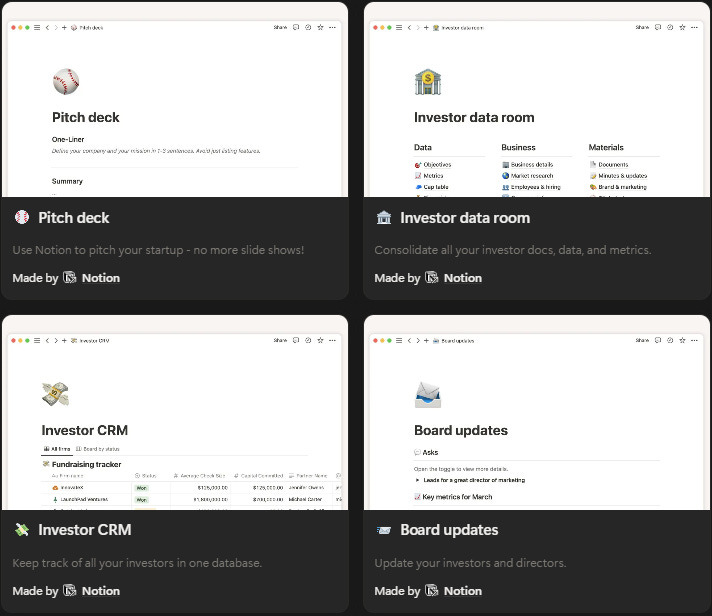

Paired with the 10,000+ investor database, this gives founders a clear, repeatable way to run a raise without rebuilding the basics.

4. Scale stage (39 templates): adding structure without slowing down
Growth introduces complexity whether you plan for it or not.

The Scale templates help with:
OKRs and company goals
Hiring plans and job descriptions
Team directories and handbooks
Metrics, budgets, and internal tracking
The emphasis is on clarity, not bureaucracy.
Designed to be adapted and shared
Everything in this kit is free.
No paywalls.
No gating.
No usage limits.
You can duplicate the workspace, adapt it to your company, and share it with other founders.
If it saves time, removes friction, or prevents rebuilding the basics, it’s working.
👇 How to use these templates for your workspace
Why this matters for AI founders
AI reduces the cost of building products.
It doesn’t reduce the cost of confusion.
The teams that win in this cycle will not just have better models. They’ll have cleaner systems, shorter feedback loops, and less friction between decisions and execution.
This kit is meant to support that kind of operating model.
Thanks for the info. Will look into this.
I’m interested in your feedback about an interactive model I built that walks through the Surface Area of Luck. Because it is wrong.
L = D × T
Luck equals Doing times Telling. It may have been true in 2010, but here we are in 2026.
You can view it here: https://claude.ai/public/artifacts/3ffeda42-c495-4421-9cc3-f59e2fa63545