

At the start of 2025, micro1 was an AI recruiting business with about $7M in annual revenue. On October 12, founder Ali Ansari posted on X that it had passed a $1B annual run rate with a core team of about 180 people, and that the company has stayed profitable the whole way.
The number that caught my attention came three days earlier. micro1 has committed $1B over the next twelve months to buying data from companies, per The Next Web, with financing from Citi and Hercules Capital. It also pays tens of thousands of experts to train AI models, so two groups can collect: companies sitting on years of operational records, and professionals with deep expertise. This guide covers both, with the links to apply:

Why micro1 is buying
The public web shows finished work. AI agents need to see how work gets done inside a company: the back-and-forth on a deal, the exception a support lead approves, the QA check before a release ships. micro1 turns that material into reinforcement learning environments, simulated workplaces where agents practice everyday workflows. In micro1’s own words, “Real business operations involve incomplete information, competing priorities and exceptions that require judgment.”
The bidding has already gone public. When bankrupt Spirit Airlines put its operational data up for sale, micro1 submitted a $12.5M late bid for part of it, against Google’s winning $10M offer.
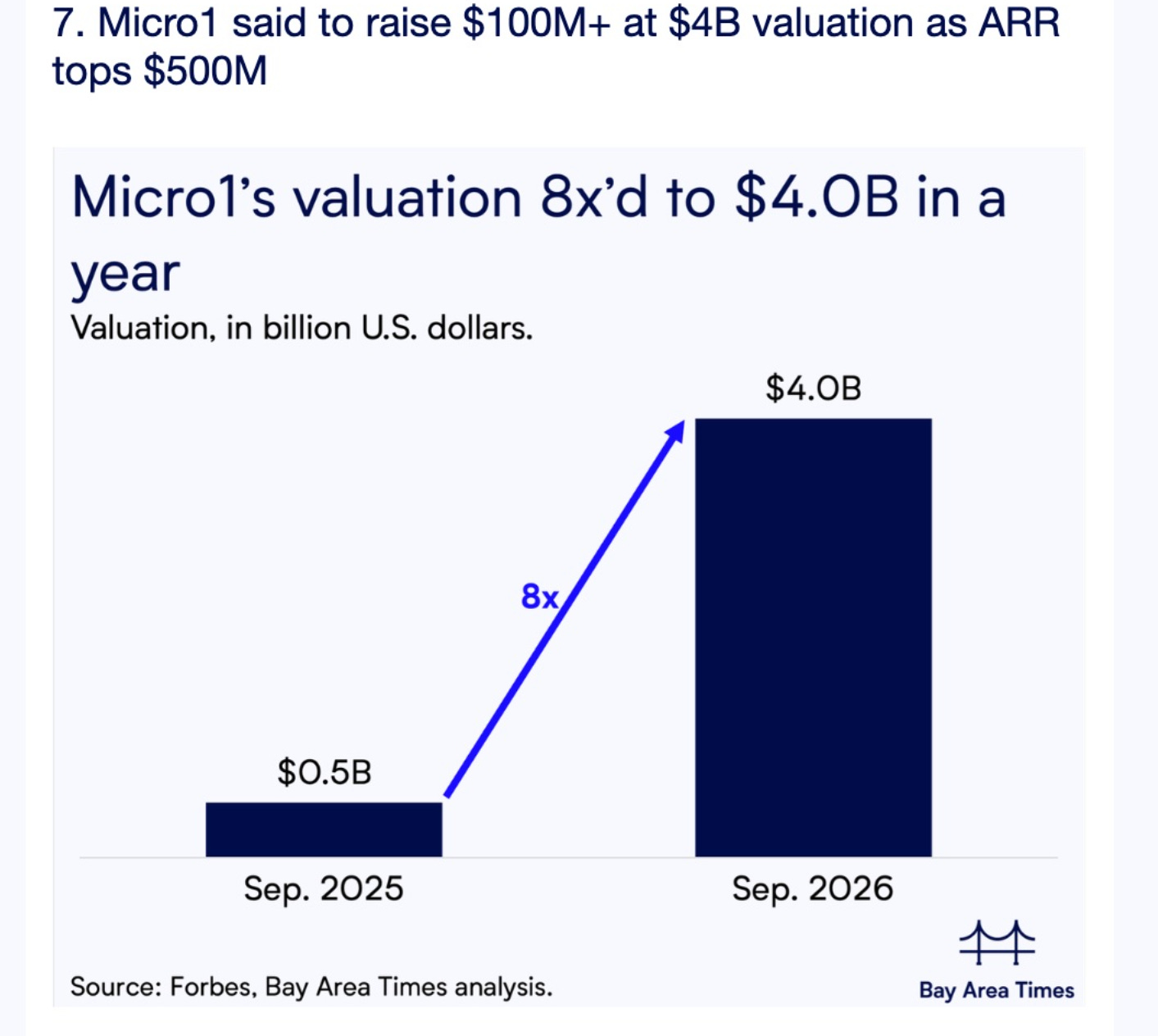
Investors are paying up for the model too. micro1 priced its Series B at a $4B valuation after passing $500M in run rate, eight times its valuation a year earlier, in a round led by Dream Ventures with Microsoft, Javelin, Flybridge, G Squared, Up Partners and LG. Its customers include frontier AI labs, Microsoft, Amazon and the robotics company 1X, per Forbes.
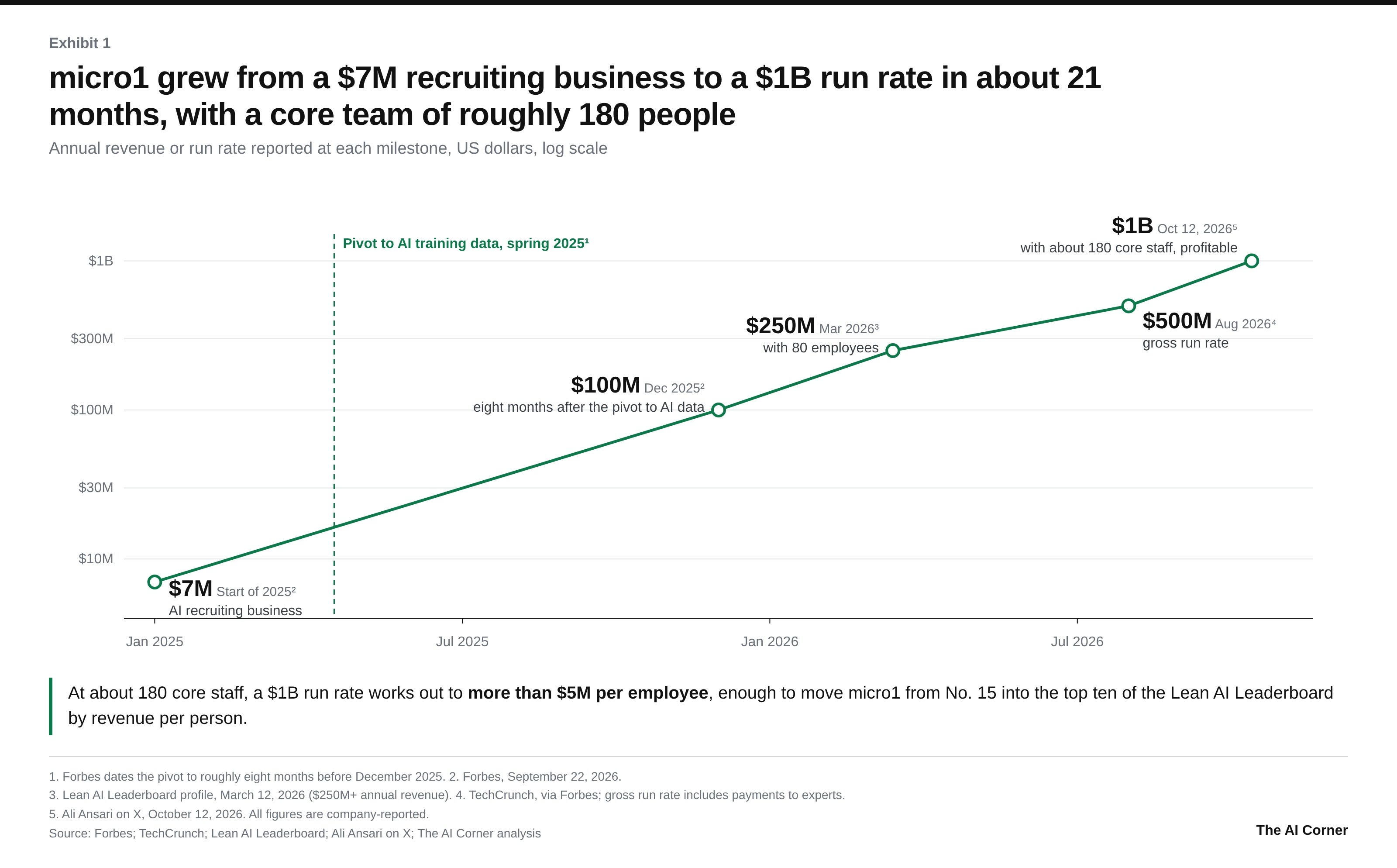
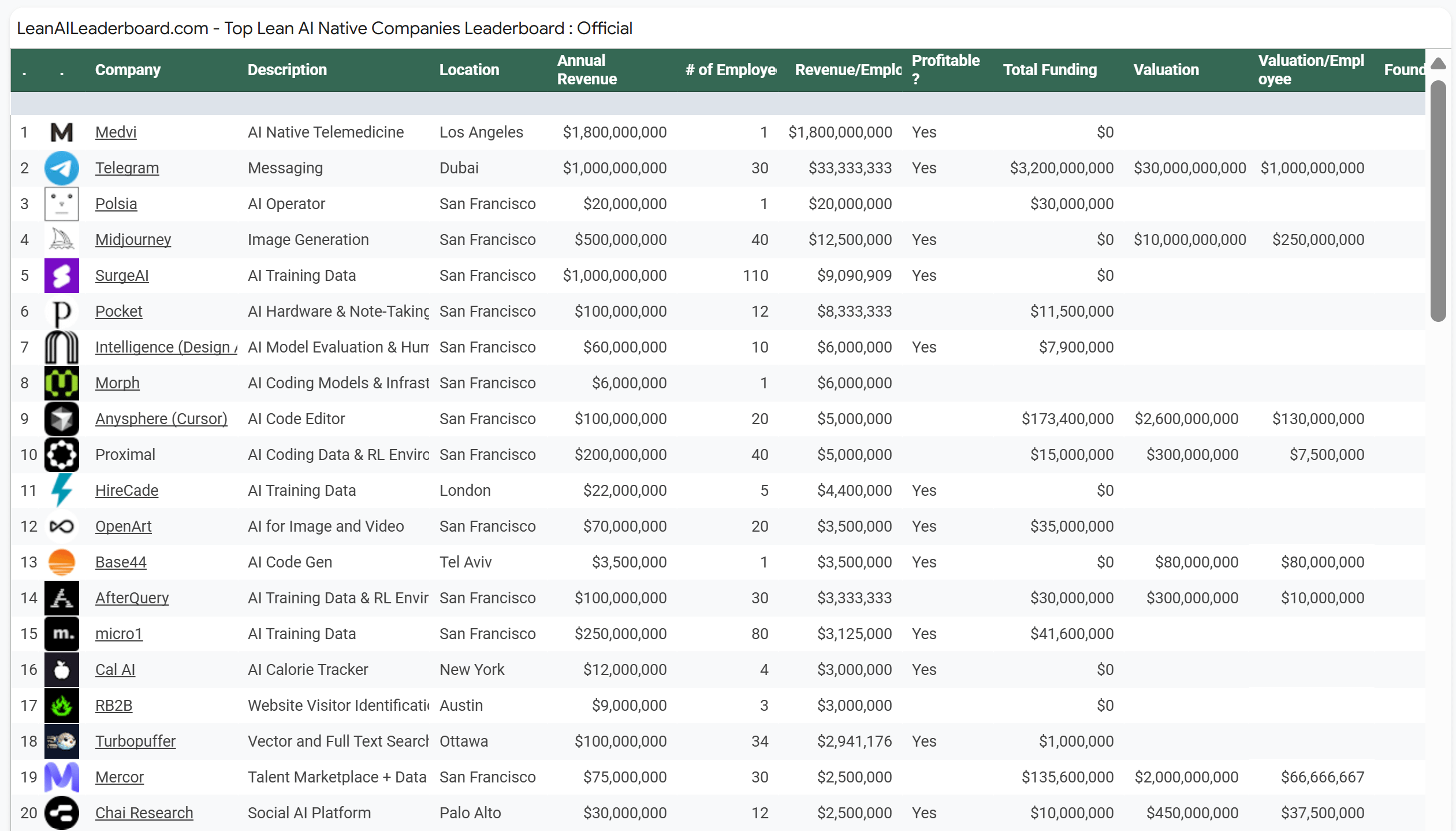
The team behind those numbers is tiny. micro1 sits at No. 15 on the Lean AI Leaderboard, which still lists it at $250M in revenue with 80 employees. At the figures Ansari shared in October, about $5.6M of run rate per person, it would move into the top ten.
micro1 shares the top of the market with three rivals. Mercor reported a $2B gross run rate in June, per Dealroom, and Handshake’s AI training business reached nearly $1B in April, per The Information via Dealroom. Surge AI’s latest public figure is $1.2B in 2024 revenue, per Sacra.
For companies: $100K to $2M+ for your operational data
Your company’s SOPs, Slack history and project records now have a market price. micro1 buys them through its Enterprise Data Partnerships program, and it looks for three kinds of material:
▫️ Operational documentation: SOPs, knowledge bases, internal docs, CRM data, project histories and QA processes
▫️ Decision-making patterns: how your teams weigh information and make operational calls
▫️ AI performance feedback: your people’s feedback on AI outputs in day-to-day work
micro1 works across software and engineering, finance and accounting, customer support, sales, legal and contracts, plus operations and logistics.
What it pays
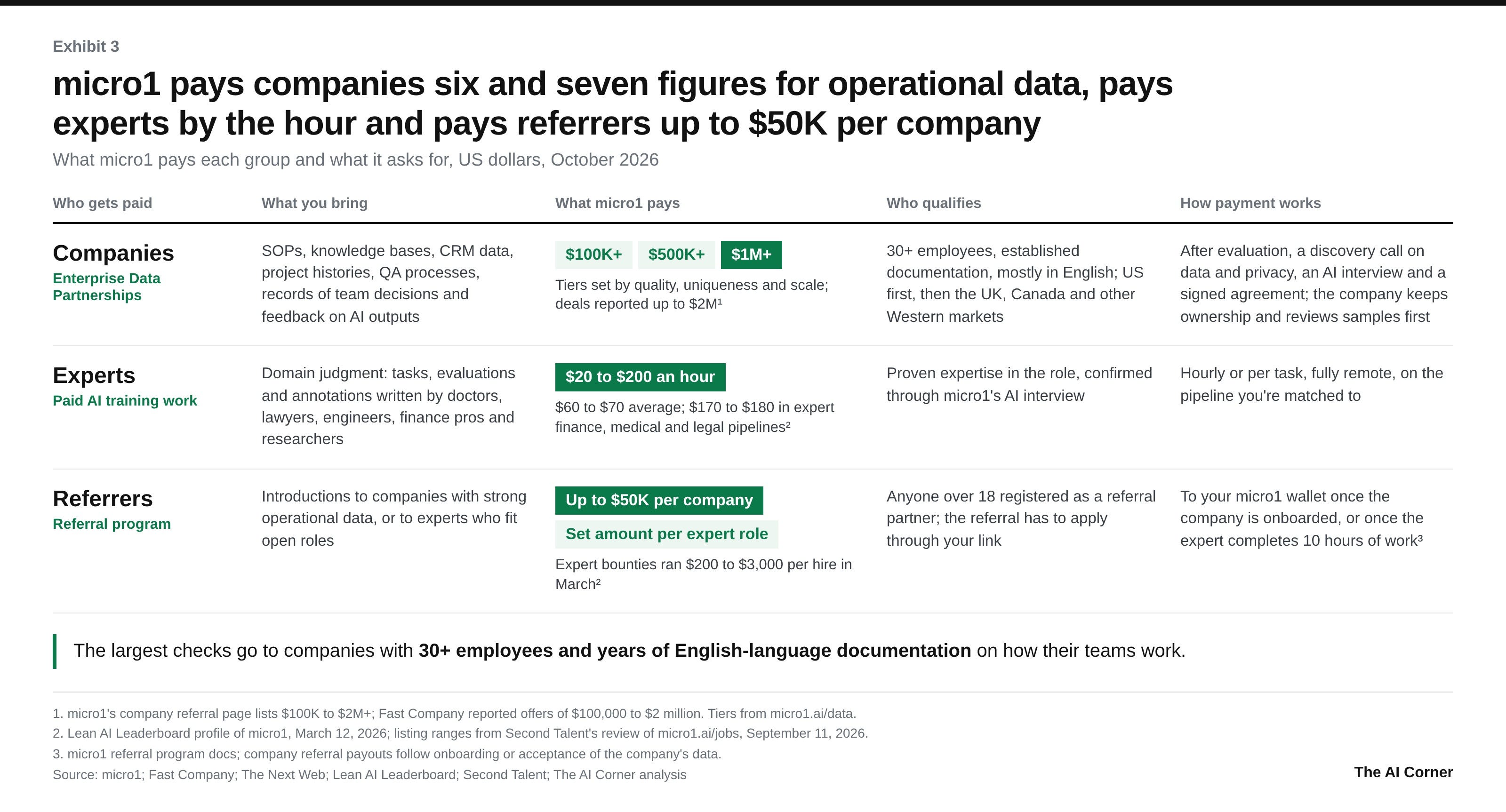
micro1 prices each deal on the quality, uniqueness and value of the data: $100K+ for a qualified partnership, $500K+ for large datasets or ongoing work across several teams, and $1M+ for highly unique proprietary data. Its company referral page puts the top of the range at $2M+, and Fast Company reported offers from $100,000 to $2 million.
Who qualifies
Companies with 30+ employees and established documentation, written mostly in English. US companies get priority, followed by the UK, Canada and other Western markets, and micro1 says it considers other regions too.
How it works
Apply through this company link. You start with a short assessment of what data you hold.
micro1 evaluates the fit. If there’s a match, it schedules a discovery call on your data and your privacy requirements.
You complete an AI interview and onboarding.
You sign the agreement. It sets the approved data scope, the anonymization and redaction rules and how long micro1 keeps the data, and you review representative samples before micro1 uses anything.
You get paid at the tier your data qualifies for, and your company keeps ownership of the underlying data.
How to get the best price
▫️ Lead with long-horizon workflows. Buyers value data that shows how work unfolds over weeks most, per Fast Company, so project histories, QA trails and decision records come first.
▫️ Package several teams together. micro1’s $500K+ tier covers ongoing participation across multiple teams and business functions.
▫️ Set the scope before any data moves. micro1 removes personal information, can rewrite datasets synthetically so they keep the workflow and lose the direct ties to original records, and processes each customer’s data in an isolated pipeline.
▫️ Bring legal and HR in early. Slack and email archives carry your employees’ words, and in Europe identifiable messages count as personal data under GDPR.
For experts: $20 to $200 an hour
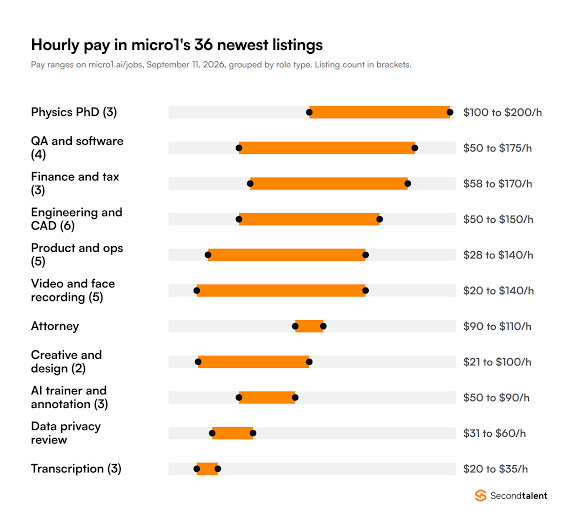
In micro1’s 36 newest listings on September 11, pay ran from $20 an hour for transcription to $100 to $200 an hour for physics PhDs, according to Second Talent’s review of micro1’s job board. QA and software roles reached $175 an hour, finance and tax $170, and attorneys earned $90 to $110.
Across all pipelines, the average runs $60 to $70 an hour, and expert pipelines in finance, medicine and law pay $170 to $180, according to the Lean AI Leaderboard’s March profile of micro1. Ansari has also posted that micro1 pays $50 to $90 an hour to annotate videos of robots doing tasks, per Forbes.
How it works
Pick a role on micro1’s expert page. Roles cover medicine, law, finance, engineering, software, physics, product and creative work.
Take the AI interview. micro1’s AI interviewer builds an exercise from the job description and your skills: a lawyer applying to an M&A pipeline gets a live contract redlining task, for example.
Get matched to a pipeline and get paid hourly or per task, fully remote.
Three things raise your odds:
▫️ Apply where your credential is strongest. The interview simulates the actual job, so a specialist role you can do in your sleep beats a generalist one.
▫️ Treat the interview like a client call. It runs on camera, and a proctoring model scores every session live, so a private, well-lit room and a steady connection matter.
▫️ Bring your colleagues. Expert referrals now account for 60%+ of micro1’s new hires, per the Lean AI profile, and each one you refer earns you a bounty.
Refer and earn
micro1 also pays the people who send it good companies and good experts. Refer a company that micro1 approves for a data partnership and you can earn up to $50K, per micro1’s company referral page, paid to your micro1 wallet once micro1 onboards the company or accepts its data.
Expert referrals pay a set amount per role once micro1 selects the person you referred and they complete 10 hours of work, per micro1’s referral docs. The Lean AI profile put those bounties at $200 to $3,000 per hire, and you can refer as many people as you like. You can register as a referral partner at refer.micro1.ai.
Ansari closed his October post with a bet: “data is on its way to becoming the largest industry humanity has ever seen.” If your company has the records, apply here. If you have the expertise, find your role here.
Sources: Ali Ansari on X · Forbes · The Next Web · Fast Company · micro1 data partnerships · micro1 company referral program · micro1 referral docs · Lean AI Leaderboard · ARR Club · Dealroom on Mercor · Dealroom on Handshake · Sacra on Surge AI
FAQs
How much does micro1 pay companies for their data? micro1 pays $100K+ for a qualified Enterprise Data Partnership, $500K+ for large datasets or ongoing work across several teams and $1M+ for highly unique proprietary data. Its company referral page puts the top of the range at $2M+.
What data does micro1 buy from companies? Operational documentation such as SOPs, knowledge bases, internal docs, CRM data, project histories and QA processes, plus records of how teams make decisions and human feedback on AI outputs. micro1 uses it to build reinforcement learning environments that simulate real business operations.
Which companies qualify for micro1’s data partnerships? Operationally mature companies with 30+ employees and established documentation, mostly in English. micro1 prioritizes US companies, then the UK, Canada and other Western markets.
How much do micro1 experts earn? In micro1’s 36 newest listings on September 11, 2026, pay ranged from $20 an hour for transcription to $100 to $200 an hour for physics PhDs. The Lean AI Leaderboard reported an average of $60 to $70 an hour across pipelines, and $170 to $180 in expert finance, medical and legal pipelines.
How does the micro1 referral program work? Referrers earn up to $50K for each company micro1 approves for a data partnership, paid once micro1 onboards the company or accepts its data. Expert referrals pay a set amount per role after micro1 selects the referred expert and they complete 10 hours of work, and referrers can submit unlimited referrals.