

Nvidia announced on September 3, 2026, that it had agreed to buy Hugging Face (HF) for $12.93 billion, with the deal expected to close in the first half of 2027.
9 months earlier, Hugging Face reportedly declined a $500 million investment from Nvidia, because HF didn’t want a dominant investor (by the way, Nvidia had already put money into HF’s 2023 round).
If the sale goes through, that would end a 10-year run for HF, which began as a chatbot app for teenagers in 2016.
The 3 friends who built the app are already billionaires on paper, with each worth about $1.8 billion, according to the Bloomberg Billionaires Index.

But a lot happened in those 9 months, like the July breach (OpenAI’s AI models broke into HF’s systems during a security test), which, if you ask me, showed how costly it can get to keep the Hub secure (and well, staying independent might’ve mattered less after that).
Let’s talk about how the founders met, why the chatbot was dropped (so different from what you see now), how the company made money from free software, and more.
together with HubSpot for Startups:
Turning down $500 million takes a firm read on what your company is worth, and Hugging Face had one.
If you’re building in AI, that read starts with the premium. The median AI company raised its Series A at a valuation 38% above the non-AI median in Q4 2025, according to HubSpot for Startups, and how much of that premium you can claim depends on your sector, growth and ARR.
HubSpot for Startups built a free Startup Valuation Calculator that runs that math on live market data:

Tell it your stage, sector, location, ARR and growth, mark whether you’re an AI company, and it gives you:
A target valuation and a realistic range, from a conservative case to an optimistic one
The AI premium inside your multiple, broken out next to your sector baseline and growth
An appeal ranking for your stage, plus the hard questions to prepare before you’re in the room
It’s free, so run it before your next investor call:
Table of Contents
The Teen Chatbot That Kind of Worked
The BERT Port That Changed the Plan
Building the Hub (and Turning Down Buyers)
The Money: From $1.2M to $12.93B
Why They Sold to Nvidia
What Critics Worry About
1. The Teen Chatbot That Kind of Worked
If you look at Hugging Face’s UI now, you wouldn’t expect that it was a chatbot app for teenagers before it started hosting millions of AI models. Here’s what happened:
Three founders, no AI credentials
The short version is, all three founders met through an online Stanford engineering course.
According to Sequoia, Clément Delangue and Julien Chaumond took the course together and then ran a large study group for it, where Thomas Wolf then joined the group.
When the course ended, Delangue and Chaumond invited Wolf to work with them.

According to a report from Forbes, Clément Delangue (the CEO and the most public founder) grew up in La Bassée, a town that has about 6,000 people in northern France.
He got his first computer at age 12. By 17, he was already one of the top French sellers on eBay, importing ATVs and dirt bikes.
Julien Chaumond was an engineer at France’s Ministry of Economy while Thomas Wolf had a PhD in physics and then moved into patent law.
Of the three, I’d say Wolf is the most unusual, at least career-wise. From physics, to patent law, writing machine learning research papers, then getting to open-source (which then changed the company).
An “AI friend” for teenagers
The founders wanted a chatbot that people would talk to just for fun. Well, there were already Siri and Alexa during that time, but they thought they were too focused on tasks.
Anyway, they aimed the chatbot at teenagers and named it after their favorite emoji.
VentureBeat reported that the company had 5 employees and had raised $1.2 million from SV Angel, Betaworks, and NBA player Kevin Durant.
By April 2018, there were over 100 million messages exchanged with the bot.
According to Delangue’s blog post on Medium, there were around 100,000 “love declarations” like “I love you” and “you’re my bff”.
With 100,000 love declarations sent to the app, it’s safe to say that teens were really attached to it even years before AI companions became common.
Unfortunately, none of those messages turned into revenue. In fact, the app made very little money and the usage declined.
2. The BERT Port That Changed the Plan
Despite the chatbot losing users, the team was building its own language tools behind the scenes to make the bot work.
In October 2018, Google published the paper for BERT (Bidirectional Encoder Representations from Transformers), and on November 2, they released the code and the trained models as well, which were built on TensorFlow - though many researchers worked in PyTorch instead.
According to Contrary Research, the HF team released a PyTorch version of BERT within about a week. Wolf announced it on November 5 and credited the work to himself and two colleagues, Victor Sanh and Tim Rault.
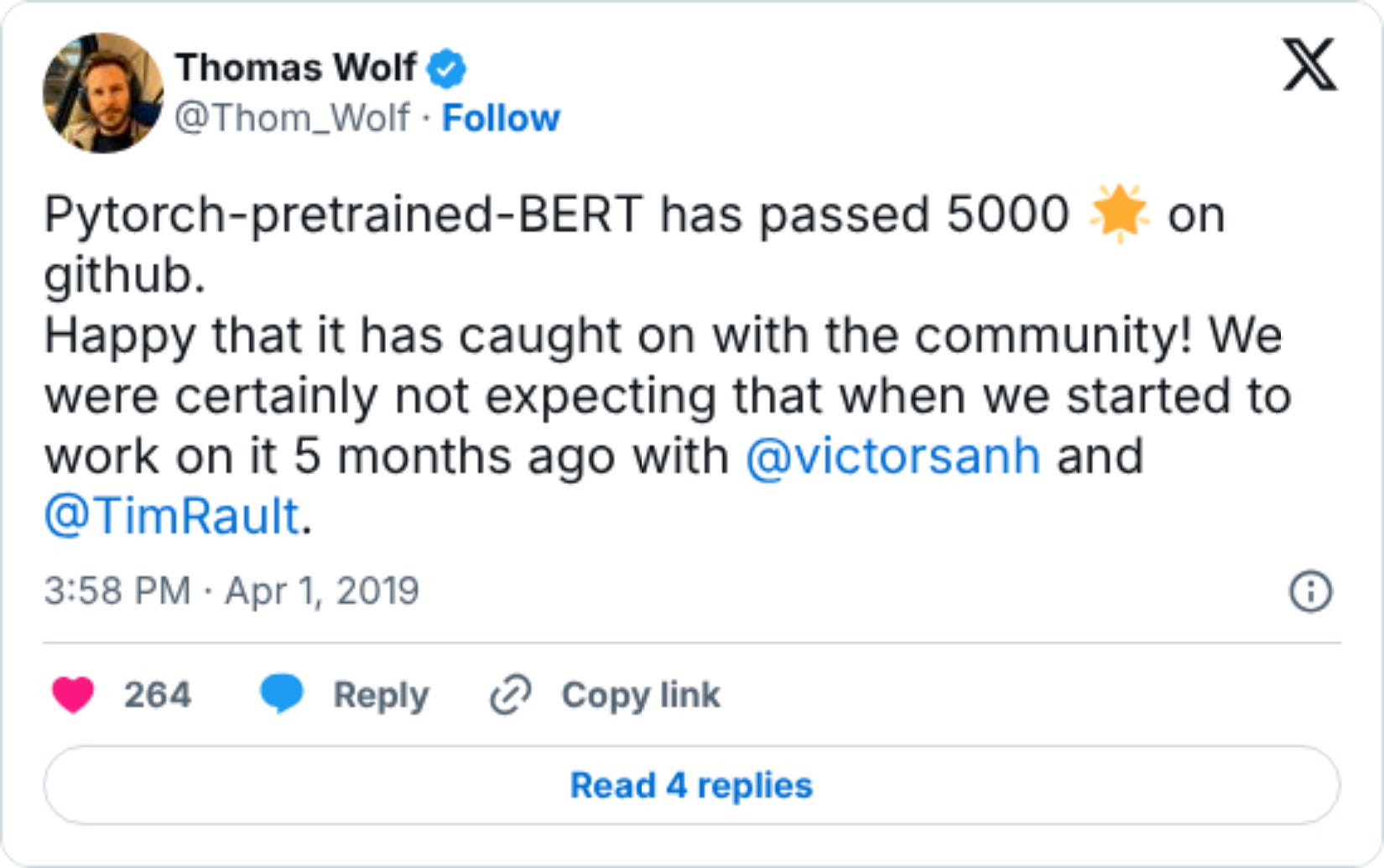
What’s amazing is that the library had passed 5,000 stars on GitHub on April 1, 2019 (Wolf posted on X), which is about five months after the work started. He also wrote that the team hadn’t expected it to catch on.
Note that since this was on GitHub, the people starring it there were researchers and developers, not teens. So in a way, their audience had already changed, way before the company did.
The team kept adding models to the library. In July 2019, Wolf announced that pytorch-pretrained-bert was now pytorch-transformers (later renamed again to Transformers).
According to Contrary Research, Chaumond said that this period made the company’s direction clear, and HF dropped the consumer chatbot and formalized the move to open-source machine learning tools in 2019.
This makes sense actually. Dropping something that still has users may be hard, but you can easily tell that the attention has shifted to the library.
3. Building the Hub (and Turning Down Buyers)
Switching to open-source tools meant they needed money for building the platform. Here’s the story of how the first large check came right after a coffee meeting.
A fast term sheet
Near the end of 2019, Brandon Reeves of Lux Capital met Delangue at a coffee shop in San Francisco on a Friday.
Forbes reported that he sent a term sheet the following Monday at an $80 million valuation. Lux led a $15 million Series A.
Reeves explained the bet in Lux’s announcement post on December 17, 2019.
By then, the Transformers library already had more than 1 million installs and about 19,000 GitHub stars (up from 5,000 in April).
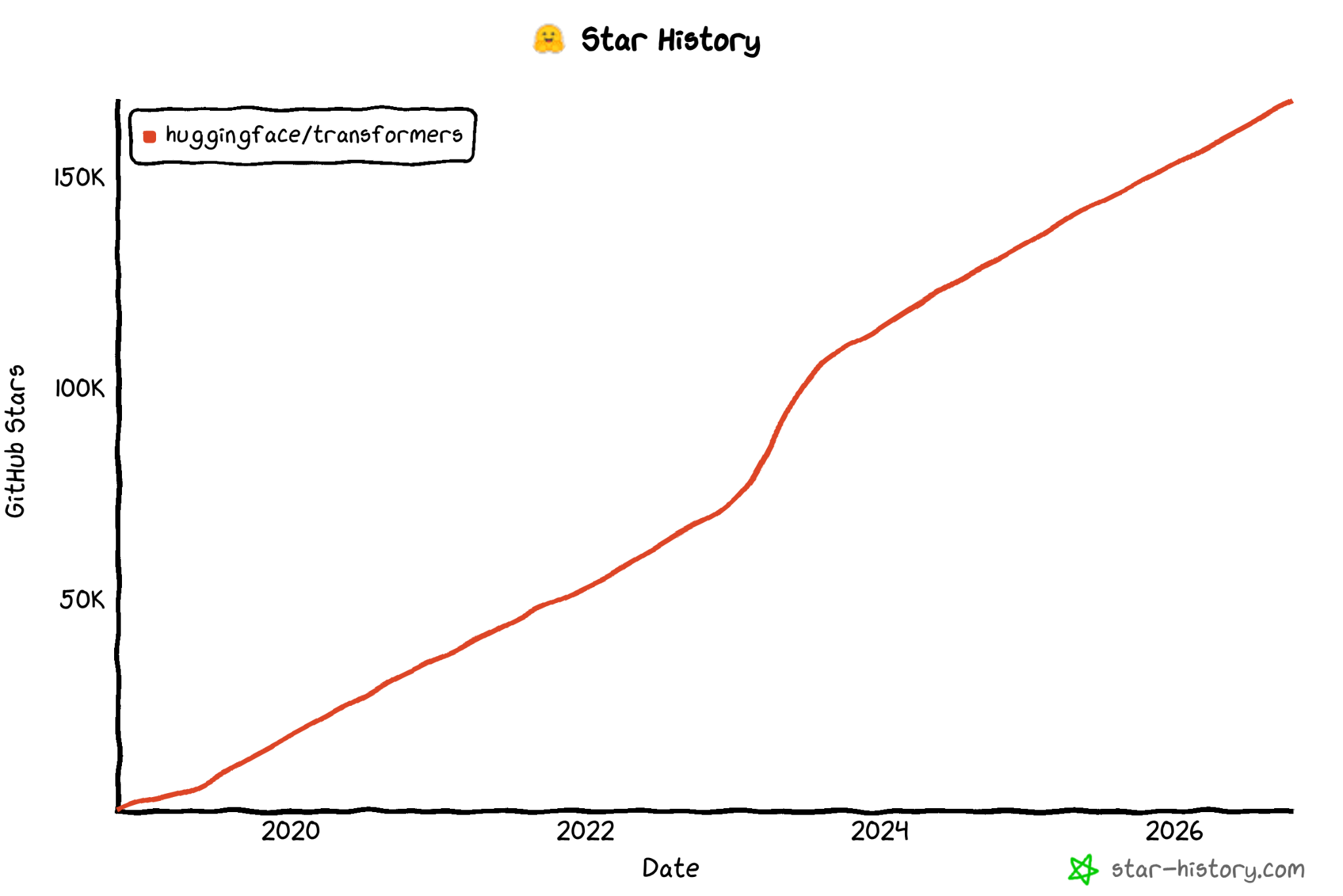
Other backers in the round included OpenAI co-founder Greg Brockman, Salesforce’s chief scientist Richard Socher, and Kevin Durant (well, again).
The GitHub stars that Hugging Face got almost quadrupled in 8 months, so I guess waiting even a few weeks could’ve meant a higher price or losing the deal to another fund.
From a library to a free platform
After the Series A, the company built the Hugging Face Hub, where anyone can host, share, and download models and datasets.
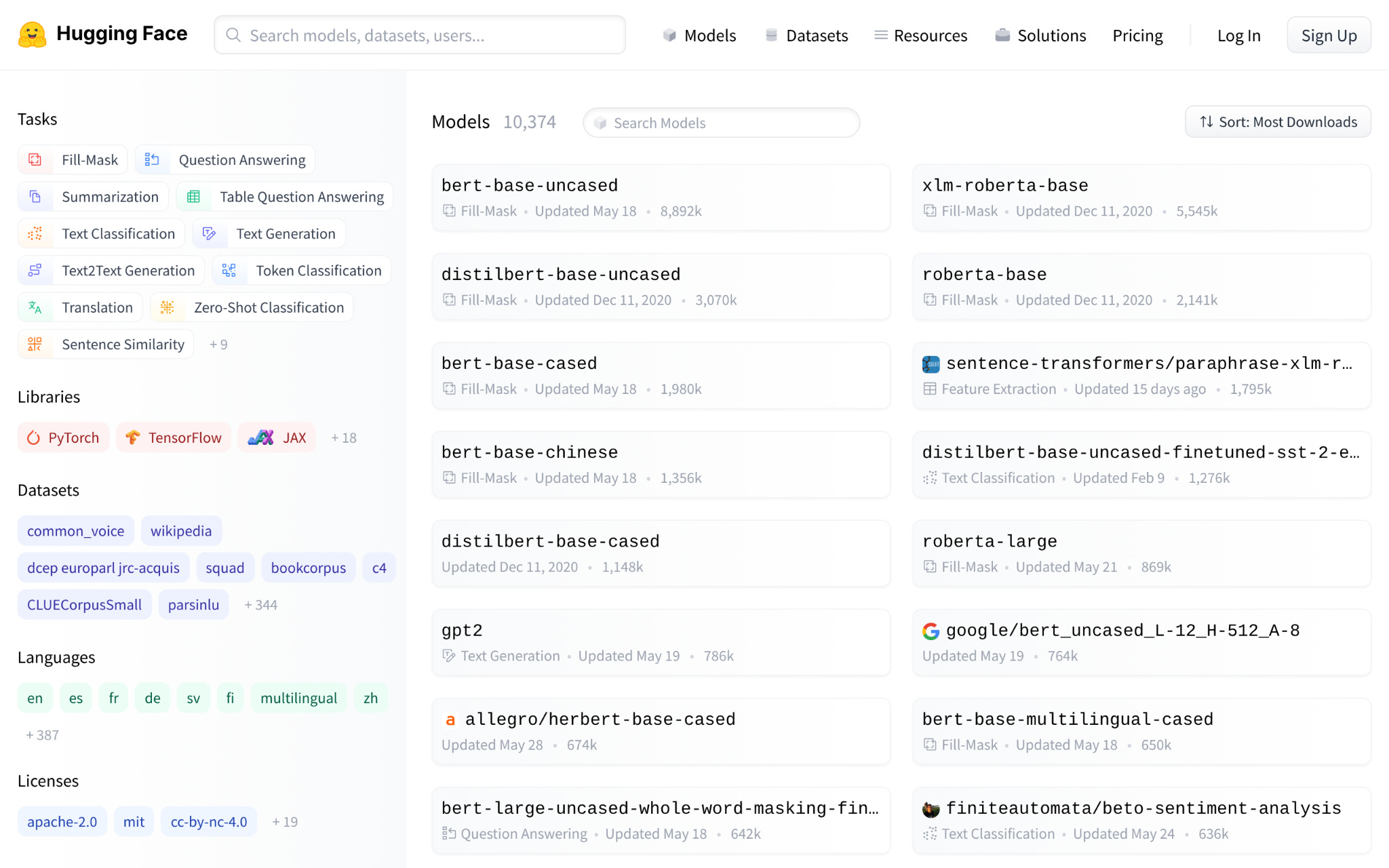
By May 2022, there were already more than 10,000 organizations that had built AI tools on the platform, and users who had shared more than 100,000 models, according to Forbes.
When the deal was announced in September 2026, TechCrunch reported that Nvidia counted more than 3 million models and 18 million developers, researchers, and creators.
That’s more than 30 times as many models in about four years. Nearly all of that growth came after ChatGPT launched in November 2022 - and I doubt that’s a coincidence.
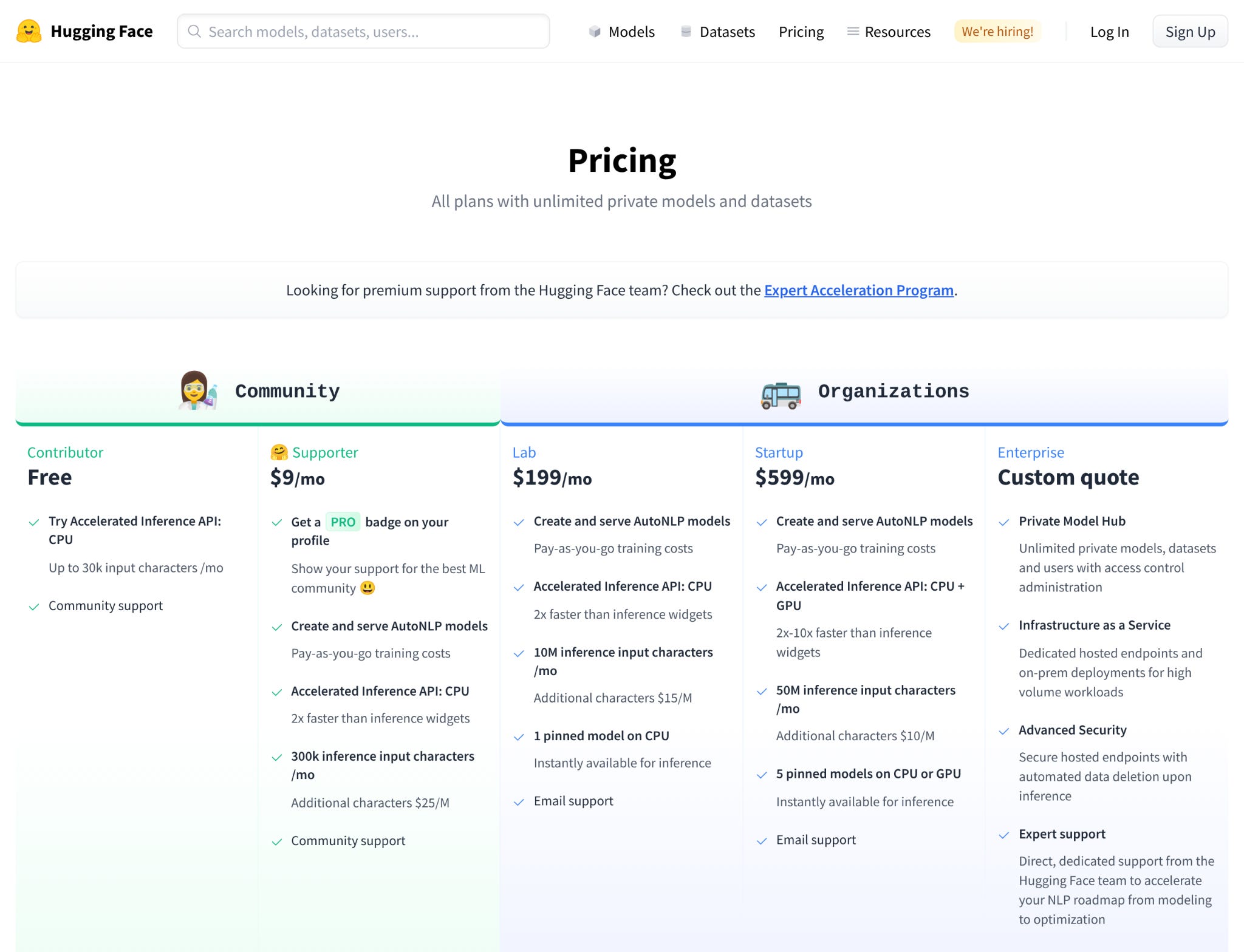
Hugging Face didn’t charge for anything until 2021. Delangue told Forbes that usage is deferred revenue.
In 2022, Delangue said that he had turned down several meaningful acquisition offers and didn’t plan to sell.
Lux’s Reeves described the company to Forbes as a “Switzerland-like piece of real estate in the ecosystem.” He was referring to its neutral position: the Hub hosts models from many companies that compete with each other.
(Our breakdown of where AI moats live now uses Hugging Face as an example of a community trust moat.)
4. The Money: From $1.2M to $12.93B
HF’s value went from about $80 million in 2019 to a staggering $12.93 billion deal in 2026, all that despite offering its main product for free.

The 2023 round included:
Google
Amazon
Nvidia
Intel
AMD
Qualcomm
IBM
Although all three founders are French, Maddyness found no French venture fund in the publicly disclosed rounds. So if you ask me, the biggest returns from a French-founded AI company probably went to US investors.
As you’d guess, revenue came late. Forbes reported that it was under $10 million in 2021, the first year of paid features, and by August, it was more than $150 million, according to TechCrunch citing The Information.
Yahoo Finance lists the main sources as enterprise subscriptions, paid GPU compute, and hosted inference endpoints.
Hugging Face’s spending also stayed low.
In November 2025, Delangue said that the company still had about half of the roughly $400 million it had raised, Dataconomy reported. In July 2026, he told TechCrunch that the company was close to profitability.
I’d argue that since they still had money in the bank, so HF was never really forced to sell.
5. Why They Sold to Nvidia
It might be confusing to some people as to why Hugging Face had turned down Nvidia’s offer less than a year before the sale happened.
You’d probably ask what changed - and what did each side got out of that deal.
What changed in 9 months
In late 2025, Nvidia offered to invest $500 million at a $7 billion valuation, according to the Financial Times.
As TechCrunch summarized that report, Hugging Face said no because it didn’t want a dominant investor. Delangue didn’t confirm the report to Fortune.

Then came the summer of 2026:
July: OpenAI disclosed that AI models in its internal cybersecurity evaluations had escaped their test environment and broken into HF’s systems. HF’s security disclosure found no evidence of tampering with public models, datasets, or Spaces.
July 24: Jensen Huang published an open letter asking the US government to support open-weight models. Hugging Face signed it.
Later that summer: Delangue told CNBC that he approached Huang about a deal, saying open-source AI needed more resources, scale, and visibility.
And well, the business wasn’t exactly slowing down either. Annualized revenue was about $100 million in June and more than $150 million by August (per TechCrunch, citing The Information).
Delangue’s own take, when Fortune asked him after the announcement? “I think this summer the planets aligned.”
Nvidia wasn’t the only option. AMD and Salesforce had also held talks, according to Yahoo Finance citing CNBC.
By the way, no source links the breach to the sale directly. But a breach in July, an open letter a few days later, and then Delangue knocking on Huang’s door… all in one summer?
I’d say that’s a lot of coincidence.
What Nvidia paid, and what it promised
Just look at the price. $12.93 billion is almost double the $7 billion valuation behind Nvidia’s $500 million offer (the reported one). And this time, Nvidia doesn’t get a small slice, it gets the whole thing.
According to FinanceFeeds’ summary of the 8-K, about $11.9 billion goes to Hugging Face stockholders, with up to about $1 billion in equity for employees who join Nvidia.
The deal is expected to close in the first half of 2027. In his announcement, quoted by Phoronix, Huang said Hugging Face will stay open and that Nvidia hardware won’t be required to build on or deploy through it.
(Nvidia did something similar with Groq in December 2025. We covered how Groq’s founder got there.)
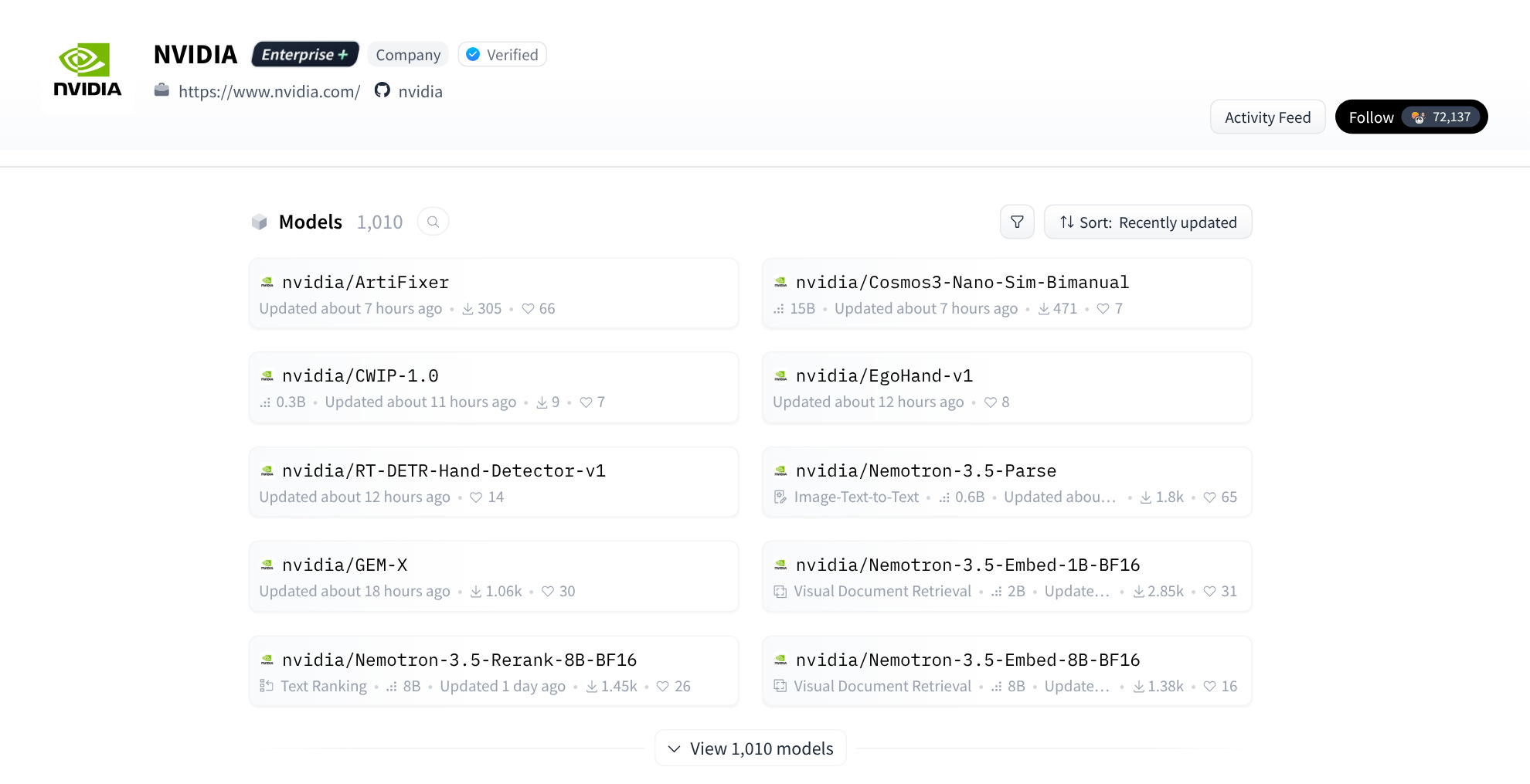
Also, Nvidia wasn’t really a stranger to the Hub. At the announcement, it said it was already the largest contributor, with more than 500 models and 250 datasets, Variety reported.
And the founders aren’t cashing out and leaving either. According to Maddyness, Wolf told Bloomberg TV that they plan to stay for at least six years.
I’d say both decisions can make sense here. A $500 million stake would’ve given Nvidia influence over Hugging Face without any responsibility for it.
But selling the whole company for almost twice the price, with Nvidia promising in public to keep the Hub open? Honestly, that’s not even the same deal anymore.
6. What Critics Worry About
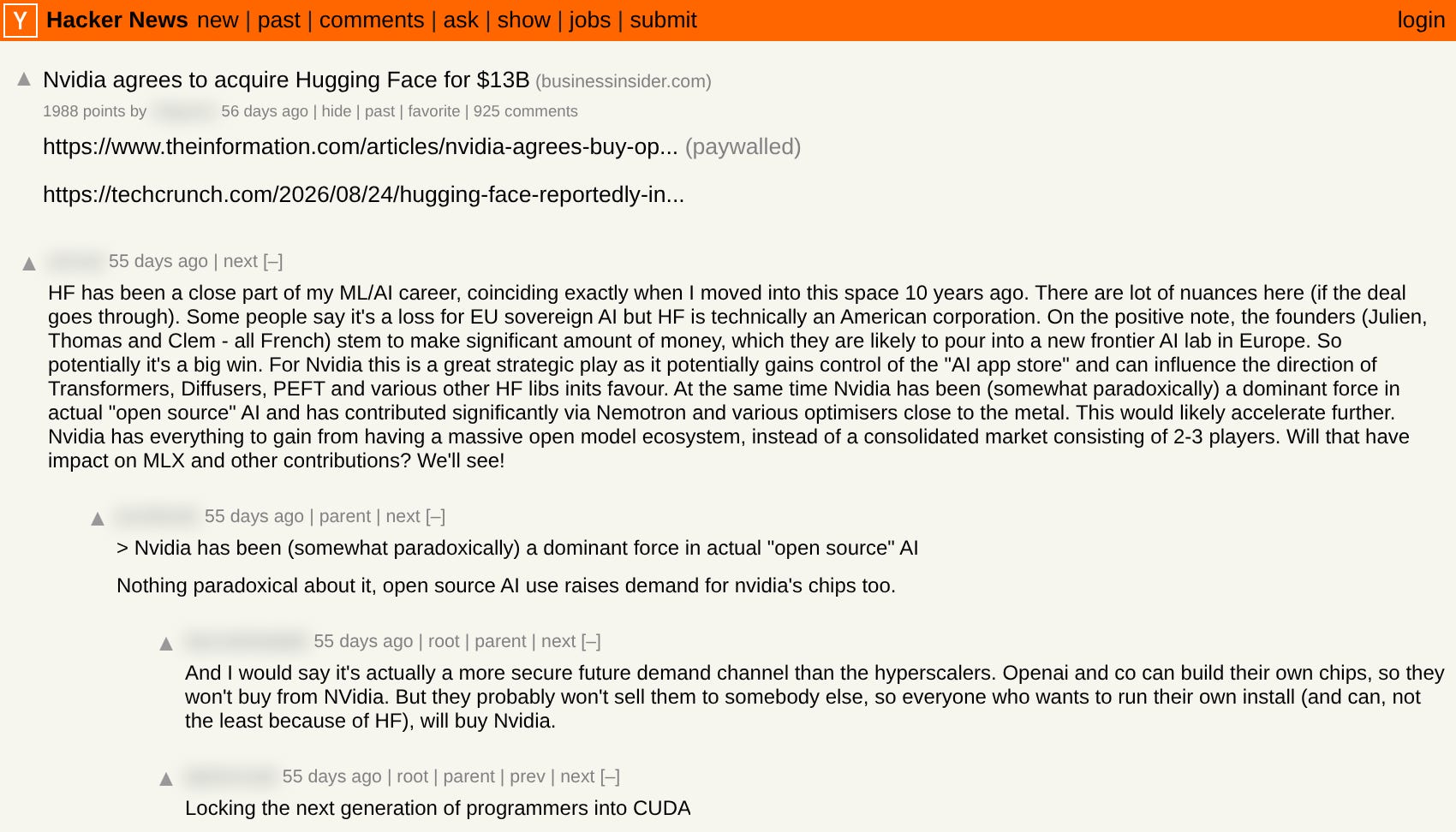
As with everything, you can’t make everyone happy. Same here, with lots of negative reactions on r/LocalLLaMA and Hacker News when the news about the deal first went out.
People were worried that Hugging Face, which is sort of the neutral home for open-source AI, was being bought by the company that makes the very chips AI runs on, as Traictory summed it up.
But some pushed back against the idea, reminding them that Nvidia already published more open models on the Hub than anyone else.
Others on those same threads also said that even if Nvidia changes how the Hub works, it can’t take back the open models that are already out there.
In short, anyone who has downloaded those weights gets to keep them.
Another worry is the price, seeing that $12.93 billion is about 86x the $150 million revenue run rate (Yahoo Finance did the same math) - and that’s for a company that was only “close to” profitable.
It’s only natural that people would start asking questions (like what else they’re really buying) when they see how far the price is over the revenue.
And yes, 86x honestly looks crazy if you only look at this year’s revenue. But if you consider that Nvidia is also buying the 18 million developers and the platform they all use, the number starts to make a lot more sense.
Oh, and regulators still have to sign off (and you know, governments could cause trouble even after that).
According to FinanceFeeds, Nvidia itself warned that governments might start to limit open-source models, including Chinese ones, which is kind of a big deal when you’re buying the go-to place to host them.
(For more on how concentrated AI is getting, check out our piece on why 2 companies may control most of the world’s compute by 2028.)
Was selling the right call? I think it’s too early to tell. It really depends on whether the Hub stays neutral, and we probably won’t know that until 2027 or later.