

TL;DR
The model: Jev, launched September 15 by TypeSafe AI, is the first public “System One” model. It generates zero text. You send it a state and typed questions, it returns answers with probabilities in 70 to 500 milliseconds.
The price: $0.042 per million input tokens, output free. Ten thousand decisions cost $0.42.
The week: flights found in 7 seconds for $0.0039, a Claude session compacted from nearly 1M tokens to 86K in one second, 1,018 papers classified for eight cents.
The catch: confidence is a probability, accuracy is a different number, and every benchmark so far comes from the vendor or the demo builders.
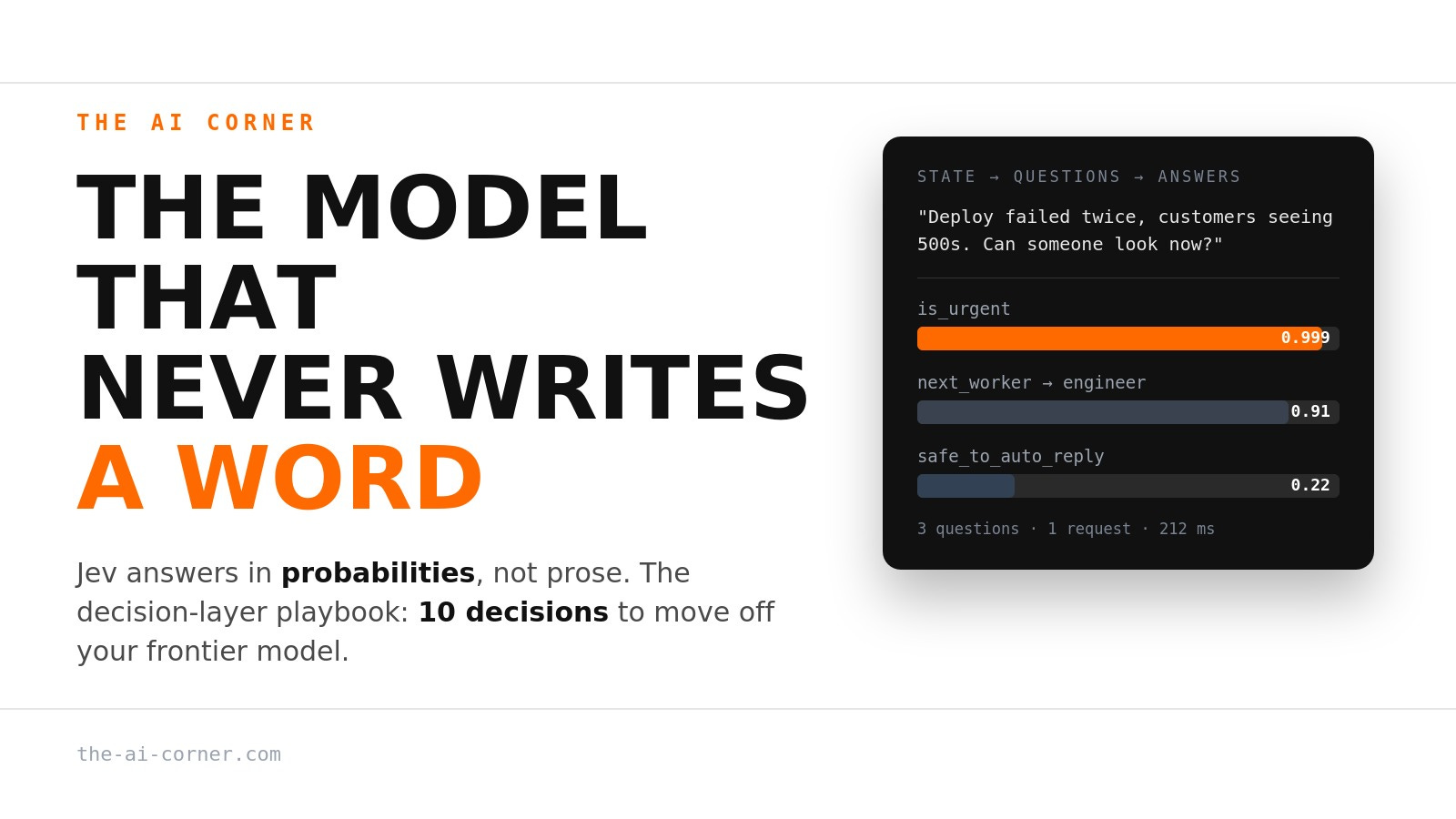
Every agent you run makes two kinds of model calls, and you’re paying frontier prices for both.
One kind creates: research, code, prose, plans. The other just decides. Which worker goes next. Is this urgent. Is this done. Is this tool call safe. Open your traces and count them. In every stack I’ve looked at since launch week, the deciding calls outnumber the creating calls, and each one is a full LLM round trip that exists to produce a single word.
Jev is a bet that the second kind never needed a language model. TypeSafe AI’s founder Diogo Almeida, who says he spent two years in stealth after co-inventing ChatGPT, trained it for one job: read a state, answer typed questions about it, attach a calibrated probability to each answer.
Three question types cover the territory:
Choice picks from your options.
Score rates against your scale.
Noul says yes or no, as a probability.
Ask ten questions about one state and they evaluate in parallel, so the tenth costs almost nothing.
What 72 hours of builders did with it
The launch claims are the vendor’s: up to 200x faster, up to 400x cheaper than comparable LLMs on classification. Fine, every launch says something like that. What made this one different is what independent builders shipped within three days:
▫️ Browser Use put Jev inside a browser agent that found flights in 7 seconds for $0.0039, picking the next action from a menu rebuilt after every click.
▫️ Tamara Tran’s compaction demo did 3.6M views: score every tool call in a Claude session, drop the irrelevant ones. Alex Volkov ran it as a plugin and watched his session fall from nearly 1M tokens to 86K in about a second.
▫️ Hassan classified 1,018 research papers into 24 topics. Total cost: eight cents.
▫️ LangChain shipped official middleware the same week, including the safety-classifier pattern that coding harnesses have kept in their closed-source layers until now.
Where it bites
I’ll be straight about the other side, because I read the docs and not just the quote tweets.
Jev explains nothing, so a wrong route hands you a probability and no reasoning to debug. TypeSafe’s own guidance says confidence and accuracy are different numbers, which means a 0.98 on a badly written question is a confidently wrong answer at record speed. And the demo economics hide a trap: a $0.00004 decision that sends your agent down the wrong branch costs you the entire branch.
The builders winning this week aren’t the ones who installed Jev fastest. They’re the ones who knew which decisions to hand it.
Setup takes twenty minutes and there are three free threads on X that cover it. The judgment layer is the part nobody’s written down.
Inside the playbook
That’s what the rest of this article is. Five tools, built from the docs, the launch-week demos, and the failure modes already showing up:
The decision audit. Four passes over your last 50 agent traces, one hour, and you have your list of delegation candidates. In the stacks I’ve audited, 60 to 80% of model calls turn out to be decisions in disguise, which is the share of your bill this touches.
The ten-decision map. Every common agent decision, from worker routing to compaction to safety checks, with the question type, an example spec, and the confidence threshold for each. The table you’ll keep open while you build.
Six question-writing rules. The difference between answers you can act on and answers that just look confident. Rule one alone explains most of the silent failures people are posting about this week.
The guardrail set. What has to be in place before any Jev decision runs unsupervised overnight: thresholds, the calibration method using 30 labeled examples, and completion checks that verify artifacts instead of believing answers.
The receipts table. Every independently reported number from launch week in one image, with the three caveats that keep you from quoting the misleading versions.
Here’s the honest pitch for the paywall: everyone reading this will bolt Jev onto something this month, because the demos are irresistible. Most will delegate the wrong decisions with the wrong questions, get burned by a confident 0.98, and conclude the model is hype. The playbook below is the difference between being that person and being the one whose agents quietly got 10x cheaper.