

Boris Cherny, who created Claude Code at Anthropic, said the quiet part out loud: he does not prompt Claude anymore. Loops prompt Claude, and his job is to write the loops.
Peter Steinberger, founder of OpenClaw, put it to 8 million viewers in a day: stop prompting coding agents, start designing the loops that prompt them.
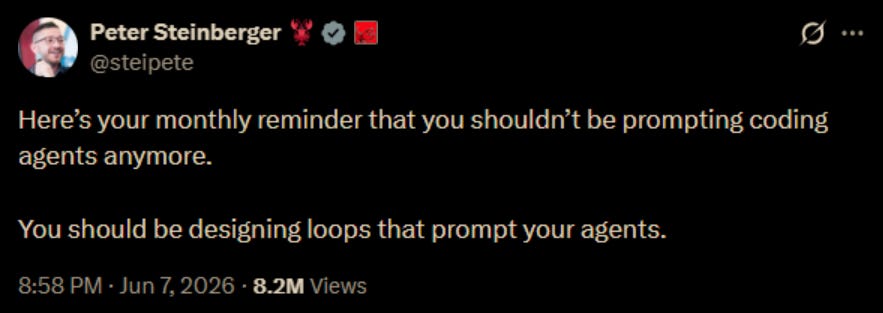
For two years the move was simple. You wrote a good prompt, fed enough context, read what came back, typed the next thing. The agent was a tool and you held it the whole time, one turn after another. That posture is ending. The new one is a small system that finds the work, hands it out, checks it, records what is done, and decides the next thing, while you watch instead of type.
Here is what changed in 2026, and why this stopped being a weekend bash-script project. The pieces ship inside the products now.
Claude Code added /goal in v2.1.139 on May 11, 2026, a native loop that runs across turns until a condition you wrote is true, with a separate fast model grading the work after every turn.
Codex shipped the same primitive in CLI 0.128.0 on April 30, plus an Automations tab and a triage inbox. Once you see that both tools expose the same five blocks, you stop arguing about which one and start designing a loop that works in either.
This is the full build:
▫️ The five building blocks of a loop mapped command-for-command across Claude Code and Codex, so your loop runs in whichever tool you are sitting in
▫️ Copy-paste /goal conditions that actually stop, plus the four constraints that silently break most of them (the evaluator reads the transcript, not your files)
▫️ A working SKILL.md skeleton and a sub-agent config for the maker-checker split that lets you trust a loop running unattended
▫️ The full reference loop, the morning-triage-to-merged-PR blueprint you design once and never prompt again
▫️ The token economics, where a loop burns money, and how to cap spend whether you are token rich or token poor
▫️ The 8 failure modes that turn an unattended loop into unattended mistakes, each with the fix
▫️ The memory spine, the on-disk state file that survives between runs because the model forgets and the repo does not
▫️ The 30-day rollout from your first /goal to a self-feeding loop with a verifier you trust
Pair it with the deeper AI Corner library:
▫️ The AI Agents library for orchestration and reliability
▫️ The Prompting and Context Engineering library for skills and intent
▫️ The Claude and Anthropic library for Claude Code and Codex internals
▫️ The AI Tools and Models library for the build stack
▫️ The Business and Investing library for where this leverage compounds
Related builds worth reading next: the Claude Code system that replaces your dev loop, the AI agent reliability playbook, the multi-agent code review build, the Claude Skills complete guide, and the context engineering guide.
🔁 The Loop Engineering Build Kit

The full system in one place: the five blocks mapped across both tools, copy-paste /goal conditions, SKILL.md and sub-agent configs, the reference loop, the token math, the 8 failure-mode fixes, and the 30-day rollout.