

Jensen Huang spent 33 years building the company the entire AI industry runs on. On November 8, Nvidia's board opened an investigation into him, and by November 12 he had resigned as CEO and given up his board seat, effective immediately.
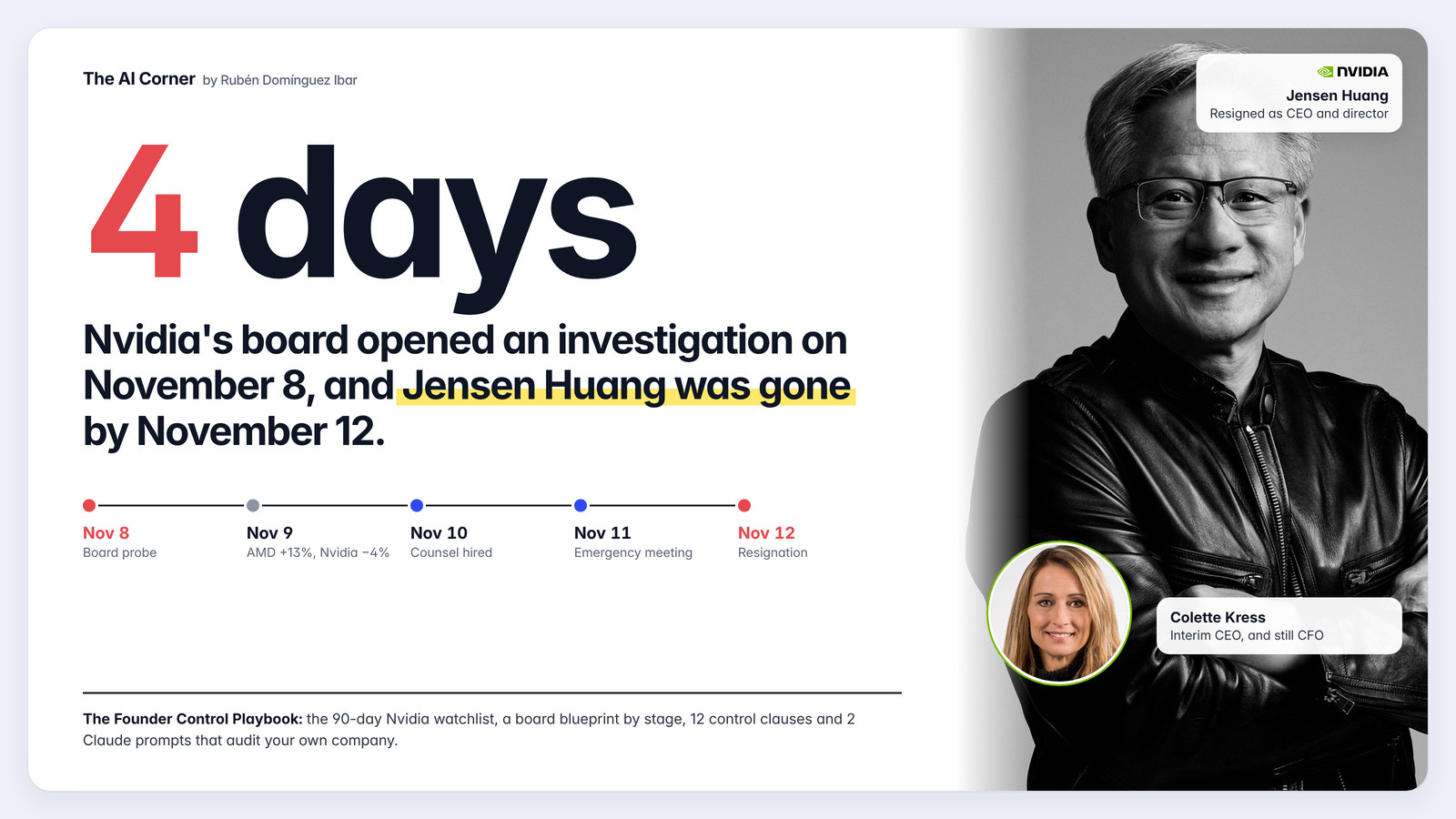
The number that stopped me was 3.6%. That's how much of Nvidia Jensen owned according to LSEG data, with one vote per share, the same as every index fund on the cap table. The most important founder in AI ran a company whose board could replace him whenever it decided to, and once it decided, the whole thing took 4 days.
Wachtell Lipton is running the investigation, so I'll leave the conduct question to the lawyers. This piece covers the 2 things you can act on this week: what Nvidia without Jensen means for everyone who buys GPUs, builds on CUDA or owns the AI trade, and the question almost every AI founder answers too late, which is who can fire you.
Inside this playbook:
The 90-day Nvidia watchlist, 8 dated events and signals that will show what the company looks like without its founder, and who each one moves
The compute buyer's playbook, 4 moves for AI startups that rent or buy GPUs while Nvidia changes hands
The control map, the 4 places power sits in a venture-backed company, plus the CEO-seat clause that flips your board the day you're replaced
A board blueprint for every round, seat-by-seat targets from seed to pre-IPO, and who should pick the swing vote
12 term-sheet clauses, with the founder ask, the usual investor push and the red flag for each, plus copy-paste language for the 4 that decide the most
2 Claude prompts, one that audits your voting agreement clause by clause and one that runs a key-person review of your company
The Jensen Test, a 10-question, 20-point score for whether your company survives 90 days without you
A one-page emergency succession plan, 12 investor diligence questions and 3 scripts for your next board negotiation
One subscription unlocks every system
Your subscription opens the full AI Corner archive:
The AI Tools and Models library, every model, tool and setup guide
The AI Agents library, the full agent-building stack, start to finish
The Prompting and Context Engineering library, the prompts and context systems that ship
The Claude and Anthropic library, every Claude playbook in one place
The Business and Investing library, turning AI leverage into revenue
Plus 3 fresh systems every week.
Four days in November
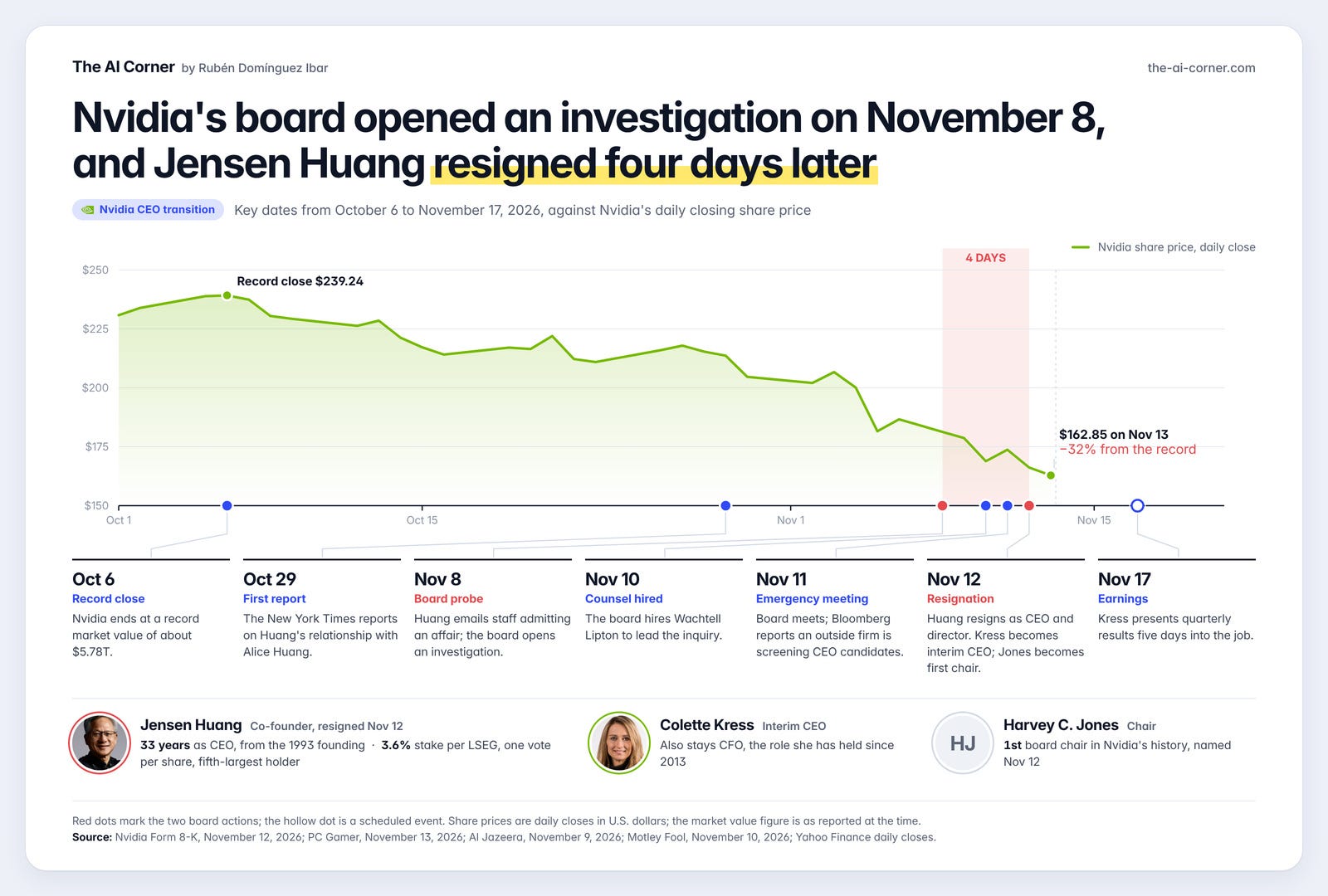
The story started on October 29, when The New York Times reported on Jensen's relationship with Alice Huang, a former Megaspeed executive whom U.S. authorities had concluded was a Chinese intelligence asset. China calls that claim baseless. Nvidia's shares fell about 21% between October 28 and November 8, and on November 8 Jensen emailed every employee to admit an affair and apologize, the same day the board announced its own investigation.
Then the board moved fast, according to the live timeline PC Gamer kept all week:
November 10: it hired Wachtell Lipton to lead the inquiry.
November 11: reports surfaced of a second relationship, this time with an employee. The board met in an emergency session, and Bloomberg reported that Nvidia was already working with an outside firm to find CEO candidates.
November 12: Jensen resigned as president, CEO and director. CFO Colette Kress became interim CEO while keeping the finance job, and Harvey C. Jones, the former Synopsys CEO, became the first chair of the board in Nvidia's history.
Between its October 6 record of about $5.78 trillion and midday on November 10, Nvidia's market value fell by roughly $1.7 trillion, a slide that started before the scandal and steepened with it. Gene Munster estimated the stock was pricing about a 25% chance that Jensen would leave, and within days he was gone.
What Nvidia without Jensen means for AI
The business Kress inherits is enormous. Nvidia's last reported quarter brought in $96.2 billion of revenue, up 106%, with $89 billion from the data center, and the company guided to about $108 billion for the quarter it reports on November 17. That call will be Kress's first as interim CEO, 5 days into the job.
What leaves with Jensen is harder to put in a filing. He ran Nvidia with roughly 60 direct reports, he personally sat across the table from the CEOs of its biggest customers and suppliers, and for 2 years the scarcest thing in AI was a GPU allocation that ran through his company's top floor. Nvidia's own annual report says it is "highly dependent on the services of our long-standing executive team." Russell Pillemer of Pengana Capital put it more bluntly: there is "nobody who is an obvious successor."
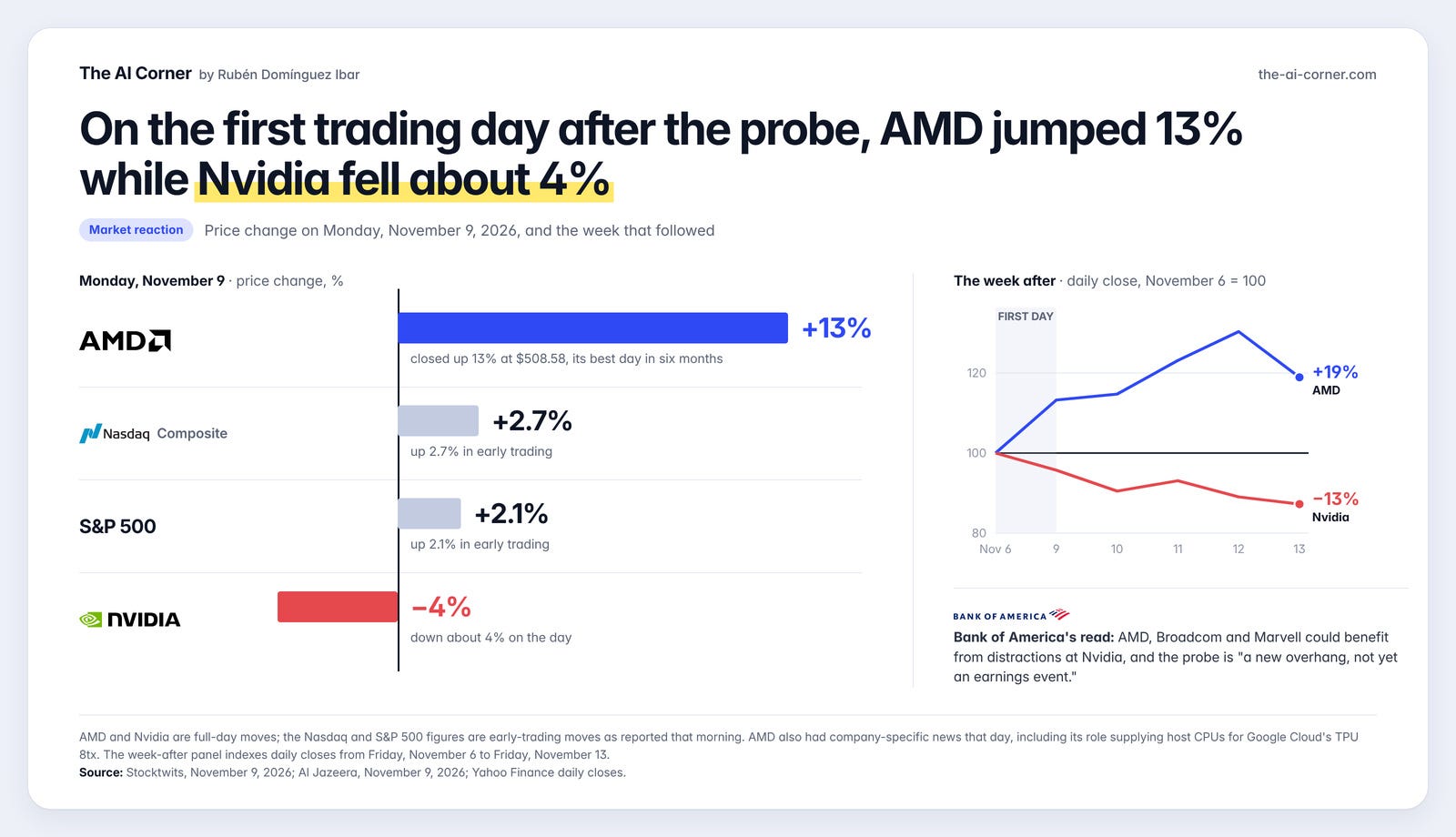
Rivals noticed first. On Monday, November 9, the first trading day after the probe went public, AMD closed up **13%** at $508.58, its best day in 6 months, while Nvidia fell about 4%. AMD had its own good news that day, including its role supplying host CPUs for Google Cloud's TPU 8tx, so part of that move belongs to AMD. Bank of America named AMD, Broadcom and Marvell as possible winners from the distraction at Nvidia and called the probe "a new overhang, not yet an earnings event."
Washington noticed too. Jensen was the industry's loudest voice for selling American chips into China, and the House passed the **Remote Access Security Act** 369-22 on January 12, a bill that would stop Chinese companies from renting restricted GPUs through overseas clouds. It still needs a Senate vote. The House Foreign Affairs Committee has moved its briefing with Jensen to December 1 and warned a subpoena could follow, while Select Committee chairman John Moolenaar said Nvidia should appoint leadership that makes "national security its top priority."
My read
The "Nvidia collapses without Jensen" takes are wrong on timing. CUDA, the Blackwell and Rubin roadmap and the supply contracts all stay with the company, which is why this quarter's numbers will probably look fine. What changes is bargaining power over the next 12 to 24 months: who decides allocation when supply loosens, who closes the next memory deal CEO to CEO, and who argues Nvidia's side in Washington. That's where AMD, Broadcom and the hyperscalers' own chips get their opening, and the premium watchlist below tracks exactly those signals.
3.6% of the vote
Jensen's position looks strange next to the founders he usually gets compared with. Mark Zuckerberg owns about 14% of Meta's economics and controls about 61% of its votes through Class B shares that carry 10 votes each, so a board has no practical way to remove him.
Matt Mullenweg showed how that plays out 2 months ago. On September 9, a special committee of Automattic's board put him on paid leave and named the CFO interim CEO. Mullenweg says he holds about 84% of Automattic's voting power, according to Fortune, and within roughly 33 hours he was back in charge. Afterwards, 2 directors resigned, a third was removed, the interim CEO and the chief legal officer were fired, and 2 weeks later Mullenweg named 4 new directors.
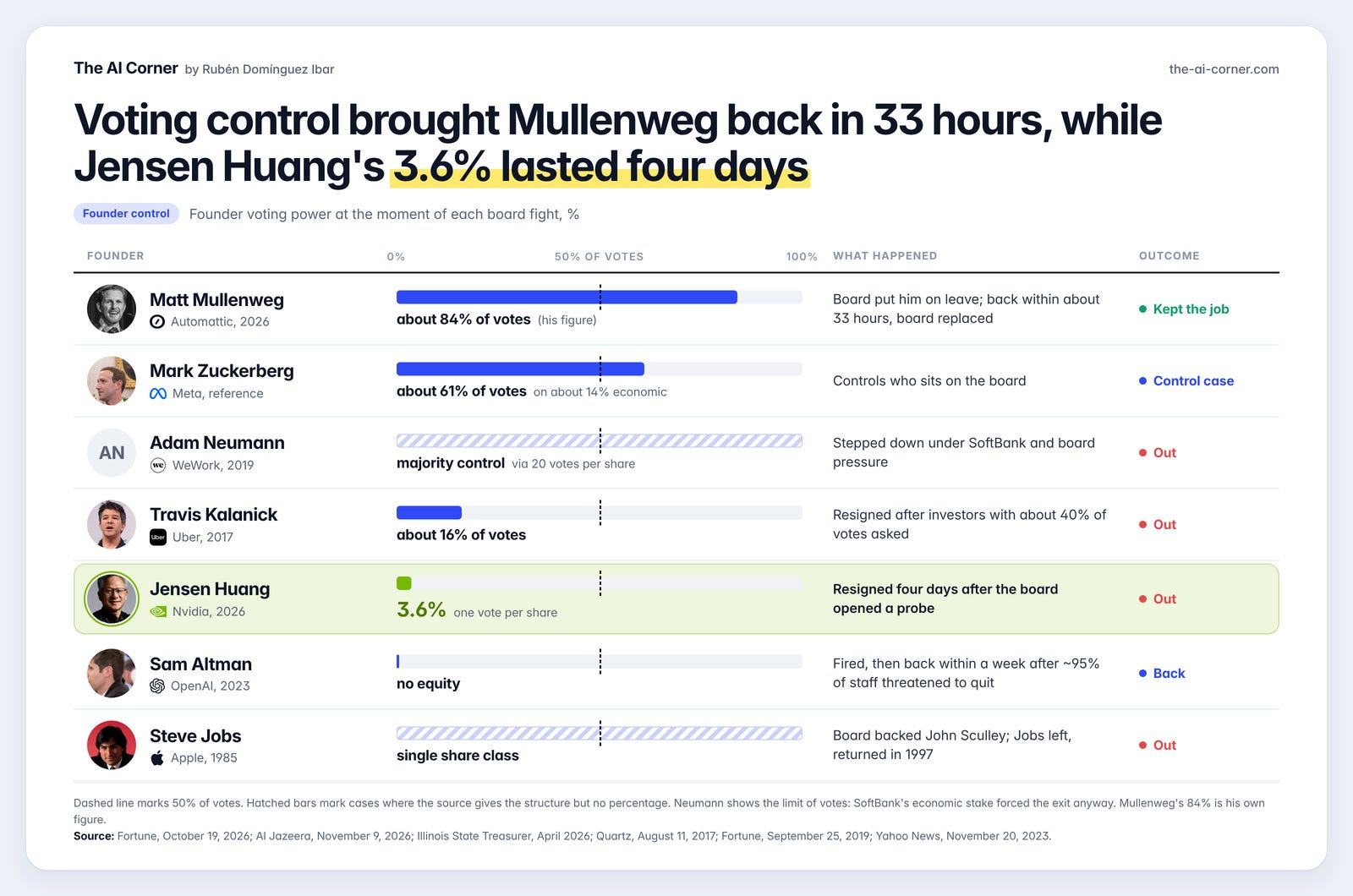
AI has already run this experiment once. Sam Altman owned zero equity in OpenAI when its nonprofit board fired him on November 17, 2023. About 95% of the staff threatened to quit, most of them by following him to Microsoft, and he was back within a week. Votes count, and so does a credible threat that the company walks out the door with its founder. At Nvidia, an internal petition asking the board to bring Jensen back collected more than 1,600 comments, according to Wired, and the board has held its position.
The older cases rhyme. Travis Kalanick held about 16% of Uber's voting power when investors with about 40% asked him to resign in June 2017, and he was out within days. Adam Neumann had 20 votes per share at WeWork and still stepped down in September 2019, because SoftBank held the largest economic stake and the IPO had stalled. Steve Jobs lost a board fight to John Sculley in 1985 and came back 12 years later. Epic Games CEO Tim Sweeney reached for exactly that comparison this week, calling Nvidia's decision "Apple firing Steve Jobs level of idiocy."
The pattern fits in one line: votes protect a founder from the board, and money protects the board from the founder.
AI founders give control away one round at a time
Noam Wasserman tracked 212 American startups for his *Founder's Dilemma* research. By year 3, 50% of the founders were no longer CEO, and fewer than 25% led their company's IPO.
Carta's 2026 Founder Ownership Report shows why board seats, rather than shares, decide who stays. The median founding team owns about 56% after seed, 36% after the Series A and 16.1% after the Series C. AI companies hold on a little longer: their founders own a median 27.3% after the Series B, against 21.8% for everyone else.
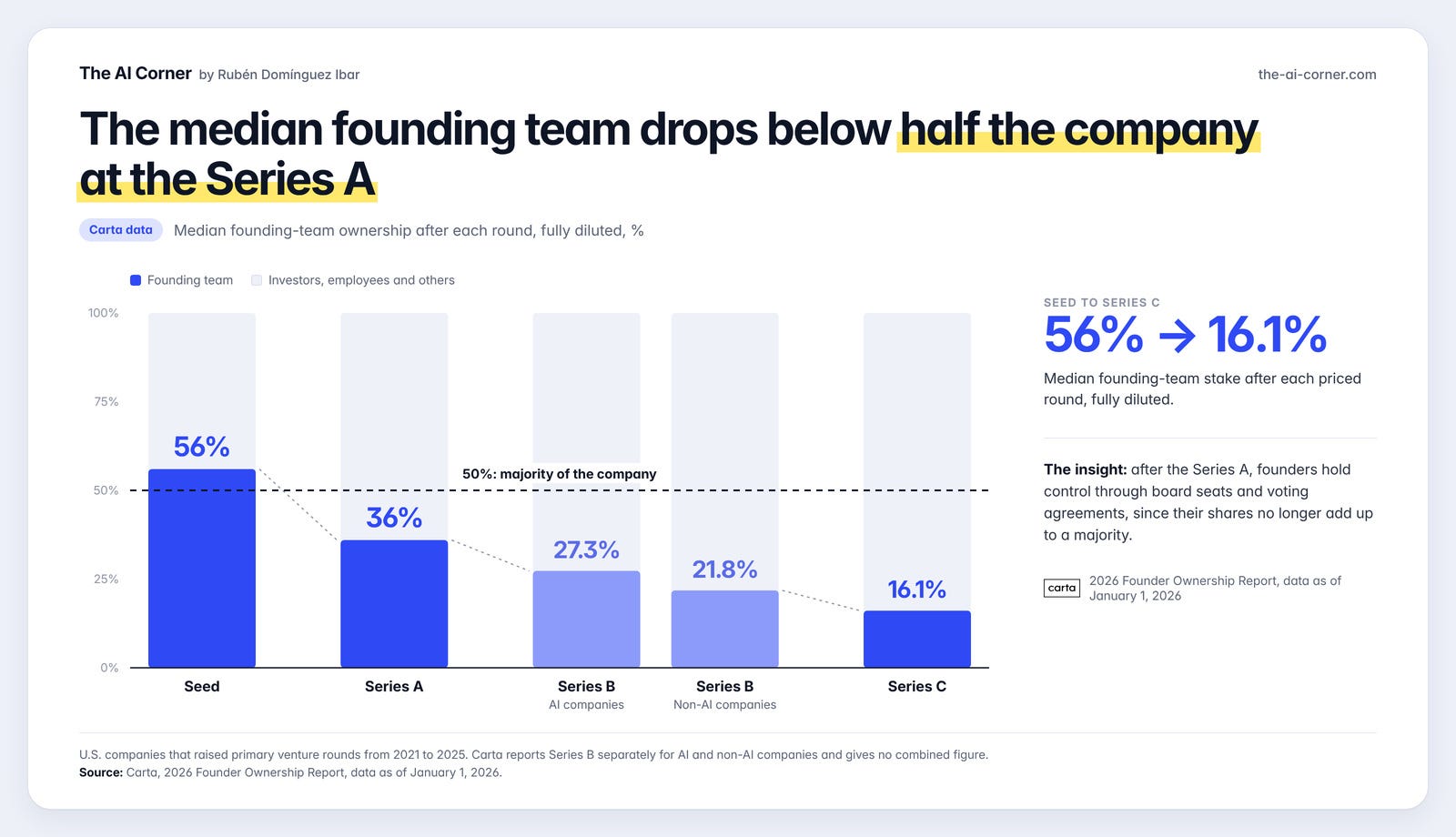
After the Series A, your shares stop deciding the outcome. What decides it is the voting agreement you signed in that round: the seats it gave away and the exact words it used to describe them. Control gets decided at the Series A, years before anyone needs it.
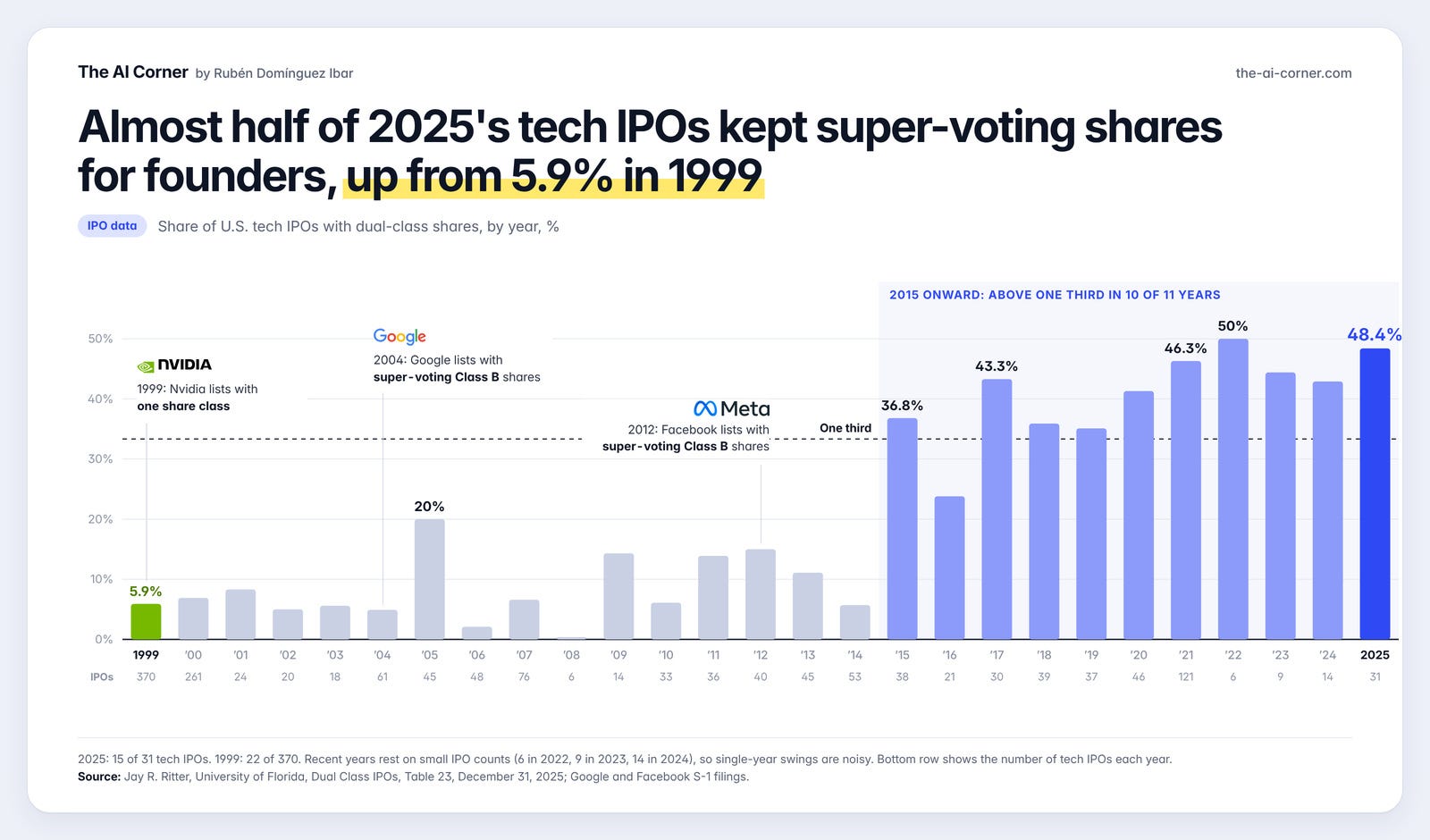
Founders going public have figured this out. In 1999, the year Nvidia listed, 5.9% of U.S. tech IPOs used dual-class shares. In 2025, 48.4% did, 15 of 31, according to Jay Ritter's IPO data at the University of Florida.
Where I part ways with the super-voting crowd
I doubt super-voting stock would have saved Jensen in a conduct and national security case, and I'm skeptical it should have. Mullenweg's 84% kept his job and cost Automattic half its board and 2 senior executives in 2 weeks. When the CEO controls the vote, the board stops working as a check, and every other shareholder carries that risk.
The structure I'd want, as a founder and as an angel investor, is narrower: enough control to protect the long bets, a board that can still act on conduct, and a company that can run for 90 days without its founder. The playbook below builds exactly that, starting with what to watch at Nvidia.
Get the full playbook below 👇
Get the full playbook with The AI Corner Premium
Below the line: the 90-day Nvidia watchlist, the compute buyer's playbook, the control map, a board blueprint for every round, 12 clauses with copy-paste language, 2 Claude audit prompts, the Jensen Test, a one-page succession plan, 12 investor questions and 3 negotiation scripts.