

Matt Palmer, Lauren Tan, and Roshan Sadanani sat down in a San Francisco studio with a camera, Grok Bot, and no plan they were willing to fake:
“We actually don’t even know what idea we’re going to build”

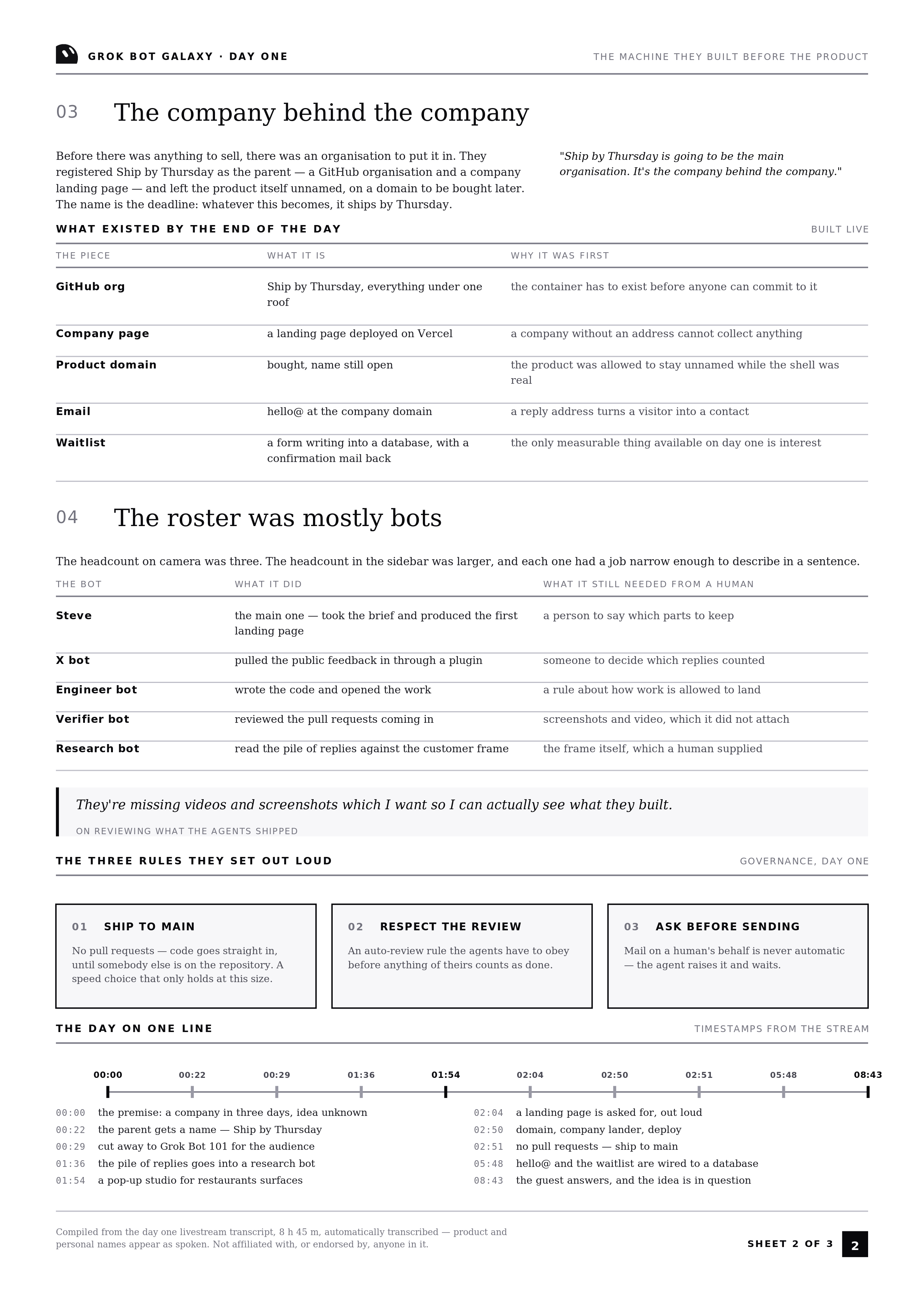
Nine hours later, on air, a company existed. GitHub org, deployed landing page, working hello@ inbox, a waitlist writing into a database with a confirmation email back. The parent entity is called Ship by Thursday because the deadline is literally Thursday.
I know, a competent human ships a waitlist page in an afternoon. If that were the whole story I’d have skipped it. What kept me watching is that the stream shows, in public, how an agent-heavy team actually splits the work, and the sheets they published are more honest than the marketing around them.
Three people on camera, five bots on payroll
The sidebar roster was longer than the studio. One bot took the brief and produced the landing page. One pulled thousands of public replies in through a plugin. One wrote the code. One reviewed the pull requests. One read the reply pile. For nine hours, the humans mostly directed.
The idea selection worked the same way. They asked publicly what to build, thousands of replies came back, and a bot read the pile so nobody had to scroll it. The humans kept one question and asked it of every surviving idea: who is the customer, what is their pain, what is it worth to them.
And the build order was backwards, at least by human standards. Org, page, domain, email, waitlist, all before knowing the product. Every accelerator tells you the opposite. For an agent team it’s right, because bots need somewhere to commit from minute one, and none of that infrastructure cares what the product turns out to be.
Governance for the whole day was three rules. Ship straight to main. Respect the auto-review. Ask before sending mail.
Someone else already built this, alone
Sabrina Ramonov runs her short-form content solo, 41 million views in 30 days, and she rebuilt her whole workflow as a four-bot department inside Grok Bot, then published what broke.

She landed on the same shape as the SpaceXAI team without talking to them: specialist bots with one job each, a shared channel, approval gates on anything external. Two teams arriving at the same architecture from different directions is a much better signal than either one alone.
The goal was never to remove yourself from your company. Your taste and your decisions ARE the company. The goal is to stop being the bottleneck.
The column nobody publishes
Now the warning, because you pay me to be straight: this stream is vendor marketing. SpaceXAI people on SpaceXAI’s product will show you the best case. The floor is in their own sheets, in a column listing what each bot still needed a human for, and it’s long. The engineer bot needed a rule for when code could land. The verifier attached zero screenshots or video. The reply-counter needed a human to decide which replies counted.
Every line in that column is a job you inherit the day you copy this setup. Most people find their gaps in production, one angry customer at a time. An hour with the system below finds them on paper instead.
Inside the operating manual
I merged the stream and Ramonov’s writeup into one system: the 7-step day-one build order in the sequence that works for agents, the five-filter test for the first job you delegate, the bot job-description template you’ll reuse for every hire, the four-bot marketing department with its skill-to-role split, the six actions that always wait for your approval, and the human-column audit that shows what you’re inheriting before it costs you.
Get the operating manual 👇