

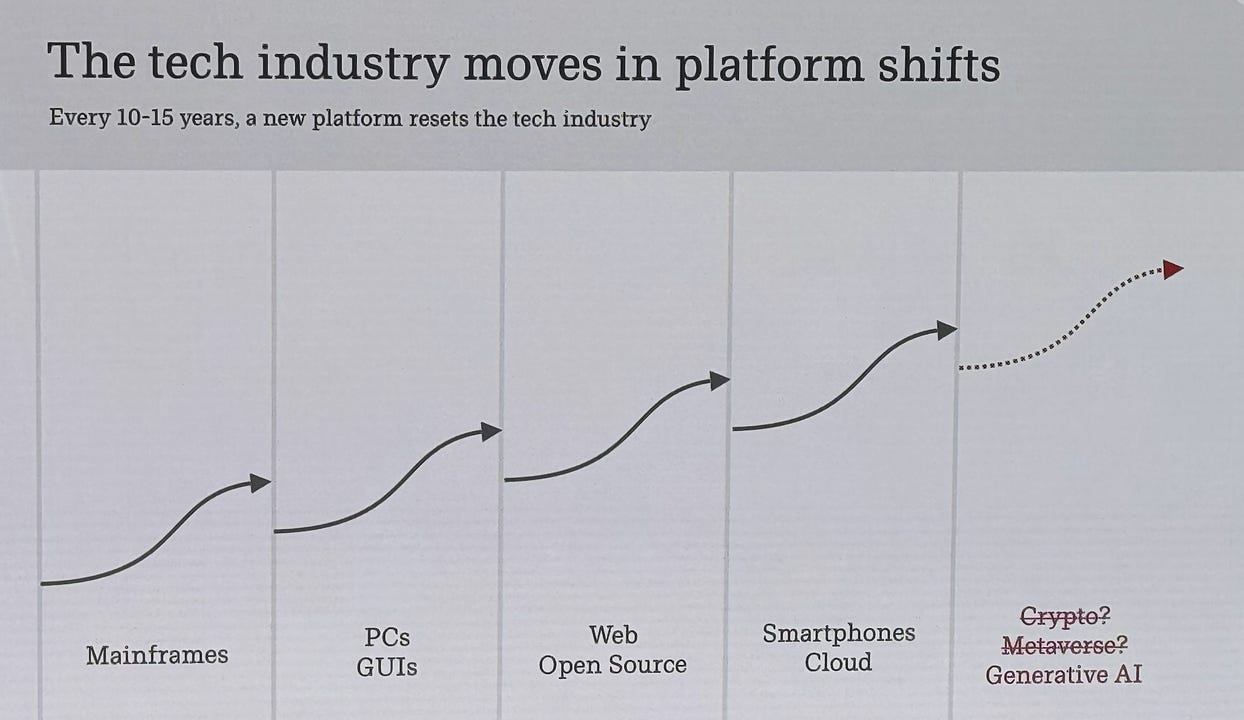
One of the most powerful companies in history almost slept through the biggest platform shift in a decade.
Google held every ingredient: the talent, the data, the compute, and a decade of AI research sitting in the building. Then ChatGPT shipped, and for a few months the giant looked flat-footed while a startup set the pace.
What Sundar Pichai did next is the part worth studying. He rebuilt the entire company in 18 months, in a deliberate order most analysts read right past.
He walked through it with Nilay Patel on Decoder after Google I/O 2025. I went through the full 45 minutes so you can keep yours.
Here are the 10 moves that matter, and the thread running through every one:
Raw capability counts for little until you organize to act on it.
Founders feel that sharpest at go-to-market, where a beautiful plan and an empty pipeline weigh exactly the same.
together with HubSpot for Startups:
Pichai’s lesson is execution over planning. Here is the go-to-market version of it.
On June 18, HubSpot for Startups and Clay run a live build-along for seed and pre-seed founders. You build it in the room with them:
▫️ Define your ICP from genuine buying signals
▫️ Build and enrich a prospect list in Clay
▫️ Launch AI-personalized outbound in HubSpot

You leave with pipeline, rather than a plan.
Apply to HubSpot for Startups and you become eligible for up to 90% off HubSpot, plus a shot at $1,000 in Clay credits.
📅 June 18, 11 AM ET (4 PM CET). 45 to 60 minutes, live:
With that on your calendar, back to Pichai, starting with the diagnosis almost everyone missed:
1. Pichai read the ChatGPT shock as permission
“I always internalized that moment. It was tough to convey it outside. But I felt like the Overton window had changed. People were adopting these technologies faster than we had expected. And so to me, it was a way to go and actually express ourselves through our products.”
Most teams read a rival’s breakthrough as a gap to close. Pichai read it as clearance to move.
Google held the ingredients. What it missed was the organizational readiness to deploy them, so the ChatGPT launch exposed a structural deficit rather than a capability one. He diagnosed that first, and the order is the whole difference between a strategic response and a reactive one.
The useful question after a competitor’s big launch skips past “are we behind.” It is “do we hold what we need to move, and are we organized to use it.”
Why it matters: a shock stays existential only while you lack the assets to answer it. Hold them, and the shock becomes permission. The teams still standing after the wave diagnosed the bottleneck before touching the org chart.
2. Merging Brain and DeepMind: the 5-step sequence that followed
“One AI team, we had world-class research teams in Brain and DeepMind. Bringing that together as Google DeepMind was harder than it sounds because it’s like saying, go put Stanford and MIT together and create a department out of it.”
From outside, Google DeepMind looked like a branding call. Pichai calls it the hardest part of the entire restructuring: two elite, proud, culturally distinct research houses fused into one model capability.
Merging two functions that both succeed and both believe they are right is harder than shutting one down, and most companies stop short of the will to do it. The moves that followed were sequenced on purpose:
▫️ Unified AI research under Google DeepMind
▫️ Centralized infrastructure under Amin Vahdat
▫️ Created a Chief AI Architect role, filled by Koray
▫️ Consolidated Search under single leadership
▫️ Weekly AI product reviews run by Pichai himself
Why it matters: each move set up the next. Research, then infrastructure, then accountability, then decision speed. Founders restructuring under pressure should map dependencies the same way, since sequence decides whether a restructuring compounds or collapses.
3. The 90-day filter that sets your decision speed
“A big part of my framework is over time understanding that there are very, very few decisions which are really consequential, and most decisions aren’t. So what matters much more is that you make the decision, because that’s what determines the velocity of an organization.”
This line runs counter to how most founders were trained. Treating every decision as heavy creates the same jam as treating every decision as light.
The distinction Pichai draws is simple: some choices look big yet reverse inside 90 days, and others lock in. Combining Brain and DeepMind was the second kind. Most product launches are the first, and experience is what lets you sort them fast.
Why it matters: organizational velocity comes from decision throughput on the reversible calls. Before your next decision stalls, ask one thing: can we fix this in 90 days if we are wrong? A yes means make the call and move. That single filter buys more speed than any process overhaul.
4. 13 products, one infrastructure layer, a moat that compounds
“For the first time, we have such a common infrastructure powering all of them with our Gemini models and the underlying AI infrastructure. So we are more able to, with intent, do things which cut across things.”
The fragmentation critique of Google is as old as the company, and the 2025 answer is structurally new. Thirteen products, each with a billion users, shared distribution for most of Google’s history yet ran on separate technology.
Gemini changes that. One model and one intelligence layer now power Search, Maps, Gmail, and Docs from a single base. Personal Intelligence is the proof: one infrastructure build, one user toggle, every product upgrades at once.
Why it matters: platforms with common infrastructure compound, because each improvement reaches every surface at once. Google’s moat here is architectural depth multiplied by distribution scale, and matching one side leaves the other gap wide open. Few rivals close both inside 36 months.
5. Agents finally deliver Google's 10-year assistant dream
“This long-running vision of Assistant we’ve all had and worked through myriad forms of it, and failing to fully do it well. I think we are closer than ever before to deliver on that promise. We haven’t delivered it yet.”
That admission is worth isolating. Google Assistant, Duplex, a decade of attempts, all fell short. Agents are the first technology able to execute the original vision, on four building blocks Pichai sees finally in place:
▫️ Reasoning across a problem
▫️ Tool use and code execution
▫️ Planning over multiple steps
▫️ Long-running task management
The same stack underpins what teams now ship with Claude Code and agent loops.
Why it matters: the agent paradigm is durable because it pays off a user expectation that already existed for a decade. Products that deliver an old promise grow faster than products that ask users to believe in a new one, so the adoption curve is shorter than it looks.
6. Pichai called a live Search result wrong on camera
“I think it’s probably more opinionated than it should be for the particular query you showed me. That’s my reaction as a user. I think that’s the scope for improvement.”
The most candid exchange in the interview. Patel ran a live search for “best Chromebook,” the AI overview gave one answer, Reddit gave another, the Times gave a third, and Pichai owned the problem on the spot.
The tension underneath is structural. The more AI overviews answer directly, the more useful Search feels, and the less it surfaces the organic content underneath. Google’s stated check is measurement: 25 years of satisfaction data, bounce rates, session length, return visits.
Why it matters: watch AI overview accuracy against click-through to organic results over the next 18 months. That gap is the cleanest signal of whether Search strengthens or erodes, and it shapes how you should rank when AI answers the query.
7. Conde Nast told its teams to plan for zero search traffic
Conde Nast CEO Roger Lynch: “Every year our search traffic was down more than we had forecast. So last year I told our teams, assume there is no search. You have to have your businesses planned as if search is zero.”
Google Zero moved from a publishing meme to a formal planning assumption at one of the largest media companies on earth. Pichai’s reply pointed to surfacing quality content, filtering low-quality clicks, and growing information overall. Each holds up, and each sidesteps the core worry.
The worry: AI overviews answer the question so well that the click vanishes. A great answer can produce zero traffic, because intent and outcome are separate things.
Why it matters: every business living on search referral should already hold its own version of the Conde Nast plan. Planning around the loss of a channel you fail to control is the rational baseline, so build the GEO playbook and your AEO backlink sources now, ahead of the curve forcing it.
8. Pichai calls AI anxiety rational, and that reshapes consumer AI
“No, I don’t think so. That’s the point I’m making. I’m, in fact, arguing against it. People are standing and telling about how AI could make a lot of jobs go away. Why wouldn’t you feel a sense of anxiety about it? I think those are deeper issues which we have to tackle as a society.”
Several executives frame public distrust of AI as a messaging miss that better demos fix. Pichai rejects that outright. In his telling the anxiety is grounded: job displacement fears hold weight, and energy concerns are legitimate.
The gap between polling (young people broadly dislike AI) and usage (nearly a billion users) reflects genuine tension rather than confusion. Closing public trust means solving the underlying problems, and reframing them leaves the gap open.
Why it matters: founders building consumer AI should plan for a trust deficit that marketing fails to fix. Products showing immediate, personal value close it, while products that ask users to bank on a future benefit stall. A sitting CEO calling this societal sets the terms for the next wave.
9. "Foothills of the singularity" has a precise definition
“I think for him, the advent of AGI is what he thinks of as the singularity. There is a harder definition of AGI, which is that it has to more comprehensively do the wide range of tasks, including cognitive tasks, in a way that’s comparable. So I think we’ll, at some point, actually put it out as a company.”
Demis Hassabis closed Google I/O with one of the year’s most-quoted lines, and Pichai grounds it in a specific bar: AI performing the full range of human cognitive tasks at a comparable level. All of them, rather than some.
Current systems sit below that bar, so “foothills” does precise work: closer than consensus expects, with road left. Google plans to publish a formal company definition of AGI, and that document rewards a close read when it lands.
Why it matters: when major labs publish operational AGI definitions, those definitions become product roadmaps, and the capabilities that close the gap attract the most capital. Track the definition and you track the priorities.
10. Skip the AGI label, build for the 36-month window
“I think that timeline doesn’t matter because the rate of progress means you’re dealing with ever more intelligent systems in a profound way. Three years from now, whether you and I call it AGI or not, doesn’t matter because it’ll be very, very powerful and we have to prepare for it.”
A precise answer dressed as an evasion. Pichai treats the label as a distraction from preparation that already needs to start. Three years out, the systems become powerful enough that societal readiness outweighs the name.
Why it matters: founders building today should model roadmaps against systems much more capable in 36 months. The strategic risk is a capability jump landing ahead of any declaration. Build for the present environment, and design the architecture that survives the next one. Both belong on the roadmap now.
What this means for you
The Decoder interview reads as a strategic document rather than a product update. The company that almost missed generative AI reorganized around one thesis: unified research, common infrastructure, faster decisions, and AI converging across every product surface. The structure is in place, and the execution runs on.
For founders. Structural readiness decides whether you can answer a competitive shock, because capability that lacks organization stays latent. Pichai’s order applies at any scale: unify research, centralize infrastructure, create single accountability, consolidate decisions. Get the capability layer unified before you build product on top, the same discipline the one-person operating system runs on.
For investors. Google’s moat is the pairing of distribution and infrastructure rivals struggle to copy quickly. The threat to it is a better distribution channel rather than a better model, so watch which AI companies build consumer reach off Google surfaces. The biggest startups and the VC money flows point to where that reach is forming.
For operators. Google Zero is a planning assumption now. Quality content still gets indexed, and traffic-dependent revenue needs diversification that holds even as referral volume falls. The Conde Nast plan is the template, and the GEO and AEO playbooks give you the build.
For anyone building in AI. The agent paradigm is durable because it pays off an expectation a decade in the making. Winners deliver the promise everyone already believed, since fulfilled expectations beat novel use cases in a market where the underlying model swaps out.
The three principles to carry forward:
Structural readiness decides your response to a shock. The bottleneck is almost always structure ahead of technology.
Most decisions are reversible. Speed on the routine ones buys the room to deliberate on the few that lock in.
The AGI label is a distraction, the trajectory is the signal. Model your business against systems much more powerful in 36 months and build accordingly.
The window to prepare is shorter than the debate about the timeline suggests. The companies that treat this as a platform shift rather than a product category set the terms. The ones waiting for clarity inherit the conditions the first group creates.
If this breakdown saved you 45 minutes, share it with one founder or investor who should see it.
Keep reading
Strategy, moats, and restructuring
▫️ Business and Investing library
▫️ Founder mental models for the AI era
▫️ Marc Andreessen on the AI moat
▫️ The one-person startup operating system
▫️ What top VCs look for in 2026
Agents and the build stack
▫️ The Claude Code system that replaces your dev loop
▫️ Loop engineering for coding agents
▫️ How to build an AI agent in 2026
Search, GEO, and the traffic shift
▫️ How to rank when AI answers the query
▫️ AEO and GEO backlink sources for founders
AGI, jobs, and the market
▫️ Claude and Anthropic library
▫️ Dario Amodei on safe AI and AGI
▫️ The Anthropic AI jobs report
▫️ The biggest VC-backed startups
▫️ Where VC money is going in AI
Full podcast:
If this breakdown saved you 45 minutes, share it with one founder or investor who needs to see it. They will thank you later.