

The AI Layoff Trap
A laid-off engineer still buys groceries for about a month. Then the savings thin out, the subscriptions get cancelled, the holiday gets postponed, and the new laptop waits another year.
Multiply that by a hundred thousand people and you get the quiet story underneath this year’s layoff headlines.

Every company cutting staff to fund its AI push is also, in a small way, cutting the income that buys its product. Most boardrooms treat that as someone else’s problem.
A sharp new paper argues it is everyone’s problem, and that the smartest firms in the world are walking into it with their eyes open. If it is right, this is the thing nobody in tech is pricing in.
The whole bet rests on one assumption: that AI agents can run the work better than the people being let go. Before we get to why the trap is so hard to escape, it is worth seeing that bet up close, from the people actually building the agents.
Together with Hard Skill Exchange:
The layoff bet assumes agents can run revenue better than the teams being cut. On July 30, ten executives show what that actually looks like in production, and where it breaks.
It is completely free to attend:

▫️ Live sessions from the leaders at Gainsight, 1mind, Dialpad, RevSure, and Vivun
▫️ The governance layer behind autonomous revenue: guardrails, context engineering, and decision traceability
▫️ When an agent should act, and when it should escalate to a human
Free and virtual, 9 AM PT.
Now, the paper itself. Here is why the trap closes even when everyone can see it.
Table of Contents
The Numbers Nobody Wants on the Slide
The Trap, Explained Without a Single Equation
The Finding That Should End the Workers-Versus-Bosses Fight
More Competition and Better AI Both Make It Worse
Why the Comfortable Solutions Do Not Work
The Catch That Keeps the Argument Honest
1. The Numbers Nobody Wants on the Slide
This year has a number attached to it, and the number keeps climbing. The layoffs are not a blip or a seasonal trim. They look real and rational, and the people running these companies are saying so on the record.
A record that arrived faster than anyone expected
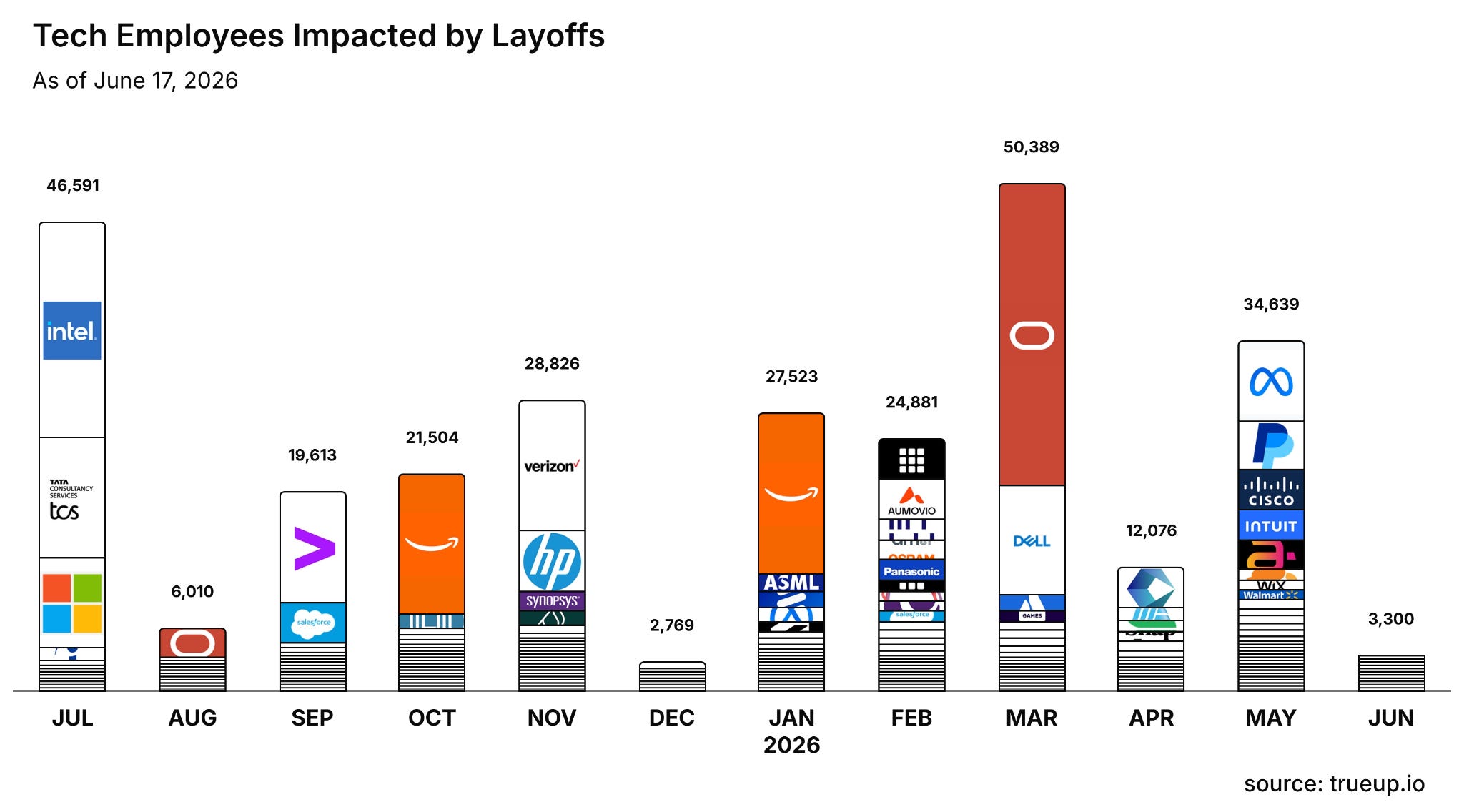
By the middle of June, the trackers had logged between 150,000 and 184,000 tech jobs cut in 2026, depending on whose methodology you trust.
The pace is the part that should bother you. Last year, a brutal year by any measure, the industry shed around 245,000 jobs across all twelve months.
This year is running closer to a thousand cuts every working day, and the first quarter alone was the worst since early 2023.
The individual events read like a who’s who. Oracle eliminated an estimated 30,000 roles, which make up around a fifth of its global workforce, in a single early-morning email.
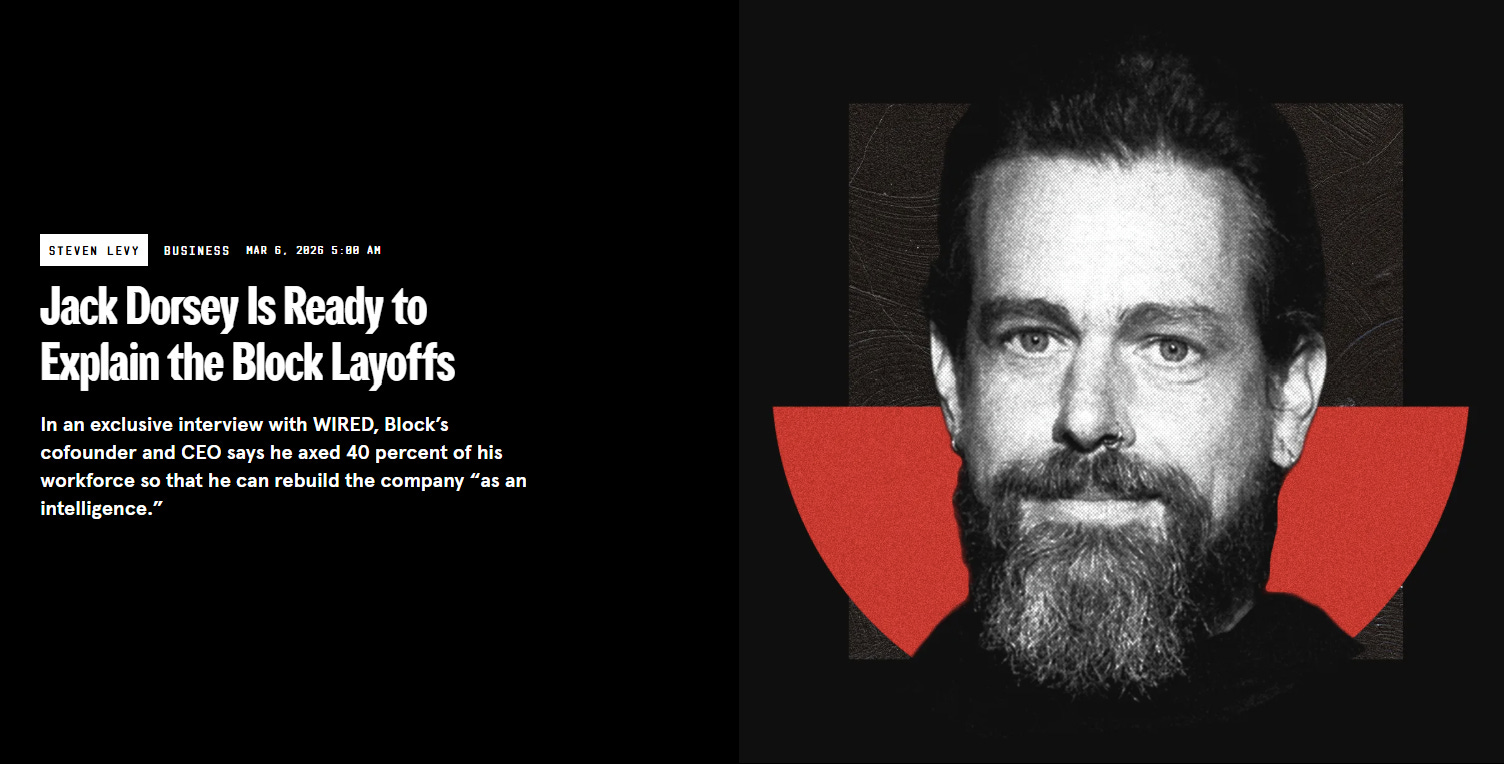
Amazon worked through roughly 30,000 corporate cuts in rolling rounds. Block let go of about 4,000 people, close to 40% of the company, with Jack Dorsey pointing directly at the growing capability of AI tools.
The reason given, again and again, is artificial intelligence. Not the economy. Not overhiring. The machines.
The line the press releases leave out
Here is the detail that should make you sit up. Amazon ran its cuts while AWS posted its fastest growth in thirteen quarters.
The cost line went down and a fast-growing business kept growing. On a spreadsheet that looks like genius.
The blunt version going around this year is that companies are firing people and buying GPUs with the savings. The savings look enormous when you only count your own ledger.
But the workers walking out of those buildings were also buyers. They bought software, subscriptions, flights, dinners, and the thousand small things that make up consumer demand.
When a firm removes a salary, it removes a sliver of the spending that every firm in the economy fishes from. The company that did the firing barely feels the loss to its own revenue.
That gap, between the saving you keep and the damage you cause, is the whole story. And a new paper has turned it into something close to a theorem.
2. The Trap, Explained Without a Single Equation
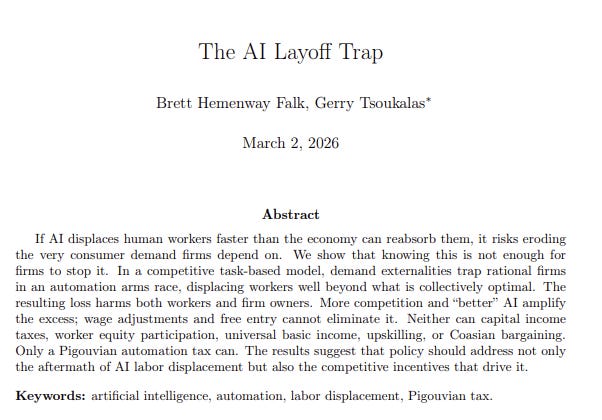
The paper is called The AI Layoff Trap, by Brett Hemenway Falk and Gerry Tsoukalas. Its power is that it needs no villains.
It does not assume executives are reckless or greedy or high on their own forecasts. It assumes they are rational, clear-eyed, and able to see exactly what is coming.
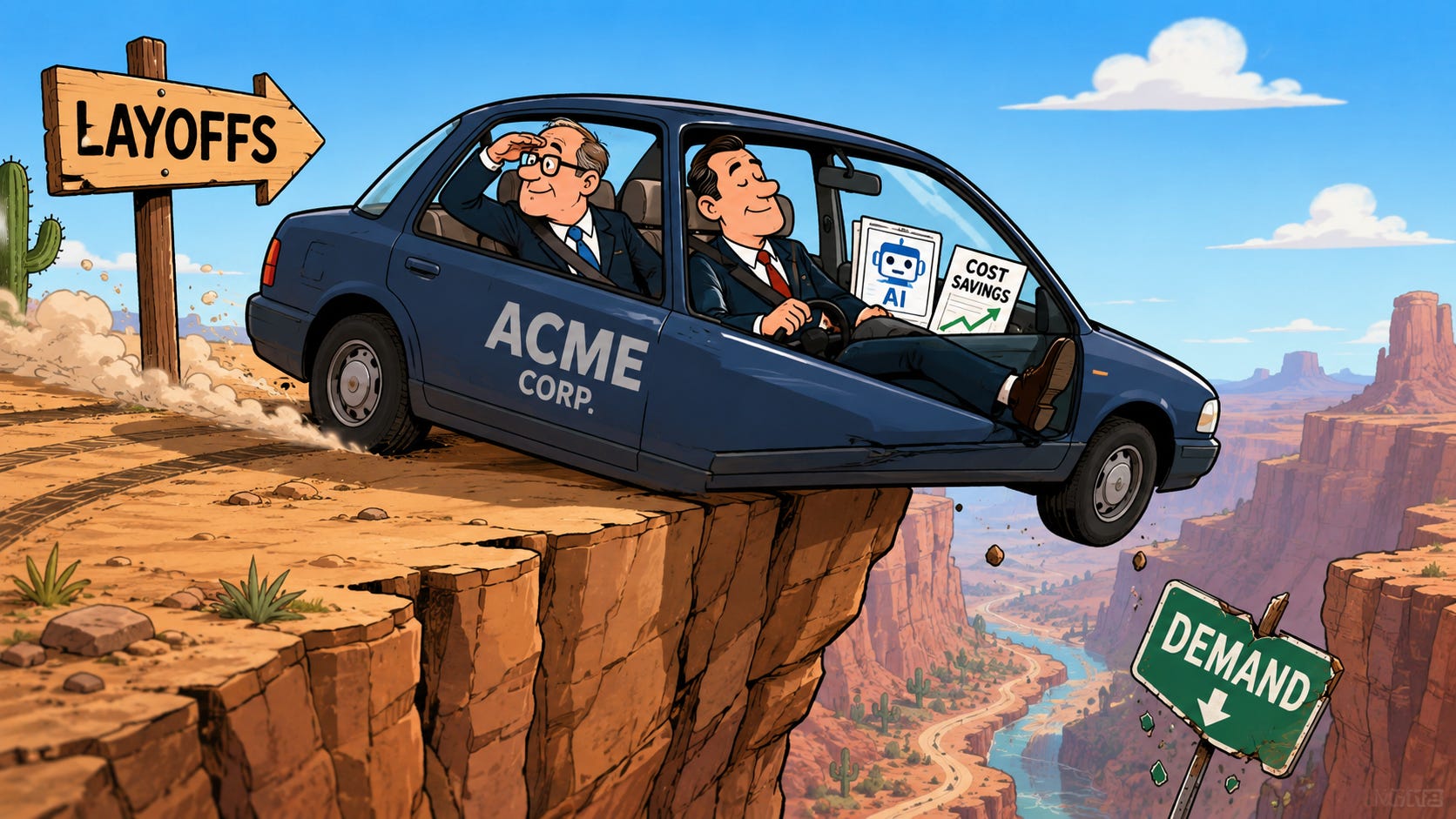
But they drive off the cliff anyway.
You keep the savings, the whole economy shares the loss
Picture a sector with ten firms. One of them replaces a worker with AI. That firm pockets the entire cost saving.
Every cent of it lands on its own bottom line. So far, so obvious.
Now follow the lost wage. The displaced worker spends less, and that lost spending does not fall only on the firm that fired them. It spreads across all ten firms, because consumers buy from everyone.
So the firm that made the cut keeps 100% of the benefit and carries maybe a tenth of the cost. The other nine-tenths of the damage gets dumped on rivals.
Run that logic through every firm at once and you get a sector that is draining its own demand. Each company is acting sensibly.
Each is making a decision that improves its own numbers. And the sum of all those sensible decisions is a market that eats the customers it depends on.
Why seeing the cliff does not slow the car
You would think foresight would help. Surely if the boardroom understands the trap, it pulls back. The paper’s most uncomfortable result is that foresight changes nothing.
In economics terms, automating is a dominant strategy. That means it pays off no matter what your rivals do.
If they hold back, you grab the savings and the market share. If they automate too, you cannot afford to be the only firm carrying full payroll into a price war. Either way, you cut, and so does everyone.
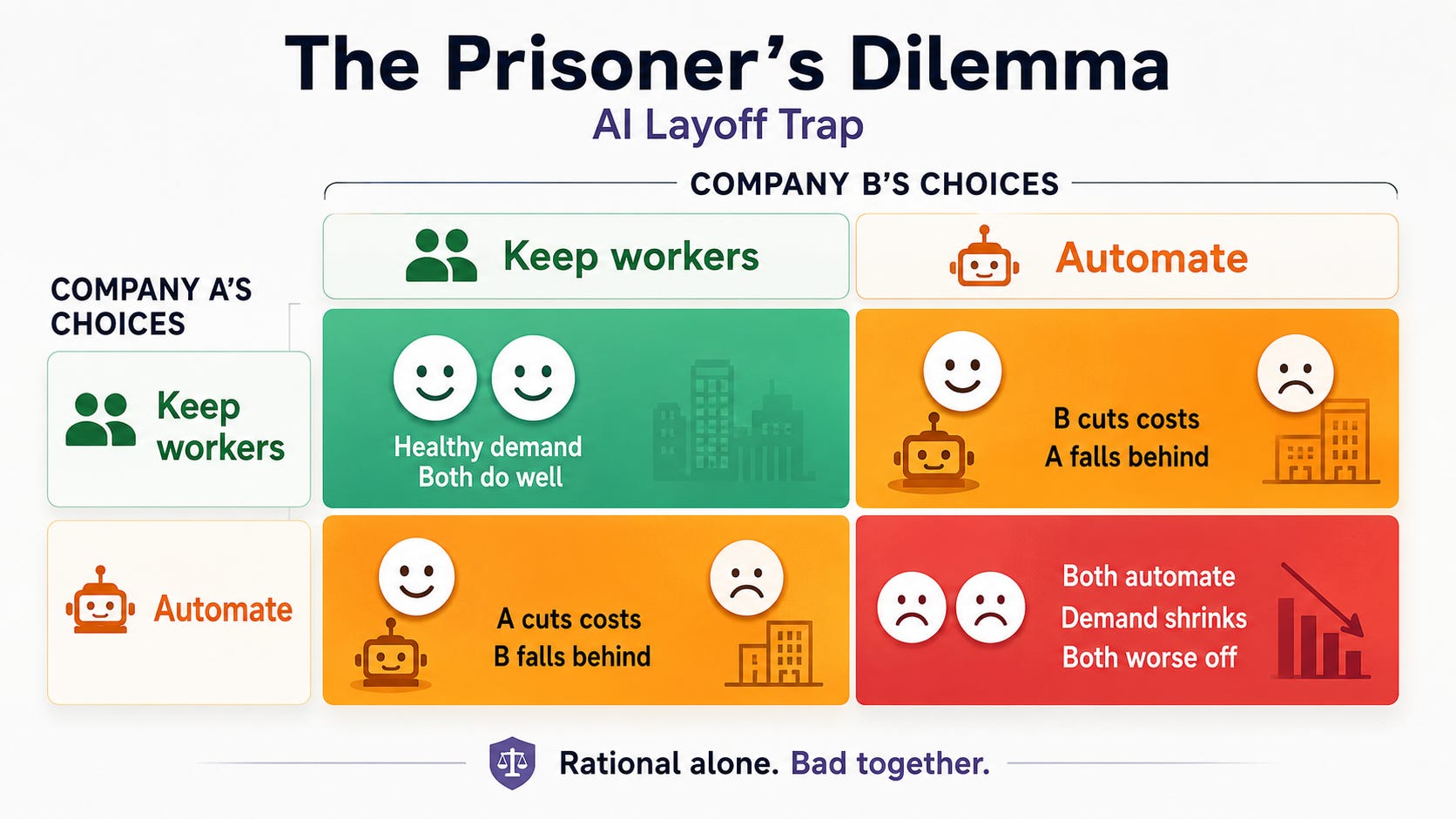
In the cleanest version of the model, the whole thing hardens into a Prisoner’s Dilemma, the famous setup where two players each act in self-interest and both end up worse off than if they had cooperated.
This is what separates the trap from a simple coordination problem. You cannot fix it with a memo or a handshake or an industry summit where everyone agrees to be sensible.
The incentive to defect survives every conversation. A firm that promises restraint and then quietly automates wins. So restraint never holds.
3. The Finding That Should End the Workers-Versus-Bosses Fight
Most automation debates split neatly into two camps. Labor loses, capital wins, and the argument becomes about how much to tax the winners to help the losers.
This paper detonates that frame, and it does so with its single best result.
Everybody loses, including the people who own the firms
The over-automation in this model is not a transfer from workers to owners. It is pure waste.
The technical word is deadweight loss, and it means value that simply vanishes, claimed by no one.
Workers lose income, obviously, through the layoffs. But the owners lose too.
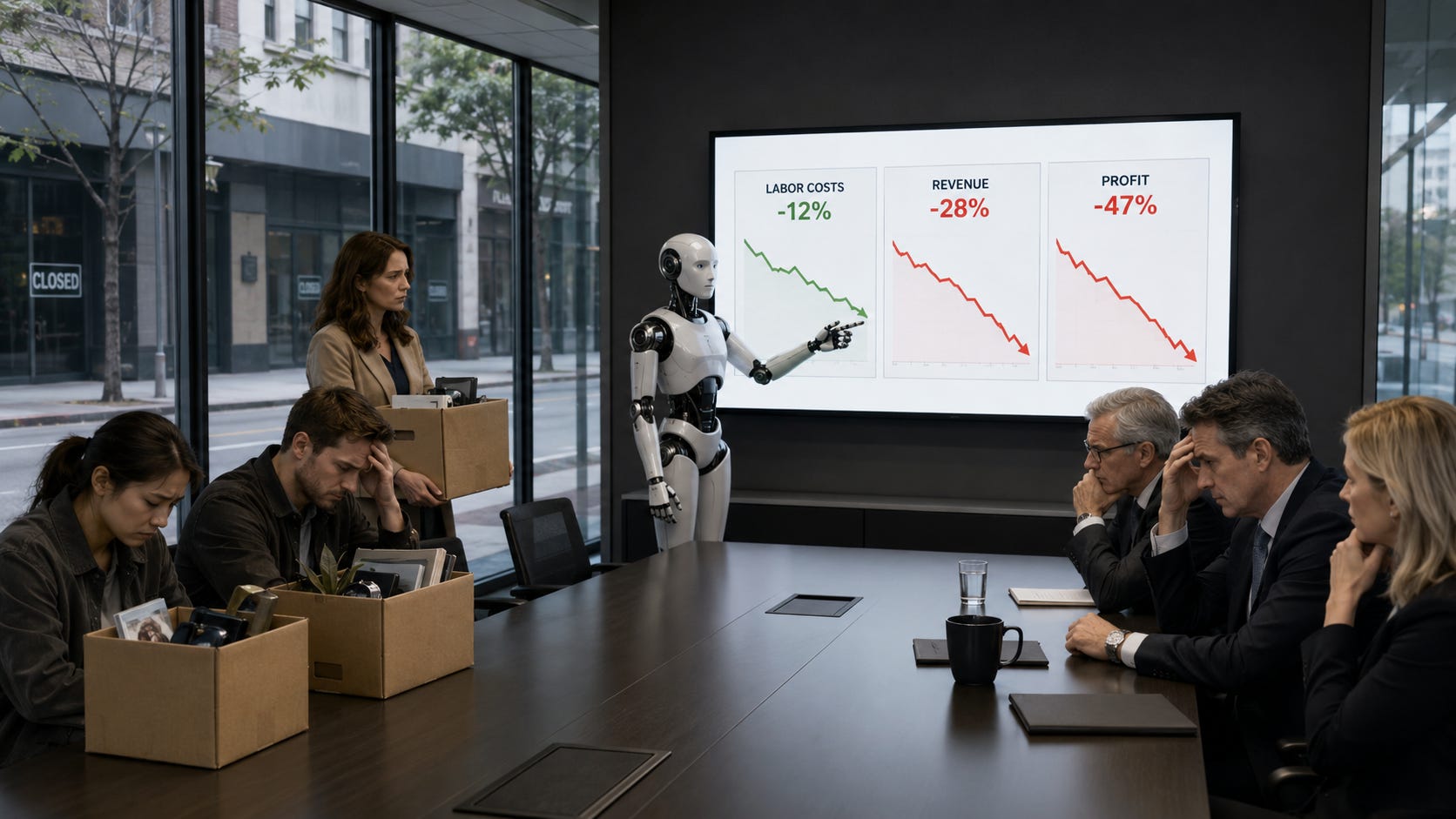
Once enough firms have cut enough demand, every firm’s profit falls below what it would have earned under collective restraint. The cost savings were real, and they still were not enough to offset the demand each firm helped destroy.
Sit with that. A profit-maximizing cartel, caring nothing for workers, would automate less than competing firms do.
The firms are not being cruel to labor and rich for it. They are being collectively stupid in a way that costs them money.
So in terms of politics, they do not need to care about workers to want this fixed. They only need to care about waste.
A monopolist would actually pump the brakes
This leads to the result that feels backwards until you trace it. A monopolist, the textbook villain, handles this problem better than a competitive market does.
The reason is that when one firm owns the whole sector, every dollar of lost demand lands back on that firm.
It cannot push the cost onto rivals because it has none. So it feels the full weight of its own automation and pulls back to the point that is actually best for it.
A crowded, competitive market does the opposite. The more firms there are, the smaller each one’s slice of the demand loss, and the weaker its reason to hold back.
Competition, the thing we normally trust to discipline companies into serving customers, is here part of what drives them to fire those customers.
That is not a comfortable sentence to read, is it?
4. More Competition and Better AI Both Make It Worse
If the trap only bit in concentrated industries, there would be room to relax. It does the reverse.
The two forces we usually count on to save us, vigorous competition and rapid technical progress, both make the hole deeper.
The crowded market is the dangerous one
The size of the problem grows with the number of firms. The paper measures an over-automation wedge, the gap between how much firms automate and how much they should.
That gap widens as you add competitors, because each new rival shrinks everyone’s share of the demand they destroy.
So the most fragmented, most competitive sectors are exactly where this bites hardest. Think customer support, software services, back-office operations.
Markets with many players, all reaching for the same AI tools at the same moment, all able to pretend the demand damage is somebody else’s. The paper points to these as the places to watch, and the 2026 layoff data has been concentrated in precisely those areas.
The fingerprint to look for is strange and specific. Standard economics says cost-cutting technology should raise profits.
If profits erode at the same time as mass layoffs, in competitive sectors deploying the best AI, that pattern is hard to explain without this trap. One mid-June headline already read that companies cite AI but the cuts fail to boost returns. That is the signature, showing up early.
Faster AI digs a deeper hole
The optimist’s instinct is that better AI will grow the pie and fix the demand problem. The paper shows the opposite for the gap it cares about.
When AI gets more productive, each firm sees a fresh prize, the chance to grab market share by out-automating rivals. So they all push harder.
But at the finish line, when every firm has expanded equally, those market-share gains cancel out. Nobody actually pulls ahead.
All that remains is more automation, more displacement, and a wider gap between what firms do and what would be best.
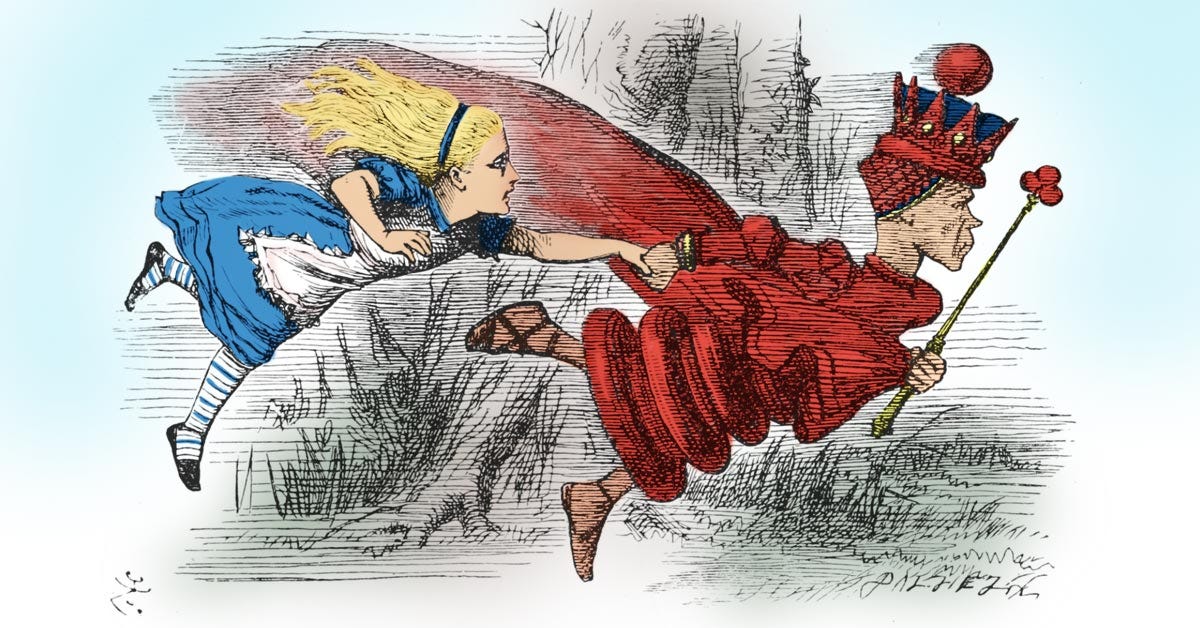
The authors call it a “Red Queen effect”, after the character in Lewis Carroll who runs as fast as she can just to stay in the same place.
The actual AI race is lopsided, with a few labs holding much better models. In a lopsided world the leader genuinely does capture ground, and the neat cancellation might break.
So treat “better AI makes it worse” as the strongest claim in the paper and the one most worth stress-testing.
5. Why the Comfortable Solutions Do Not Work
Here is where the paper earns its keep for anyone in policy. It walks through the popular fixes and shows most of them miss the target.
The trap lives at one specific point, the decision to automate one more task. Anything that does not touch that point does not work.
UBI raises the floor but never touches the brake
Universal basic income is the answer everyone reaches for, and the paper is brutal about it. UBI hands the same payment to the employed and the displaced alike.
It lifts the floor on everyone’s living standard. What it does not do is change the math of automating one more job.
The reason is technical but easy to feel. UBI moves the overall level of demand without changing the marginal decision.
A firm deciding whether to cut one more role still keeps the saving and still dumps most of the demand loss on rivals. The arithmetic of that single choice is untouched, so the automation rate stays exactly where it was.
The same logic sinks capital-income taxes. They scale profits up or down but cancel out of the decision that actually drives the layoffs.
This is a deflating insight for anyone who thinks a check in the mail solves AI displacement. UBI might be worth doing for other reasons.
It cushions the people who fall. It does not stop the pushing.
The one tool that hits the right nerve
After knocking down wage adjustment, free entry, upskilling, UBI, capital taxes, worker equity, and private bargaining, the paper is left with one instrument that works.
A Pigouvian automation tax.
The name comes from the economist Arthur Pigou, and the idea is the same one we use, in theory, for pollution.
A factory that dumps waste into a river enjoys the profit and leaves the cleanup to everyone downstream. A pollution tax says fine, keep producing, but pay for the harm you were offloading.
Applied here, the logic is identical. If a firm automates a job and pockets the saving while the lost wages drain demand across the economy, a tax claws back that unpriced damage.
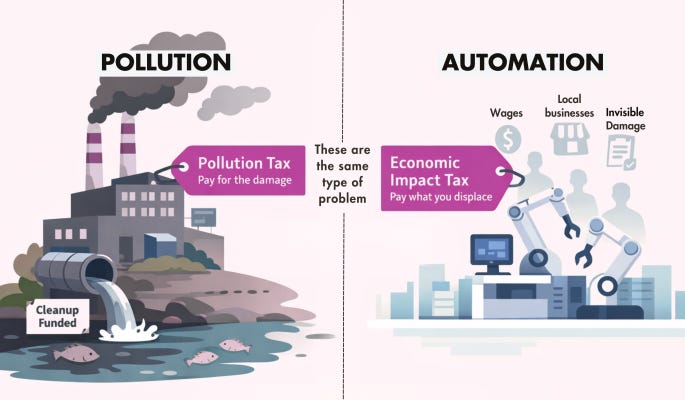
The point is not to ban useful technology. It is to make the private calculation match the real one.
The human translation is simpler. If you insist on firing your customers, do not expect the rest of us to subsidize the experiment.
The catch is that his tax is clean in a model and very hard in the world.
It would require observing how much each firm automates, setting a rate from parameters nobody can measure cleanly, and stopping companies from simply moving the work offshore.
The paper gestures at carbon-style border adjustments as a fix.
That is a hope, not a finished mechanism. So the real takeaway is the shape of the right tool, not a bill you could pass next quarter.
6. The Catch That Keeps the Argument Honest
All of this can sound inevitable. It is not, and the place where the argument could break is the most important part to understand.
The paper rests on one number. Any view of the future should rest on it too.
It all comes down to whether people land somewhere better
The trap only springs if displaced workers do not get reabsorbed into decent jobs. The paper calls this the income replacement rate.
If laid-off people quickly find roles that pay as well or better, the lost demand comes back, and the whole mechanism flips. In that happier world, firms actually automate too slowly, and the right policy is a subsidy, not a tax.
History mostly sits on the happy side. Looms, tractors, spreadsheets, ATMs.
Every past automation panic eventually moved people into new and often better work. So the paper is really a bet that this time the transition is slow enough, or permanent enough, that the demand damage lands before the new jobs arrive.
That is a defensible bet about AI in particular. It is still a bet, and the model cannot tell you which world you are in. It only tells you what happens in each.
So far the early signs lean grim. There are hundreds of thousands of open AI roles, and the displaced workers mostly cannot cross the skills gap to fill them.
Displacement is hitting entry-level and middle white-collar work, the polished tasks people went to university to learn. The ladder into professional life is being pulled up with an email about efficiency.
The truth that should be hard to shake
The trap can be modeled with precision. It can be published, read, nodded at gravely, and sent to the Treasury.
And the march off the cliff can still happen in perfect formation, each firm congratulating itself on its discipline while the customer base quietly thins out beneath everyone.
The machines are not the danger here. The danger is a market that takes a genuinely brilliant technology and points it at its own foundation, one rational quarter at a time.
The question is no longer whether AI can do extraordinary things. It plainly can.
The question is whether the incentives can be changed before the market optimizes itself into something it cannot survive.
I’ve been laughing about this for years: every tech bro entrepreneur dreams about firing all the staff without realizing that employees are customers.
Massive workforce reductions often mask a deeper failure to retain the institutional knowledge required for the next growth phase. When companies treat headcount as a variable cost rather than a core asset, they hollow out the very teams needed to execute when the market turns. This cycle creates a permanent state of operational amnesia where the company forgets how it actually wins. We see this play out when the transaction is processed but the underlying value exchange vanishes because the people who built the process are already gone. Sustaining momentum requires protecting the human infrastructure that keeps the engine running through the quiet periods.
https://cyrilsimonnet.substack.com/p/the-order-went-through-and-the-card?utm_source=substor&utm_medium=substack&utm_campaign=comment