

Every December, a16z partners share the problems they believe founders will tackle next. It’s one of the most reliable signals of where technology is actually heading, because these ideas come from patterns across real companies, not predictions made in isolation.
The 2026 list stands out.
The conversation has clearly moved beyond AI experiments and copilots. The focus now is on systems that act, infrastructure built for agents, and companies that replace entire workflows instead of assisting them.
Across enterprise software, consumer products, and the physical world, a16z partners are converging on the same idea: AI is becoming the execution layer of the economy.

Below are the 15 most important AI ideas for 2026, explained clearly and practically. If you’re deciding what to build or how to position your company for the next wave of AI, this is a useful place to start.
1. Marc Andrusko — Prompt-free, proactive applications

The prompt box is a temporary interface. In 2026, the best AI products will stop waiting for instructions and start acting based on context. Software will observe what you’re doing and step in at the right moment with suggestions or actions that feel obvious in hindsight.
This changes product design completely. Founders won’t optimize for clever prompts or better chat UX. They’ll design systems that understand intent from behavior. The winners will feel invisible, helpful, and hard to replace because they save users from having to ask in the first place.
2. Sarah Wang — Systems of record lose ground

For decades, enterprise software has revolved around systems of record. CRMs, ERPs, and ITSM tools stored data while humans did the thinking and execution. AI collapses that separation.
In 2026, the strategic layer shifts upward. The system that understands intent and executes workflows becomes the product users care about. The database underneath becomes a commodity. Founders should build for execution, not storage.
3. Anish Acharya — ChatGPT becomes the AI app store

Every consumer platform needs distribution. AI finally has one. With ChatGPT, Apple mini-apps, and SDKs for AI-native extensions, developers can reach hundreds of millions of users without rebuilding social graphs from scratch.
This feels like the App Store moment all over again. Founders who understand how to build inside these new AI surfaces will move faster than those chasing traditional consumer growth loops.
4. Angela Strange — AI rebuilds banking and insurance infrastructure
AI cannot fully transform finance until the infrastructure underneath is rebuilt. Legacy banking systems were designed for batch processing and manual workflows, not autonomous agents acting in parallel.
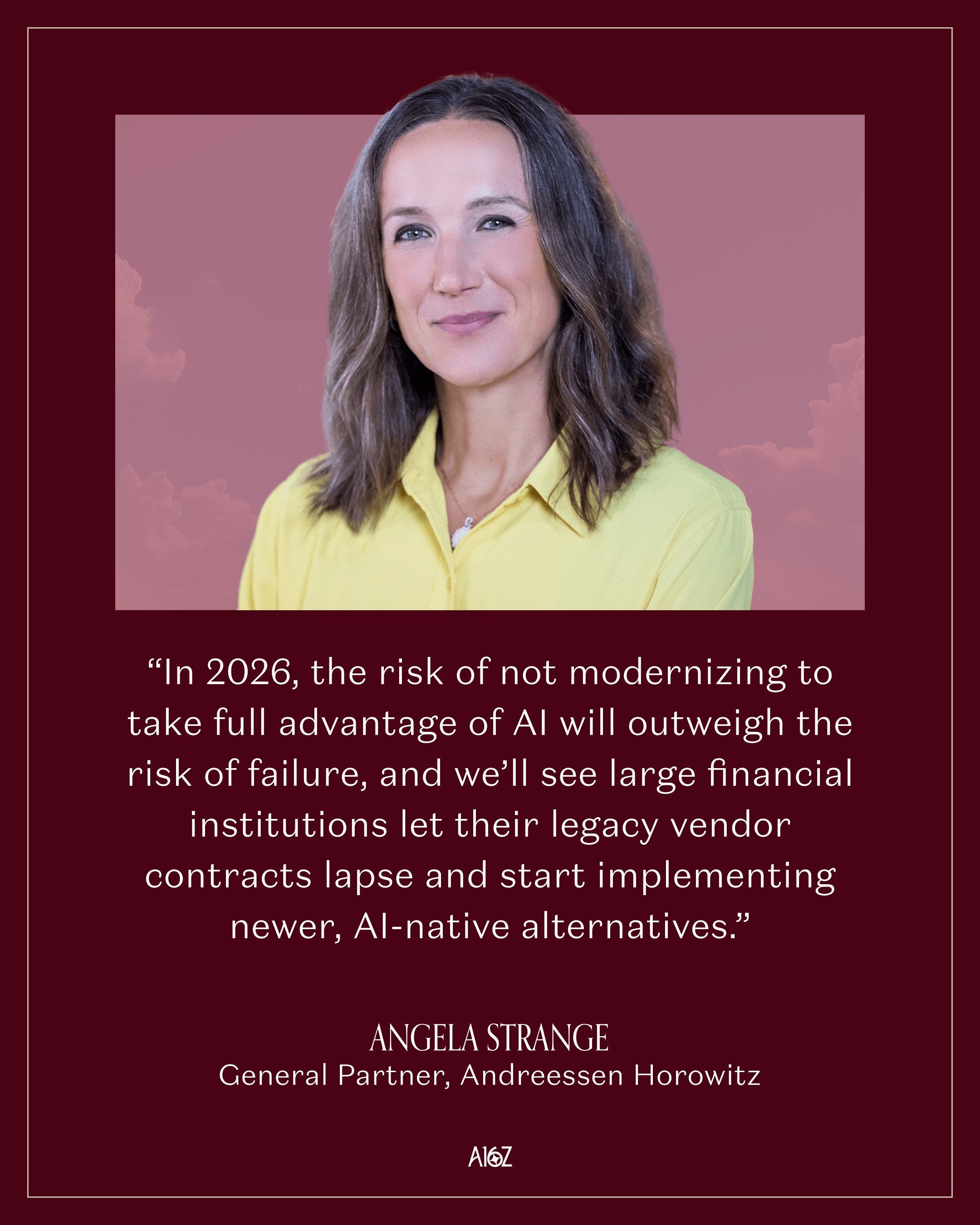
In 2026, institutions will finally replace core systems with AI-native platforms. This opens space for startups that look less like fintech wrappers and more like operating systems for money.
5. Jonathan Lai — AI World Models Will Redefine Storytelling in 2026
Jon Lai believes 2026 is when AI world models turn stories into places. Instead of generating isolated scenes, models like Marble and Genie 3 are starting to create explorable worlds that remember, react, and stay consistent over time.
This opens a new medium where people co-create worlds using natural language, move between connected experiences, and build new digital economies around shared spaces.
6. Justine Moore — Creative tools go fully multimodal

We already have models that generate text, images, video, and sound. The missing piece is control. Creators want to iterate, edit, and direct outcomes with precision, not hope for a lucky output.
In 2026, creative tools become collaborative environments where creators guide AI using references, constraints, and feedback loops. The opportunity spans from memes to movies.
7. Emily Bennett — The first AI-native university
Universities have added AI tools, but the structure remains unchanged. An AI-native university is built around continuous adaptation. Courses evolve. Curricula update in real time. Assessment focuses on how students work with AI.
This matters because every industry needs people fluent in orchestration, not memorization. Education becomes a dynamic system, not a static institution.
8. Alex Immerman — Vertical AI goes multiplayer

Vertical AI has moved from search to reasoning. The next step is collaboration. Most real work involves multiple stakeholders with different incentives and permissions.
In 2026, vertical AI products coordinate across parties. Agents negotiate, synchronize changes, and surface conflicts for humans to resolve. Collaboration becomes the moat.
9. Olivia Moore — Voice agents take over workflows

Voice agents already handle calls. Next, they manage entire workflows. Scheduling, intake, follow-ups, and resolution happen through conversation instead of dashboards.
This works because voice removes friction. When agents connect deeply to business systems, they stop being a feature and become an interface.
10. Josh Lu — “The year of me”
The biggest companies of the last century optimized for the average user. AI allows companies to optimize for the individual.
Education, health, media, and finance all shift toward products that adapt to you specifically. Retention improves because people feel understood, not served.
11. Stephenie Zhang — Designing for agents, not humans

Agents increasingly consume content, software, and data on our behalf. That changes what matters. Visual design and layout matter less. Machine legibility matters more.
Founders will build products optimized for agent consumption. The human interface becomes secondary. This is a subtle but profound shift.
12. Jennifer Li — Multimodal data finally gets untangled

Most enterprise data lives in messy formats: PDFs, screenshots, emails, videos. AI systems fail when inputs stay chaotic.
The opportunity is building platforms that continuously clean, structure, and govern multimodal data. Whoever controls that layer controls everything built on top.
13. Joel de la Garza — AI fixes cybersecurity hiring
Security teams drown in alerts and burn out their best people. AI can automate the repetitive work that created the hiring crisis in the first place.
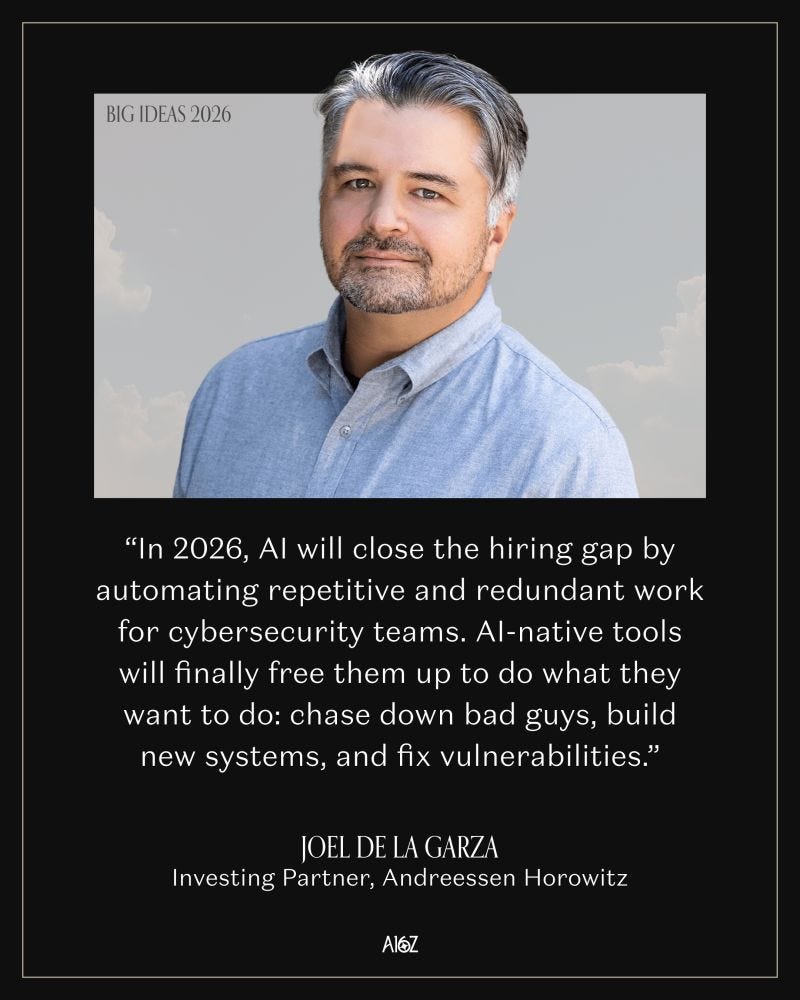
In 2026, AI-native security tools free humans to focus on real threats. Hiring becomes easier because the work becomes meaningful again.
14. David Ulevitch — The AI-native industrial base

AI moves from software into factories, energy systems, and logistics. These companies start with simulation and automation, not modernization.
The upside is enormous because this touches real-world GDP. The founders who build here shape the physical economy.
15. Seema Amble — Multi-agent orchestration reshapes the Fortune 500

Enterprises move from isolated AI tools to coordinated fleets of agents. These systems plan, execute, and adapt together.
This creates new roles and new software layers focused on coordination, governance, and reliability. Founders who build the orchestration layer sit at the center of enterprise transformation.
Conclusion
What connects all 15 ideas is a shift in how value gets created. AI is becoming the layer where decisions are made, work is coordinated, and outcomes are produced.
Founders building for 2026 are starting from a different place. They think first about architecture, leverage, and responsibility, then about features. When software can plan and execute, teams stay small, feedback loops tighten, and progress compounds faster.
This list works best as a way to sharpen judgment. It highlights where complexity is moving, where old assumptions will start to break, and where new companies can grow quickly by designing for the next version of work.
If you’re deciding what to build, the signal is clear. The biggest opportunities sit where AI is treated as the foundation, not the add-on.
Predictions are great... Predictions are poor in a meaningless context... Amidst of all the greatness and brilliant predictions, it is important to note that 2 billion people currently lack access to clean water. It is estimated that 700 million people go to bed hungry each night. In what way is this relevant to "the GDP" in a world where technology is deflating economies due to AI? There has been no discussion of AGI, privacy, information security, misinformation, shortcuts in development to "win" the rat race to supremacy, or the effects on labor and contextual robots. The recall "We are still early" => to conclude that we are losing control over AI because we are so short-sighted with premordial brains on steroids (meaning instinctive, emotional, short-termistic thinking...).
This is great, thanks for sharing. I believe externalities like geopolitics will play a role on how these are executed though; as more nations and companies are erecting barriers and new alliances are being formed: building companies across jurisdictions and various ecosystems may prove to be challenging