

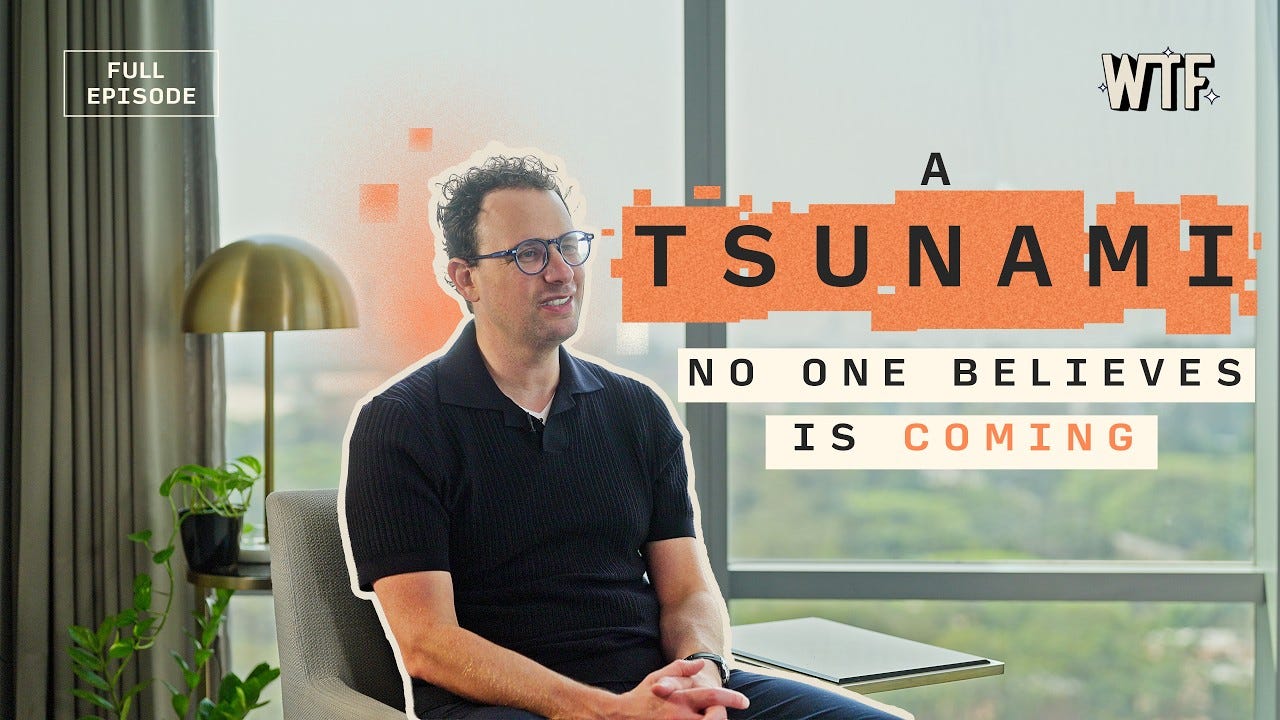
Dario Amodei sat down with Nikhil Kamath for over an hour. No PR filter. No scripted answers. Just the CEO of a $400 billion AI company explaining why he thinks human-level AI is closer than almost anyone believes, and why society isn’t adjusting fast enough.
I watched the full thing. Here’s what matters.
1. Anthropic's Safety Research Is Working. Public Awareness Isn't.
Anthropic has found neurons that track specific concepts. Circuits that track how rhyme works in poetry. That level of visibility into what models actually do wasn’t supposed to happen yet.
But public understanding is moving in the opposite direction.
“We’re starting to understand what these models do. I felt maybe a bit more negative about the public awareness and the actions of wider society.”
He’s encouraged by the technical progress. Worried about everything outside the lab. Both are true.
This is why I’ve been writing so much about how serious builders are actually using Claude. The gap between what’s possible and what most people understand is widening fast.
The takeaway: If you’re waiting for public consensus before changing how you work, you’re waiting for the last signal.
2. Why Dario Amodei Left OpenAI
Two convictions drove the split:
Scaling works. More data and compute produce smarter models, predictably. He saw this in 2019, pushed for it, OpenAI eventually came around. If you want to understand how OpenAI was thinking back then, I shared their original 2018 AGI roadmap recently. 64 slides that predicted almost everything that happened since.
Safety is the whole game. If these models approach human-level capability, how you govern them isn’t a footnote. This one didn’t land the same way internally.
“Don’t argue with someone else’s vision. Go off and do your own thing. At least it’s yours.”
He made his case. Saw it wasn’t landing. Built a new institution around it.
3. Scaling Laws Explained in One Analogy
“If you put in the ingredients, data and model size, what you get out is intelligence. Intelligence is the product of the chemical reaction.”
A chemical reaction doesn’t produce results steadily. It builds, then something happens fast.
All the progress came from the same dynamic: more data, more compute, bigger model. No separate breakthroughs required.
The takeaway: Next time someone says AI progress is slowing, ask them to list what models couldn’t do 18 months ago. The list is long. The gap is widening faster than most people think.
4. Why Anthropic Lost the Consumer AI Race to ChatGPT
The sequence: $8M raised, early Claude One ready, arms race feared, model held back. Then OpenAI released ChatGPT and the arms race started anyway.
“We had an early version of Claude One, before ChatGPT, and we chose not to release it. We probably seeded the lead on consumer AI because of that.”
Other moves that cost them commercially:
Pushed on chip export policy, making suppliers angry
Disagreed publicly with the US administration on regulation
Still reached $400 billion in valuation. And now they’re shipping tools like Claude Cowork that triggered a $285 billion software selloff. The market took notice.
The takeaway: Judge a company by what it was willing to pay for its principles.
5. Will AI Replace Programmers?
“Coding is going away first. The broader task of software engineering will take longer. The elements of design, knowing what the demand is, managing teams of AI models. Those things may still be present.”
If AI handles 95% of your job, the 5% you contribute gets amplified because you’re directing 100% of the output.
This is exactly what I’m seeing with tools like Cowork. People who set it up properly are getting dramatically different results than people who treat it like a chatbot. Same with the workflows that actually work.
What survives longest:
Work that requires touching the physical world
Roles built on real human trust and relationships
Judgment that evaluates AI output
Hardware and semiconductor engineering
Biotech, where domain knowledge is still scarce
The takeaway: Write down the three parts of your job AI touched this month. That list is your threat map. If you want help thinking through this, I wrote about why career zigzaggers are winning in AI.
6. Infrastructure Over Applications
Anthropic’s strategy is to be what makes everything you open smarter. The layer underneath, not the app on top.
Amodei referenced Amdahl’s Law: speed up the slow parts of a system and the parts that seemed irrelevant suddenly become the bottleneck. Old advantages disappear. New ones emerge from nowhere.
This explains why they shipped Sonnet 4.6 at $0.30 and Opus 4.6]with the capabilities they did. They’re trying to be the infrastructure everyone else builds on.
Indian IT companies have built local compliance knowledge, client relationships, and regional trust over decades. AI hasn’t touched any of that yet. As everything around them accelerates, those components become the edge.
The takeaway: Map your role into five components. Circle the ones AI touched in the last six months. The uncircled ones are worth doubling down on.
7. Why He's Betting on Peptides
“Peptides have this almost digital property where you can substitute in this amino acid here and this amino acid there. It allows for more continuous optimization.”
Small molecule drugs: improve one thing, something else gets worse. Peptides work more like software. Each change is testable. The design space is enormous.
He also flagged CAR-T therapy. Take cells from a patient’s body, engineer them to attack a specific cancer, return them.
The two areas he’s watching:
Peptide-based therapies
Cell-based therapies (CAR-T and what follows)
If you’re looking at where to invest or build, this aligns with what YC laid out in their 2026 requests for startups. Bio is on the list.
The takeaway: The wave hasn’t started yet. The people who position early will look obvious in retrospect.
8. Will AI Replace Doctors?
AI got better than radiologists at reading scans. Radiologists are still employed.
The hardest technical part automated. Walking patients through results, sitting with them in the uncertainty, that stayed. That turned out to be most of the job.
“We’re steering this car toward a good place. But there are trees, there are potholes. We might need to occasionally slow down to steer in the right direction.”
Someone needs to be steering. That’s where humans remain. This is why prompting is no longer about clever wording. It’s about judgment, context, and knowing what to ask for.
9. Anthropic’s India Revenue Doubled in 3 Months
“The number of users and revenue we’ve seen in India has doubled since I last visited in October. That was three, three and a half months ago.”
Indian companies know local compliance, relationships, and demand in ways Anthropic can’t replicate. Each new model release opens capabilities that didn’t exist before.
The people who build fast on each window, before the next one opens, establish advantages that compound. I’ve been tracking this closely. Perplexity just launched a system that runs 19 models at once. The tools keep getting more powerful.
The takeaway: Look at what the last model release made newly possible. If you haven’t built on it yet, that window is still open. Barely.
10. From Biophysics to AI: The Origin Story
“I was starting to despair that biology was too complicated for humans to understand. Then I noticed the early work around AlexNet. Maybe this is ultimately going to be the solution.”
He’s attached to the problem. AI is just the first tool that seems capable of addressing it.
The logic chain:
Biology is too complex for humans to understand alone
AI might solve it
But only if built carefully, or it causes harm at scale
The takeaway: The people who understand where a founder came from usually understand where they’re going.
What This Means
For founders: Domain knowledge layered on top of model access. Move before the window closes. If you’re raising, these are the angels actually writing checks and the 200 most active ones with emails.
For investors: The biotech wave hasn’t started. Peptide-based and cell-based therapies are where the next compounding cycle begins. For AI infrastructure plays, I compiled email addresses from the top AI VC funds.
For operators: The way you use AI determines whether it makes you sharper or more dependent. That’s a deliberate choice. If you’re using Claude, [the Cowork setup guide and the SEO workflows are worth your time. If you’re doing presentations, I mapped out every way to make slides with Claude. For spreadsheets and financial models, these 30 prompts are what I use.
For everyone: In a world where AI generates convincing text, images, video, and code, the ability to evaluate what is real becomes the most valuable skill you have. If your writing sounds AI-generated, here’s how to fix it. And if you want to understand the psychology behind better AI output, I wrote about that too.
Five Things Worth Keeping
The tsunami is visible. Adjust accordingly.
Moats come from domain knowledge, not API access.
Comparative advantage lasts until suddenly it doesn’t.
Invest in the parts of your work AI can’t yet speed up.
Reason from first principles past the point where the conclusion feels uncomfortable.
The people who understood the steam engine in 1820 didn’t have more information. They had fewer reasons to look away.
Watch the full interview:
If you want to go deeper on any of the tools Anthropic is shipping:
Claude Opus 4.6 Explained

Anthropic positions Claude Opus 4.6 as better at planning, persistence, and agentic work.
How Serious Builders Co-Work With Claude

Claude has quietly become one of the most valuable AI tools for people doing real work.
The Claude Cowork Setup That Actually Works

I’ve been using Claude Cowork since launch day. It’s now the first thing I open every morning.

Every Way to Make Slides with Claude in 2026

Claude has quietly become one of the most versatile AI presentation tools available.

Claude Cowork: The Tool That Triggered a $285 Billion Software Selloff

Anthropic launched Claude Cowork on January 12, 2026.
Claude Can Now Do SEO Like a $10,000/Month Agency (For Free)

The results changed how I think about SEO execution entirely.
Anthropic Just Launched a $0.30 AI Employee (Sonnet 4.6 Breakdown)

Anthropic just shipped Sonnet 4.6.
Dario's 'infrastructure over applications' framing resonates. I'd extend it: the companies winning with AI aren't necessarily the ones with the best infrastructure - they're the ones with the clearest direction.
I've been building with AI daily for months. The pattern I keep seeing: undirected AI produces technically correct, creatively empty output. Directed AI - with specific constraints and a real point of view - produces things worth shipping.
The Dario interviews always skew toward capability. The thing nobody's modeling: direction quality as a competitive advantage.
Wrote about this after 30 days of experiments: https://thoughts.jock.pl/p/directed-ai-experiments-vibe-business
Do the geniuses in the datacenter get lunch breaks?
https://blog.dnmfarrell.com/post/do-the-geniuses-in-the-datacenter-get-lunch-breaks/