

The “Seniorization”
“Seniorization” is a real word now. PwC coined it in June, after feeding more than a billion job postings through its models.
What they found is that in the occupations most exposed to AI, entry-level roles are now 7 times more likely to demand skills that used to take a decade to earn.
Those are skills like strategic judgment and stakeholder management. They translate to knowing what to build, not just how to build it.
Some are worried that junior roles are disappearing.
But the truth is that they are being rewritten to require the one thing a junior person cannot have, which is time.

If you set that beside the rest of this year’s hiring data and it stops looking like a quirk. Senior postings are climbing while entry-level postings fall. In software, roughly seven in ten open roles are now senior. Firms are hiring hard at the top of the ladder while sawing off the bottom rung.
Indeed, as AI makes execution cheap, the prize moves to judgment. But where does that judgment comes from?
together with Outskill
Part of the answer: reps. Judgment starts with knowing which tool to reach for, and nobody teaches those reps for free.
This Saturday’s live workshop covers the 15 AI tools that matter right now, which one fits which job across research, writing, design, data, and code, plus how to build an AI coworker that works while you sleep.

▫️ Saturday, 10 AM EST, 3 hours live + bonus sessions
▫️ They price it at $395. Free this week:
Table of Contents
1. The Resume Was a Map of Roads Being Repaved
2. Hire Against the Fog, Not the Org Chart
3. Judgment Is the New Scarce Input
4. The Apprenticeship Just Got Automated
5. Capability Debt Is the Bill Nobody Has Booked
6. The Filter Is Right. The Factory Is Missing.
1. The Resume Was a Map of Roads Being Repaved
For decades a resume worked as a kind of atlas. It recorded where someone had been so an employer could guess where they might go next.
That map is getting less reliable, because the roads keep getting repaved underneath it.
The shortcuts that used to be good enough
The old system ran on signals, and the signals were not stupid. A recognizable logo implied someone else had already done the quality control.
Eight years in a role implied a full cycle survived. A familiar title implied the problem had been solved before at similar scale.
All of it answered one narrow question well. Can this person do a known job inside a known system?
The trouble is that fewer and fewer valuable jobs are known, and almost no system stays still for a year.
A role written in January is a rough sketch of the work that will matter by December.
What replaced the logo
The ICONIQ report The New Hiring Filter, built on interviews with operators at Atlassian, Canva, ElevenLabs and Nevis, lands on the same observation.
Canva’s Chief People Officer describes moving the core interview question from “what did you do” to “how did you figure it out.”

One question asks for a replay. The other exposes the machinery. What did they assume, what changed their mind, what did they build and throw away.
ElevenLabs has largely dropped year-count requirements in favor of what a candidate built outside their formal role and how they use AI without being told to. Evidence is quietly replacing pedigree as the currency.
One thing the report says gently, but it’s worth saying plainly.
The signal that replaced “went to the right school” is now “had the evenings, the hardware and the financial slack to build things nobody asked for.”
That is a different bias, not the absence of one.
2. Hire Against the Fog, Not the Org Chart
The most useful idea in the ICONIQ piece is also the least repeated.
Your first hires should attack the company’s single largest unknown, not copy the org chart of the last place you worked.
Two companies, opposite choices, identical logic
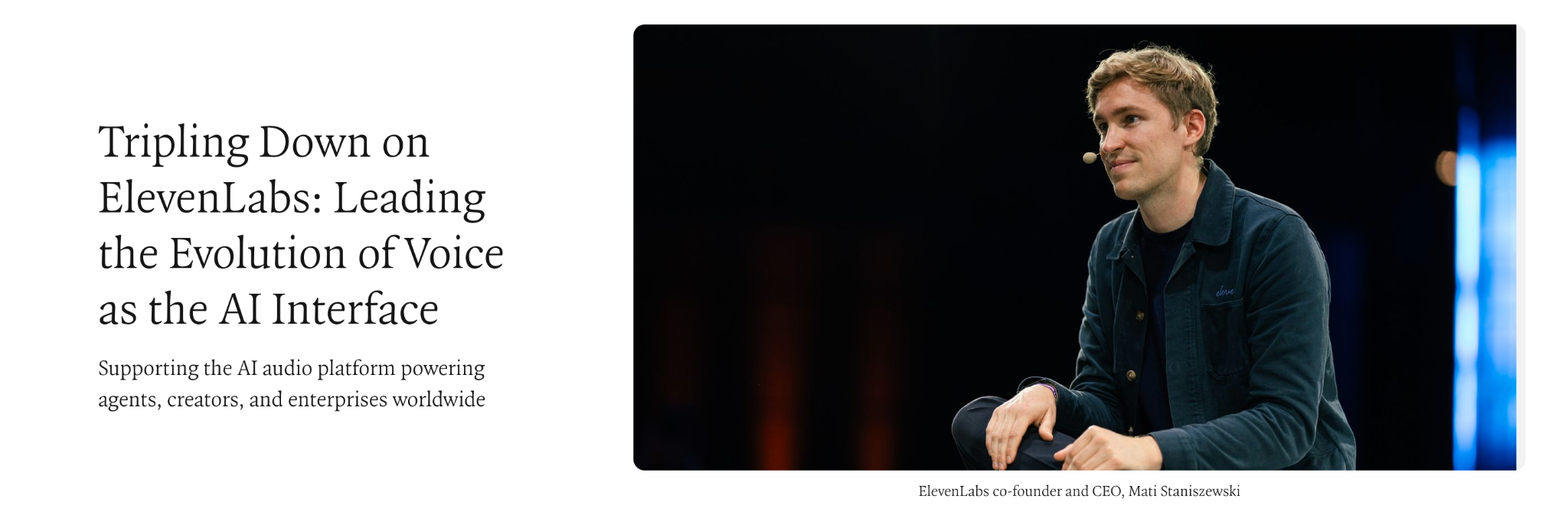
ElevenLabs hired researchers before it built a conventional engineering team, because its existential question was whether it could build proprietary voice models at all. If the answer was no, nothing downstream mattered.
Nevis went the other way and hired a founding designer before any engineer, because in a brand-new category the scarce thing was not the ability to build. It was knowing what deserved to be built.
Two opposite-looking sequences, one shared move. Each company hired first against the thing it understood least.
Why the old order was never a law
Engineers first, then sales, then everyone else. That pattern came from a period when execution was the bottleneck.
Cheapen execution and the bottleneck moves, so the first hire should move with it.
A founder who cannot name the company’s biggest uncertainty in one sentence is not ready to make a senior hire.
They will end up hiring against comfort instead, and comfort is rarely the risk that kills the company.
Which raises the obvious question. Once you know what you are hiring against, what exactly are you screening for?
3. Judgment Is the New Scarce Input
When everyone can generate code, dashboards, mockups and analysis, the value does not vanish. It moves.
It moves from producing the output to deciding which output is worth producing at all.

The part everyone agrees on
Nevis’s founding designer puts it bluntly for his own craft. If generating interfaces becomes trivial, design’s value can no longer live in production.
It has to move to taste, direction and the judgment about what to make.
An early ElevenLabs design leader frames the same thing as the gap between a product that merely works and one that feels inevitable to the person using it.
Across product, revenue, data and finance, the highest-leverage people increasingly look less like operators and more like scouts.
They can enter unmapped terrain, form a point of view, and bring back something the org can act on.
The caution that keeps it honest
Phil Fernandez, the former Marketo CEO, supplies the counterweight the argument needs. AI tools do not turn engineers into designers, and they do not remove the need for deep expertise underneath the taste.
A company that mistakes cheaper output for better decisions moves faster while drifting further from what customers actually need.
That sentence deserves more weight than it gets. A team that ships five times as much with the same judgment does not ship five times the value.
It ships five times the mistakes, at speed, each one wrapped in a polished artifact that makes it look considered.
4. The Apprenticeship Just Got Automated
Here is where the comfortable story about “hiring for judgment” runs into the data, and the data does not flinch.
The numbers pointing one way
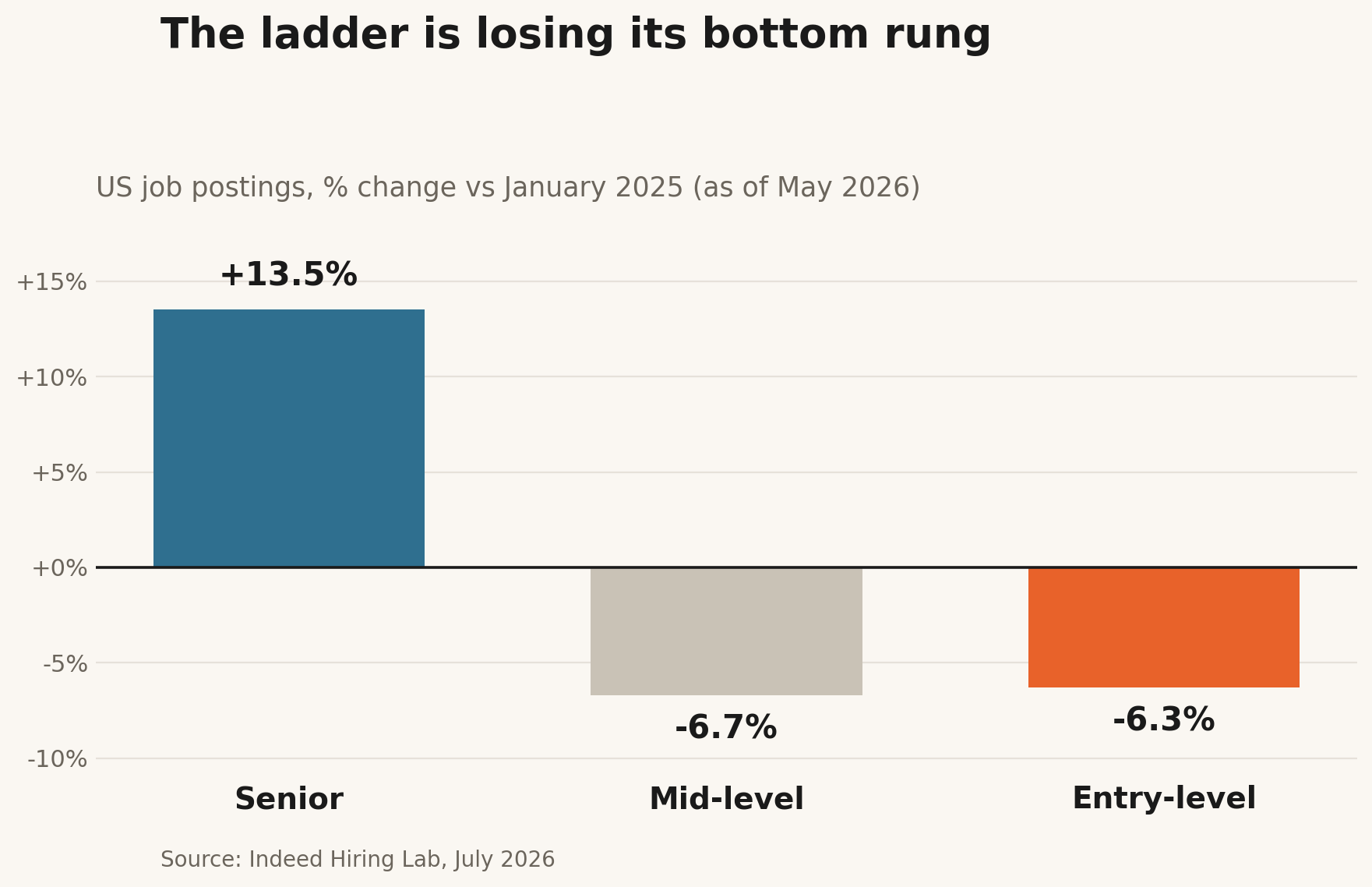
Indeed’s Hiring Lab reported that as of May 2026, US senior-level postings were up 14.7% year over year, while entry-level postings kept sliding, down 7.5%, a decline running since 2022. In software development, senior roles now make up close to 70% of all postings.
Stanford’s Digital Economy Lab, using ADP payroll data, found workers aged 22 to 25 in the most AI-exposed occupations saw roughly a 16% relative decline in employment after generative AI spread, even after controlling for the usual macro noise.
A Harvard working paper covering 66 million workers across more than 280,000 firms found companies adopting generative AI cut junior hiring sharply while senior headcount kept growing.
The honest caveat belongs here too. Rates rose, the post-2021 overhiring unwound, and the Stanford authors themselves say the AI signal only turns clearly significant from 2024. Nobody serious claims AI alone emptied the graduate market.
But the tilt toward seniority is concentrated exactly where AI exposure is highest, and that is hard to wave away.
What the junior job was really for
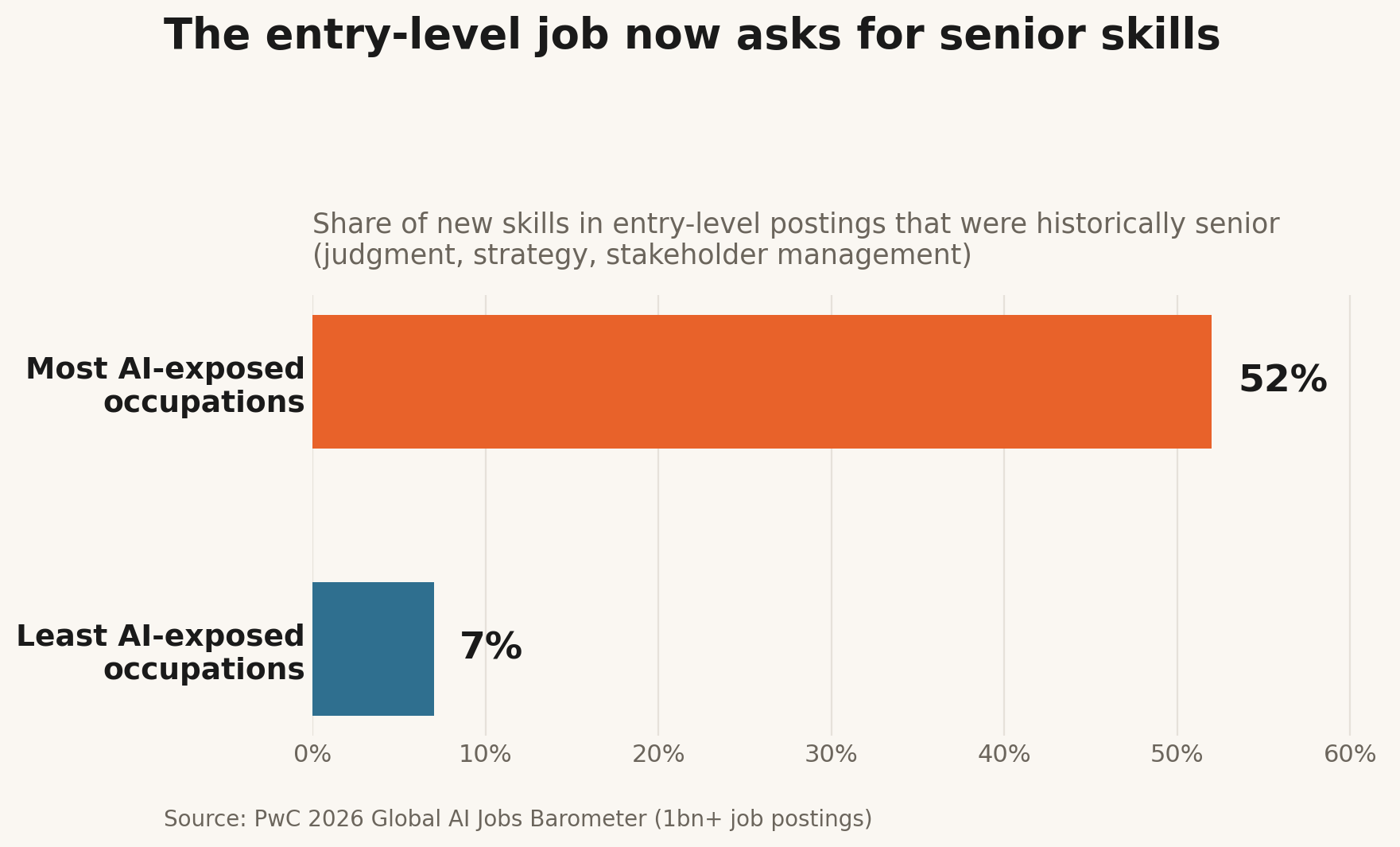
PwC’s 2026 Global AI Jobs Barometer, built on more than a billion job postings, gave the mechanism a name. Seniorization.
Entry-level roles in the most AI-exposed occupations are now seven times more likely to demand skills that used to appear a decade into a career.
Look at what that actually deletes. The junior job was never only cheap labor. It was the factory floor where judgment got made.
A first-year analyst gathering data, writing the rough draft and sitting in the room while a manager rewrote it was not mainly producing output.
She was watching an experienced person handle a disagreement, change direction, or deliver bad news.
Repeat that for two or three years and you get the exact capability employers now list on day one.
The market deleted the tuition and kept demanding the degree.
5. Capability Debt Is the Bill Nobody Has Booked
Writing in Harvard Business Review this summer, Jenny Fernandez gave this a name that should worry any CEO: organizational capability debt.
A debt that doesn’t show up until it’s expensive
It is the widening gap between the judgment a company will need in its future leaders and what its shrinking early-career pipeline is actually producing.
Like technical debt, it sits invisible on the books until the quarter it suddenly is not.
ICONIQ hits the same nerve from a different angle. In a lean AI-native company, a handful of people build the agents, the workflows and the internal operating system.
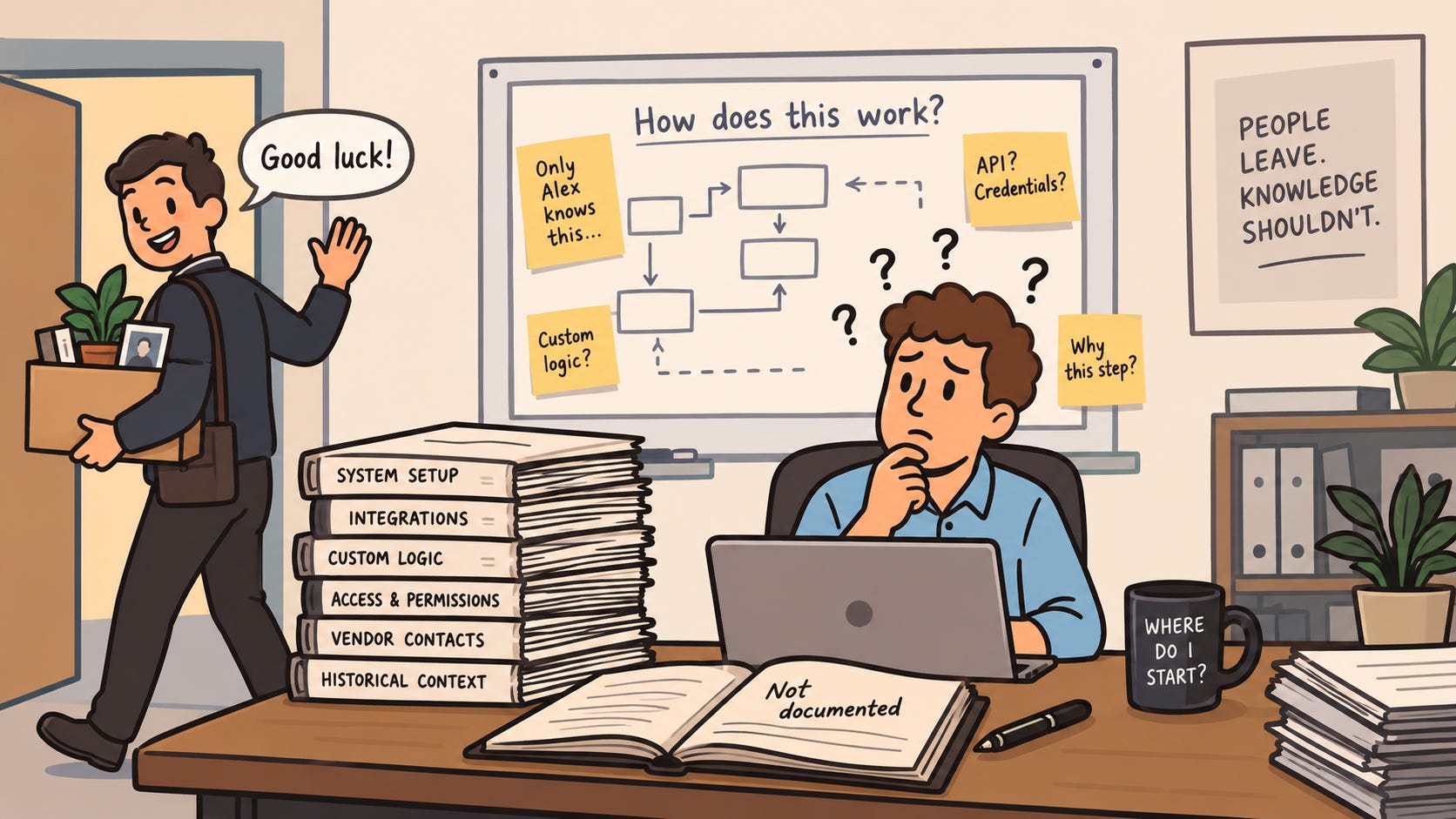
Lose one of them and, in Fernandez’s image, it feels like losing the wiring behind the walls.
Documentation and shared learning loops help, and the report is right to insist on them. But documentation preserves what one person knew. It does not manufacture a second person who can decide.
The contrarian move almost nobody is making
The interesting play in 2026 is to hire juniors anyway, and rebuild the entry-level job so it produces judgment faster than the old one did, on purpose rather than by accident.
There is a live example. Brainlabs, a thousand-person media agency, grew its entry-level cohort from 19 hires in October 2023 to 64 in April 2026, a 237% jump, by retooling a long-running internal academy around AI instead of shutting it down.
Legal teams are converging on a similar model, recruiting junior lawyers who arrive able to validate model output and manage the workflow around it rather than grind out the first draft.
That is what a redesigned first job looks like. Less drafting, more checking. Less gathering, more deciding what the gathered thing means and who it affects.
The apprenticeship is not dead. It just has to be built deliberately, because the version that ran on grunt work no longer exists.
6. The Filter Is Right. The Factory Is Missing.
None of this compounds if the organization the new hire walks into is pointed the wrong way.
When Incentives Undermine the Filter
AI adoption is not AI impact, because the moment tool usage becomes a performance metric, people use the tools because they are measured on it, and the work does not necessarily get better.
You can hire curious people and punish experimentation. You can hire builders and bury them in approvals.
You can hire for judgment and then grade them on volume. The system wins every time.
The Filter Improved. The Pipeline Didn’t
So put the whole picture together. The hiring filter has genuinely improved, and it has moved in the right direction. Evidence over pedigree.
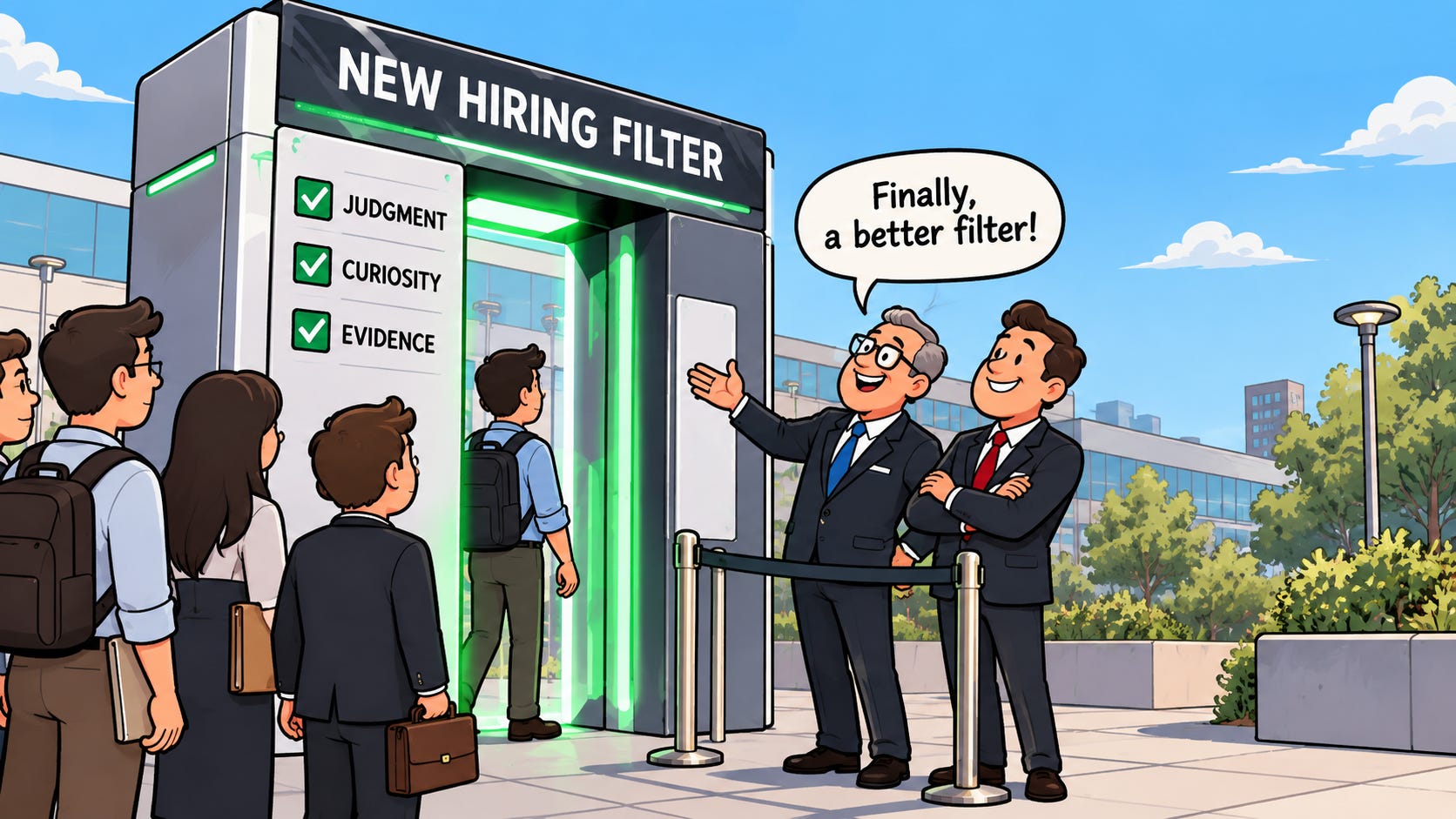
Judgment over output. Uncertainty over the inherited org chart.
Every operator quoted here is reading the moment correctly.
The failure sits one level down, and it is collective rather than individual. Almost every company applying the new filter is drawing from a pool it has quietly stopped refilling, on the unspoken assumption that someone else will keep producing the people who can direct the machines.
The machines are not the problem here. The problem is a hiring market that got smarter about spotting judgment at exactly the moment it stopped building any.
Although the filter is right, the factory is missing, and the companies that notice first will now start hiring out of everyone else’s shortage.