

Martin Casado has watched 3 AI cycles from inside Andreessen Horowitz. None of them worked like this one.
Here’s what this one looks like: in a single week, SpaceX closed its $60 billion acquisition of Cursor, and Stripe agreed to buy OpenRouter for more than $7 billion.
Both a16z bets. $67 billion, 7 days.
“What we’ve never been able to do in the history of this industry is put in $10 and get anything back. But now it really is $10 in and then some amount out pretty directly.”
Casado has skin in this game. He runs infrastructure investing at a16z, joined in 2016, and sold his own company, Nicira, to VMware for $1.26 billion, back when that number meant something.
I watched the full interview so you can skip it.
Here are the 10 takeaways that matter.
together with Alumni Ventures:
Casado’s math just changed: $10 in, real dollars out, and 2 exits worth $67 billion in one week to prove it. The catch is that the money is being made in rounds most people never see.
Alumni Ventures opens that access to individual investors, with AI, deep tech, quantum, and cybersecurity deals co-invested alongside firms like a16z, Bessemer, and Y Combinator:

▫️ Curated deal flow of AI-first startups, the same category Casado is describing
▫️ AV invests alongside the elite lead firms in these deals
▫️ No cost to see deals, zero obligation to invest
The rounds being priced this cycle are the exits of the next one:
1. The $10 rule that never worked, until it worked twice in one week
Every AI wave before this one promised this math and never delivered it.
Casado joined a16z in 2016, during what he calls the drone and autonomous-vehicle wave of AI investing, and watched capital get burned for a decade. Hand a startup a billion dollars 10 years ago and you got headcount, an office, and eventually a mess.
Hand a frontier lab a billion dollars now and it turns into GPU hours and a product people pay for the same quarter.
The scarce resource moved from people to compute. Most of venture still prices risk like it’s 2015.
Two deals in one week made the case for him. SpaceX’s Cursor acquisition and Stripe’s OpenRouter deal both round-tripped capital into product inside months, the return math every fund model assumes takes a decade.
2. 20 people built a $2 billion model
Casado’s proof for the new capital math fits in one sentence.
“One of the very famous models... was built with a team of about 20 people. And I would say the cost of that was probably $2 billion plus.”
He won’t name the model on record. The ratio does the work anyway: a result used by millions, built by a team small enough to fit around one table.
The old ceiling on ambition was headcount. Coordinate too many engineers and burn rises while the roadmap dilutes, the mythical man-month problem every software team eventually hits. The new ceiling is capital and compute, and neither scales the way headcount used to. 20 people used to mean a seed-stage team. Now it can mean $2 billion deployed, which is exactly the leverage a one-person operation runs at the small end of the same curve.
3. His prediction: labs keep 80% of the money, lose 60% of the usage
Ask Casado who wins the AI stack and he hands you 2 numbers pointing in opposite directions.
“If I were to guess, I’d say supply constraints will ease in 2028-ish. I think the big labs will probably, dollar weighted, get 80% of the market going forward, because that’s historically what we’ve seen for large incumbents. But I think token weighted, 60% will be long tail and open source.”
The gap between those numbers is the whole thesis. Dollar weighted, the frontier labs keep most of the revenue. Token weighted, the long tail of open source and smaller providers runs most of the actual volume, because there is simply more of it, spread across more places.
Right now the split hides because the biggest labs buy compute in bulk nobody else can touch. Casado’s 2028 timeline is when that edge fades: once GPU supply catches demand, the surface area of AI fragments the way every past technology stack has.
If his timeline holds, the capital side already looks like this:
▫️ Anthropic Is Closing In on a $1 Trillion Valuation
▫️ Anthropic Just Passed OpenAI in Revenue, Spending 4x Less
▫️ Where AI Moats Actually Live Right Now
4. Why he won't say "recursive self-improvement"
Ask him about AI compounding on itself and he corrects your vocabulary before answering.
“Recursive is when you take something and make another copy of that thing wholesale. Autocatalytic is using the thing to help you make that thing faster, as a tool.”
Recursive self-improvement, in his framing, means a system copying itself wholesale, a runaway loop nobody steers. What’s actually happening across labs is narrower: using AI as a tool to build faster AI, the way engineers have used software to build software since the first compiler shipped.
He calls it autocatalytic and dates the pattern back decades. It compounds steadily, bounded by capital and data. A runaway loop implies nobody can slow it down. A compounding advantage implies a handful of labs pulling ahead while everyone else still gets to watch and react, the same pattern behind every self-improving loop worth building.
5. The routing problem even he can't solve
Everyone building on top of models eventually hits the same question: which one should actually answer this?
“It does seem like model routing is a very difficult technical problem. I think it’s AI complete. Let’s imagine you’re trying to answer the question: what question does the smartest thing in the universe need to answer? I think you need the smartest thing in the universe to answer that question.”
Casado splits routing into 2 products most builders lump together. Quality-based routing, picking whichever model answers best, is close to circular: you would need a model smart enough to grade every other model’s output as fast as it arrives, and nobody has that model.
Cost-based routing already works. Pick the cheapest model on the Pareto frontier that still clears your quality bar, the way Cursor’s own router and OpenRouter already do. That is the routing problem worth building for today: which model is good enough for the least money.
6. The $200 subscription loophole operators in China are running
Casado’s most surprising story in the whole conversation has nothing to do with models. It’s about people gaming a monthly bill.
“There are these very sophisticated operations out of China that will use the single service tiers and arbitrage them. They will sign up to a $200 plan, use all the tokens in three days, then cancel and get prorated for the 27 days, even though they used all the tokens.”
Frontier labs subsidize heavy users on purpose. Tokens are cheap to acquire and expensive to lose once a business gets built on top of an API, so the subsidy is a growth lever. Casado says the losses concentrate in the top 5% of users, and providers keep tightening account limits to contain that group.
The operators he describes found the gap between a flat subscription and a metered bill and moved in: burn the allotment fast, cancel before the next charge, collect a refund for days never used. He calls it a new kind of routing entirely, arbitrage between subscription tiers instead of between models.
The mechanics behind why the gap exists at all:
▫️ Your AI Bill Is Mostly Wasted Tokens
▫️ You Are Overpaying for Intelligence
▫️ How to Never Hit Claude Limits: The Token System
7. Why nobody actually swaps their model, even when a better one ships
Conventional wisdom says models are commodities you drop the second a better one ships. Casado says that’s mostly wrong.
“We’ve actually learned that these models are a lot stickier than people assumed. Everybody talks about just swapping them out, but it actually doesn’t happen very often. I bought a bunch of credits from OpenAI, why would I swap them out?”
Procurement decides model choice more than benchmark scores do. Once a company commits budget and integration work to a provider, switching costs show up in places that have nothing to do with quality: prepaid credits, contract terms, tooling wired to one API.
Procurement inertia is a moat.
That stickiness is why a single dashboard across an Anthropic key, an OpenAI key, and an OpenRouter tab holds value beyond routing itself: distribution to millions of users on one side, a hedge against ever migrating on the other.
8. Marketing just became a finance decision
Marketing used to be the hardest line item to defend on a board deck. Casado says AI turned it into arithmetic.
“It’s like the new CMO is turning into a CFO now. It used to be there were these long discussions about the art of marketing: paid, content, events, social. Now it’s literally, should we subsidize more or less?”
Field marketing, content, and events all share the same old problem: spend a dollar and nobody can tell you exactly what it returns. AI collapses that uncertainty, because subsidized token usage converts directly into signed-up users in a way no channel has managed reliably.
“Every new role will just be the role of a CFO in a trench coat.”
Engineering is flattening the same way, he says. Building a company used to require a long chain of technical judgment calls. Increasingly it reduces to whether you can raise the capital for the GPUs you want.
9. What SpaceX actually bought for $60 billion. It wasn't the model.
Casado reduces the largest private acquisition in tech history to 4 ingredients, and only one of them is money.
“If you’re going to reduce it to something very simple, one has the data, one has the compute, one has the distribution, and the other has enough resources that you would need to be on the frontier.”
Cursor was already a fast-growing business in its own right. It brought coding data and a culture built around shipping product instead of publishing research: Casado says the founders spent 30% to 40% of their time on hiring and culture, and kept the company product-first even with research talent on tap.
“My absolute favorite example of this was Ryo Lu, who was the head of design. He did this project called Ryo OS, which is like retro Mac looking, a retro Mac OS emulator of sorts.”
SpaceX brought the rest: compute at a scale almost no startup reaches alone, plus the balance sheet to keep buying more, the acquirer logic every M&A structure prices in.
10. He won't tell you what to build, and that's the point
Ask a venture capitalist where the opportunity is and most hand you a thesis. Casado hands you a rule.
“I am a hill climber. My first love is technology and startups and creative destruction and innovation. I am very, very long Silicon Valley. As long as there’s a hill for me to climb, and I can do it in this place that I love, I’ll be incredibly happy.”
He skips predicting what’s hot, which means founders asking him that question are asking the wrong person. His actual filter is founder-market fit: whether a specific person’s path maps to what a specific market needs, weighted heavier than raw brilliance. He would rather back 3 or 4 strong founders in a market he understands than chase a thesis he cannot defend, the same pattern in every deck that closed.
The AI Corner playbook
Money now converts into product on a timeline of months, and that’s rewriting who wins.
▫️ Founders: Stop competing on model quality alone. Casado says pricing power comes from being an epsilon better, so put your energy into the product layer, distribution, or routing economics wrapped around the model.
▫️ Investors: Drop the zero-sum lens on this wave. Weigh the strategic control points a company sits on, not just the balance sheet, before you call it overvalued, the diligence discipline that separates conviction from vibes.
▫️ Operators: Audit your token spend for the stickiness Casado describes. If you haven’t revisited your model provider in 6 months for reasons other than quality, that’s procurement inertia, so put it on next quarter’s roadmap.
▫️ Everyone else: Watch the 80/60 split. If his prediction holds, the labs keep the revenue and the ecosystem keeps the usage, and that gap is exactly where new companies get built.
Start building the product layer instead of chasing model quality:
▫️ Model-Market Fit: The New Make-or-Break for AI Startups
▫️ Nobody Cares About the Model Now, It’s About the Moat
▫️ Marc Andreessen: The AI Moat Is Not the Model
The 5 principles to steal
Capital now buys capability. 20 people and $2 billion built one of the most-used models on earth. Headcount stopped being the bottleneck.
Autocatalytic beats recursive. Using AI to build faster AI compounds steadily, bounded by capital and data, over a runaway loop.
Route for cost, not for genius. The unsolved problem is picking the smartest model for every question. The solved one worth shipping is picking the cheapest that clears your bar.
Procurement inertia is a moat. It keeps customers in place longer than product quality does on its own.
Founder-market fit beats founder brilliance. Casado backs the intersection, not the individual.
2 portfolio companies. 7 days. More than $67 billion combined, and Casado never once called it a bubble.
If this breakdown saved you 40 minutes, send it to one founder or investor who needs it.
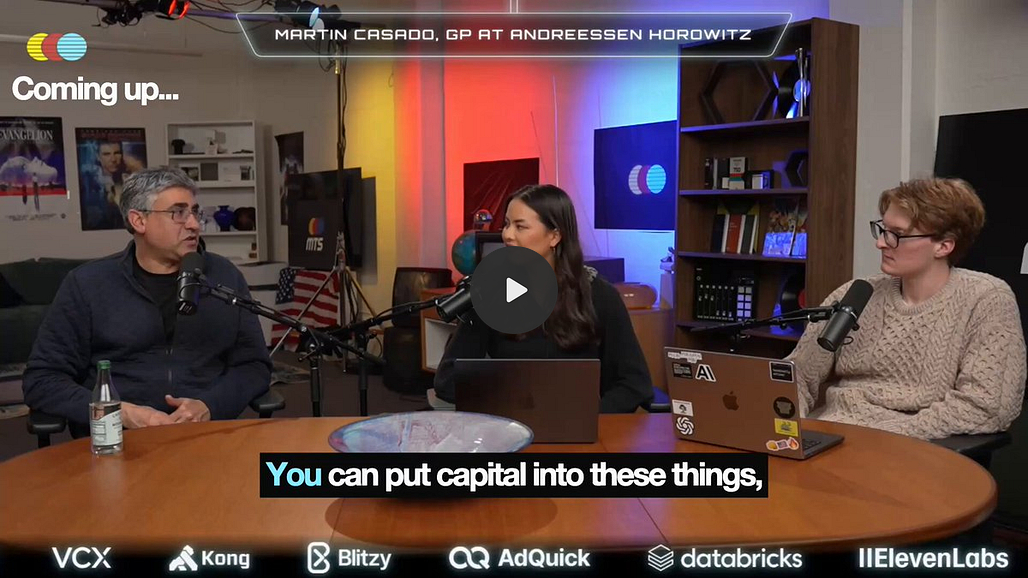
FULL INTERVIEW:

Keep reading
More on AI infrastructure deals
▫️ Jonathan Ross Turned a 3-Week Phone Call Into a $20 Billion NVIDIA Deal
▫️ SpaceX Just Became the Biggest IPO in History
▫️ The AI Trade Just Lost $1 Trillion
More on where AI capital is going
▫️ How This One Fund Built the Entire Venture Capital Industry
▫️ OpenAI’s Cap Table Just Leaked
▫️ The Distribution Singularity
More on building the moat, not the model
▫️ What Makes a Business Unbreakable When Software Costs Nothing
▫️ Anthropic Is Closing In on a $1 Trillion Valuation