

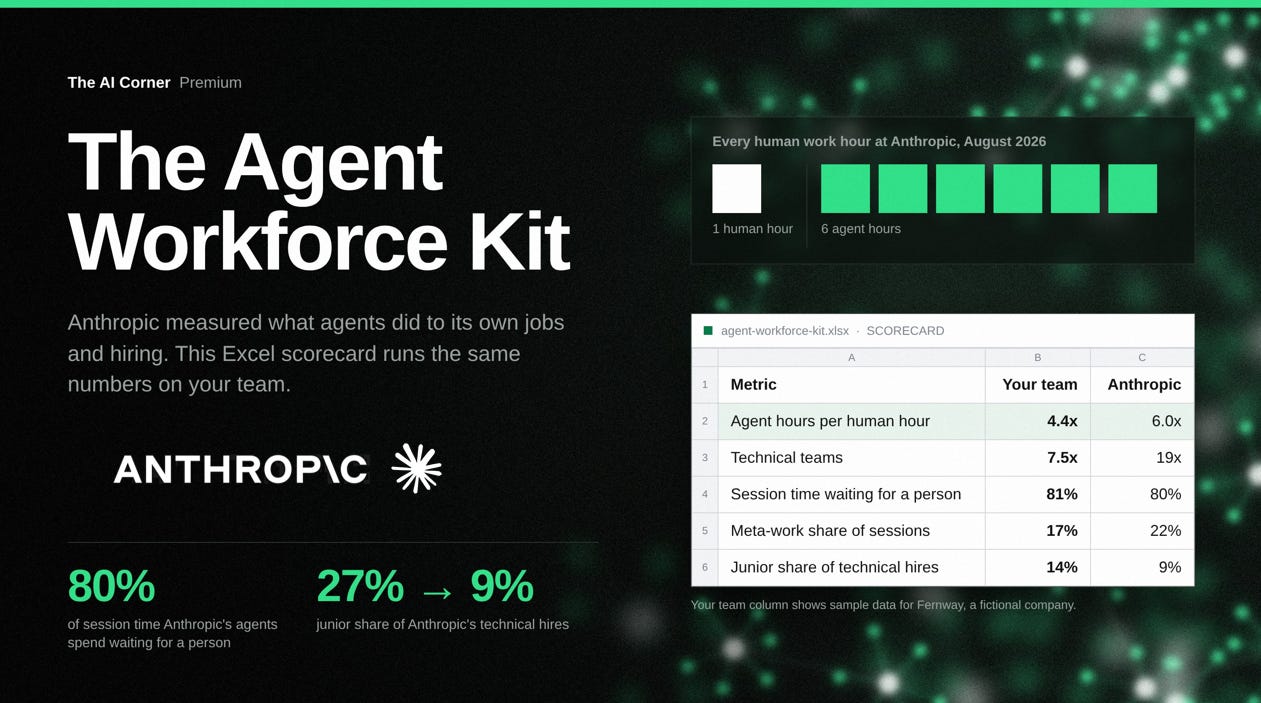
On October 16, Anthropic published a study of its own workforce. Four researchers at the Anthropic Institute pulled HR records, agent telemetry, calendars, Slack threads and the scorecards hiring managers fill in after interviews, then talked to 17 employees about how their jobs had changed.
By August, the agents Anthropic’s employees direct were working six hours for every hour their humans worked. Over roughly the same stretch, the junior share of technical hires fell from 27% to 9%.
Seventeen months ago, Dario Amodei told Axios that AI could eliminate half of entry-level white-collar jobs within five years. How employment is changing at Anthropic is the first time his company has shown what that shift looks like inside Anthropic itself, with numbers attached.
I expected the junior number. The one that stopped me was 80%, which is how much of an interactive Claude session the agent spends idle, waiting for a person to answer.
The report works on two levels. It’s the best evidence so far of what an agent-heavy company looks like from the inside, and it’s a measurement method any company can copy. I built a kit for the second part.
Inside Anthropic’s numbers
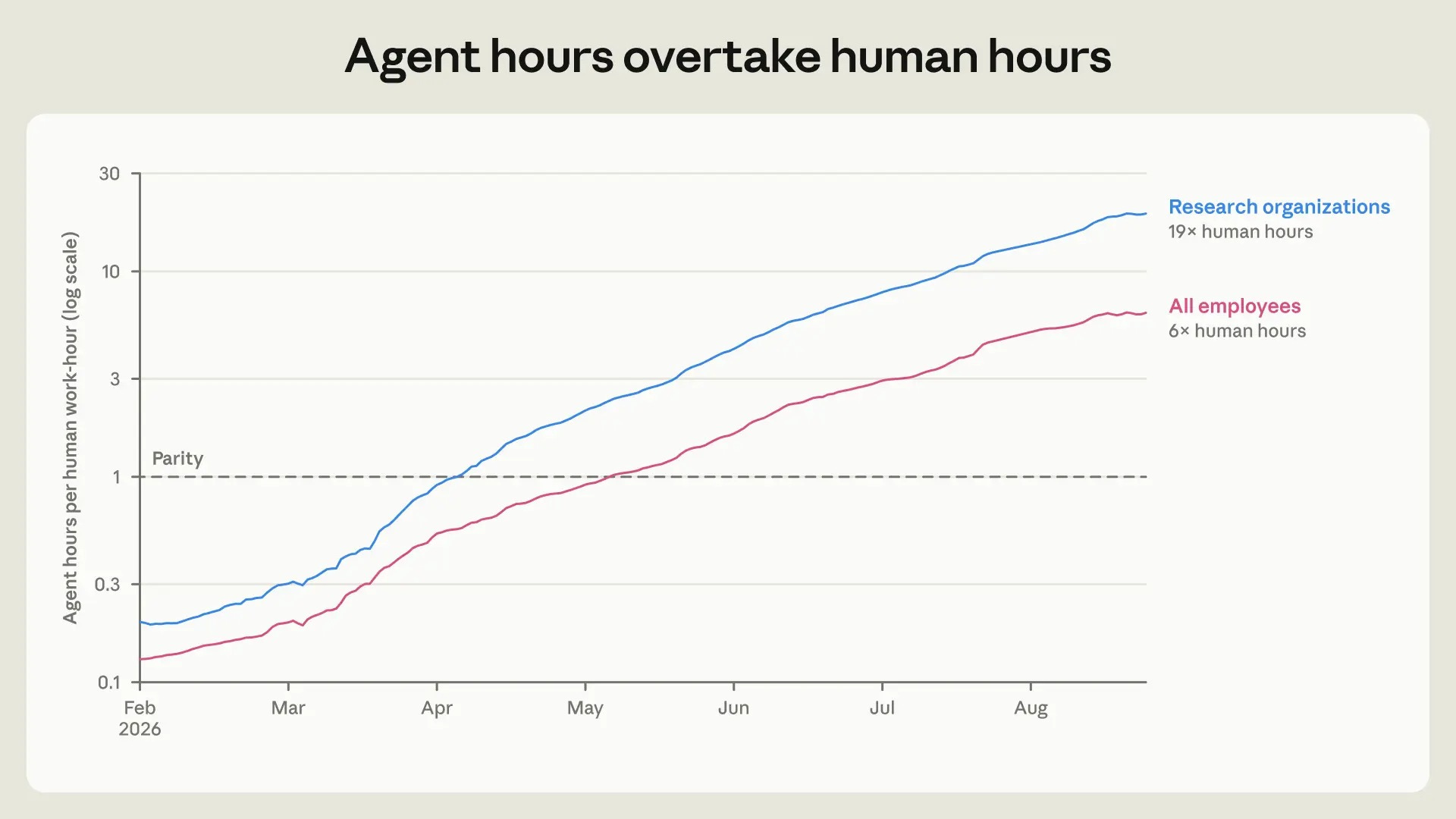
Here’s the whole report on one page before we get into each finding.
Agents passed people in March
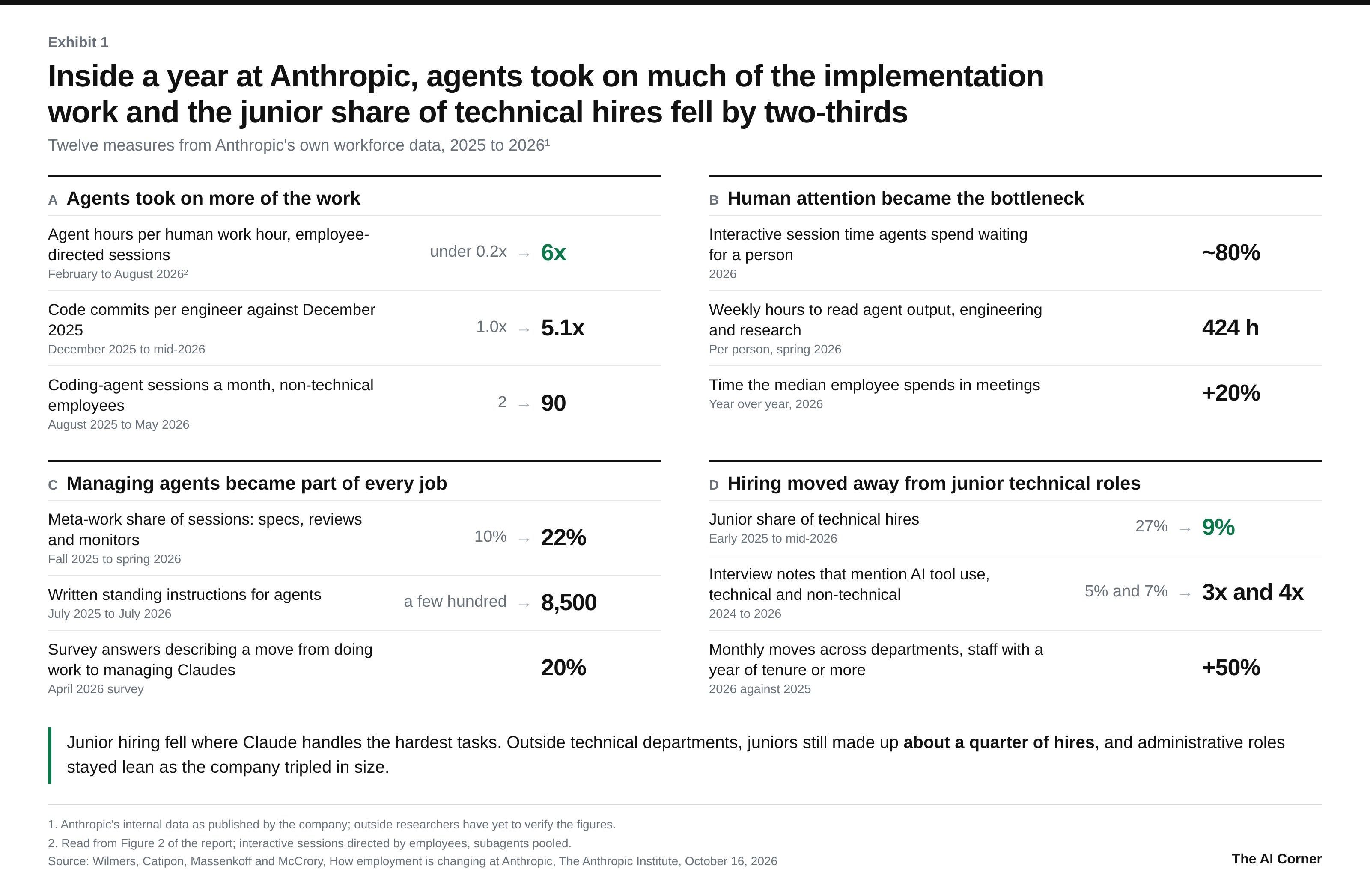
Counting every autonomous and interactive session, agent work hours passed human work hours for the first time in March 2026. Narrow it to the sessions individual employees direct and agents logged 6 hours per human hour by August, with research organizations at 19x.
Much of that is industrial: fleets of agents filling in tests, maintaining infrastructure code and translating whole codebases. Some of it is ordinary office work, where personal agents read calendars, brief employees on who they’re about to meet and turn incoming messages into to-do lists.
Output rose wherever someone counts it
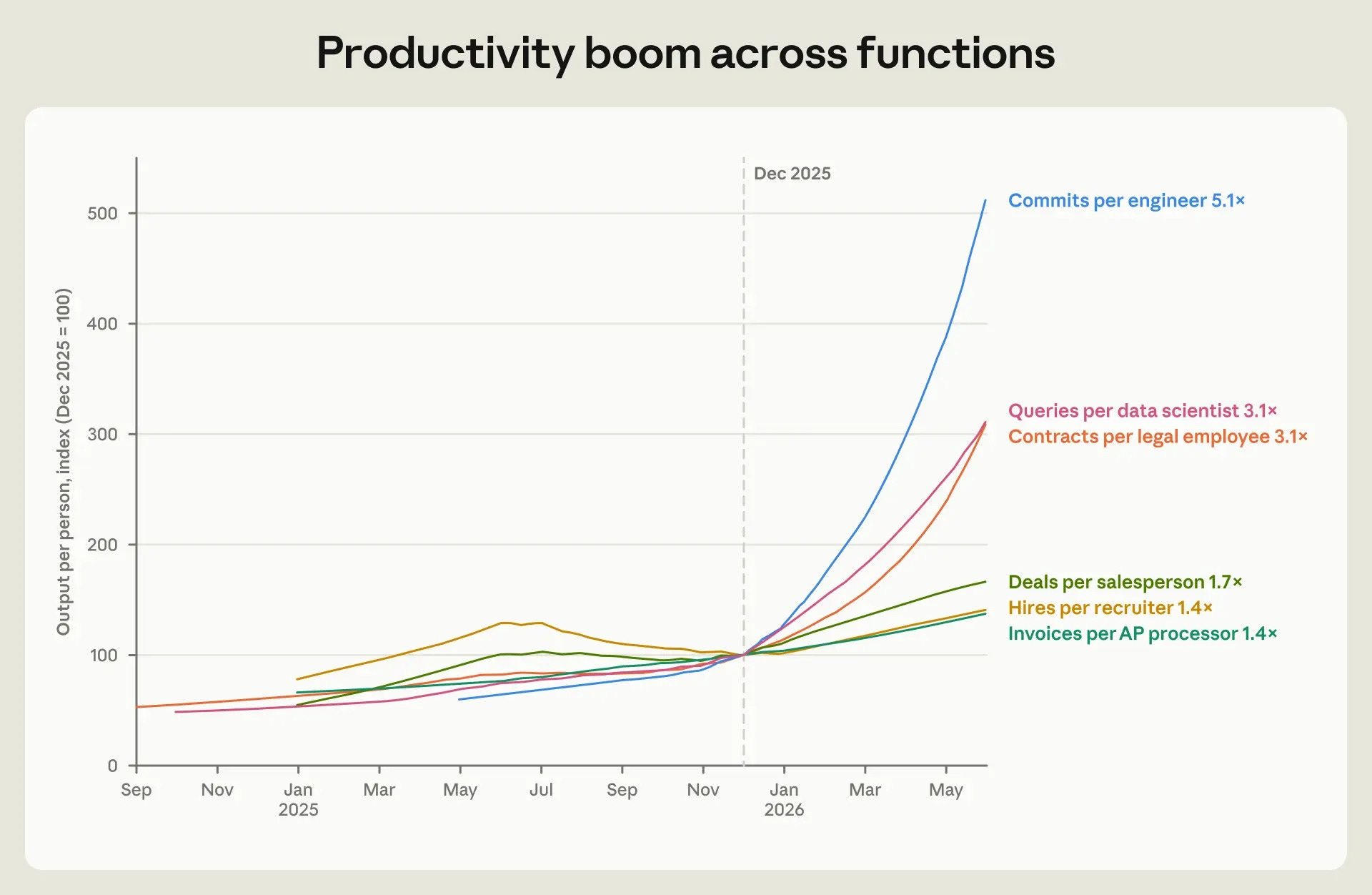
Commits per engineer reached 5.1x their December 2025 level. Queries per data scientist and contracts per legal employee both hit 3.1x, while deals per salesperson rose 1.7x and hires per recruiter 1.4x.
Anthropic’s revenue exploded over the same months, and it’s easier to close deals when you sell a strong model. So the researchers compared 192 engineers who adopted coding agents with 74 who stayed on their old tools, month by month. Output jumped after adoption, and engineers removed or reverted agent-written code at the same rate as code they wrote by hand in the same month and the same directory.
Sales showed the same pattern. One account executive estimated that Claude automations took over about 20% of their prior tasks, and another now talks to 30% more customers.
Junior technical hiring fell by two-thirds
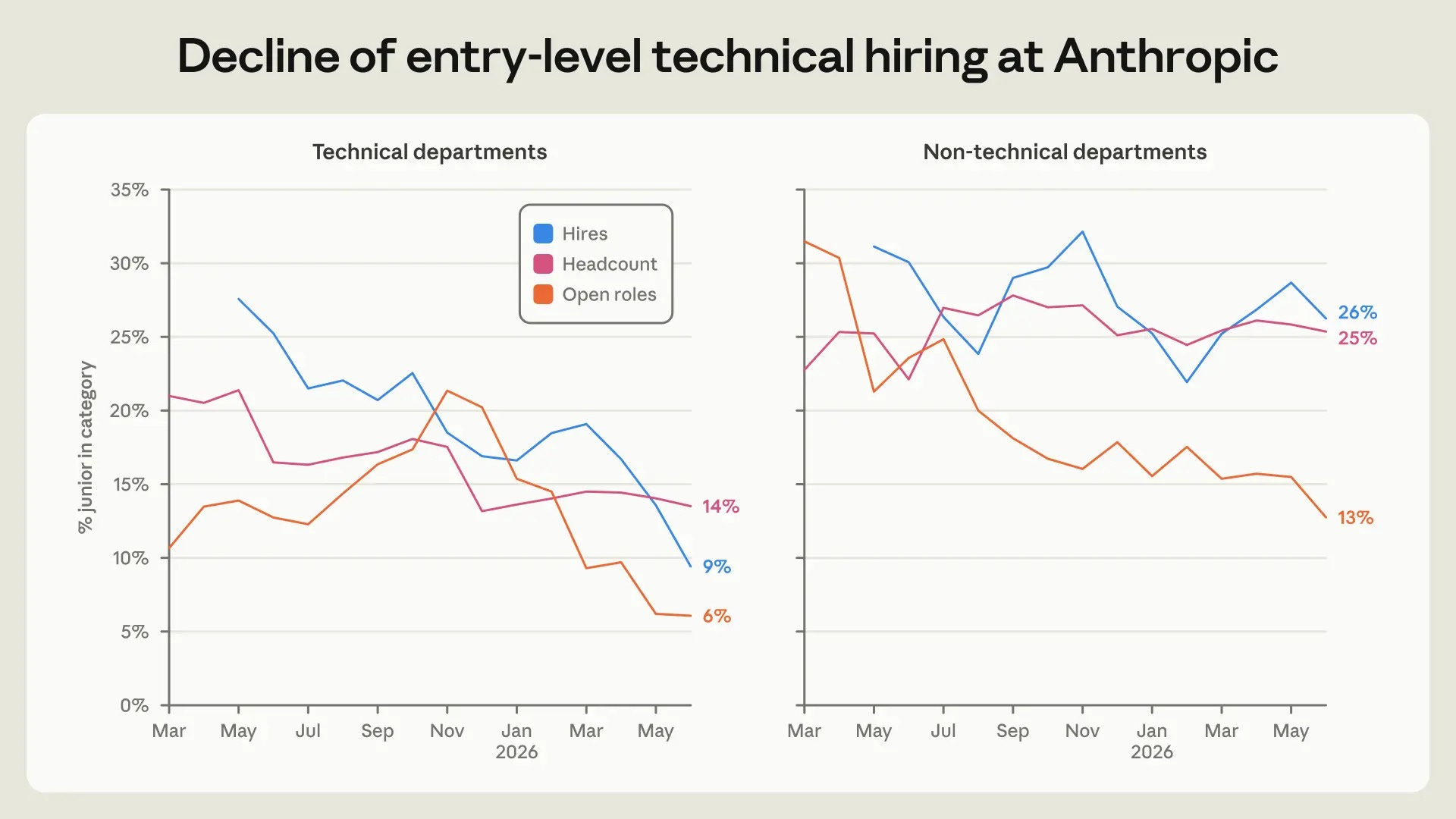
The junior share of technical headcount slipped from 21% to 14% since early 2025, and the junior share of technical hires fell from 27% to 9%. Postings for juniors dropped fastest after December 2025, when, in one manager’s words, a new model “basically overnight changed what we were looking for.” Non-technical departments held steady, with juniors still making up about a quarter of hires there.
Anthropic kept growing through all of it. It tripled in size in a year, and it takes in two to four times the revenue per employee that Google and Meta did at the same age. Total technical hiring kept rising, while the share of juniors inside it shrank.
The pattern shows up outside Anthropic too. In August, Stanford’s Digital Economy Lab updated its canaries study: employment for 22-to-25-year-olds in the most AI-exposed occupations now sits about 19% below peers in less-exposed jobs, up from 15% a year earlier, and the gap comes from fewer hires rather than more layoffs. Seyed Mahdi Hosseini Maasoum and Guy Lichtinger tracked 62 million US workers at 285,000 firms and found junior employment at AI-adopting firms falling behind non-adopters from early 2023, through the same hiring channel. Rembrand Koning and Hyunjin Kim found that AI-native startups run 25% smaller, with entry-level shares about 15% lower and senior shares 20% higher.
People became the bottleneck
Convert agent output tokens into reading time and even non-technical teams at Anthropic would need more than half their week to read what their agents write. For engineering and research, the figure is 424 hours per person per week. One engineer described the job as facing “an army of Claudes, with every one asking for my attention.”
Employees answered by building tools for the agents. Meta-work, meaning specs for multi-agent runs, agents that review other agents and monitors for pipelines, rose from 10% of interactive sessions to 22% between fall 2025 and spring 2026. Written standing instructions for agents went from a few hundred to 8,500 in a year, and the median employee now spends 20% more time in meetings.
Hiring managers write about judgment
Mentions of a candidate’s AI tool use tripled in technical interview notes and quadrupled in non-technical ones between 2024 and 2026. For technical candidates, comments on autonomy and judgment grew the most, and domain expertise shrank as a share of the assessment.
“I expect models to continue to be jagged, so for my team I want them to be fungible across domains.”
An Anthropic hiring manager, quoted in the report
The number I trust least
Commits per engineer at 5.1x is the figure I’d discount. A commit measures activity, and the gap between activity and shipped product is wide. Mert Demirer, Leon Musolff and Liyuan Yang followed more than 500,000 GitHub developers through three generations of AI coding tools: autonomous agents lifted commits about 240%, while actual releases rose about 30%. Their verdict is that “large task-level AI productivity gains have therefore translated only partially into shipped and used software thus far.”
Keep in mind who wrote the report, too. These are Anthropic’s own figures about Anthropic, a company with first access to its own models, and outside researchers have yet to verify them. The authors name the selection problem themselves: engineers about to start a big project may pick up agents first, which inflates the adoption effect.
Agent hours per human hour still belongs on every leadership dashboard next to revenue per employee. It’s the first AI metric that tells you how much of your company’s work already runs while your people do something else.
Three numbers you can calculate this week
Agent hours per human hour. Turn on Claude Code telemetry with
CLAUDE_CODE_ENABLE_TELEMETRY=1, sumclaude_code.active_time.totalwheretype="cli"for one month, and divide by headcount x 173 work hours. Anthropic sits at 6x. Below 1x, your people still out-work their agents.Reading load. Take a month of output tokens per team, multiply by 0.75 to get words, divide by 250 words a minute and by 60, then by headcount and by 4.33 weeks. That’s how many hours a week each person would need to read everything their agents produced. Once it passes half a work week, as it did across Anthropic, your team needs triage tooling, which is exactly what Anthropic’s employees built.
Junior share of hires. Junior hires divided by all hires over the last four quarters, split into technical and non-technical. Anthropic’s technical figure went from 27% to 9%. If yours moved by accident, put it on the agenda this month.
Those three numbers tell you where you stand. Paid subscribers get the full system Anthropic described, rebuilt so any company can run it:
▫️ The Agent Workforce Kit, an Excel workbook with 10 tabs and 2,000+ live formulas that computes Anthropic’s 8 workforce metrics for your company and opens in Google Sheets
▫️ The early warning radar, which scores every role on agent exposure and hiring demand and shows where to plan redeployment first
▫️ The adoption test, Anthropic’s adopter-versus-non-adopter comparison in one tab, with a pre-trend check that catches inflated results
▫️ The agent-era hiring scorecard, with interview evidence for each criterion and a 90-minute work trial
▫️ 12 Claude prompts, from pulling Claude Code telemetry to the monthly workforce memo for your leadership team
Your subscription also opens the rest of the library, including how to use Claude like the top 1%, Claude Code as your chief of staff, the one-person startup operating system and the 2026 AI engineer roadmap, plus every guide in the Claude and Anthropic and AI agents libraries.