

Every founder I know asks me for the same links. Which investor database is worth paying for, where the credits are, what goes in the data room, whether YC still gives $500K.
So I started putting them in one place, and then I checked every one, because a list like this goes stale faster than most founders think. Pulley, the cap table tool, says it will cease operations on December 8. Anthropic’s startup program filled its cohort and closed to new applicants. The US SBIR program lost its authority to make new awards for six months, until Congress reauthorized it in April.
What follows is the toolkit I’d want if I were raising this quarter, with every link checked on October 18, 2026, and organized around how a raise actually runs.
What changed in 2026
AI companies took 82.7% of US venture dollars through September, according to the PitchBook-NVCA Venture Monitor. Globally, AI startups raised $102B of the $159B invested in Q3, per Crunchbase.
Those headlines hide where the money sits. Rounds of $100M or more made up about 5% of US deals in Q3 and 75% of the dollars, and in the same quarter 27 rounds of $1B or more took about a third of everything raised worldwide.
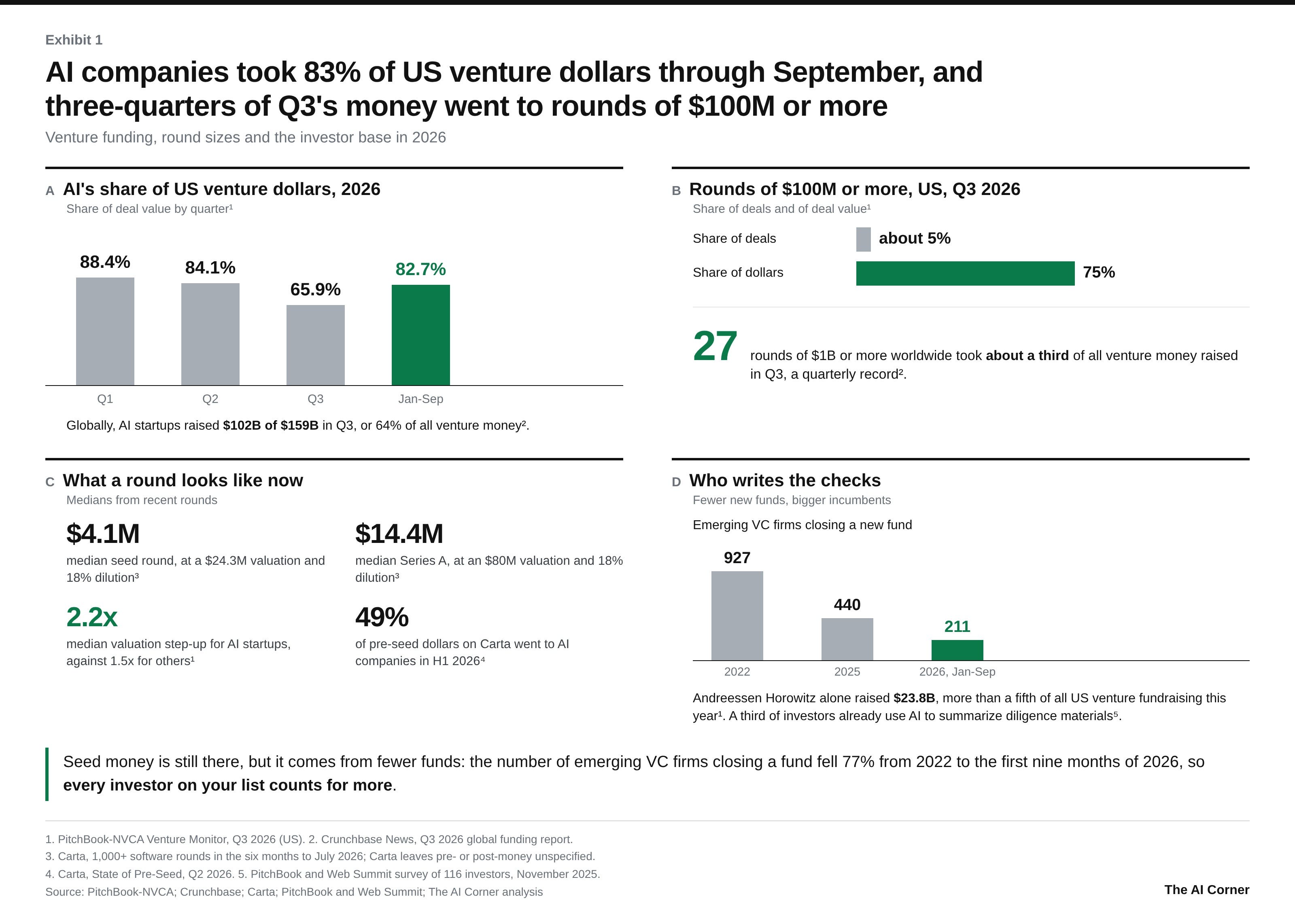
For a seed founder, the useful numbers are smaller. Carta’s benchmarks from more than 1,000 software rounds put the median seed at $4.1M raised on a $24.3M valuation, with 18% dilution, and the median Series A at $14.4M on $80M. AI startups get a median valuation step-up of 2.2x between rounds, against 1.5x for everyone else, per PitchBook.
The number that changed how I’d raise is 211. That’s how many emerging VC firms closed a new fund in the first nine months of 2026, down from 927 in 2022. Andreessen Horowitz alone raised $23.8B, more than a fifth of all US venture fundraising this year. Fresh seed money now comes from fewer desks, which makes every investor on your list worth more of your preparation.
Those desks also read differently. In a PitchBook and Web Summit survey of 116 investors, 34% said they already use AI to summarize due diligence materials and 26% use it to find deals. Your data room gets read sooner and more literally, and a number that disagrees with your deck is easier to spot.
The premium I’d ignore
I’m skeptical of the AI valuation story as a fundraising plan. Carta’s 95th-percentile seed valuation reached $200.4M in Q2 2026, up from $72.2M a year earlier, and those outliers are the rounds founders hear about. The median is still $24.3M, and AI’s share of US dollars fell every quarter this year, from 88.4% in Q1 to 65.9% in Q3. Price your round off the median and your metrics, and treat anything above it as upside.
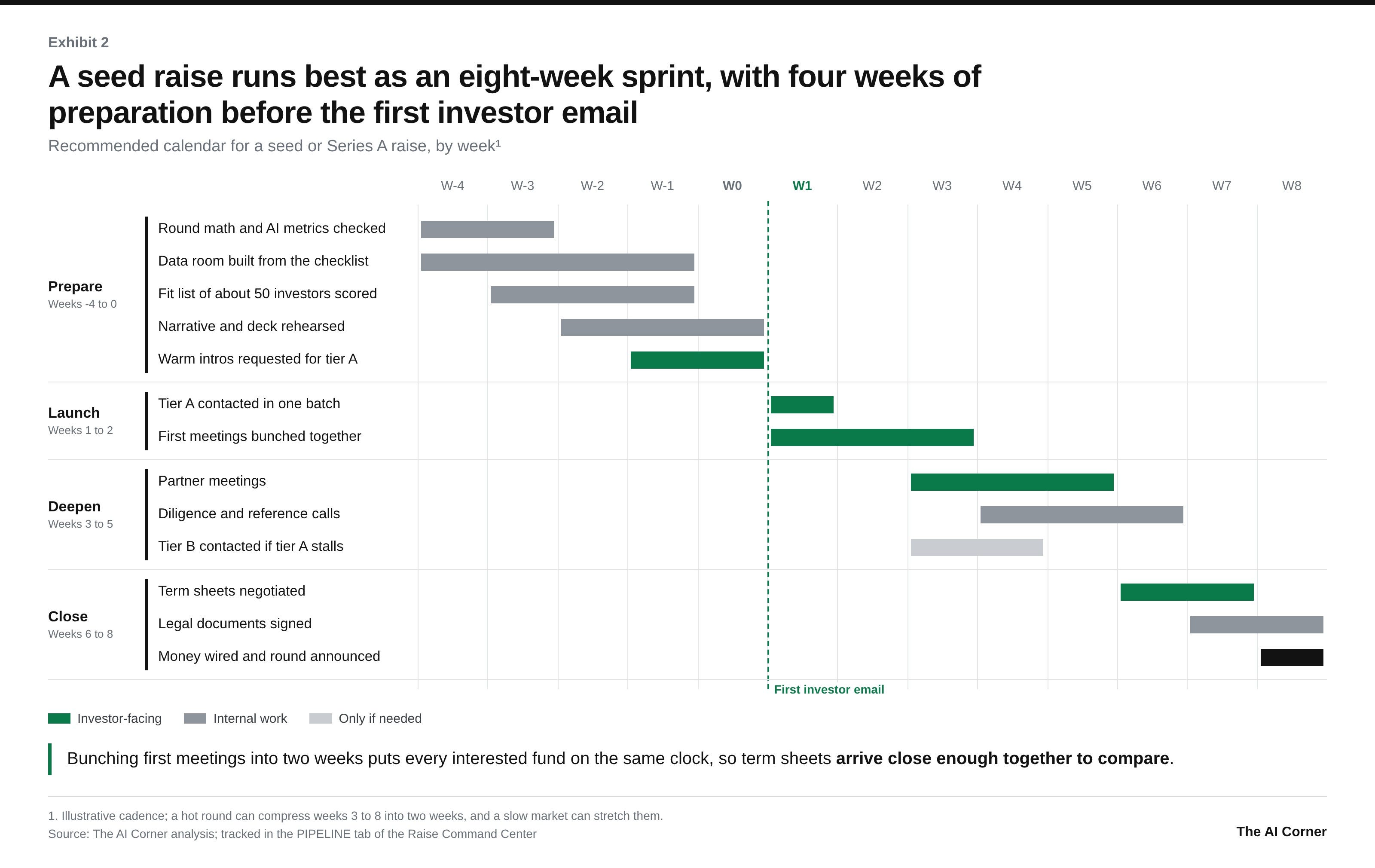
A raise in 2026 is won in the four weeks before the first investor email. The round math, the fit list and the data room decide how fast the next eight weeks go.
The 10 links I’d send any founder today
YC’s guide to seed fundraising, the most complete free guide on why, when and how to raise.
Paul Graham’s How to Raise Money, still the best case for raising fast and keeping investors on the same clock.
Carta’s 2026 fundraising benchmarks, so your round size and dilution start from current medians.
OpenVC, a free investor search that currently lists 18,478 investors and tracks your outreach.
NFX Signal, free investor lists cut by stage, sector and region.
Visible Connect, a free database with 19K+ investor records to cross-check your list.
YC’s SAFE documents, the standard post-money SAFE templates and the user guide that explains them.
Papermark, an open-source data room you can self-host, with page-level analytics on who read what.
Google for Startups Cloud, AI tier, tied with Cloudflare for the largest credit offer I found: up to $350K over two years for AI-first startups with institutional funding.
EIC Accelerator if you’re in Europe (a grant below €2.5M plus up to €10M in equity, next cut-off November 4) or NSF SBIR if you’re in the US (up to $305K in Phase I, next deadline November 4).
Those ten get you started. The other 95 links, the workbook and the prompts are where the raise actually gets run.
Paid subscribers get the full toolkit today:
▫️ The Raise Command Center, an Excel workbook with 10 tabs and nearly 800 live formulas: investor fit scoring, a pipeline with stale-follow-up flags, round math with dilution and runway, a credits tracker and a data room checklist. It opens in Google Sheets.
▫️ The 105-link library, every resource sorted into seven sections, each with a note on what to use it for and checked on October 18
▫️ The AI diligence pack, covering what investors check in an AI company at each stage and the documents that answer it
▫️ The credits stack, $1.31M advertised across 12 open programs, plus the partner codes that open the top tiers
▫️ The Europe and US funding map, with grants, loans and tax relief from the EIC to SEIS and current deadlines
▫️ 15 Claude prompts, from the readiness check to the term sheet review
Your subscription also opens the rest of the library, including the Claude prompts that close rounds, 153 email addresses from top AI VC funds, the 200 most active angel investors and the AI startup pitch decks library, plus every guide in the Business and investing and Claude and Anthropic libraries.
The Raise Command Center
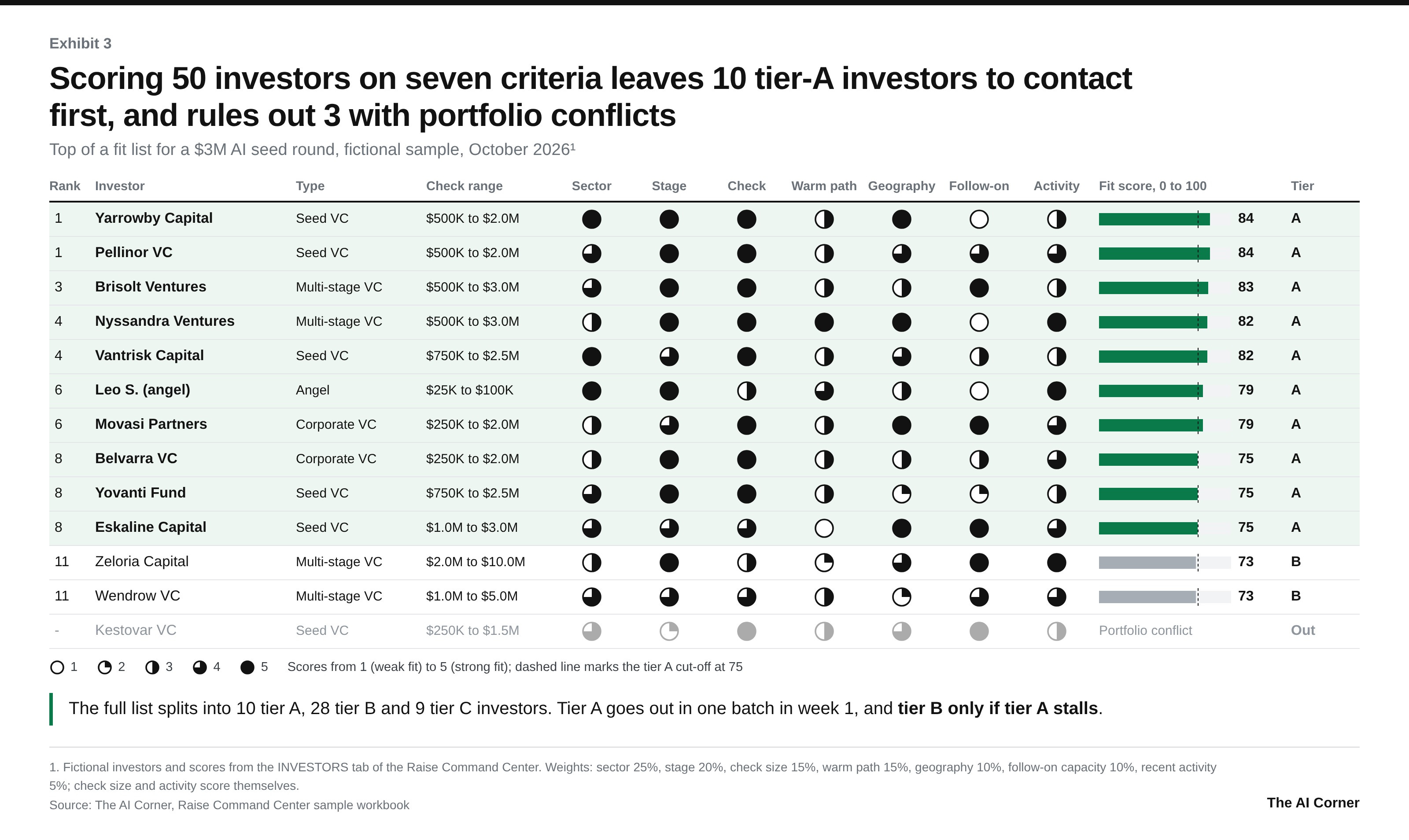
The workbook opens on README, then DASHBOARD. Blue cells are inputs and black cells are formulas, while yellow cells hold the settings you’ll change, such as scoring weights and thresholds. The sample company is Lumora, an invented AI startup raising a $3M seed, and every investor in it is invented too: