

A Single Foundation, Every Floor
Every earnings call this year centered on AI adoption inside enterprises.
Pull back the aggregate growth numbers, though, and a huge share of the actual dollars traces back to a short, specific list of names.

A legal AI startup burning through venture capital. A coding assistant that got cut off by 1 lab entirely, the same week its owner changed. A pair of hyperscalers mostly re-routing money that 2 AI labs promised them years in advance.
The industry describes all of this as demand.
Look closely at the customer lists, the compute contracts, and who is paying whom, and nearly the entire commercial case for AI runs through a group small enough to fit at a few dozen conference tables, with every floor of the stack leaning on the floor below it.
The whole building rests on one foundation, and almost nobody has checked what it’s made of.
Here’s what that structure looks like, floor by floor.
Together with Hard Skill Exchange:
Concentration risk sits above your pay grade. Agent governance sits squarely inside it, and the Agentic Harness Summit is live right now.
Day 3, virtual, free, and you can join mid-session without a ticket:

Today’s lineup:
▫️ The Pattern Breaker After the Model, with Mike Maples Jr. (Floodgate)
▫️ Context Graphs: The Enterprise Moat, with Jaya Gupta (Foundation Capital)
▫️ The Company Brain, with Jay Hack (Head of AI, ClickUp)
▫️ The Next AI Investment Thesis, with partners from Insight, Scale VP, Thomson Reuters Ventures, and Gradient
Table of Contents
1. The Adoption Numbers Are Real, and Also Beside the Point
2. Money That Isn’t Quite Money Yet
3. 1 Customer, 2 Endings, Same Year
4. The Promises That Haven’t Come Due
5. The Concentration Runs All the Way Up
6. Same Few Names, Every Floor
1. The Adoption Numbers Are Real, and Also Beside the Point
In July, Anthropic grew to 43.5% of US businesses paying for AI subscriptions or tokens, up 1.1 points month over month.
xAI posted its fastest growth since July 2025, up 0.94 points to 4%. OpenAI grew only 0.23 points, to 39.7%, trailing the market’s overall pace.
Based on these numbers, AI adoption looks like a rising tide lifting 3 competitors at once, broad based and accelerating.
The 1% That Actually Pays
Ramp’s own customer data shows that just 1% of OpenAI and Anthropic’s customers generate 80% of their enterprise revenue, a split that hasn’t moved in 3 years, and Ramp’s lead economist has called it a level of concentration risk unseen in any other software category the firm tracks.
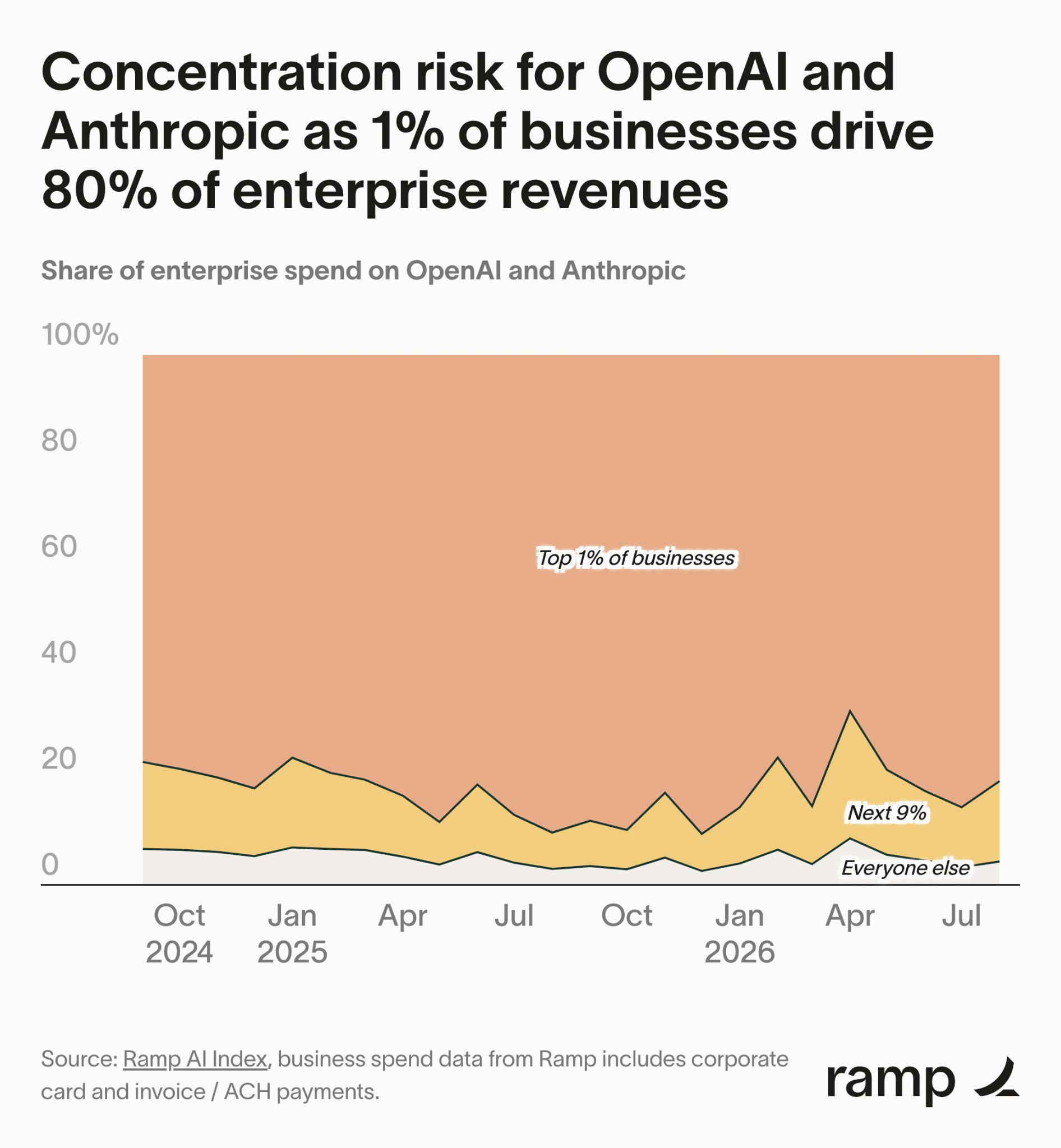
The gap between the top and the middle is enormous. The median business spends $11.95 per employee a year on AI. The top 1% of spenders, a mix of AI-native companies and ordinary businesses spending to look current, spends a median of $7,400 per employee, more than 600 times as much.
That top 1% skews toward 2 kinds of company: AI startups whose entire product is a wrapper around someone else’s model, and tech companies spending because their competitors are.
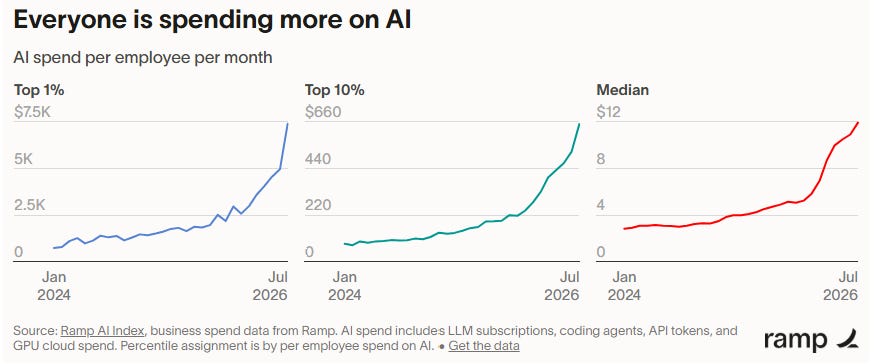
Growth is also spreading sideways, not just up. 6.1% of AI using businesses now use model serving platforms that provide access to open source and Chinese developed models, up 0.2 points from the previous month, a share that has been climbing steadily.

2. Money That Isn’t Quite Money Yet
A large share of what AI labs count as enterprise revenue is downstream of a funding round, not a customer’s own balance sheet.
How the Subsidy Actually Works
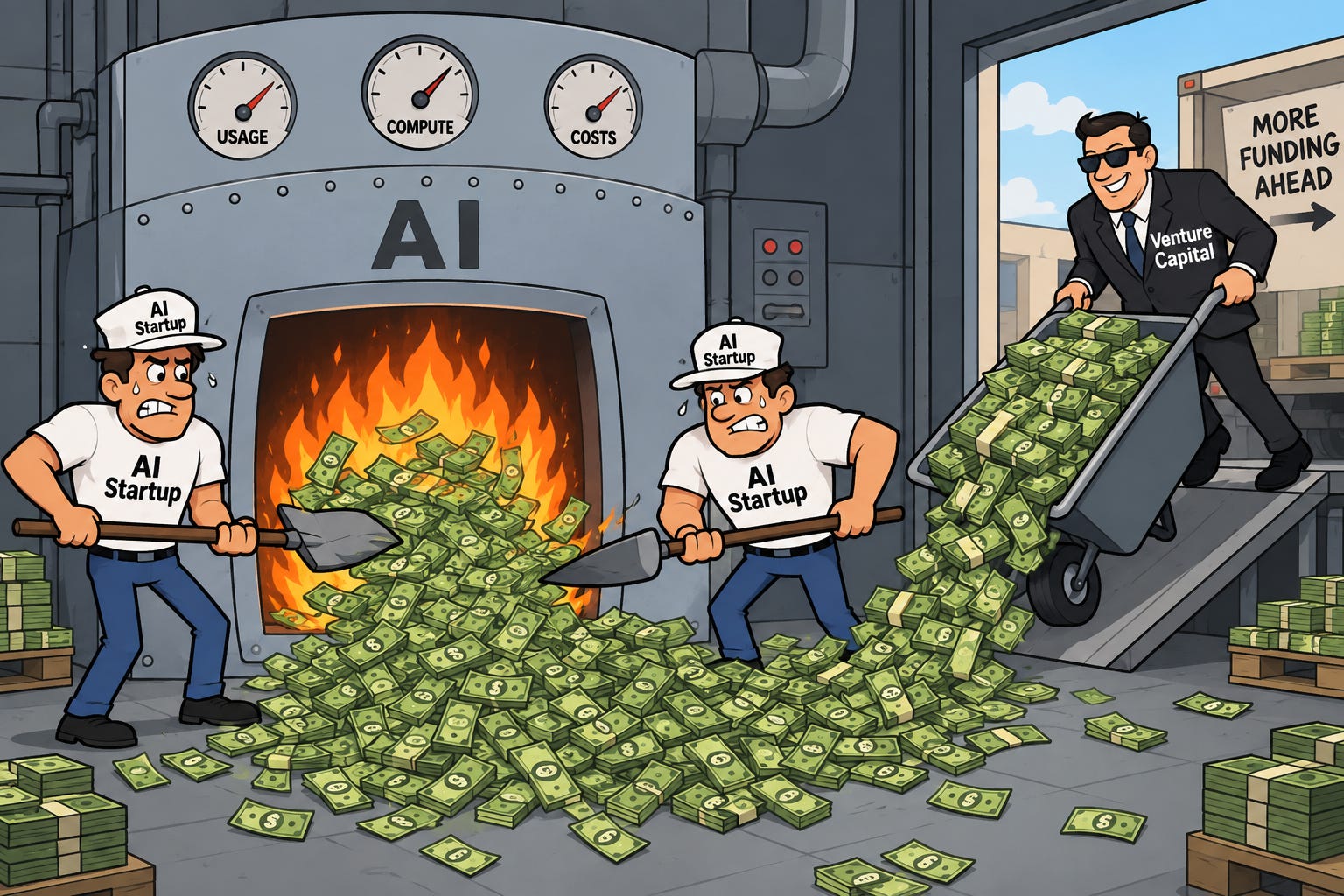
Many AI native startups sell a flat subscription, then let customers burn far more than that subscription price in tokens behind the scenes, with the startup absorbing the difference.
That only works as long as venture capital keeps refilling the gap. The startup isn’t paying OpenAI or Anthropic because the unit economics work. It’s paying because investors are still funding the difference between what customers pay and what the tokens actually cost.
Harvey’s 2 Numbers
Legal AI startup Harvey is a clean example. It has raised over $1.5 billion total including the latest $550 million, while running at roughly $350 million in annualized revenue, or about $29 million a month.
Harvey raised more than $800 million in 2025 alone, and closed the year at roughly $190 million in annualized run rate, about $15.8 million a month. It raised close to 4 times what it earned over that same 12 months.

None of this makes Harvey a bad business. It makes Harvey a bet, and every dollar it sends to Anthropic or OpenAI is, for now, a dollar that came from somewhere other than a paying legal client.
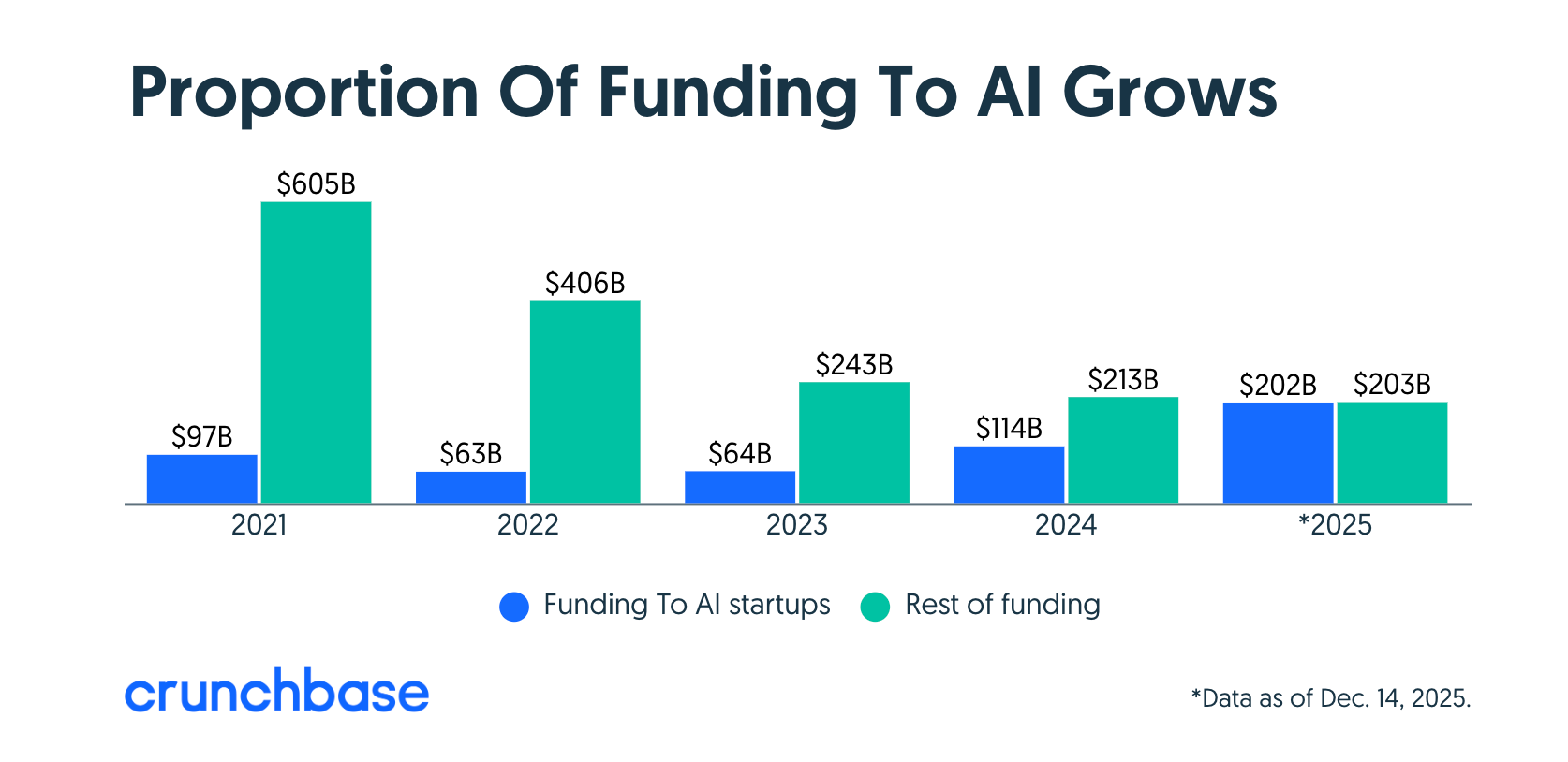
None of this is a fluke of a couple of unusual companies either. Roughly 50% of all global venture capital flowing into startups in 2025 went into AI, which means the subsidy machine funding bills like Harvey’s was itself the single largest destination for growth capital anywhere in the world that year.
But Harvey is just 1 company. The next example shows how quickly that kind of dependency can become someone else’s problem entirely.
3. 1 Customer, 2 Endings, Same Year
No example makes concentration risk more concrete than what happened to 1 coding startup over about 14 months.
What Cursor Was Worth To 2 Labs At Once
Cursor raised $3.2 billion across 2 rounds in just 4 months in 2025: $900 million in June, $2.3 billion in November, largely to keep funding its own token bill.
By mid-2025, Anthropic’s 2 largest customers together represented $1.2 billion of annualized run rate, roughly 30% of its $4 billion run rate at the time, and investors believed Cursor was 1 of the 2.
Separately, Cursor was reportedly on track to generate over $1 billion in 2026 revenue for OpenAI alone, more than 3% of OpenAI’s projected $30 billion for the year, even though OpenAI’s own models made up only about 5% of Cursor’s traffic.
What Changed In August 2026
Late that month, Elon Musk’s SpaceX completed a roughly $60 billion acquisition of Cursor’s parent company, valuing a business with close to $4 billion of its own annualized revenue at around 15 times that figure.
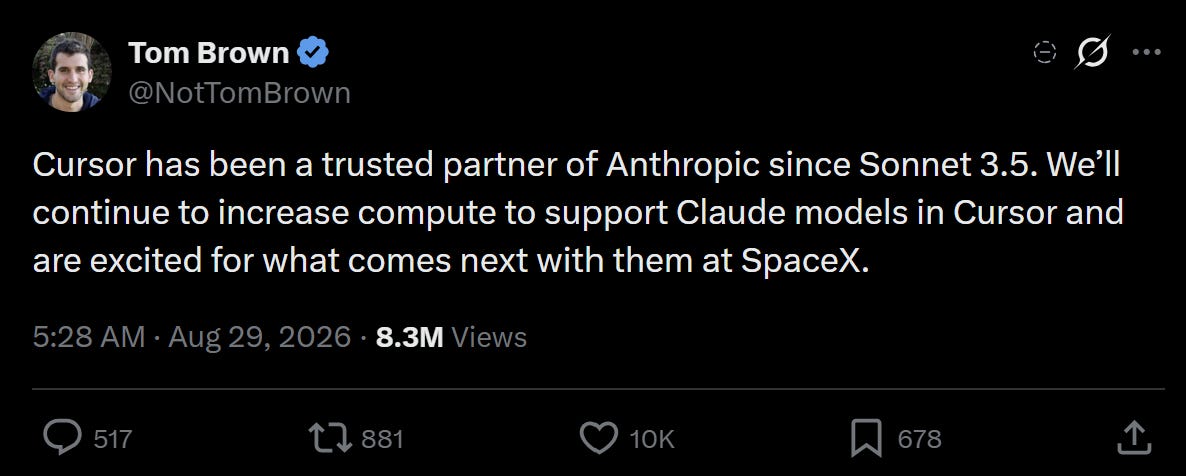
Within days, OpenAI moved to cut off Cursor’s access to its models entirely, citing its own experience with Musk’s companies breaking contracts, with a shutoff date of November 12, 2026.
Anthropic, almost immediately and publicly, pledged to expand compute for Claude inside Cursor instead. A relationship worth hundreds of millions of dollars a year to 1 lab changed direction because of an acquisition that had nothing to do with the product, the customer’s usage, or anything either AI lab actually controlled.
So, if a single coding customer can move that much revenue overnight, the far larger commitments sitting 1 floor above customer revenue deserve just as much scrutiny.
From our partners:
Harvey's bill gets paid by a funding round. The agents your own company runs get paid for by you, so knowing what they're authorized to spend and do is the cheaper problem to solve.
The Agentic Harness Summit is live right now, day 3, virtual, free, join mid-session.

4. The Promises That Haven’t Come Due
Do you know which, much larger, number awaits to be calculated?
What OpenAI and Anthropic have already promised to pay for compute, most of which hasn’t been billed yet.
How Big The Promise Already Is
Anthropic and OpenAI’s compute commitments now represent more than $1.3 trillion in future revenue for hyperscalers and neoclouds, including Google, Microsoft, Amazon, SpaceX, Oracle, Cerebras and several smaller players.
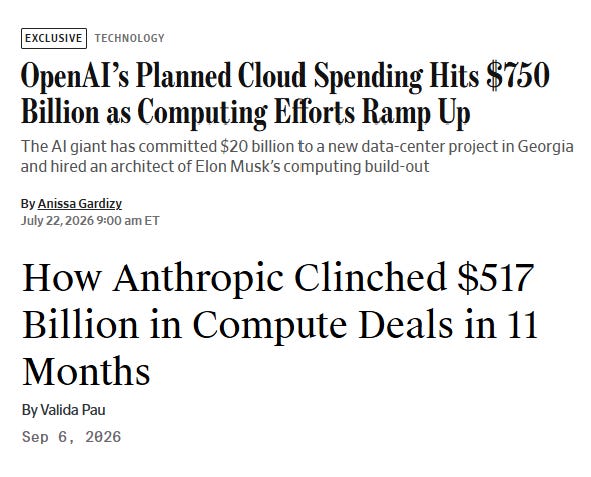
OpenAI was projected to spend over $750 billion on compute through 2030 before it added another major deal on top of that figure.
Anthropic has signed roughly $517 billion in compute agreements over the last 11 months alone.
On top of the headline commitments, the 2 labs together are expected to spend about $40 billion on Amazon Web Services and at least $50 billion more on Microsoft Azure in calendar 2027, layered on top of everything above.
Why None Of It Feels Urgent Yet
Most of these are take or pay contracts, which means that the buyer owes the money on schedule whether or not it uses the capacity. Signing one costs very little upfront, because the data center capacity being promised hasn’t been built yet.
That changes starting in 2027, when a large share of that capacity comes online and the bills start arriving at scale.
Analysts estimate OpenAI and Anthropic will together account for at least $444 billion of hyperscaler revenue over the next 3 fiscal years combined, a figure that only holds if both companies keep growing at close to their current pace.
The affordability gap is easiest to see in OpenAI’s own numbers: $34 billion in operating expenses against $13.07 billion in revenue in 2025, with its operating margin reportedly worsening to negative 183% in the 2nd quarter of 2026.
5. The Concentration Runs All The Way Up
Every layer above the AI labs turns out to be leaning on the same 2 companies too.
Whose Cloud Revenue This Really Is
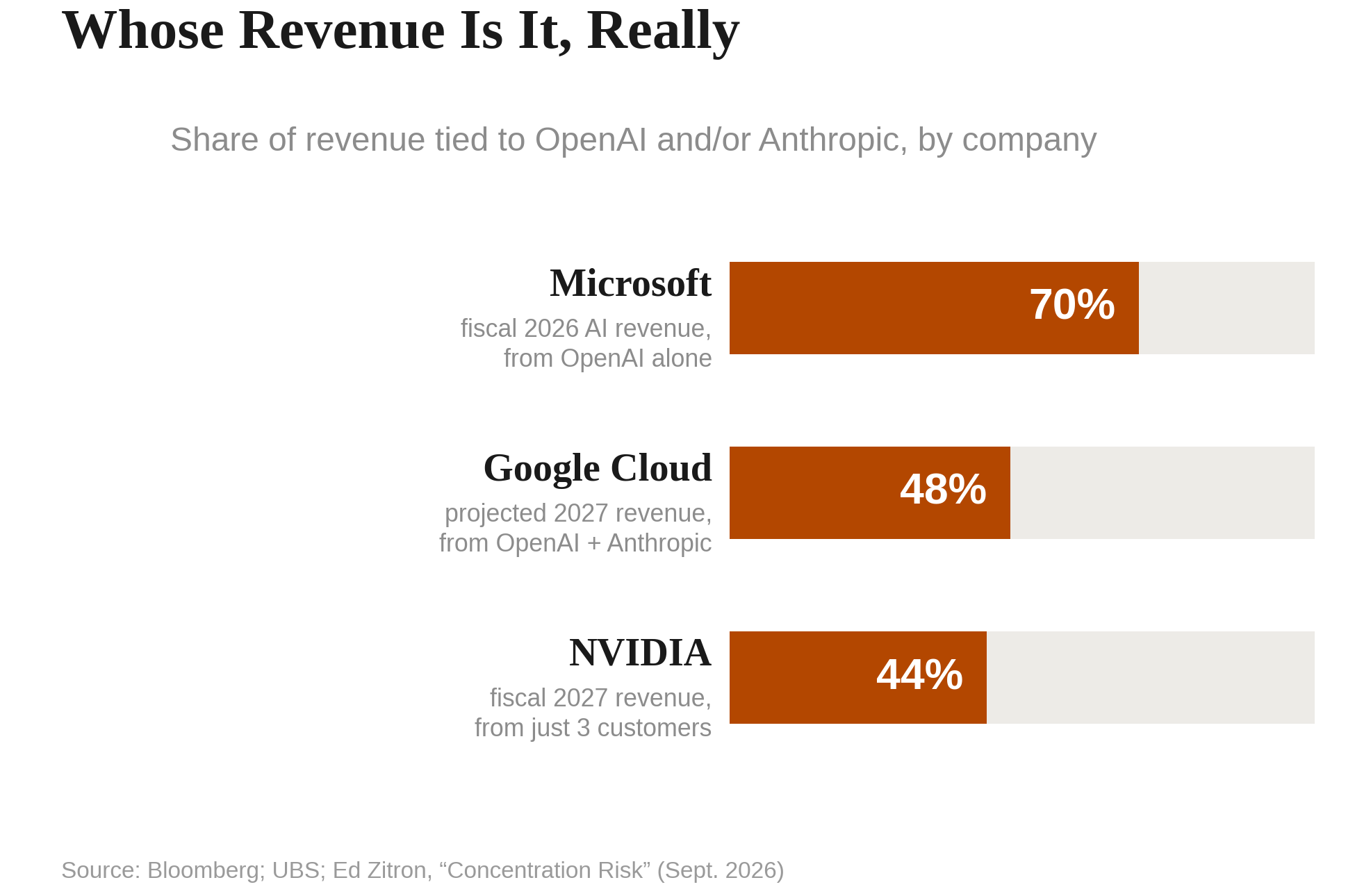
Only about $10 billion of Microsoft’s $33.33 billion in fiscal 2026 AI revenue reportedly came from selling compute or AI software to Microsoft’s own customers. The rest traces back to OpenAI’s committed spend, which by itself made up around 70% of Microsoft’s entire AI revenue that fiscal year, or a little over 7% of Microsoft’s total company-wide revenue.
Analysts estimate OpenAI and Anthropic’s compute spend will account for 48% of Google Cloud’s entire revenue next year, somewhere between $84 billion and $100 billion.
Even The Chipmakers Have 1 Real Customer
Across its most recent 2 quarters, 44% of NVIDIA’s fiscal 2027 revenue came from just 3 customers, and 16% of its most recent quarter came from 1 customer widely believed to be serving Anthropic’s compute needs.
Jensen Huang Bet Wrong, Told the Truth, and Built a $5 Trillion Company
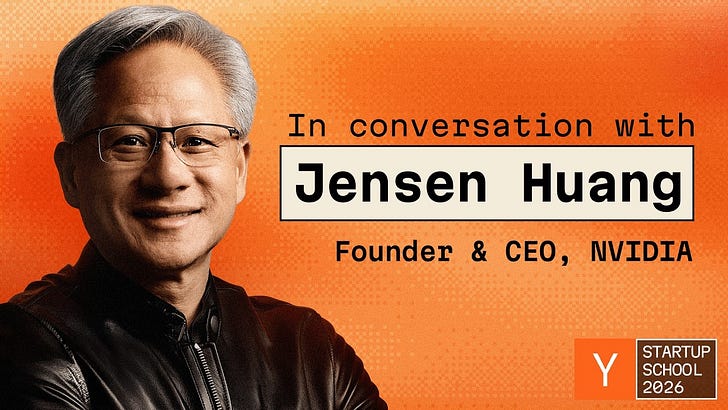
NVIDIA’s founding algorithm was wrong.
Broadcom’s next fiscal year has Anthropic and OpenAI set to become its largest and 2nd largest customers. Cloud backlogs tell the same story further down the stack: CoreWeave’s $104 billion backlog includes roughly $22.4 billion from OpenAI alone, and SB Energy’s $439 billion backlog is 99.4% earmarked for OpenAI.
6. Same Few Names, Every Floor
The money keeps landing on the same short list, no matter which layer you look at.
A handful of subsidized startups pay Anthropic and OpenAI. Anthropic and OpenAI owe hundreds of billions to hyperscalers and neoclouds, and those hyperscalers owe hundreds of billions more to NVIDIA and Broadcom for the chips underneath all of it.
Every layer of that chain looks fine right now, because the bills that matter most haven’t arrived yet.
The customer subsidies are still being funded. The compute contracts are still in their early, low cost years. The 2027 obligations are still a forecast, not an invoice.
The Cursor story already showed what 1 broken link can do. A single ownership change, unrelated to the product or the customer, redirected over a billion dollars of annual revenue between 2 labs in a week.
The commitments sitting above that same chain run to $1.3 trillion, resting on a customer base just as narrow.
Whether AI is useful was never really the question. Whether a few hundred companies can keep saying yes to each other, all at once, for years in a row, is the one that matters.
The Cursor story is the clearest illustration of the fragility you describe. There is a competitive layer underneath the customer concentration that makes the 2027 math even harder. Anthropic's own threat report (published September 10) documents that 7 China-based labs ran distillation attacks totaling roughly 200 million exchanges — Alibaba's operation alone accounted for 151 million, used to train the Qwen 3.5 through 3.7 series. If the top-1% of spenders keeping that $1.3 trillion commitment chain solvent start routing even a share of their spend to models trained that way, at a fraction of frontier pricing, the concentration risk at the foundation becomes harder to price.
I use AI every day, so I don’t need convincing there’s real demand for it. Yet I'm not convinced that real demand automatically makes the AI money currently moving around sustainable.