

Someone on the team points Claude or ChatGPT at a folder of company docs, and everyone starts asking it questions. In week one the answers look great.
By month three, pricing has changed and nobody updated the files. The AI keeps quoting the old number with full confidence.
Building an AI second brain takes an afternoon now. Keeping it accurate is the real work, and it comes down to how you store what your team knows and who is allowed to change it.
together with HSE
How do you manage a workforce of humans and AI agents?
Most GTM teams are still figuring it out. At the Agentic Strategy Summit, 100+ GTM leaders share how they’ll plan, sell and grow with AI in 2027: ServiceNow’s Brian Solis, Parloa’s CMO, ZoomInfo’s CRO and Harvard’s Mark Roberge.

You’ll get their 2027 predictions, priorities and budgets to benchmark your own plan against.
▫️ December 8-10
▫️ Virtual and free
Table of Contents
Why Your GTM Knowledge Drifts
Context and Record: The Split That Keeps It Honest
The Stack, and Why Each Piece Is There
Build It in an Afternoon
Four Workflows You Will Run Every Week
Where It Breaks, and How to Keep It Alive
The Copy-Paste Kit: File Map, Launch Test and 30-Day Rollout
1. Why Your GTM Knowledge Drifts
Ask five people on your GTM team to describe your ideal customer and you will probably get five slightly different answers. Each one came from a different deck, and often from a different quarter.
What is a GTM second brain?
A GTM second brain is a small set of shared files that describe who you sell to, what you say, what you charge and what you have learned. When anyone on the team asks a question, the AI reads those files first, answers from them and names the file it used.

Point an AI at a few thousand unsorted files instead and it will happily quote a 2024 pricing deck, because nothing in the folder says which version is current. Newer frontier models make the same mistake, since the problem sits in the files.
This guide covers the shared version for a team, which has more moving parts. For a personal one, start with the $0 Obsidian second brain that compounds for life or the 10-minute Granola and Claude stack.
What the drift costs you
Atlassian’s State of Teams 2025 survey of 12,000 knowledge workers and 200 executives found that teams waste 25% of their time just searching for answers. McKinsey Global Institute put it at nearly 20% of the workweek for interaction workers, spent looking for internal information or tracking down the colleague who knows.
Both numbers describe a team without one shared copy of the truth. The fix starts with separating two kinds of information, because they need opposite rules when something changes.
2. Context and Record: The Split That Keeps It Honest
The cleanest version of this idea comes from The GTMnow Newsletter: split the brain into two parts with opposite update rules.
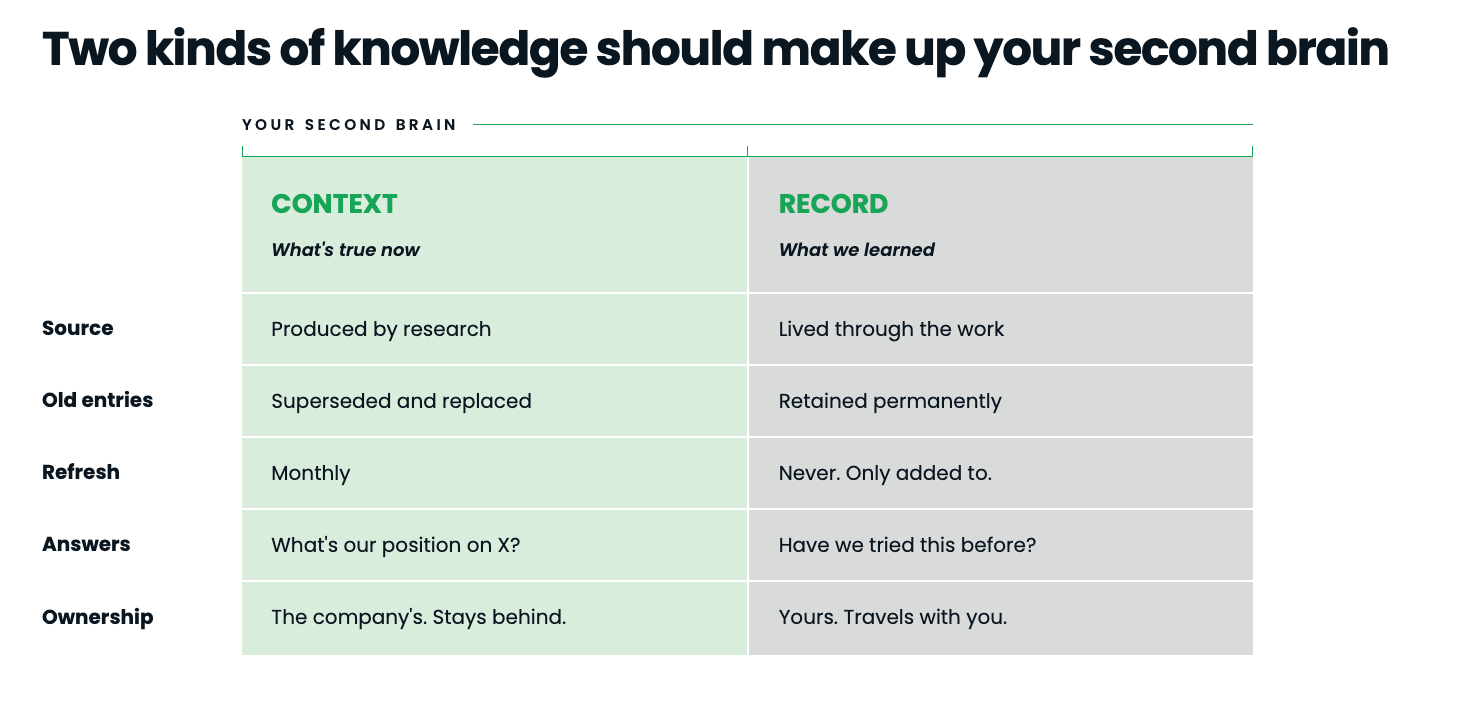
Context is what’s true right now: ICP, positioning, pricing, competitor notes. When something changes, you overwrite it.
Record is how you got here: decisions, experiments and what customers said. You never edit it. You add a new dated entry.
Old context has to disappear so the AI never quotes it. Old record entries stay, because they teach the AI what the team learned.

Here’s what goes wrong when both live in one file. Say your Growth plan cost $149 and you raised it to $199 in March, after a test showed customers would pay more without much pushback.
If you overwrite the $149 line, the price is right and the reason is gone. Six months later someone asks “did we ever try $149?” and nobody can answer, the AI included.
If you add the $199 line under the $149 one, the history survives and the AI now sees two prices. Ask it what the Growth plan costs and it may pick the wrong one.
Split the file into pricing.md and decisions.md and both problems go away. The rule file in Step 3 tells the AI to answer “what is” questions from context and “why” questions from the record.
GTMnow stops at the split. The rest of this guide covers what comes after it: who owns each file and how you check what the AI says. It’s the same discipline that keeps an AI agent from hallucinating at scale.
Get the full build with The AI Corner Premium
Below the line: the stack, the 7 build steps with the exact rule file, 4 weekly prompts for sales, research, marketing and competitive, the maintenance rhythm and a copy-paste kit with a file map, a launch test and a 30-day rollout. Premium also opens every playbook linked in this guide:
AI Agents library, with production playbooks for agents you can leave alone
Claude & Anthropic library, with Claude systems and copy-paste prompts
Prompting & Context Engineering library, including the context engineering guide
Business & Investing library, with GTM, pricing and fundraising resources for founders
The AI Product Shipping Kit, with 12 agent briefs and 16 graded practice cases
Premium costs $49/month or $199/year. Start with a 7-day free trial, or take 50% off your first year with the button below.
3. The Stack, and Why Each Piece Is There
You need four pieces: