

Elliot Lindberg emailed Lovable with a problem he had already run into: connecting a client’s website to Shopify.
He offered to work on the integration during an internship. In a public post, he later credited that email with getting him into the company at 17.
The useful part is how little the recipient had to imagine. Elliot had used the product for a real task. He could explain where it broke and propose work he wanted to do.
That is the starting point I would use for AI startup outreach: give someone a concrete reason to continue the conversation.
Below are real emails, with the useful decisions pulled out of each. Then comes the paid kit: copyable PDF templates and an editable XLSX workbook for turning your research into outreach you can stand behind.
Start with a problem you have actually touched
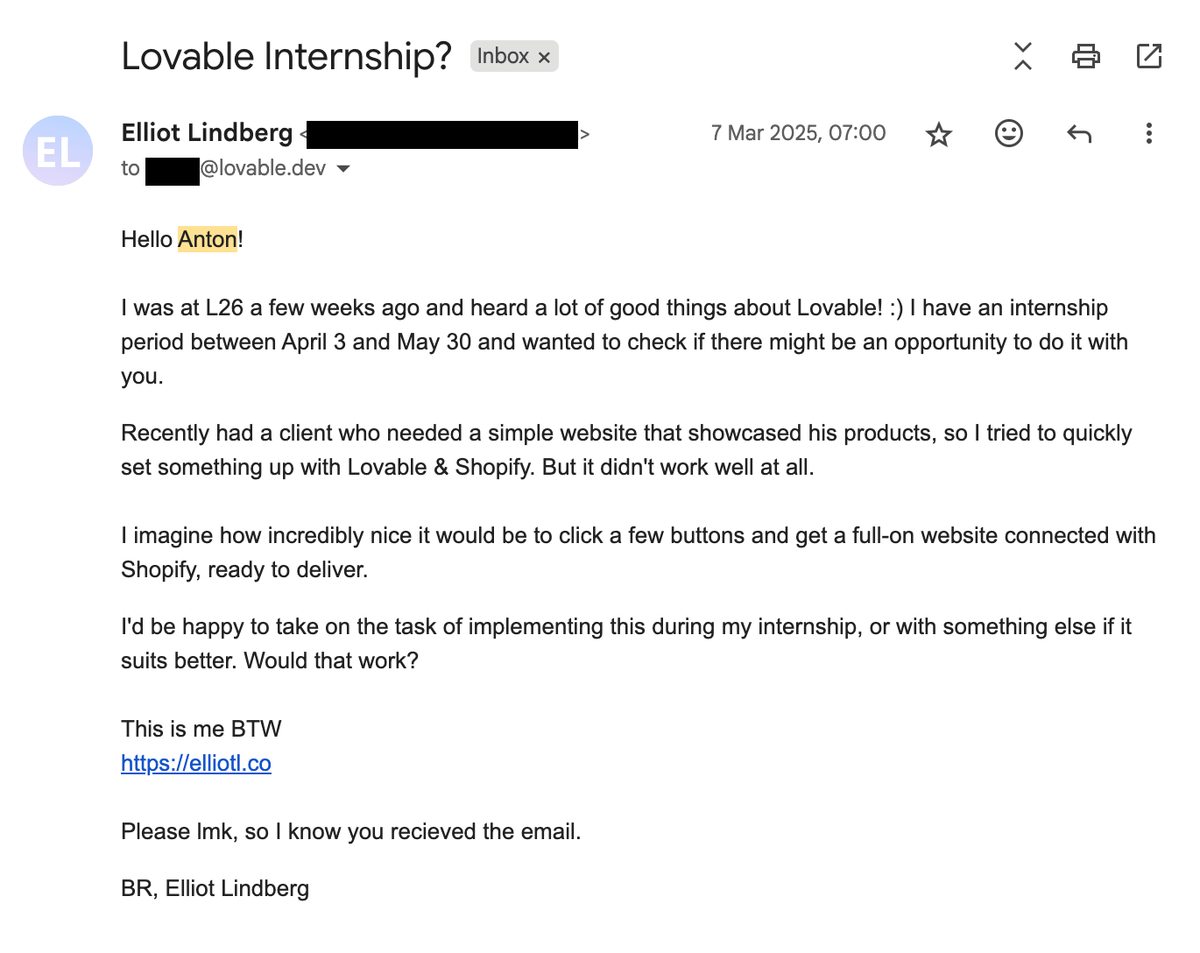
He names a real client use case and describes the experience he wished the product had. He also gives exact internship dates, so the founder knows what he is being asked to decide.
The email contains something valuable even if the company passes on him: feedback from someone who tried to use the product for a customer.
For an AI engineering role, I would adapt this with a small reproducible example of a failure. For a product role, I would show where a user gets stuck and a proposed acceptance test. A commercial candidate could bring a sample account brief built from public information.
Keep the work small enough that you can explain every decision. A focused example gives the team a place to begin assessing your judgment.
Give the recipient an easy handoff
Niraj Pant sent Evan Spiegel a short internship request in 2014. The visible reply thanks him for being brief and copies Snapchat’s lead recruiter.
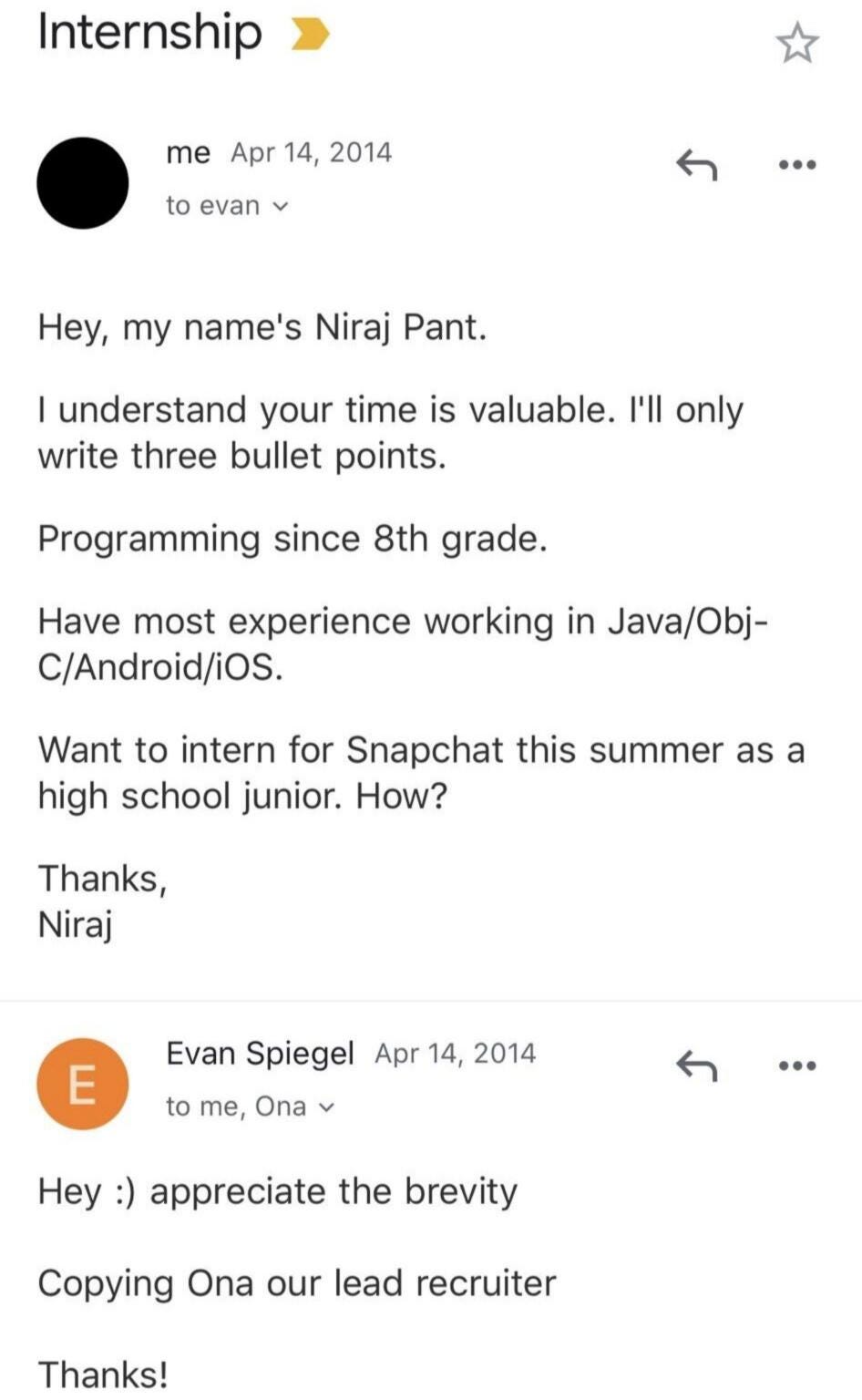
Pant makes his experience easy to scan and finishes with an explicit internship request. Spiegel can route the email with a short reply.
That is a useful test for your own message. Could the person forward it to the relevant colleague without writing an explanation of what you want?
For an AI startup founder, the equivalent is a narrowly scoped pilot request. Say which workflow you want to test and what the buyer would need to provide. The recipient should be able to tell whether it belongs with them.
One caveat: these are selected success stories. They show what people sent, and they say nothing about your likely reply rate.
Take the method into your own inbox
The gap between an interesting example and a useful email is the preparation. You need a recipient whose work fits your request, plus evidence that supports what you say.
The paid section walks through that preparation for technical and commercial AI roles. It also covers founders approaching design partners or hiring candidates.
The Agent Workforce Kit pairs with this if you are designing the hiring process. Founders preparing investor outreach can also use the AI-Era Fundraising Toolkit.
Paid subscribers get the implementation kit:
The editable XLSX outreach workbook, with qualification gates, follow-up review dates and a dashboard that separates replies from useful next steps.
The copyable PDF template library, with 8 original outreach templates. It also includes follow-ups and reply handling. Every example is clearly labeled illustrative.
The PDF proof packet, including a worked AI support-triage example and a blank version for your own role or product.
The PDF practice materials, with 12 synthetic cases and expected routes so you can build a small, inspectable work sample.
Upgrade to get the complete AI Startup Cold Email Kit and the worked playbook below.