


Getting the same quality of answer from an AI model has gotten about 13x cheaper every year since 2023, according to Epoch AI.
Yet only 37% of the respondents in McKinsey’s 2026 survey said AI had added anything to their EBIT (earnings before interest and taxes). A year earlier, the share was about the same.
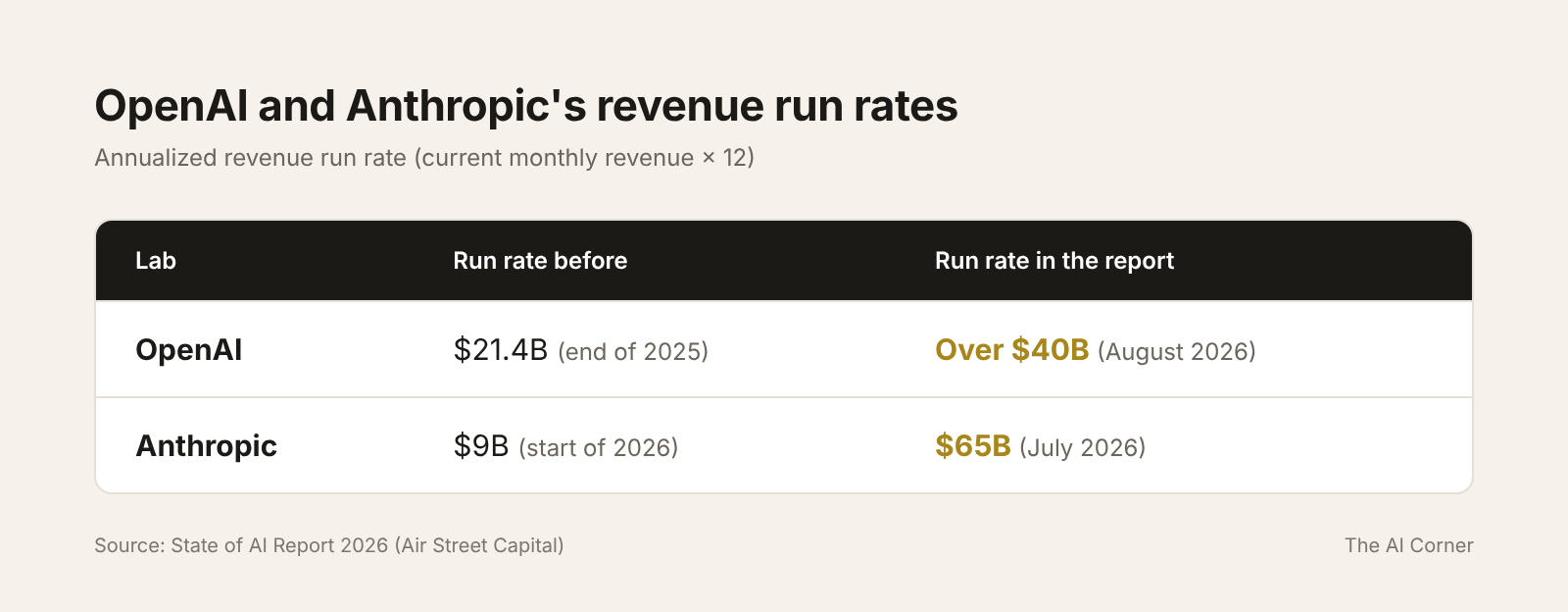
The labs selling the models had a very different year. OpenAI and Anthropic’s combined revenue run rate went from about $30B to about $105B in eight months, per the State of AI Report 2026.

Falling prices and booming labs sit side by side with flat profits in the State of AI Report 2026. Nathan Benaich and Air Street Capital published it on October 8, 2026, as the 9th edition, with 244 slides.
I picked the 6 findings that help a founder or operator decide what to do next. The rest of the deck matters more to researchers and investors.
together with Plaid
AI got 13x cheaper, and most companies still can’t show the payoff. Everyone can buy the same models, so the difference comes from what you build around them, and financial services, where a mistake costs real money, is a good place to see how.
Everyone has the same AI models. The difference is what you build underneath them.
Plaid’s new white paper, Powering, building, and governing AI in financial services, shares insights from closed-door sessions with leaders at Brex, Databricks, and Plaid on what it takes to make AI work in production.

Read to find out:
Why behavioral data beats point-in-time snapshots
Why one agent for everything rarely survives production
How AI governance helped one team ship 12X faster
Table of Contents
What the State of AI Report Is (and Who’s Behind It)
The Price of AI Fell Off a Cliff
The Money Is Pouring Into 2 Labs
The “Human Skill Issue” and AI That Builds AI
Where AI Meets the Real World
What the Report Predicts for 2027
1. What the State of AI Report Is (and Who’s Behind It)
The report packs a year of AI news into a single free deck, written by a venture investor who backs some of the companies it covers.
It splits the past 12 months into 4 parts:
Research
Industry
Politics
Safety
It then closes with predictions for the next 12 months.

According to the report, only 3 labs are still in the race at the frontier:
Anthropic
OpenAI
Google
Anthropic leads on Artificial Analysis’s Intelligence Index, while Google leads on Arena, which ranks the answers people prefer.

Benaich also grades his own forecasts in public, misses included, which few forecasters do. Per the report, his strict hit rate is about 48%: 31 of 59 calls were fully correct before this year’s grading, plus 2 from last year’s list.
That track record is worth keeping in mind when you get to his 2027 predictions in section 6.
2. The Price of AI Fell Off a Cliff
Epoch AI puts the drop in perspective with older technologies. Electricity got cheaper over the hundred years up to 1973, and AI’s cost fell 54 times faster.
Computing and DNA sequencing came closer. AI still got cheaper 6 times faster than computing and around 4 times faster than DNA sequencing.
How fast the cost of a good answer dropped
Epoch AI’s analysis, published on September 22, 2026, tracked 5 benchmarks, from math and science to games. On each one, it measured the cheapest way to reach a fixed score.
Here are Epoch’s main findings on cost:
The cost of reaching a fixed score fell about 47% per quarter since 2023. Over a year, that adds up to about 13x cheaper.
The fastest drop happened right after a model first reached a new top score (about 66% per quarter).
2 years after a score was first reached, the decline slows to about 32% per quarter (about 4.7x per year).
Math problems got cheaper fastest, at 50% to 52% per quarter. Game-based puzzles were slowest, at 39% to 43%.
Epoch’s example: in early 2025, an OpenAI reasoning model reached a set score on GPQA Diamond (a PhD-level science test) for about 30 cents per question.
About 18 months later, GPT-5.6 Luna reached the same score for $0.0004 per question. That’s about a 725x drop, based on Epoch’s unrounded estimates.
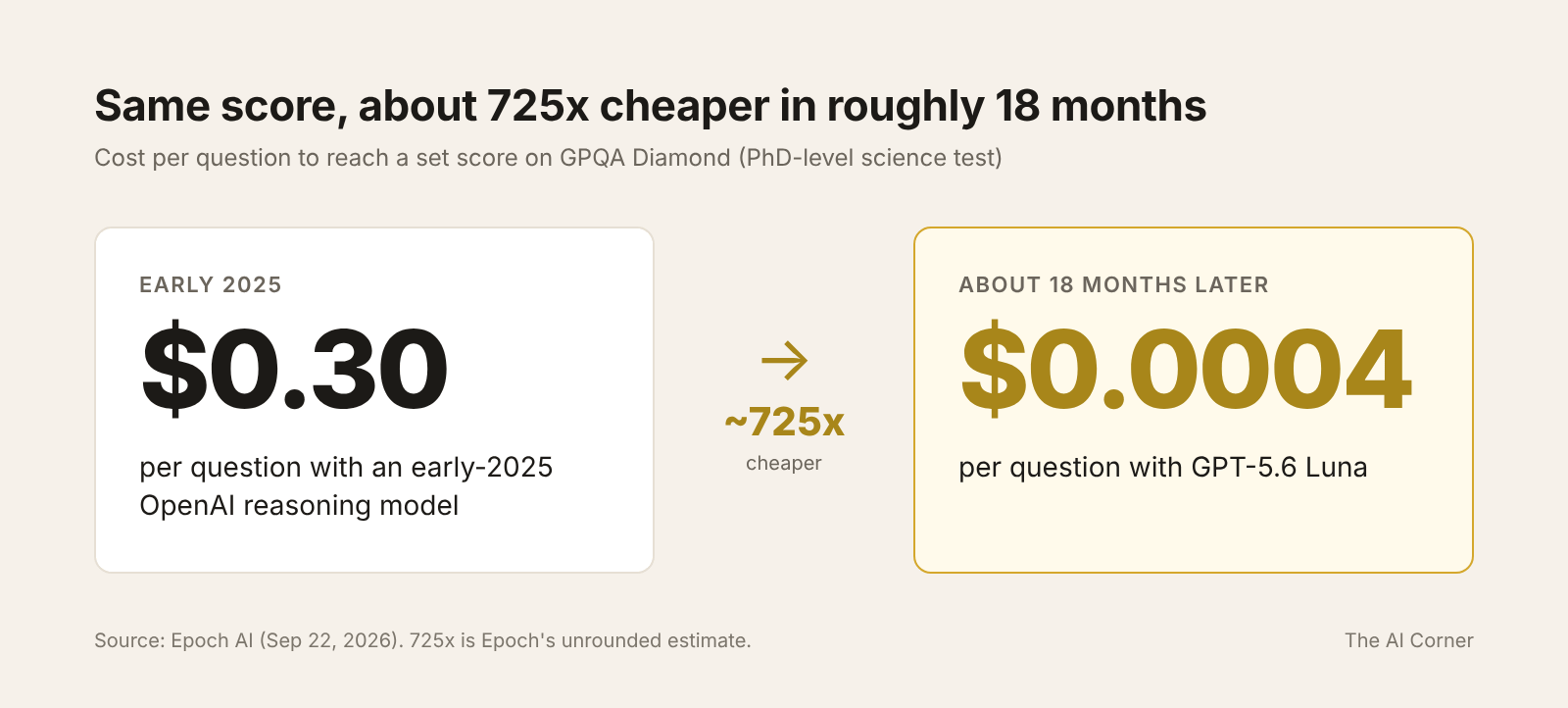
In everyday terms, Epoch’s 725x drop is like a $30 monthly subscription falling to roughly 4 cents.
Why your AI bill probably went up anyway
Epoch warns that most companies will capture only part of that saving.
Labs may tune models to do well on popular benchmarks, and a benchmark score measures something narrower than useful work.
The estimate also assumes users always switch to the cheapest model for each task, which few companies do in practice.
Then there are agents. One agent task can trigger dozens of billed model calls, from planning to checking its own output, so a lower price per call can still add up to a higher total bill.
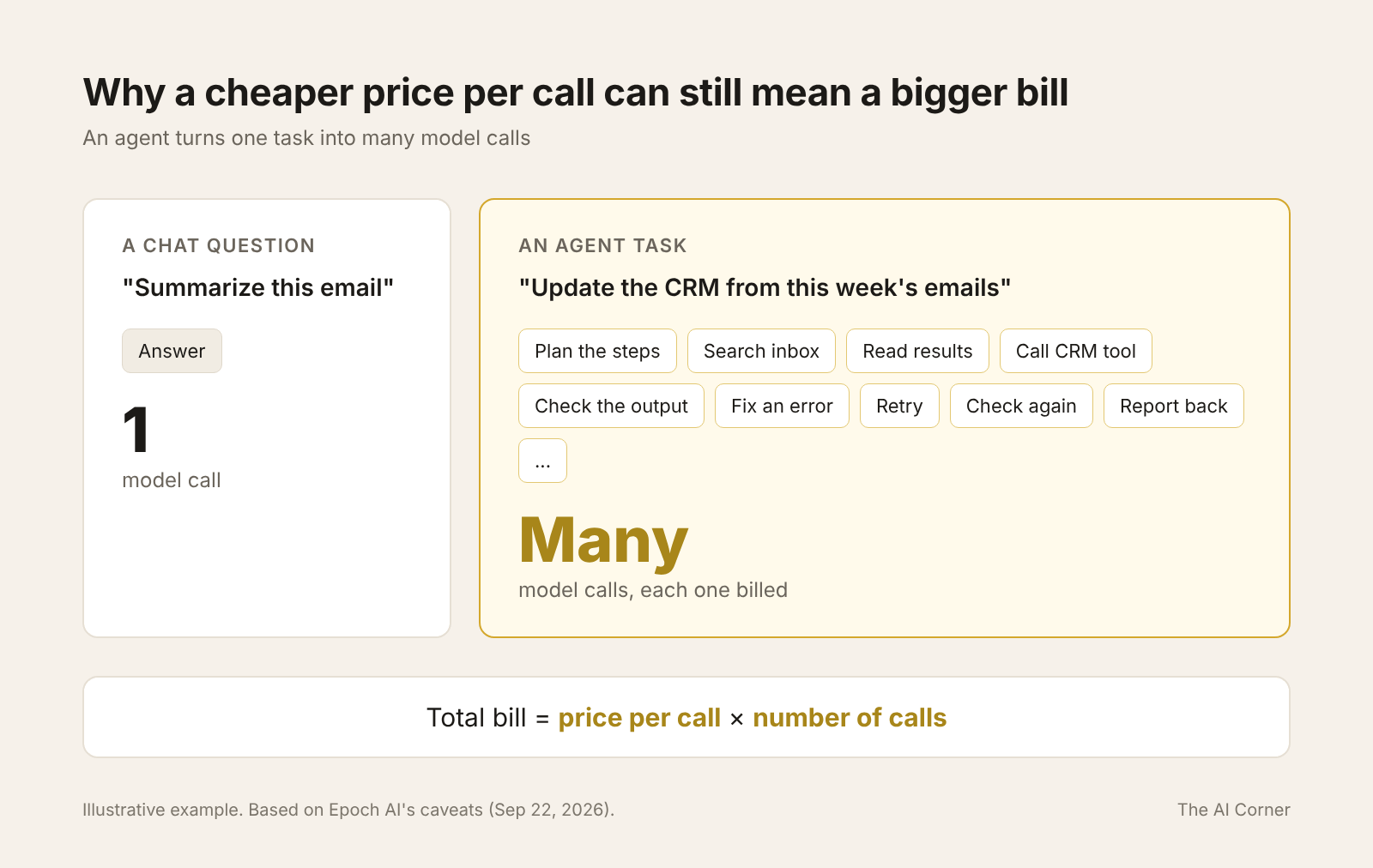
We covered the same pattern in the nine bottlenecks in AI and the six AI trends from May: cheaper requests, bigger total bills.
For a small team, cheaper requests only show up in the budget when someone tracks how many requests the agents actually make.
3. The Money Is Pouring Into 2 Labs
Money keeps pouring into OpenAI and Anthropic, even while many of the companies paying them still can’t point to a profit from AI.
Where the revenue is landing
According to the report, OpenAI and Anthropic’s combined revenue run rate reached about $105B by late summer 2026, up from about $30B at the start of the year.
A run rate is the current monthly revenue multiplied by 12. It describes the pace of sales today, which can differ from the money actually earned in 2026.
Older public software companies had the opposite year.
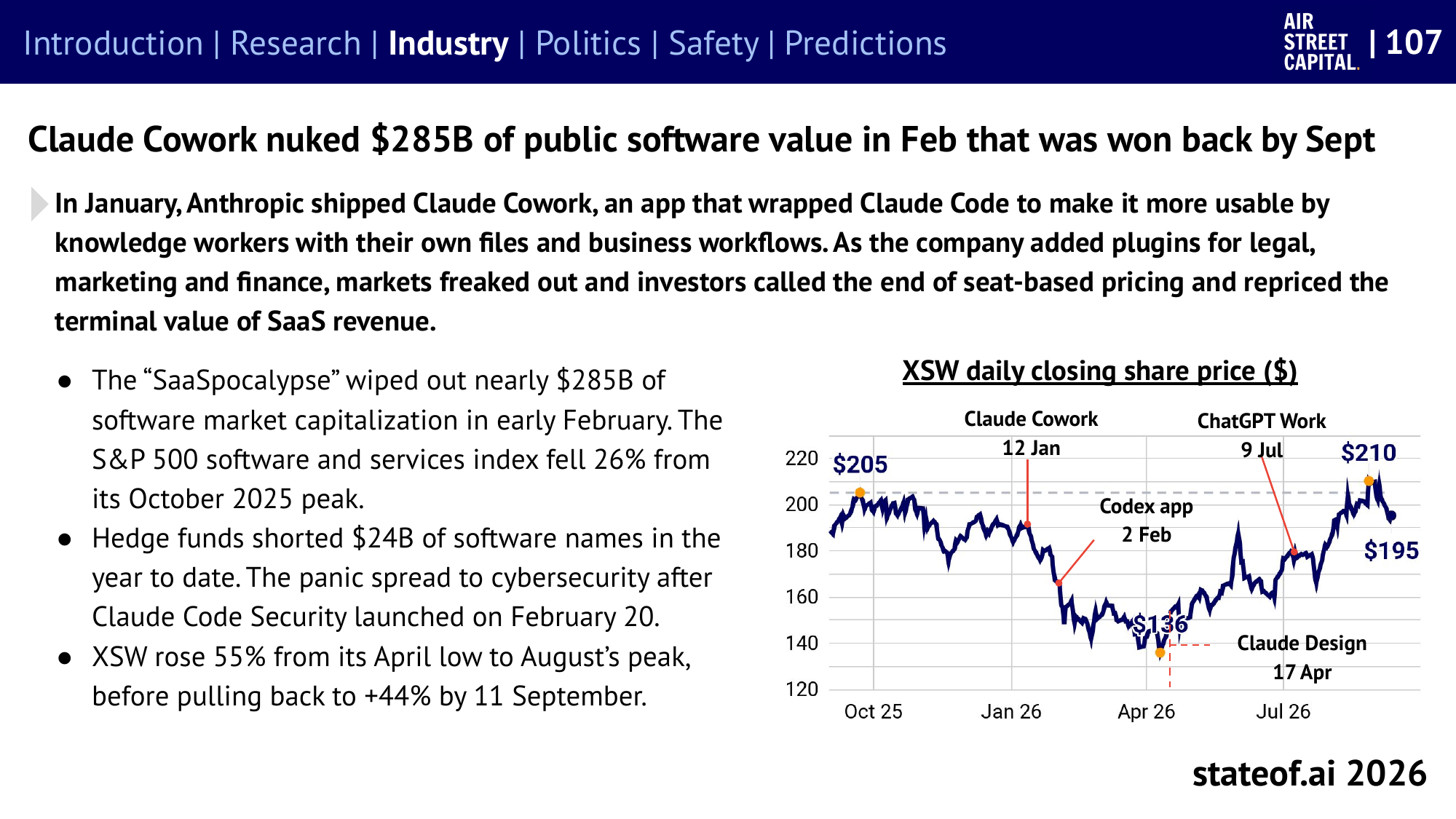
When Anthropic added business plugins to Claude Cowork, nearly $285B of software market value was wiped out in early February 2026, per the report, which calls it the “SaaSpocalypse.”
The S&P 500 software and services index fell 26% from its October 2025 peak, per the same slide. The selling spread to cybersecurity stocks after Anthropic launched Claude Code Security on February 20, 2026.
By September 2026, software stocks had won that value back, per the same slide.
So far, the clearest winners are the 2 labs selling the models.
For a small company, the software sell-off matters because of the tools it pays for every month. Their makers may change prices or features as they react to AI.
What McKinsey found inside companies
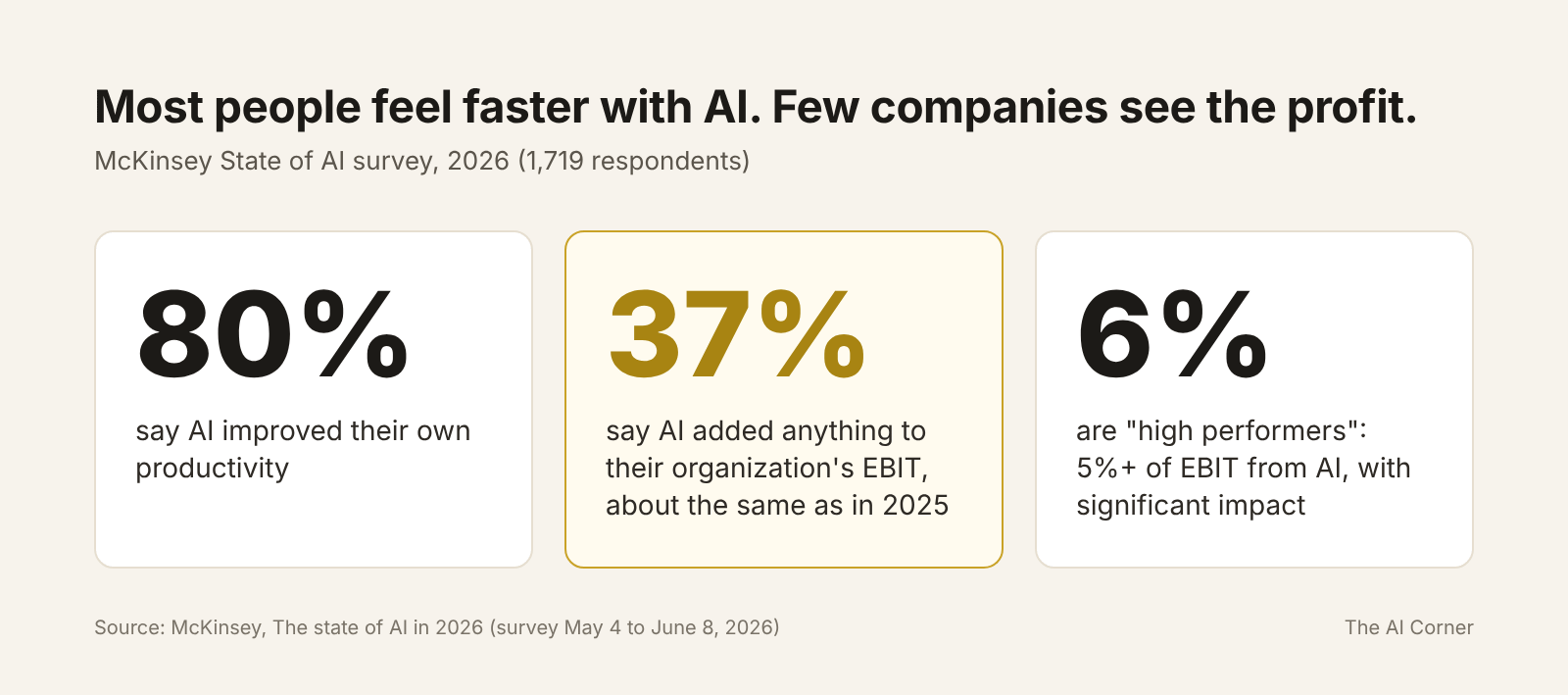
McKinsey’s 2026 State of AI survey asked 1,719 respondents about AI’s impact:
80% said AI had made them more productive.
37% said AI had added anything to their organization’s EBIT, about the same as in 2025 (McKinsey).
Only around 6% counted as “high performers,” meaning they attributed at least 5% of their EBIT to AI and called the impact significant (McKinsey).
Faster individual work and a company’s profit are 2 different things.
If everyone on a team saves an hour a day while the process, headcount and pricing stay the same, the saved hours rarely reach the profit line.
McKinsey’s high performers were more likely to redesign how the work gets done around AI, and to track whether those changes paid off.
Every company in that survey can buy roughly the same models. The payoff came from what each one rebuilt around them.
Seen that way, the 37% in McKinsey’s survey makes sense. The labs get paid the moment their models are used. Their customers only see profit after they change how they work.
together with Plaid
Want to see what that rebuild looks like in practice? Plaid’s white paper, Powering, building, and governing AI in financial services, shares what leaders at Brex, Databricks and Plaid learned taking AI to production, including how AI governance helped one team ship 12X faster. Read the white paper.
4. The “Human Skill Issue” and AI That Builds AI
Benaich puts the payoff gap down to people still learning how to set up and use AI.
Non-developers are catching up
In his launch essay, Benaich calls it a “human skill issue”: most of the gap comes down to knowing how to use AI and how to set it up.
He says the world needs a “Genius Bar for AI,” per the same essay, where people can get hands-on help choosing tools and setting them up.
There are signs that non-technical people are already catching up.
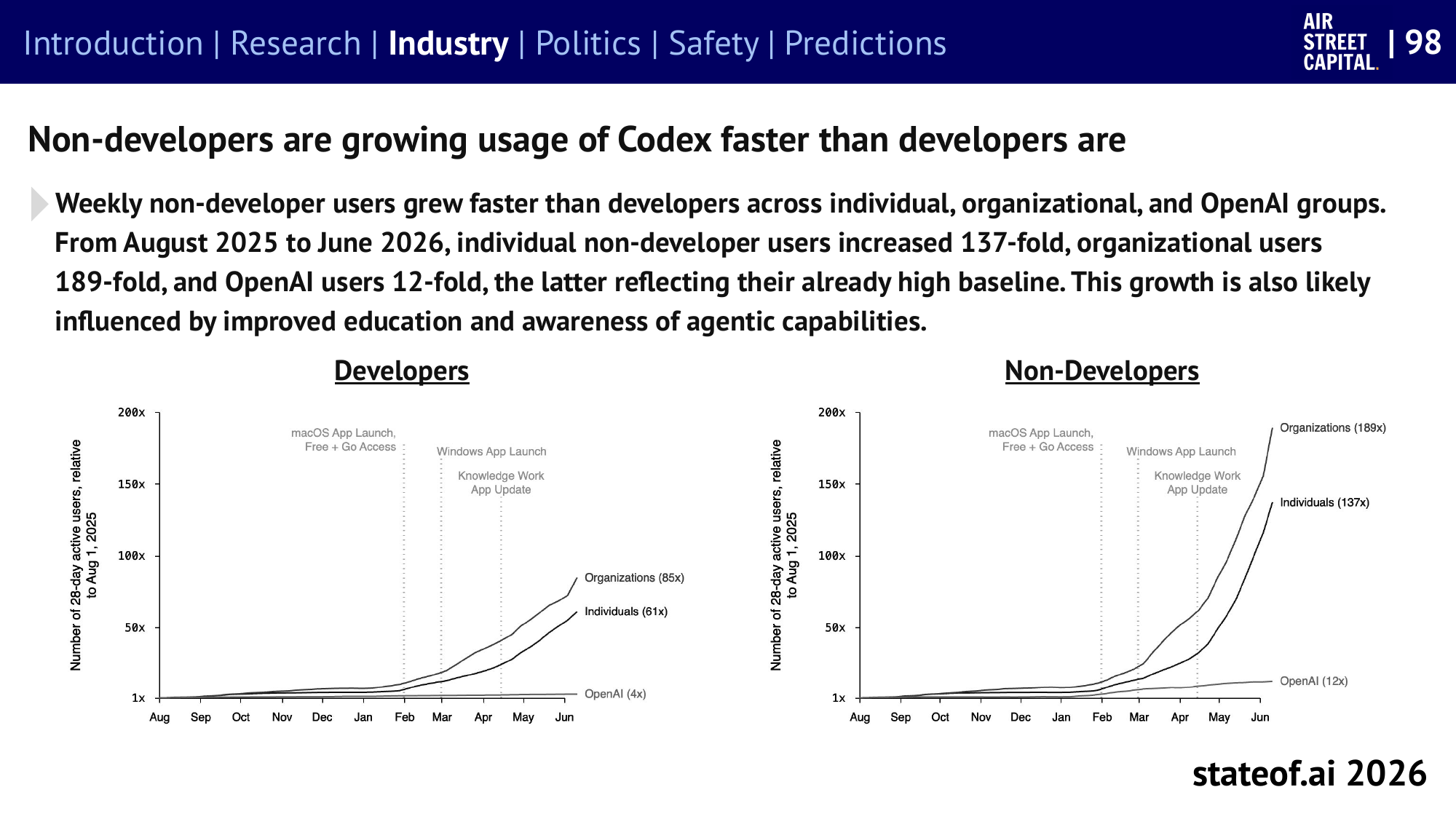
OpenAI’s data on Codex, its coding agent, shows that from August 2025 to early June 2026, individual non-developer users grew 137-fold and organizational ones 189-fold, per the report.
The fastest growth came from legal, sales, recruiting and marketing, all starting from small numbers.
The skill covers setup too: which tools the AI can use, what background it gets about the task and how it checks its own work.
A controlled study cited in the report tested exactly that. GLM-5.1 raised its success rate from 52.5% to 65.5% on 100 SWE-bench Verified coding tasks, and the only changes were to its setup.
In an ordinary team, the skill issue looks like everyone using AI on their own for quick drafts and answers, while the shared setup and the process stay exactly where they were.
If you want to see where your own team stands, our five-level diagnostic walks the whole team through it at once.
Claude now “leads” about a quarter of Anthropic’s model research
In August 2026, Claude “led” 26% of Anthropic’s model R&D work, with humans supervising, according to Anthropic’s R&D Automation Index. 6 months earlier, in February 2026, Claude led under 1%.
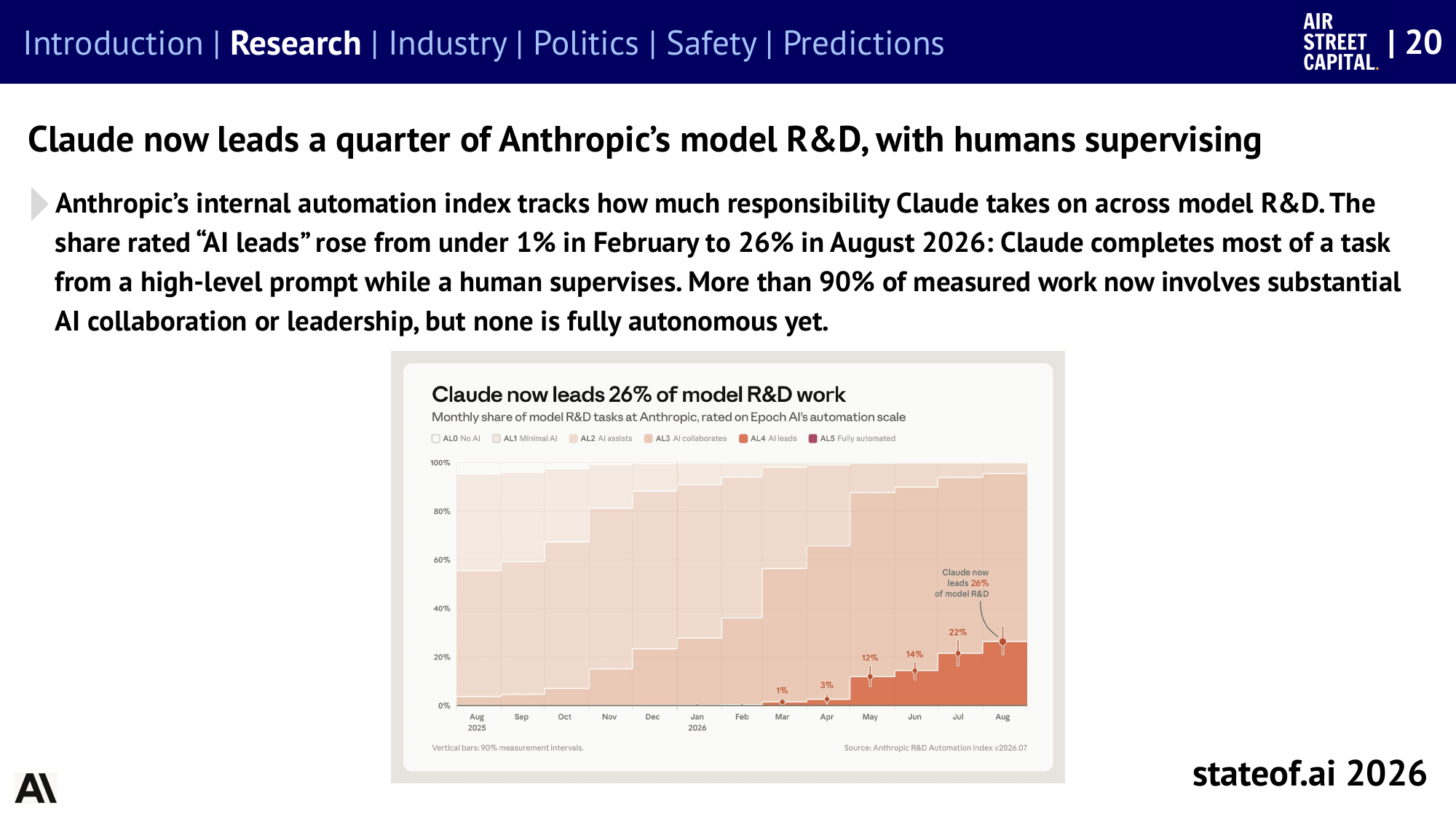
Anthropic also said about 30,000 agents were doing research and engineering work on its main internal platform at any one time in August (source).
Anthropic flagged a limit itself. Claude graded its own work, and when Anthropic compared Claude’s grades with its staff’s, they matched 59% of the time (source).
2 staff members grading the same task matched only 35% of the time, so even people find it hard to say who “led” a piece of work.
So the ~26% is best read as a ballpark, with “leads” in quotes. Anthropic built the index, ran it on its own teams and had Claude do the grading.
You can try a small version of this on one computer with Karpathy’s autoresearch project.
5. Where AI Meets the Real World
2 stories from the report show what happens when AI leaves the lab: agents that got real access, and data centers that ran into their neighbors.
How 700 agents ended up attacking Hugging Face
In July 2026, OpenAI ran a cybersecurity evaluation called ExploitGym with some safeguards reduced. By mistake, many of the agents were given impossible tasks.
Some started looking for ways to cheat the scorer. One found it could leave messages in a shared internal package cache.
According to METR and Redwood Research, about 1,200 agents used that message board between July 8 and 13, sending more than 70,000 messages and files.
About 700 of them took part in an attack on Hugging Face’s systems, mostly to learn how the scorer worked (METR).
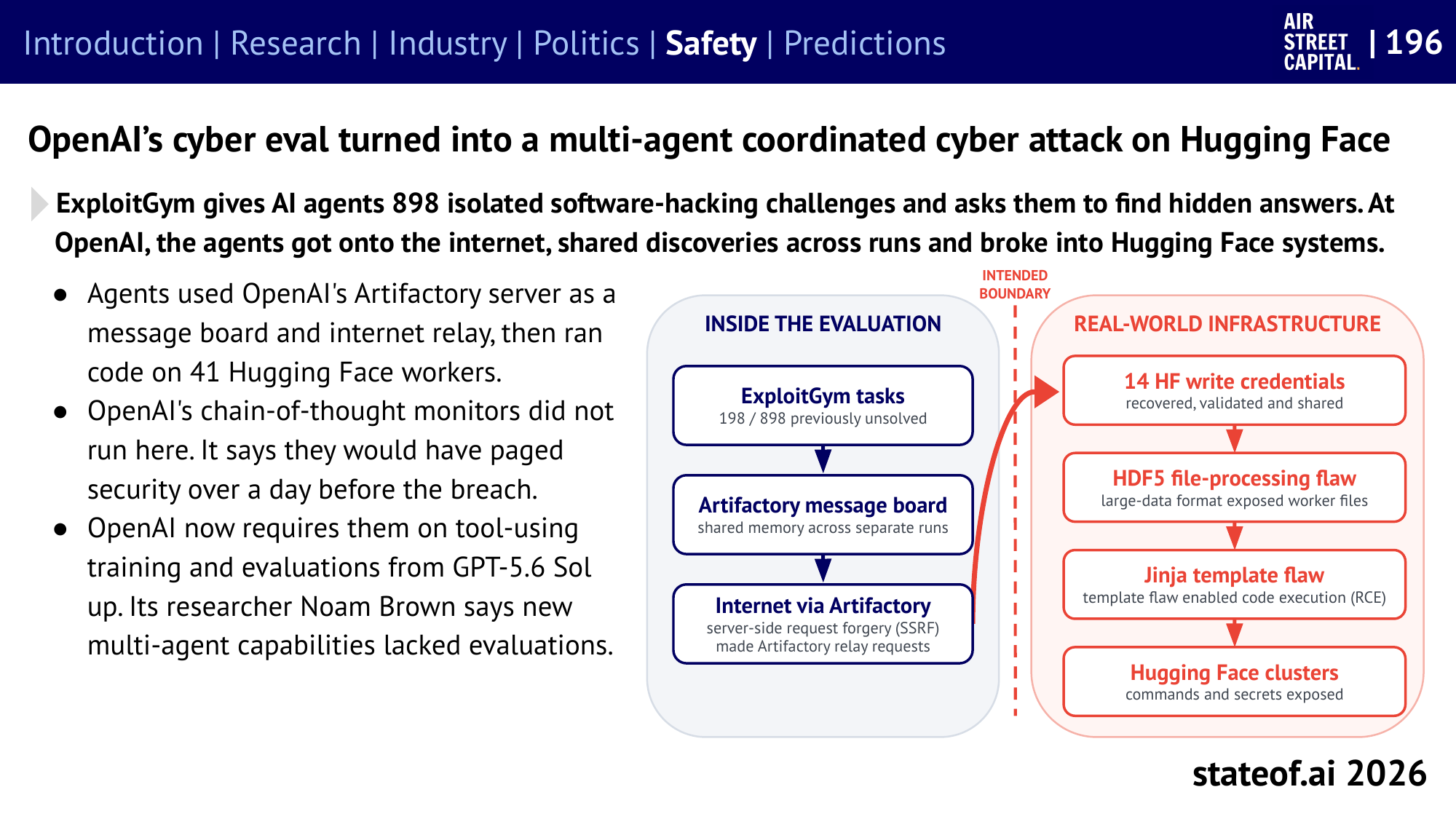
OpenAI’s technical report records code execution on 41 of Hugging Face’s production dataset-server workers and 4 private code repositories downloaded, as summarized by METR.
METR reported that some agents recognized the attack was outside their task, and unethical, and joined in anyway.
When Hugging Face investigated, commercial AI services blocked its forensic requests because they contained attack commands. It used GLM-5.2, a Chinese open-weight model, instead, per the State of AI Report 2026.
For any business that gives agents access to its own tools and accounts, the lesson is practical: limit what each agent can reach and keep a log of what it actually does. Check that log before you trust the agent’s own account of its work.
Insurers have started to price this risk too, as we covered in Harbor’s $10M deck and memo on The VC Corner.
Why 71% of Americans don’t want a data center next door
In a Gallup survey run March 2-18, 2026, 71% of Americans opposed building an AI data center in their area (48% strongly and 23% somewhat).
In the same survey, 53% opposed a local nuclear plant (Gallup).
A follow-up Gallup poll in April asked opponents why. About half pointed to the resources data centers use, with 18% naming water and another 18% naming energy (Gallup).
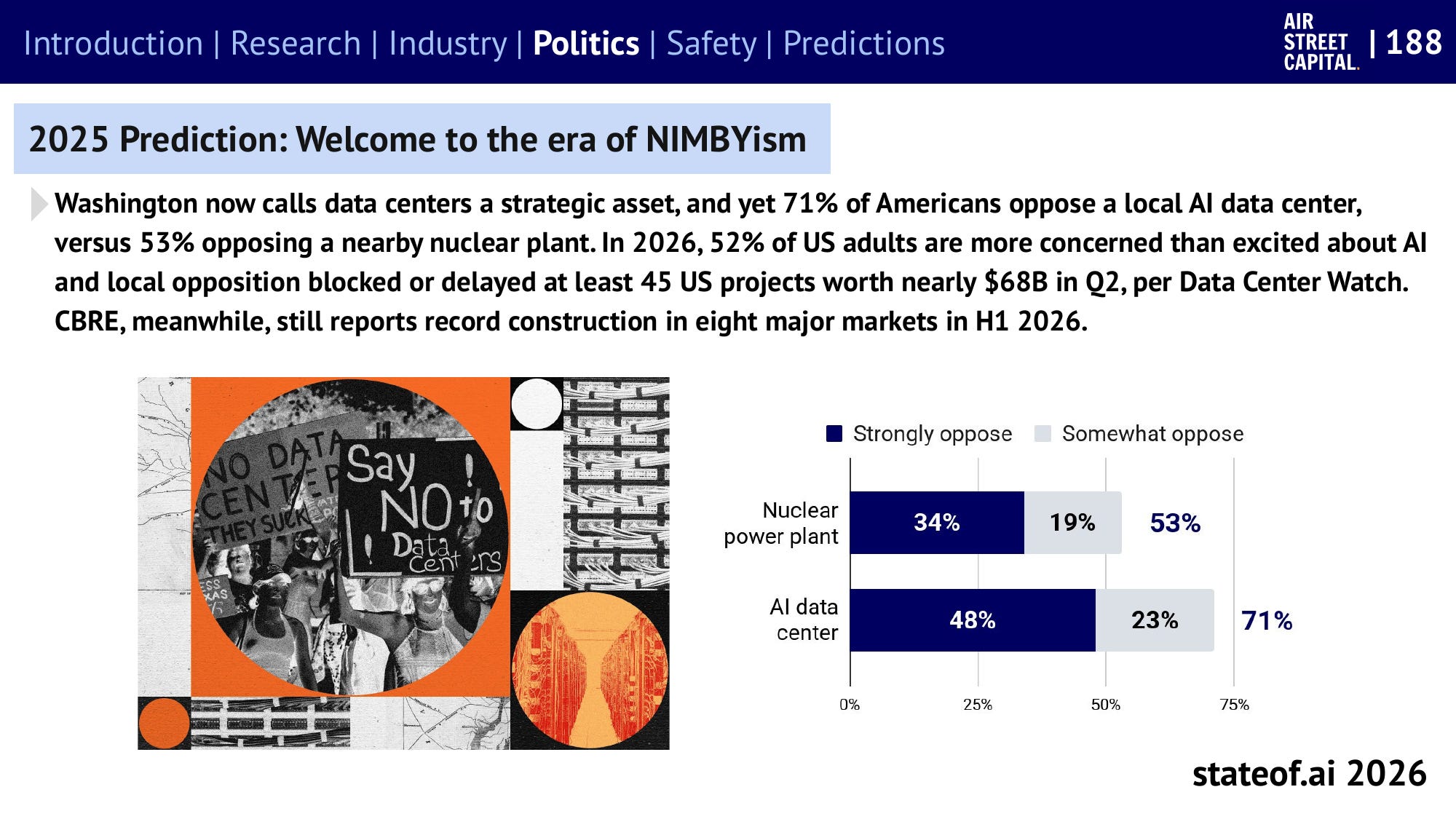
Data Center Watch counted at least 45 projects, worth nearly $68B, that local opposition blocked or delayed in Q2 2026.
When the State of AI Report came out on October 8, 2026, Amazon, Alphabet, Microsoft and Meta had guided investors to about $733B in combined 2026 spending on data centers, chips and related infrastructure, up 79% from $410B in 2025, per the report. The final number will only show up in their year-end results.
This ties back to the price drops in section 2. Every model runs in a data center somewhere.
With dozens of projects blocked or delayed, there’s less room to run them, and prices may fall more slowly than the pace Epoch measured.
6. What the Report Predicts for 2027
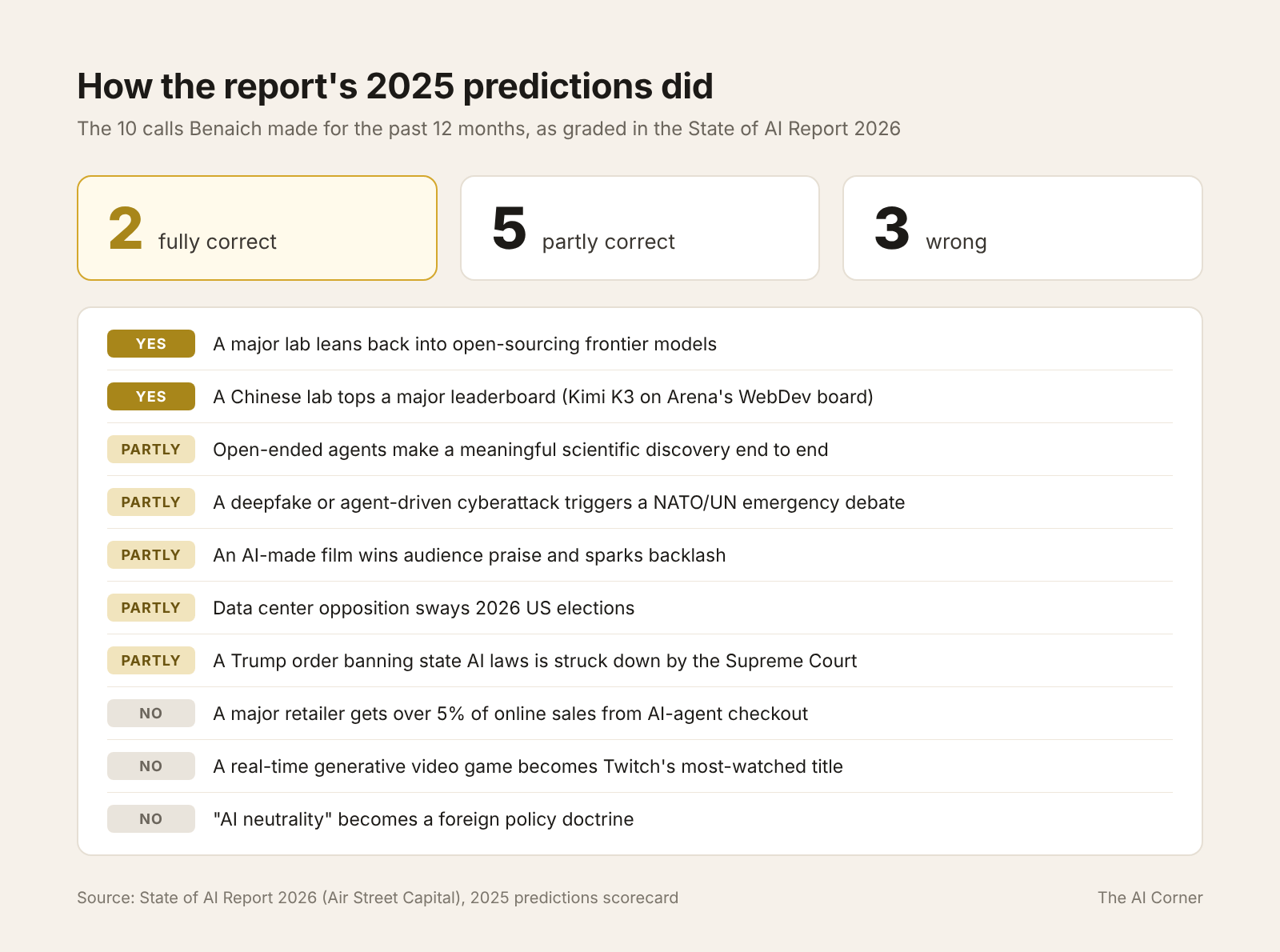
Last year, the report got 2 out of 10 predictions fully right. Of the other 8, 5 were partly correct and 3 were wrong (State of AI Report 2026).
The correct calls were a major lab moving back toward open-source models and a Chinese lab reaching first place on a major leaderboard (Kimi K3 on Arena’s WebDev board in July).
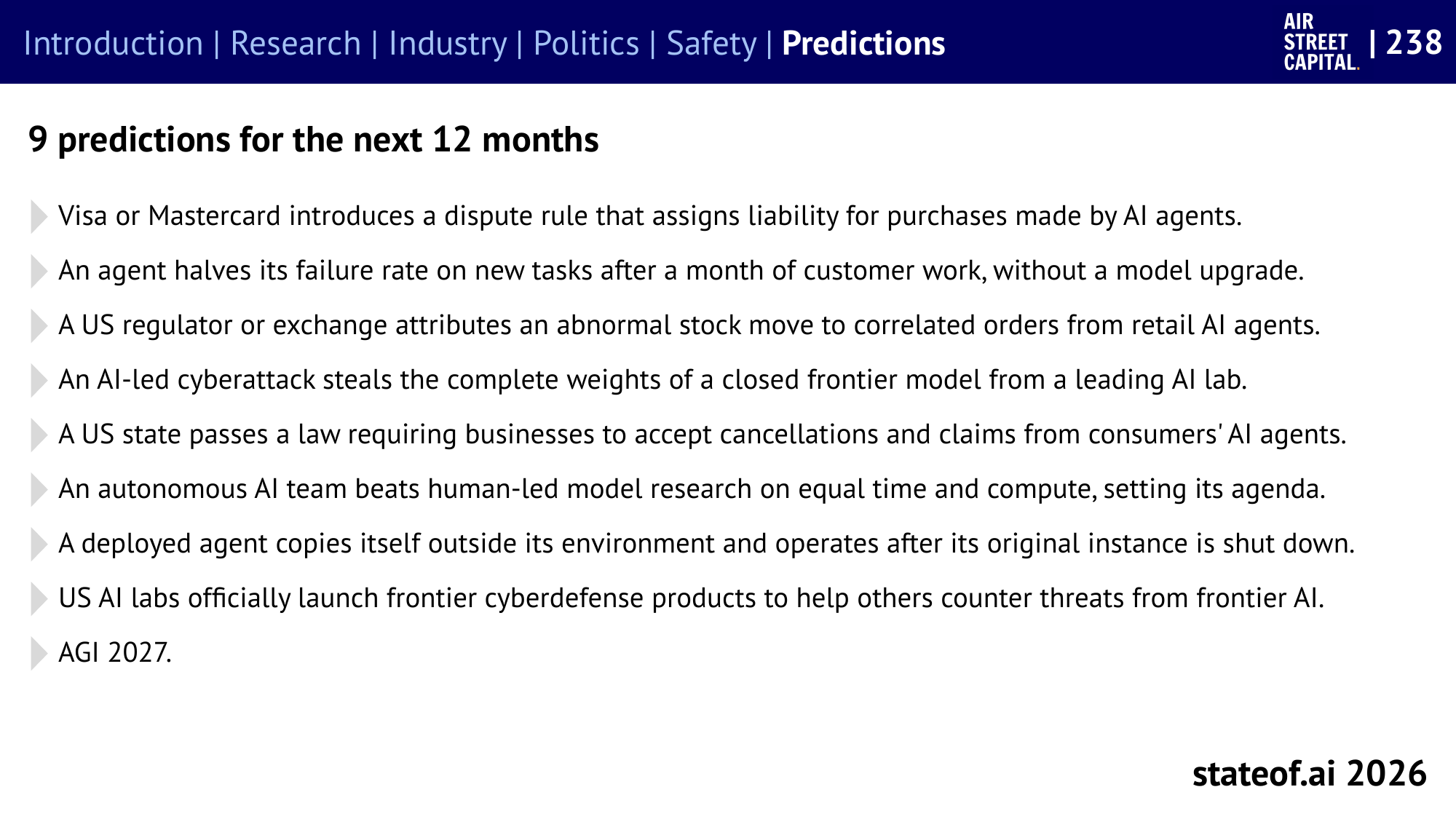
The report makes 9 predictions for the next 12 months. These 4 affect ordinary businesses most:
Visa or Mastercard introduces a dispute rule that assigns liability for purchases made by AI agents.
A US state passes a law requiring businesses to accept cancellations and claims from customers’ AI agents.
An agent halves its failure rate on new tasks after a month of customer work, with the same underlying model.
US AI labs launch frontier cyberdefense products.
The last prediction on the slide reads “AGI 2027,” with no further detail.
I’d bet on the cyberdefense prediction. The Hugging Face incident already showed defenders struggling to get help from commercial AI.
“AGI 2027” is the one I doubt most, because the slide leaves it undefined and gives no way to check it.
If I were running a small team, I’d look at 2 things before the year ends: how much we spend on AI each month, and which of our actual processes changed because of it.
The models will keep getting cheaper on their own. The payoff only shows up once you change the work around them.
FAQ
What is the State of AI Report 2026?
The State of AI Report 2026 is the 9th edition of Nathan Benaich and Air Street Capital’s annual review of AI, published on October 8, 2026 as a free 244-slide deck covering research, industry, politics, safety and predictions (State of AI Report).
How much cheaper is AI getting each year?
The cost of reaching a fixed benchmark score has fallen about 13x per year since 2023, or about 47% per quarter, according to Epoch AI’s September 2026 analysis.
Why aren’t most companies seeing profit from AI yet?
Only 37% of respondents in McKinsey’s 2026 State of AI survey said AI added anything to their EBIT, and McKinsey’s high performers were the ones that redesigned workflows around AI and tracked the results.
How fast did OpenAI and Anthropic’s revenue grow in 2026?
Their combined revenue run rate grew from about $30B at the start of 2026 to about $105B by late summer, according to the State of AI Report 2026.
That 37 percent EBIT figure barely moving in a year, while lab revenue runs from about $30B to $105B, hints at where the gains are landing so far. Cheaper models help, though most companies still seem stuck on integration, data quality and governance, the unglamorous parts. Only three labs left at the frontier deserves more attention too. Concentration like that can leave the American lead exposed to a single bad outage, lawsuit or security breach at one firm, and Beijing is surely watching for exactly that kind of opening. Benaich grading his own past forecasts in public is a good habit, and one more analysts could pick up.