


Guillermo and I just invested in Roma (YC F26) through GR Angel, our YC rolling fund. Roma is one of our picks from the Fall 2026 batch, which presents at Demo Day on December 2.
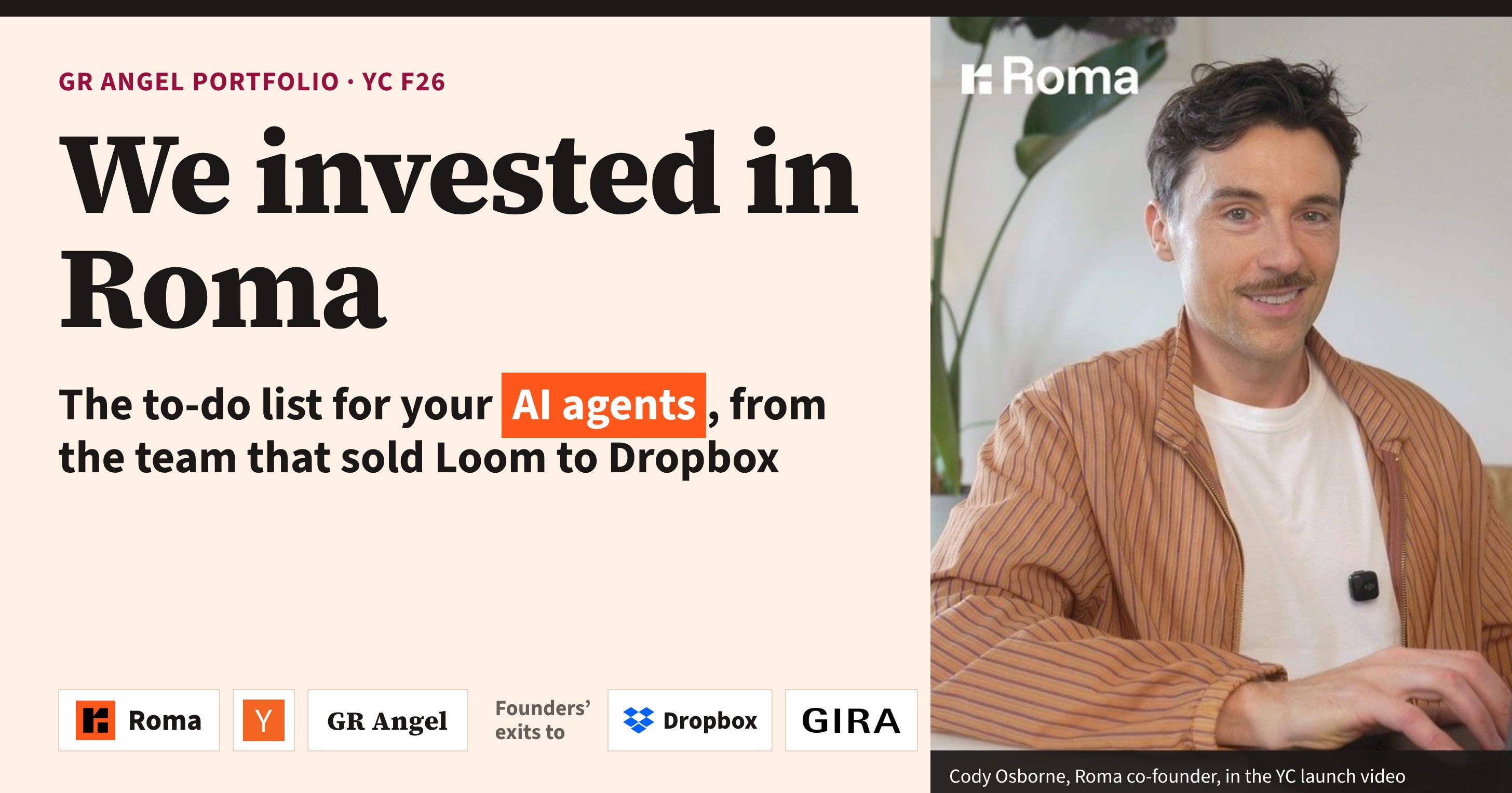
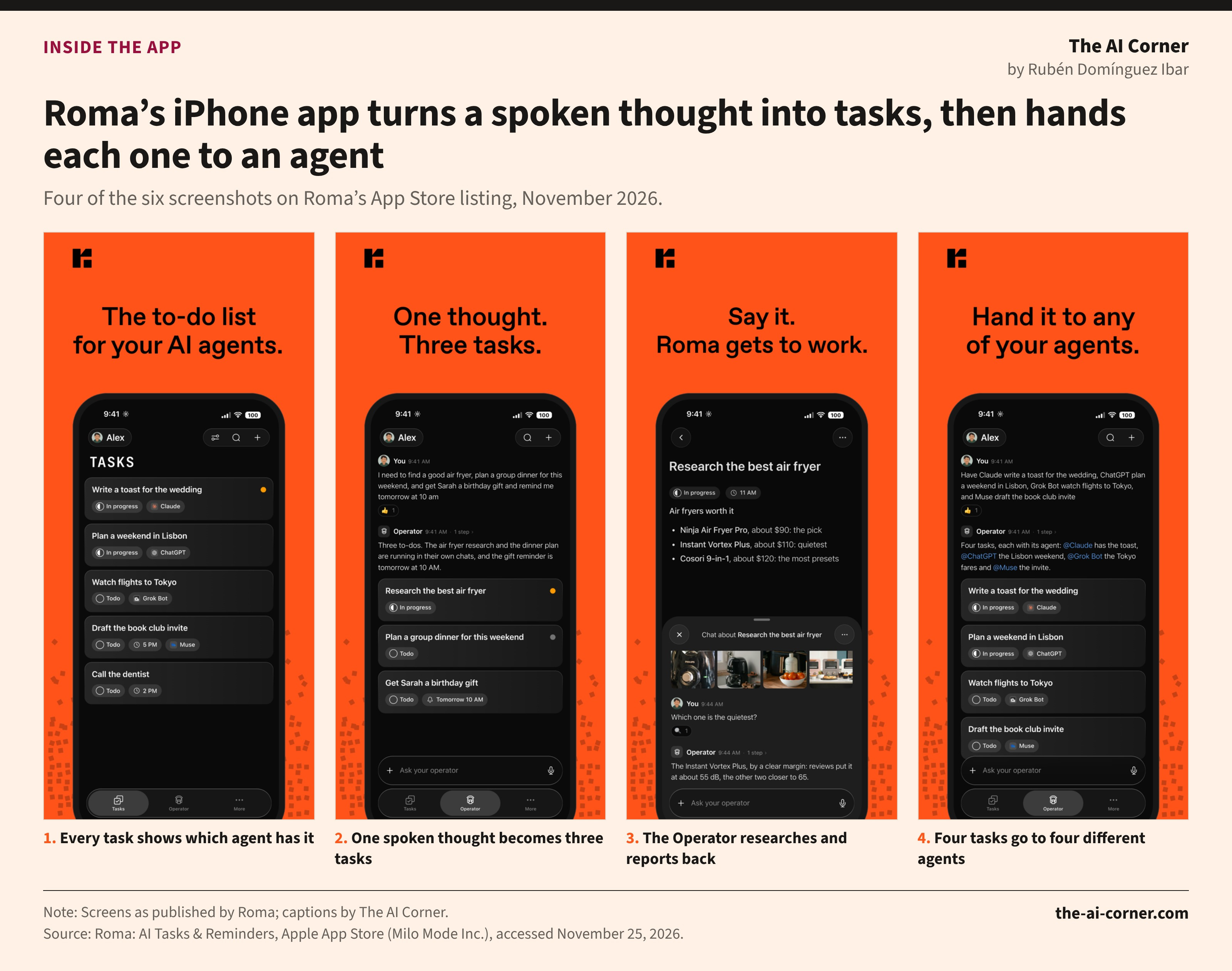
Roma is a to-do list that hands your tasks to AI agents. You say or type what you need, Roma turns it into tasks, and each task goes to an agent: Roma’s own Operator or the one you already use, like Claude, ChatGPT, Grok Bot or Meta’s Muse. The work comes back on the task, with a record of every step.
Jan Senderek, Roma’s CEO, sold his first YC company to Dropbox in 2014. His Roma 2.0 launch post from November 11 now has 1.6 million views on X.
Further down: how Roma’s three founders run the company with their own agents, and our full investment memo, with the risks we’re underwriting and the metrics we’ll track.
What Roma does
Roma’s founders start from a habit they kept seeing: people now run several agents at once, and the work ends up scattered across them. “We tell each agent the same thing over and over, copy and paste between chats, and chase down work we’ve already done,” Roma wrote when it launched version 2.0.
The answer they landed on is the oldest productivity tool there is. Every request becomes a task on one list, and a task can belong to you, a teammate or an agent. Whoever picks it up posts results and questions in the task’s own chat, and Roma logs every handoff.
Roma’s 82-second version of the pitch:
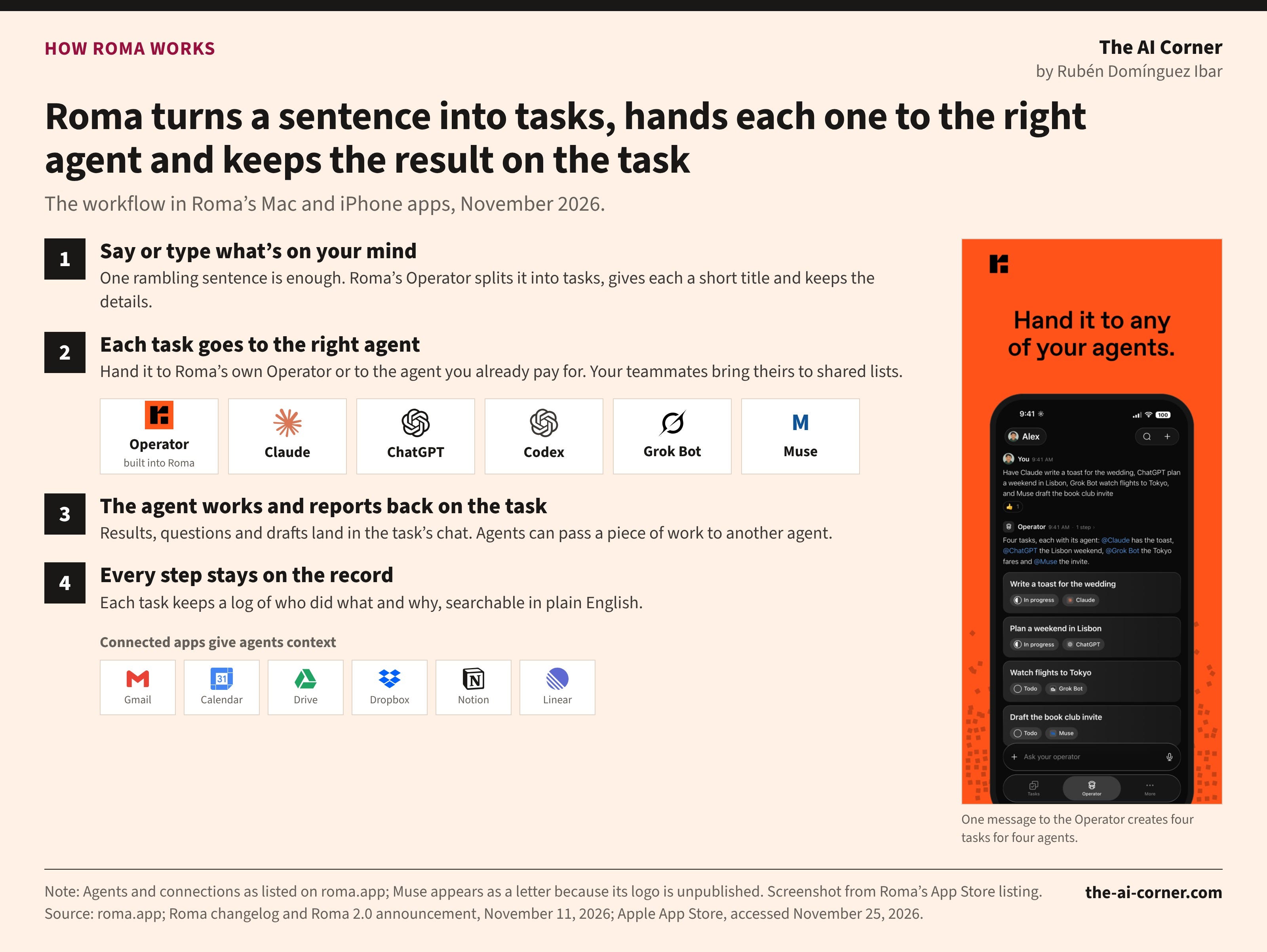
The November 11 release, Roma 2.0, made the list multiplayer. “Your Claude and their ChatGPT can work on the same task,” as Roma’s announcement puts it, and agents can now hand work to each other.
Both apps, Mac and iPhone, connect to Gmail, Google Calendar, Google Drive, Dropbox, Notion and Linear, so an agent starts each task with the files and threads behind it. Granola joined the list this week, and further down we show how that connection got built in a day.
How to try it with your own agents
Download the app. Roma runs on Mac and iPhone and is free for everyone until the end of the year, from roma.app.
Connect your agents. At roma.app/agents you can link Claude, ChatGPT, Grok Bot or Muse, and each one reads and writes tasks both ways.
Hand over one task you’ve been putting off. Assign it to an agent and watch its results and questions land in the task’s chat.
Share a list. Invite a teammate so their agent can work on the same task, then check the log to see who did what.
The founders
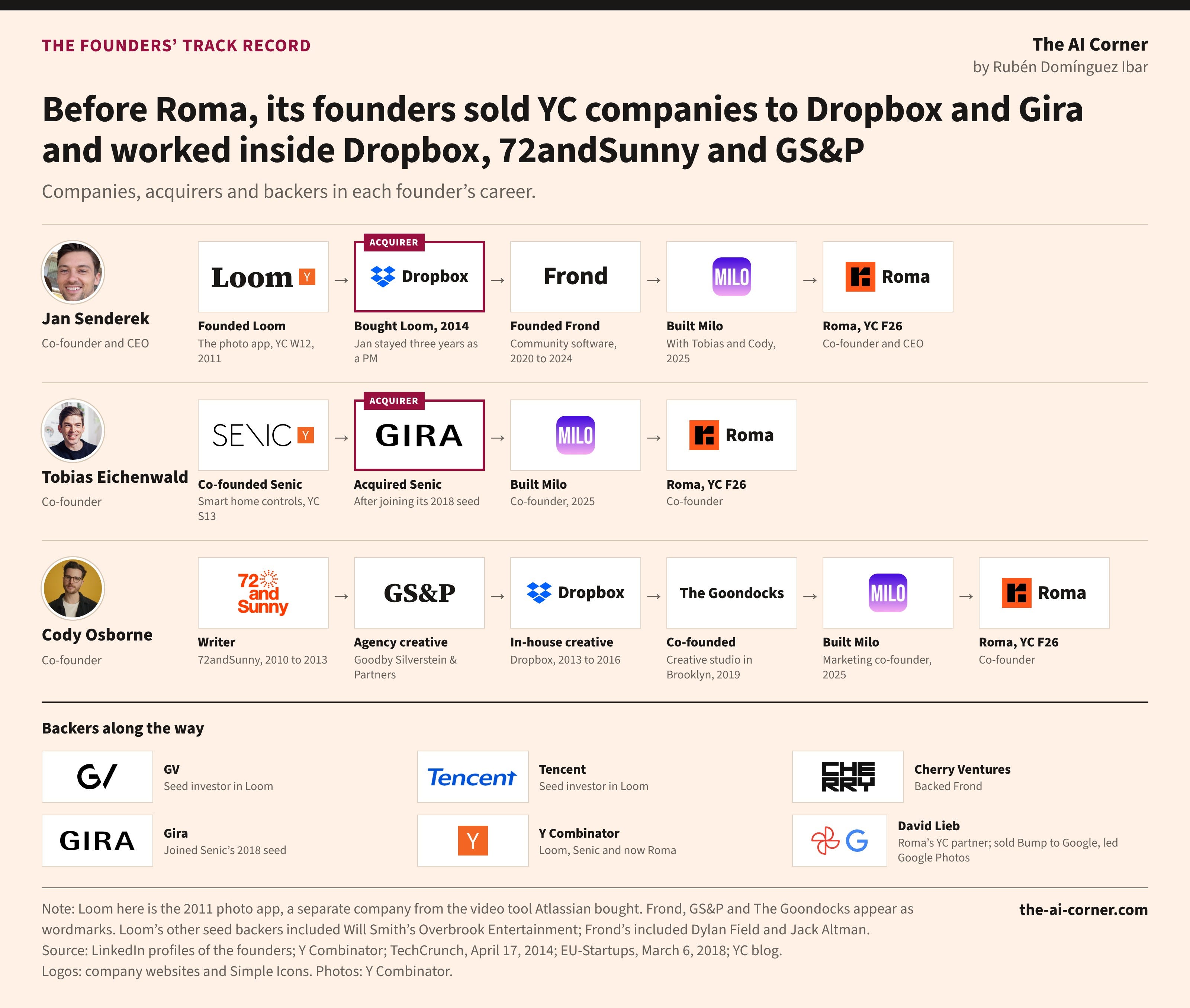
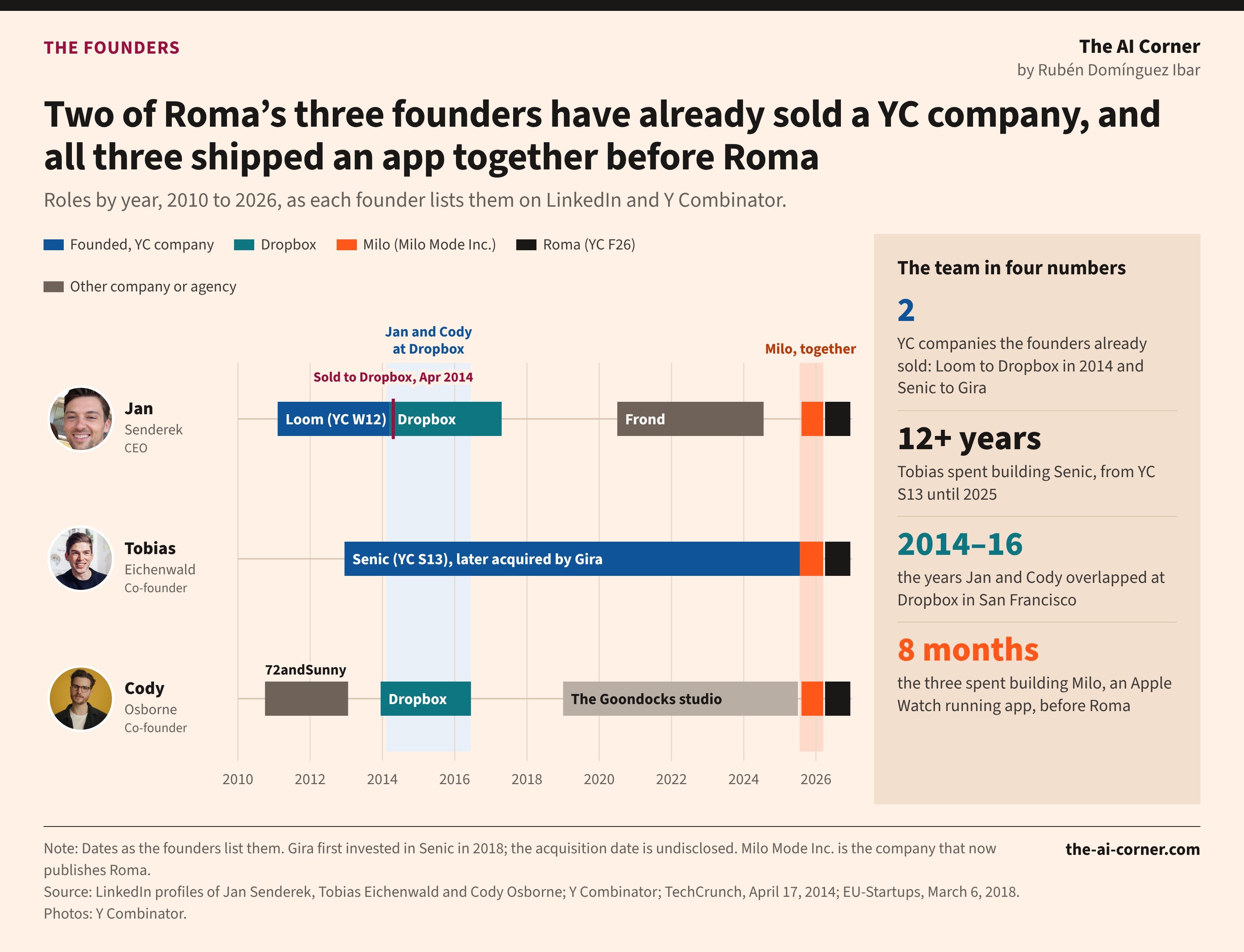
The team made this an easy yes for us. We’ve written about why second-time founders tend to do better. Roma has two of them, plus a third co-founder who has already worked with both.
Jan Senderek, CEO
Jan founded Loom in YC’s Winter 2012 batch. This is the cloud photo app, a separate company from the Loom video tool that Atlassian bought. Loom kept people’s full-resolution photos and videos in the cloud and synced them across iPhone, iPad and Mac before Google Photos existed. It raised a $1.3M seed from Google Ventures, Tencent and Will Smith’s Overbrook Entertainment, and in April 2014 Dropbox acquired it, bringing over the whole seven-person team.
Jan stayed at Dropbox for three years as a product manager. He worked with the machine learning team on early AI features that led to the Dropbox document scanner, and later ran Dropbox Mobile. After that he founded Frond, community software for remote teams and creators backed by Cherry Ventures, Dylan Field and Jack Altman, which he wound down in early 2025.
Tobias Eichenwald, co-founder
Tobias co-founded Senic in Berlin and went through YC in Summer 2013. Senic built smart home controls for products like Sonos and Philips Hue, including the Nuimo controller it launched on Kickstarter in 2015. Gira, the German maker of building-control systems, joined Senic’s $4M seed in 2018 and later acquired the company. Tobias describes himself as a programmer and designer, and he has won three Red Dot design awards.
Cody Osborne, co-founder
Cody has spent nearly two decades in brand and creative work. He was an agency creative at Goodby Silverstein & Partners and 72andSunny, worked in-house at Dropbox from 2013 to 2016 and co-founded The Goondocks, an award-winning creative studio in Brooklyn. He’s also the face of Roma’s launch video.
Jan and Cody overlapped at Dropbox in San Francisco, and in 2025 all three built Milo, a running app for the Apple Watch, under Milo Mode Inc., the company that now publishes Roma.
Their YC partner is David Lieb, who co-founded Bump, sold it to Google and then led Google Photos past a billion users. For a consumer team, that’s about the best partner match YC could make.
Early traction
Roma launched publicly in October and shipped 2.0 on November 11. It’s early, so we treat these numbers as signals, and we’ve flagged the one that comes from Roma itself.
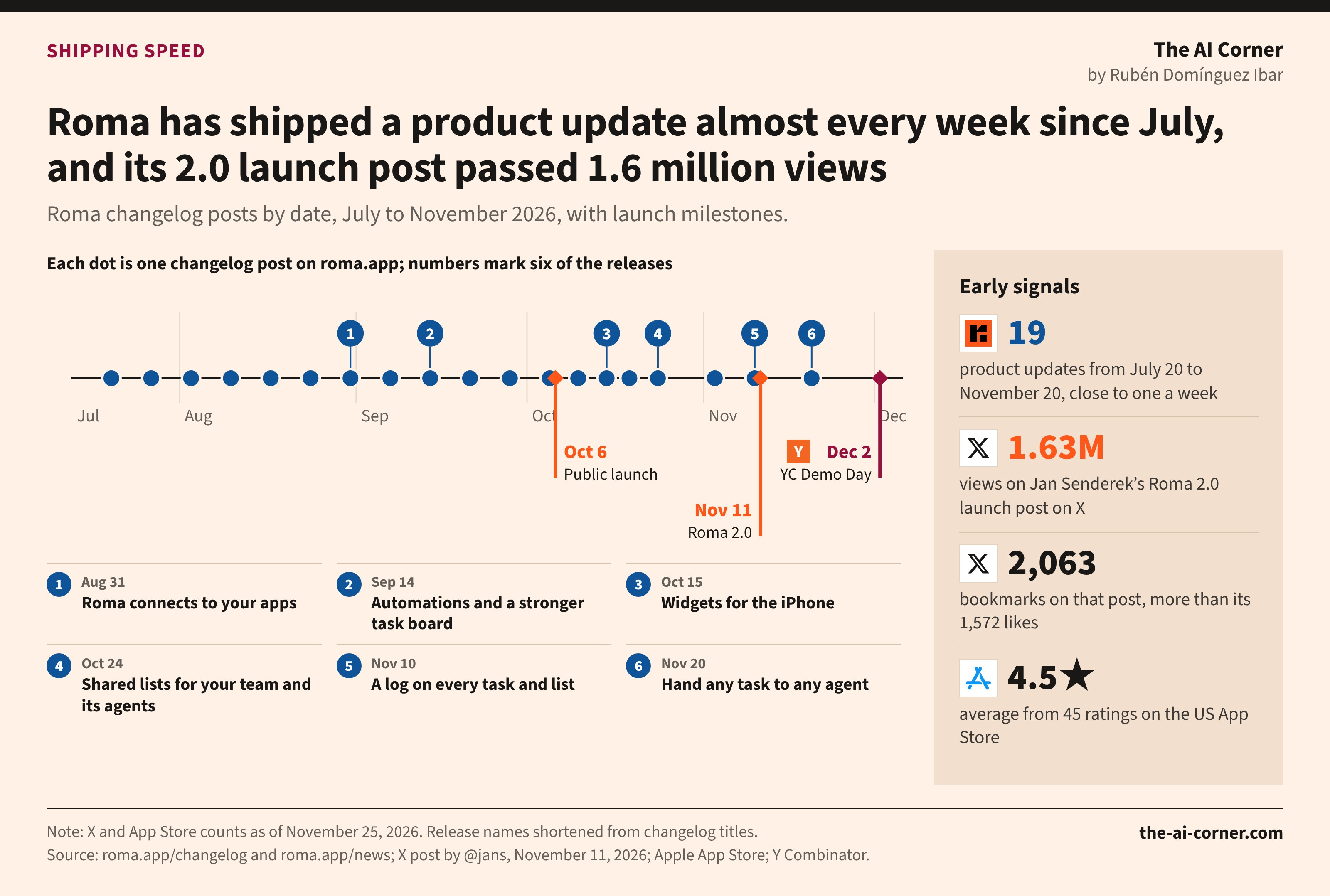
1.63M views on Jan’s Roma 2.0 post on X, with 2,063 bookmarks against 1,572 likes.
4.5 stars from 45 ratings on the US App Store.
3+ hours a day in the app for many of Roma’s most active users, according to the company, with some passing 100,000 tool calls each.
19 product updates between July 20 and November 20, close to one a week.

The bookmarks stood out to us. A like costs nothing, while a bookmark usually means someone plans to come back, and this post got 31% more saves than likes.
The X and App Store counts are public as of November 25, 2026. The usage figures are Roma’s own, unaudited by us.
How three founders run Roma on Roma
Two weeks after 2.0, the feedback was arriving faster than the team could answer it. “Three of us couldn’t keep up,” Jan wrote on X on November 25. “So we built a loop using our agents and Roma. Our agents do the work. We make the calls.”
His video follows one request through that loop. A user emailed asking for a Granola connection, so tasks from their AI meeting notes would land in Roma. Tobi’s Grok Bot read the email, checked the engineering log, replied to the user and handed the job to Tobi’s Claude Code, because connections are Tobi’s area.
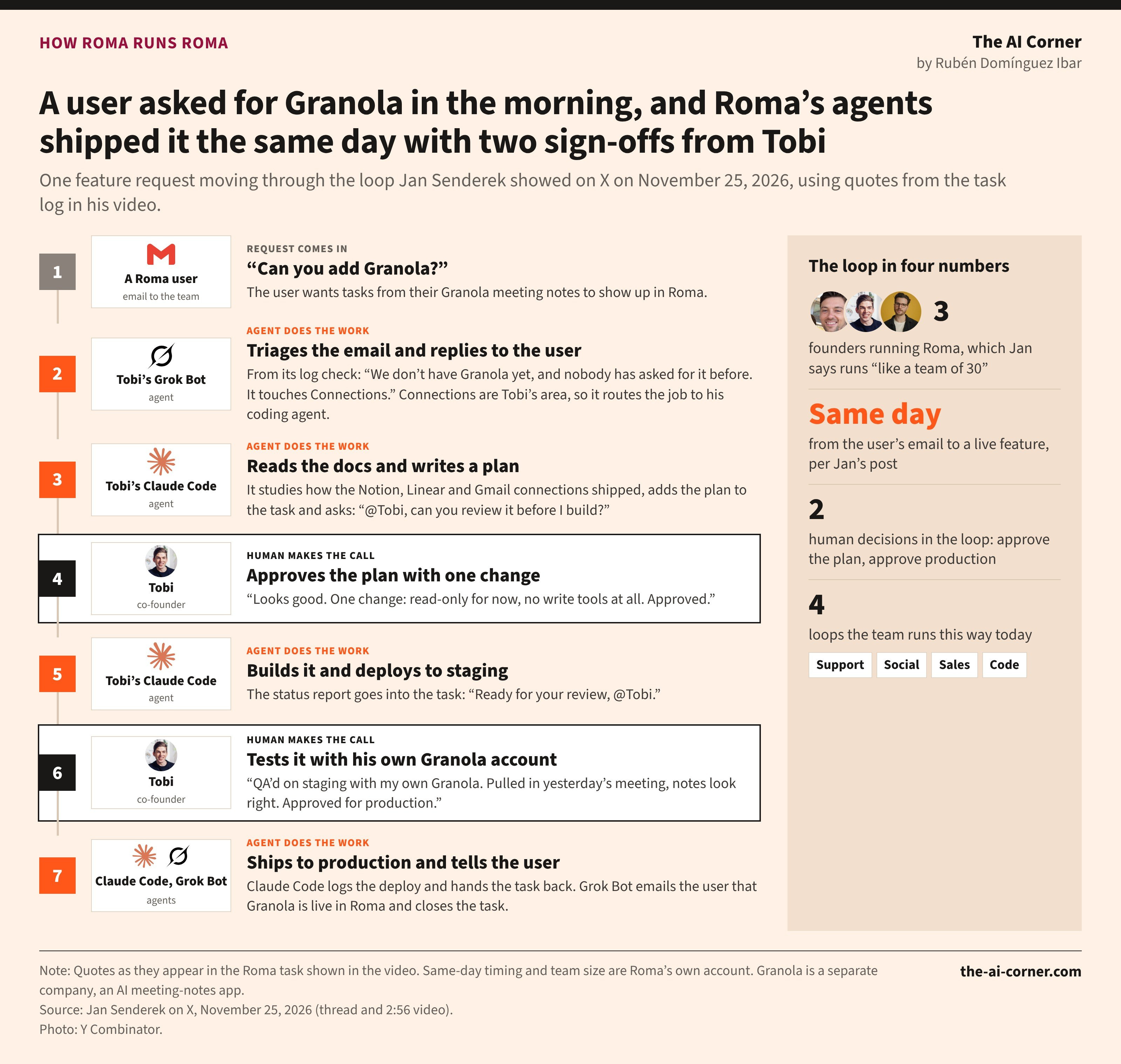
The humans step in twice. Tobi approved Claude Code’s plan with one change (“read-only for now, no write tools at all”), then tested the build on staging with his own Granola account before approving it for production. Claude Code shipped it, and Grok Bot emailed the user that Granola was live. Per Jan, the request came in that morning and went live the same day. The final deploy check still happens by hand, “but we’re working on that,” he says in the video.
Jan’s full video, 2 minutes 56 seconds:
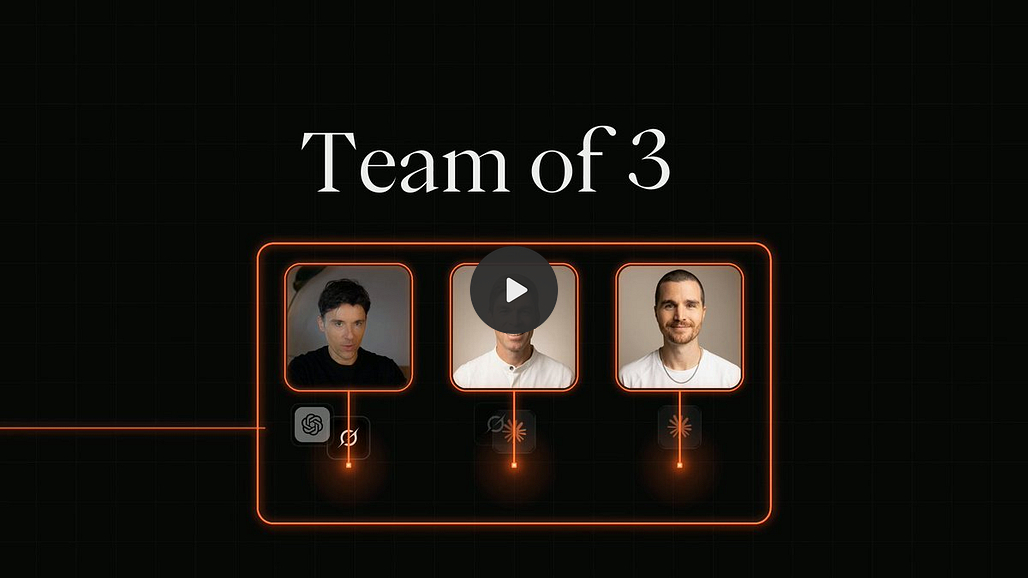
The team runs the same kind of loop for support, social, sales and code. “We started with a to-do list, and then our agents came in and turned it into a place our entire company runs,” Jan says. “That’s how a team of three runs like a team of 30.”
For us this is one of the strongest early signals a product can send. The founders hit every rough edge of Roma before their users do, and every loop they build is one their users can run too.
Why we said yes
We said yes for two reasons. The first is the team, which has already built consumer products and sold them to the companies that knew those categories best. The second is timing: we use more agents every month ourselves, and the app where one person manages all of them is still being decided.
Jan put the bet in one post this week: “The labs are betting you want one assistant that does everything. We’re betting the opposite: you want the best agent for each job, and one place where it all comes together.” We’re betting with him.
The Roma investment memo
This is the memo version of our thinking, written the way we’d send it to our own LPs, minus the deal terms.
The bull case
Agents are multiplying, so coordination becomes a product. Each lab wants to be your only assistant. Roma bets you’ll keep several, each picked for the job it does best, and that the list above them becomes the surface that matters most. If that’s right, a neutral layer wins, because only an independent company can sit across every lab.
The to-do list is the right container. Everyone already keeps one, and a task already carries what an agent needs to work: an owner, a due date, a status and the context behind it. Roma upgraded the object people already trust instead of inventing a new one for agents.
Shared lists build a moat inside each team. Once a team’s tasks, agents and decision history live in one place, switching means losing the record of why things happened. Roma shipped exactly that this month, with a log on every task and list.
The team ships like a much larger company. In about eight months as a company they’ve built a Mac app, an iPhone app with widgets, two-way integrations with four outside agents and a changelog post nearly every week since July. The Granola loop above shows how: their agents do most of the building, and the founders make the calls.
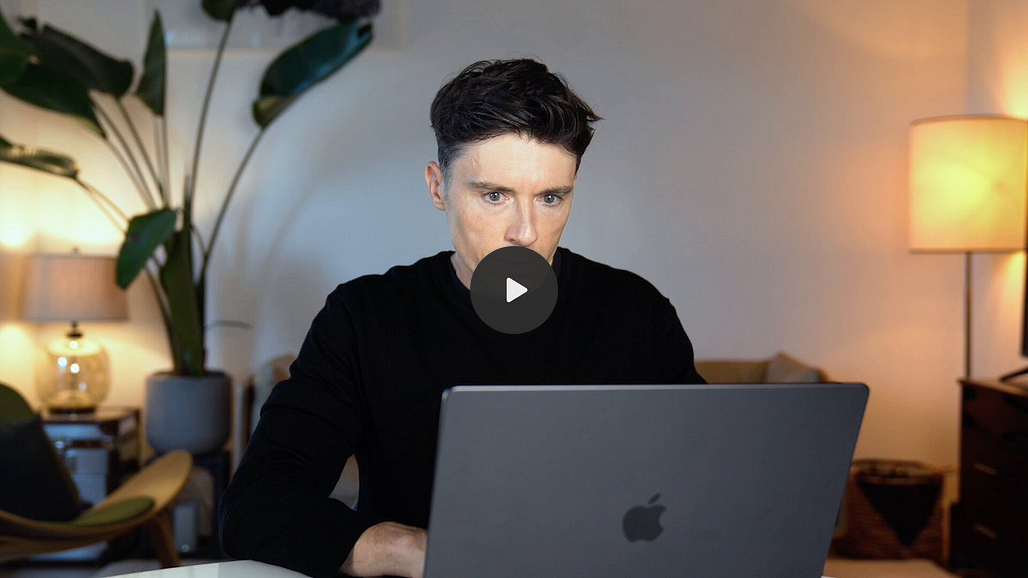
Roma’s YC launch video, with Cody Osborne at the laptop:
The risks we’re underwriting
The labs could build a list of their own. OpenAI, Anthropic and xAI all want to own your day, and any of them could ship a task view. Roma’s defense is that it works with all of them, which matters more as people spread their work across labs.
To-do apps have historically stayed small. The category is full of products people love that grew into modest businesses. Roma has to become the place where work gets delegated, a much bigger job than reminders.
Developer platforms are moving in. Vercel launched Vercel Board on November 18, a shared place where agents claim tasks, post progress and log results. Jan’s take on X: “This is the right idea, and Vercel nailed the shape of it. What we’re seeing at Roma is where it goes next.” Board is built for developer teams, while Roma is built for anyone with a phone.
Pricing is still ahead. Roma is free for everyone until the end of the year, Jan says, and consumer AI is a hard place to charge: only 4.5% of Americans pay for AI. We’ll learn what the usage is worth once Roma starts charging.
What we’ll track through 2027
Weekly active users, and the share who connect at least one outside agent
Teams on shared lists, and the number of agents per team
Tasks completed by agents per user each week, the closest measure of a list that does itself
Month-three retention for people who delegate against people who only capture tasks
The first pricing model, and whether it charges for delegated work
Where Roma fits in our portfolio
A large part of our AI portfolio builds infrastructure for agents, from sandboxes to training data. Roma sits at the other end of the stack, as the place where a person or a team decides what those agents should do next.
We’ll be in San Francisco for F26 Demo Day on December 2, and founders in the batch can reach us through grangel.co. If you’re building agents yourself, start with our guide to Claude Managed Agents.
You can follow Roma on X, LinkedIn and YouTube, and Jan on X and LinkedIn.
Every to-do list since pen and paper has made the same promise: write it down and stop worrying about it. Roma is built so the list does the work after you write it.