

What the Task Economy Actually Trades
Venture capital has a new favorite phrase. Benchmark’s Everett Randle calls it the “Task Economy”, the fast-growing market where AI labs pay human experts to teach models their craft.
His pitch is elegant. Tokens became the standard unit of AI usage, so tasks should become the standard unit of AI improvement and the spending behind them will become the next $1 trillion category.
The numbers make the case easy to believe. Mercor, the market’s leading platform, crossed $1 billion in annualized revenue this February and $2 billion by June and is now raising at a $20 billion valuation.
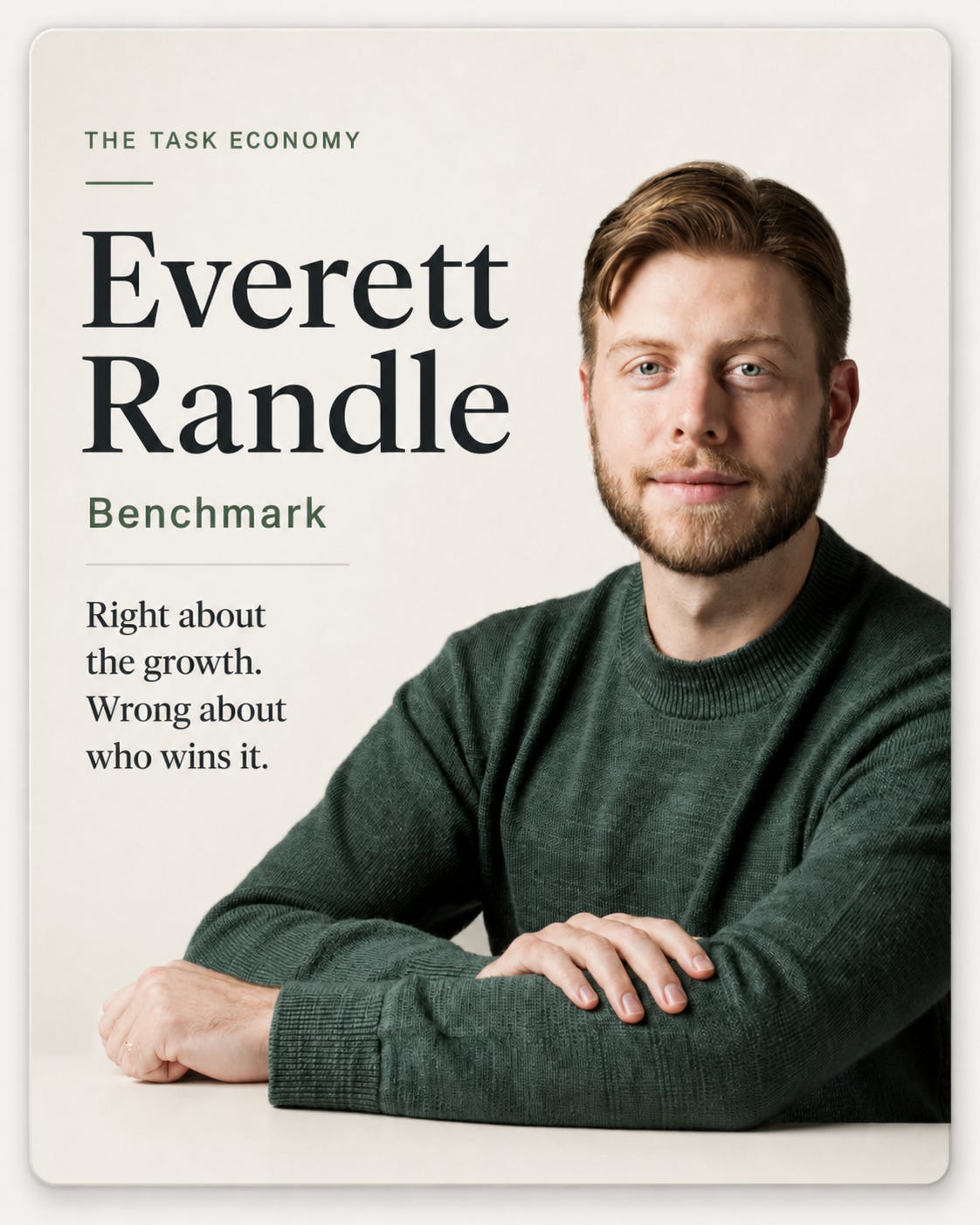
Here is the problem. The thesis is right about the growth and wrong about what kind of market this is.
A task is not a service being consumed. It is a transfer of ownership, the moment a piece of human judgment stops being rented by the hour and becomes an asset someone else keeps forever.
That distinction decides who actually wins the Task Economy and it is missing from the entire conversation.
together with Granola:
The Task Economy pays experts to hand their judgment over.
Granola makes sure you keep yours. It is the AI notepad that takes notes in the background wherever your meetings happen, Zoom, Slack, Google Meet, Teams, even in person with the iPhone and Apple Watch apps:

▫️ A brief before every call: who you are meeting, what you discussed last time, the context that matters
▫️ Clean summaries and action items the moment you hang up
▫️ Always follow up: a drafted email seconds after the call, or context pulled from your CRM via MCP
A second brain that was actually in every meeting.
(code THEAICORNER for 1 month off)
Table of Contents
1. The Task Economy in Plain Terms
2. What a Task Actually Transfers
3. Wages In, Capital Out
4. The Countdown Built Into the Boom
5. The Layer That Outlives the Buildout
6. Encode or Be Encoded
1. The Task Economy in Plain Terms
For 3 years, AI models got smarter mainly by reading the internet. That well is now dry and the Task Economy is what the industry built to replace it.
From tokens to tasks
Pretraining on public text carried models from autocomplete toys to competent generalists.
It cannot carry them much further, because the open internet never contained the working judgment of skilled professionals.
A model can read every published court ruling and still have no idea how a good lawyer actually reviews a data room.
A task closes that gap.
The model receives a realistic assignment inside a realistic environment, a contract to review, a diagnosis to reach, a codebase to fix and a practicing expert grades its attempt against a professional standard.
Randle’s framing is that tasks are to model improvement what tokens are to model usage.
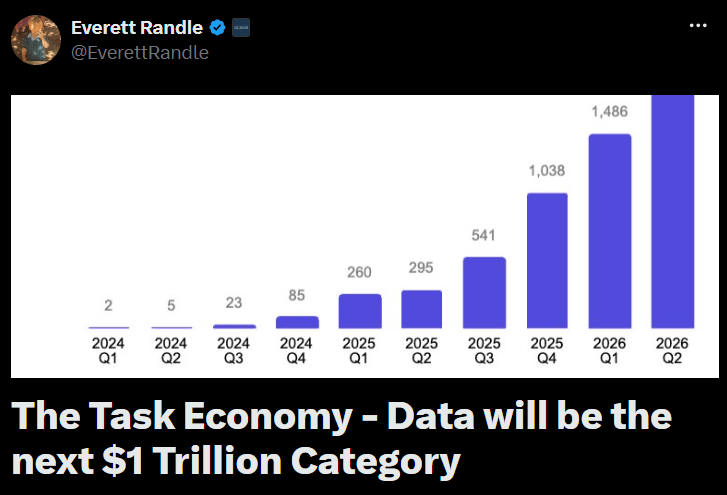
As adoption grows and models get hungrier for harder, longer exercises, task volumes compound the same way token volumes did.
The growth is not hype
The spending curve backs him. His essay reports OpenAI and Anthropic scaling their data budgets by roughly 10x year over year, mobilizing experts across every professional domain.
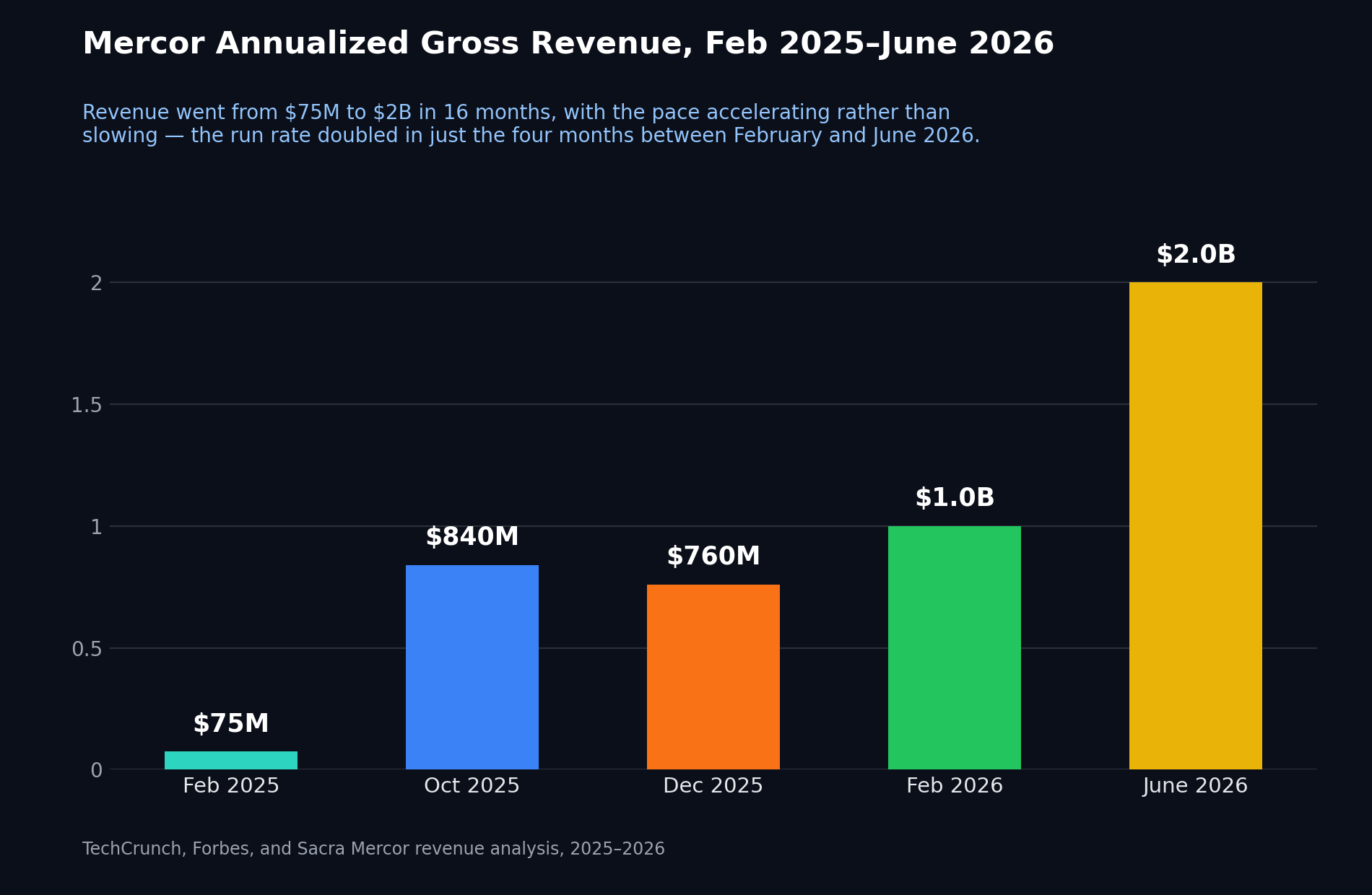
Mercor went from $1 million to $2 billion in annualized revenue in roughly 24 months and The Information reports its fastest-growing demand now comes from AI app developers and large enterprises rather than the labs alone.
So the Task Economy is real, large and accelerating. On the facts, Randle wins.
The trouble starts with the word economy itself, because it smuggles in an assumption about what is being bought and sold.

2. What a Task Actually Transfers
For 300 years of industrial capitalism there was exactly 1 way to access expert judgment. You rented it.
The one thing money could never own
A surgeon’s intuition or a litigator’s feel for a hostile negotiation lived inside a skull and skulls charge by the hour.
You could own a machine, a building, a patent or a brand. You could not own judgment.
You could only employ it and when the employee retired, the asset walked out the door with them.
The philosopher Michael Polanyi named the reason decades ago. We know more than we can tell.

Software never broke this constraint, because software encodes procedures, the explicit if-this-then-that. The valuable core of professional work was never procedural.
The conversion moment
Now run a task through that lens.
A firm pays experts for 6 months of demonstrations and grading.
The wages are incurred once, yet what comes out the other side is a permanent, infinitely copyable asset. Encoded judgment that works at 3am, in 10,000 parallel instances, for the price of electricity.
Nothing about the invoice reveals this.
On the income statement it looks like any other vendor expense, which is exactly why the market keeps mislabeling what it is watching.
Every task in the Task Economy is a small act of this conversion.
Judgment goes in as labor and comes out as capital and once you see that, the trillion-dollar question changes shape.
3. Wages In, Capital Out
If tasks are capital formation rather than services, history offers a very specific warning about where the money settles.
The railway lesson
The railway booms of the 1800s paid out staggering sums in construction wages and the construction firms were the hottest businesses of their decade.
Almost none of them survived as great companies. The railroads did.
That is the standard shape of a buildout.
Spending explodes while the asset is being created, then it collapses toward maintenance and value migrates from the builders to the owners.
The task platforms booking billions today are the construction firms of this cycle. Their growth is real and their position is transitional and those 2 facts coexist more often than markets like to admit.

The pass-through problem
The headline revenue also flatters the underlying business.
Bloomberg reported that Mercor’s $2 billion figure reflects gross billings and that the contractors doing the work take home 60 to 70% of it.
The platform keeps roughly a third. The rest is wages passing through on their way to the experts.
So even the promised trillion dollars of task spend, if it ever materializes, would be substantially a trillion dollars of salaries. That is a labor market wearing a software valuation.
None of this makes the platforms bad businesses today.
It means the durable question about any of them is not how fast task volume grows, but what they will still own when the buildout slows.

4. The Countdown Built Into the Boom
There is a stranger problem underneath the growth and it has no equivalent in the token economy everyone keeps comparing this to.
Customers funding their own exit
Nobody at a data center is working on making customers want fewer tokens. The Task Economy’s biggest buyers are doing exactly the equivalent.
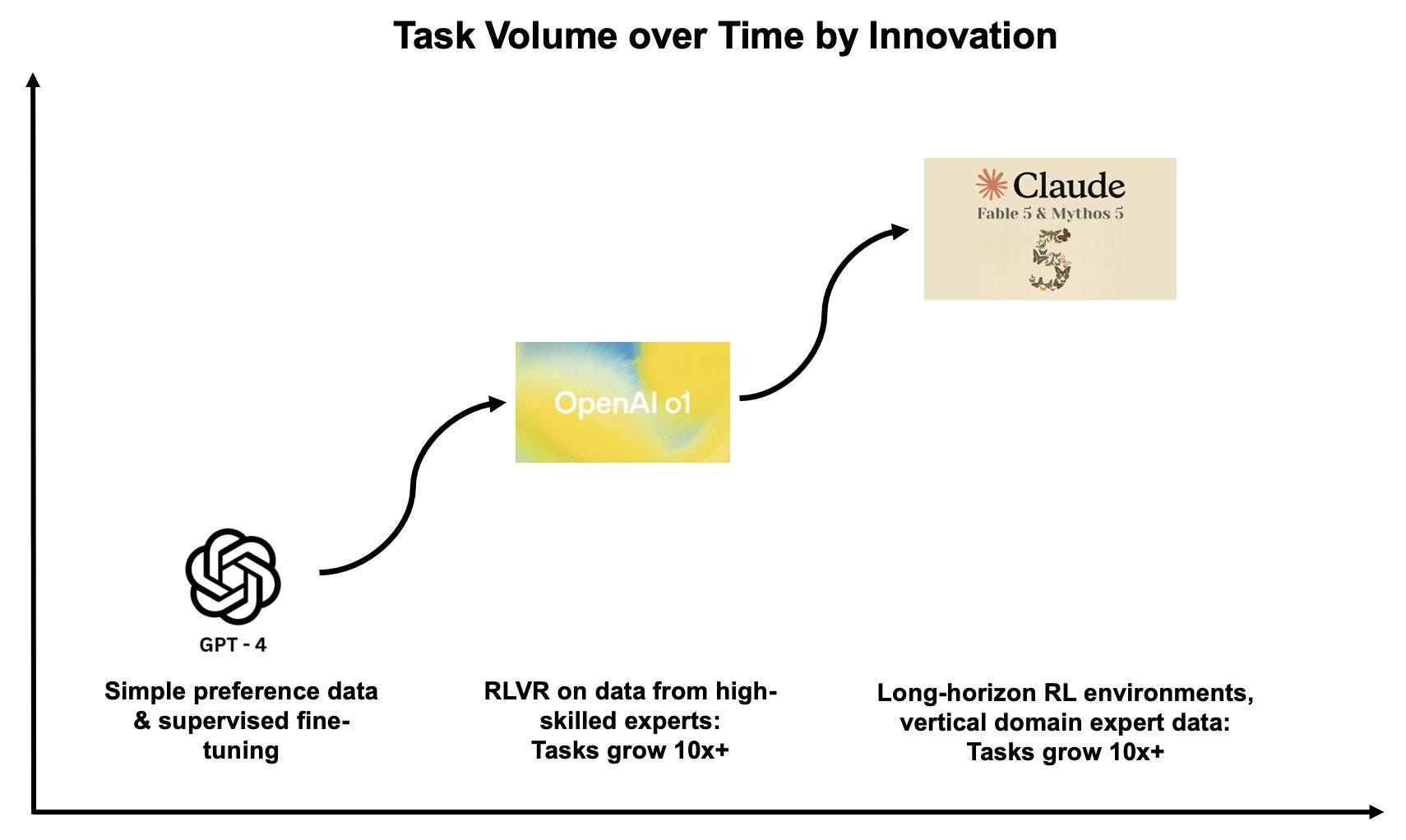
Every frontier lab funds research whose explicit purpose is to reduce the need for human training data. Synthetic data, self-play, AI graders and reinforcement learning against automatically checkable rewards in code and math.
In other words, each dollar a lab spends on tasks comes with a second dollar spent building the task vendor’s replacement.
The window may stay open for years. Randle’s own essay estimates that 99% of the knowledge relevant to future AI capability still sits in people’s heads, which is both the bull case and a measure of how much extraction remains before the buyers can leave.
Even so, a market whose customers are financing their own exit cannot be extrapolated with a ruler.
Concentration has already drawn blood
The other structural weakness is that the big buyers can be counted on 1 hand and this market has already run the experiment on what that means.
Scale AI was the category king until Meta bought 49% of it in mid 2025, at which point the other labs fled within weeks and gutted its core data business.
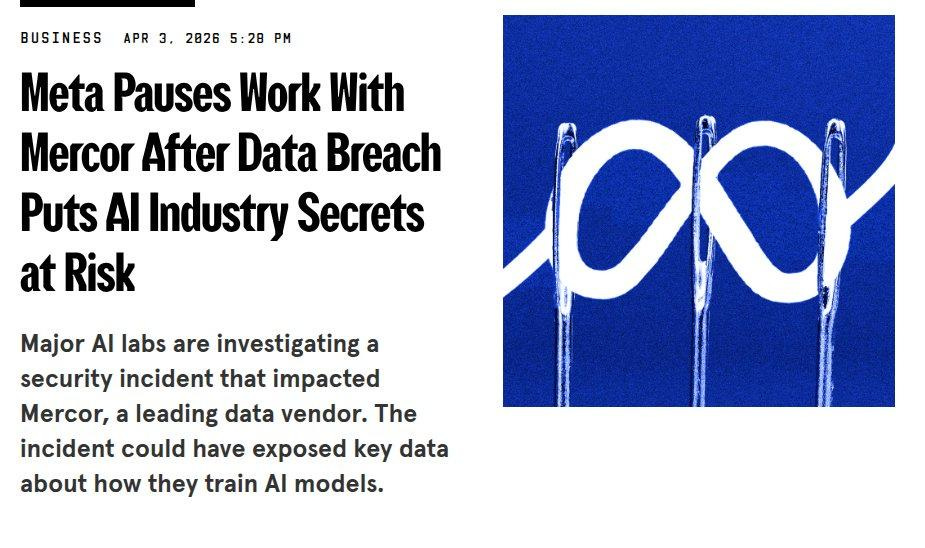
Mercor got its own taste this year. After a March 2026 supply chain attack exposed up to 4 terabytes of internal data, Meta, one of its biggest clients, paused all work with the startup indefinitely.
When 5 buyers control most of your revenue, you do not have a market position. You have a portfolio of large contracts with correlated termination risk and the correlation only becomes visible when it fires.
5. The Layer That Outlives the Buildout
Inside the Task Economy, 1 segment does not follow the buildout-then-fade curve and it is not the segment collecting the headlines.
Teaching ends, grading does not
Generation, meaning the work of showing a model what good performance looks like, is a stock problem. Once the judgment is encoded, it is encoded.
Verification is a flow problem and it never closes.
The frontier keeps moving, so models are perpetually graded against harder work than last year. The world keeps changing too, so a rubric written today goes stale within a couple of years as laws and standards change.
Someone has to grade the grader
There is a deeper reason this layer persists. As encoded expertise takes over real economic work, demand for assurance grows with deployment rather than with training.

Every regulated industry that hands work to a model will need a continuously refreshed apparatus of evaluation and much of it requires exactly the human judgment being automated, because the chain of trust has to stop somewhere.
So the honest map of the Task Economy has 2 layers with opposite economics. Generation is enormous now and ultimately bounded, while verification is smaller now, recurring and sits right next to regulation.
Anyone screening companies in this space should ask 1 question before any other. Is this revenue teaching the model, or auditing it? The second kind compounds.
6. Encode or Be Encoded
Every company sitting on decades of accumulated know-how is holding an asset that the Task Economy is about to convert into capital. The only open question is who ends up owning the result.
Do nothing and a generic version of your domain’s expertise gets encoded anyway, drawn from the industry-wide talent pool, by labs and by competitors. Your inherited know-how gets quietly repriced from moat to commodity.

If you run the extraction yourself, with your own problems and your own experts, you will end up converting a wasting asset into a compounding one.
The enterprises now driving the fastest-growing slice of task demand appear to have worked this out already.
The accounting has not caught up. Money spent encoding expert judgment is booked as an operating expense and managed like a cost, when it behaves like capex in everything but the label.
For individuals, the arithmetic is uncomfortable but worth stating plainly. The experts earning excellent rates on task platforms are executing a 1-time sale of an asset they previously rented out in perpetuity.
Once a functional copy of mid-tier professional judgment exists, the wage for mid-tier professional judgment does not stay where it was. The professions will not erode evenly. They will hollow out from the middle, while frontier judgment and the people who audit the machines become more valuable, not less.
So take the Task Economy thesis seriously, because the growth is real and the buildout will be enormous. Then take it 1 step further than its authors do.
Tasks will be king, exactly as promised. The kingdom belongs to whoever owns what the tasks leave behind.
Calling this a services market may be the first accounting mistake.
We’ve done something similar for years with documentation and process design: treating as overhead work that actually builds institutional infrastructure.
But AI adds a more interesting wrinkle. You can pay for the work, contribute the judgment, and still not own the asset being created.
So the question isn’t only whether this is really capex disguised as opex. It’s whose capex is it?
Companies may be celebrating AI ROI while quietly helping build someone else’s most valuable asset.
If the money is buying human judgment permanently, the valuation question is what kind of judgment holds its price. The pattern I keep seeing in engineering is that judgment which is expensive to verify holds, and judgment which is cheap to verify collapses fast. Faros AI, across 22,000 developers, found throughput per developer up 33.7% while median code review time rose 441.5%. The generation side got commoditised and the adjudication side got scarcer and more valuable in the same quarter. Any task-economy business whose moat is labelling rather than adjudicating is buying the half that deflates.