

A startup called Shift now pays more than 35,000 people to film themselves doing physical work so robots can learn it. Demand for that footage is roughly 10 times higher than a year ago, according to Encord’s head of robot learning.
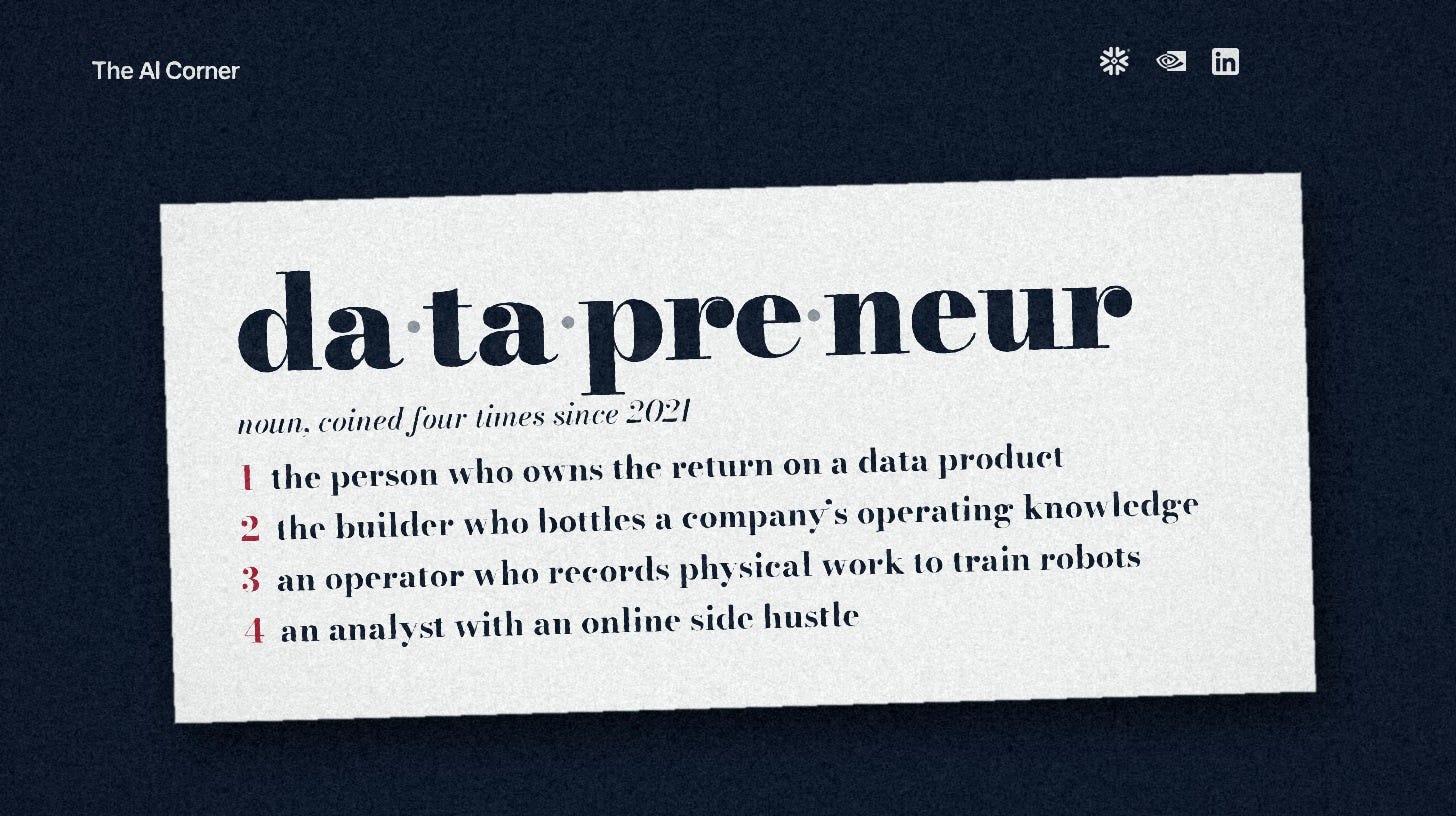
The people selling it have a name: the “Datapreneur.” It’s the 4th meaning that word has had since 2021, and 2 of those 4 build real revenue.
So, what exactly is a “Datapreneur”?
Sponsored by Voices
Robots are one place where recordings of real human behavior set the price of training data. Voice is another, because a model has to learn when to talk and when to listen.
Can your voice AI tell a backchannel from an interruption?

People talk over each other and drop an “mm-hm” mid-sentence, and the newest voice AI is being built to do the same. Synthetic audio misses the timing that makes it sound real.
The data gap: even in Fisher, the most widely used full-duplex corpus, overlap is only about 14% of speech duration
What good data needs: the three requirements for duplex-ready training data, from the white paper by Voices’ CTO
How to get it: custom datasets recorded as two-channel audio on a shared clock and fully consented for AI training
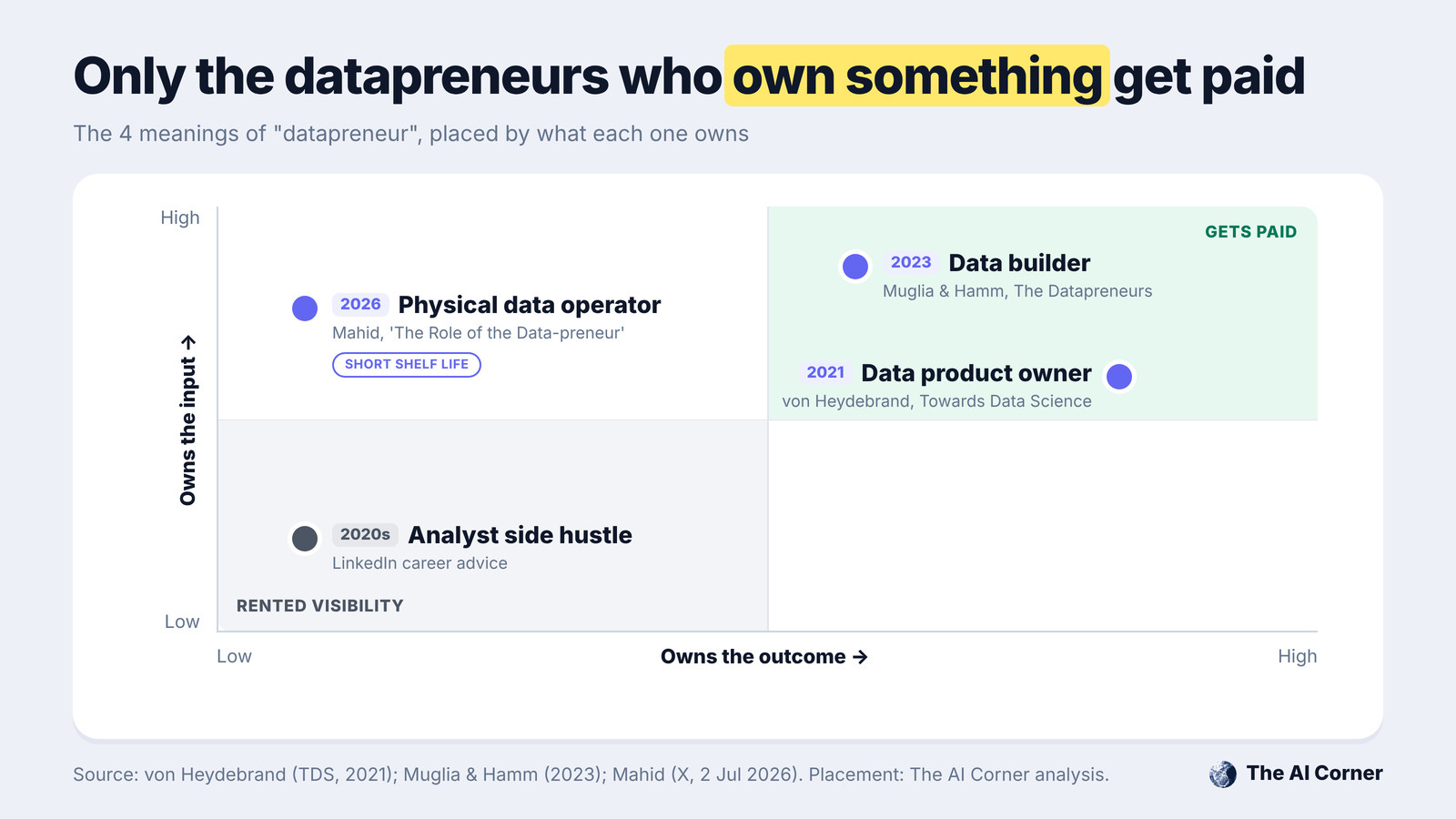
The 4 datapreneurs at a glance
The 2021 data product owner: pays, because someone owns the outcome.
The 2023 data builder: pays, because someone owns the input.
The 2026 physical data operator: pays when access is exclusive, with a short shelf life.
The analyst with a side hustle: the version most people have seen, and the one that rarely pays.
Table of Contents
Where the Word Came From
The Version That Went Physical
What Physical Data Actually Sells For
The Version Spreading Through Data Teams
What the Machines Are Doing to Both Sides
The Only 2 Things That Have Ever Paid
1. Where the Word Came From
The first 2 versions were written by people watching a decade of data investment struggle to convert, and both landed on the same culprit.
The 2021 version, built inside companies
On 12 March 2021, Nadiem von Heydebrand published a piece in Towards Data Science with a blunt argument: enterprise data had a people problem, and the models were fine.
He had spent the 2010s watching organizations finance data labs and AI hubs. Then a stakeholder asked when the return would arrive, and the mood turned.
By his account, research firms put the failure rate at about 90% of data initiatives that would stay stuck before production.
His diagnosis was organizational.
Teams ran projects where they should have been building products. Desirability went unchecked, and the business case had no owner.
Output shipped on schedule, while the outcome belonged to nobody. His datapreneur is the person who signs up for the return and carries the loss when it fails to arrive.
The 2023 version, built from a career
2 years later, former Snowflake CEO Bob Muglia published The Datapreneurs with journalist Steve Hamm. Muglia describes the word as data and entrepreneur run together.
His datapreneurs are builders. He worked on SQL Server in its early days at Microsoft and later ran Snowflake, so the roll call is credible, even if the category is broad.
The part worth keeping is smaller and sharper. Muglia argues the real unclaimed asset is the semantic model of a business: the operating knowledge scattered across apps, dashboards, people’s heads and Slack threads.
Whoever bottles that owns something an agent would struggle to rebuild from a warehouse schema.
He expects data engineering to become business engineering for exactly that reason.
Hold onto both ideas. They come back at the end, because every version of this word that made money is built from them.

2. The Version That Went Physical
In July 2026 the word picked up a 4th meaning, a hyphen and, for the first time, a balance sheet with hardware on it.
The essay that spread it is “The Role of the Data-preneur” by Mahid, published on X on 2 July 2026. Worth knowing: Mahid co-founded The Open Robot Company, which sells capture rigs and field operations to exactly these operators, and the essay closes with a note from his company.
Access is the asset
The data-preneur in this telling is an operator who controls physical spaces where people do real work: warehouse crews, garment factory floors, restaurant kitchens, repair bays, farms.
The premise is that robots learn from demonstrations of physical work that are expensive to simulate, and the people standing next to that work know which parts are worth recording.
That local knowledge is the product.
It means knowing which tasks repeat, which ones fail, and which environment details change the outcome.
The serious version looks like a small operations company. It runs devices across sites where useful work already happens, with a buyer pipeline that says what to collect next.
The real business is keeping those devices productive.
Start here: our Physical AI Investment OS maps where this data layer sits in the wider robotics stack.
What a buyer is actually purchasing
What sells is closer to a skill package.
That means a task definition, synchronized camera streams, success criteria, failure examples, rights and provenance, and a delivery format a training pipeline can consume without a week of cleanup.
The rights layer comes first. Who owns the recordings and whether workers consented to resale decide whether the asset exists at all.
And the first pass over any submission increasingly runs through an agent, which means data has to be machine-legible before it can be persuasive.
The Physical AI Investment OS: 12 Layers, 4 Tiers, and Where the Money Actually Sits

Where the data layer sits in the physical AI stack.
3. What Physical Data Actually Sells For
The pricing logic here is unusually clean, and it transfers to almost any knowledge work sold to a sophisticated buyer.
2 ways data earns a premium
The first is distribution expansion. The data goes somewhere the buyer’s training set has yet to reach: a new task or a new environment.
The second is signal improvement. The buyer already has coverage there, and you bring back better evidence: cleaner geometry, synchronized viewpoints, force signals that plain video misses, tighter provenance.
Anything that satisfies neither is a commodity: the same task, in the same room, from the same angle.
Underneath both sits sample efficiency, which is the thing actually being priced.
If a buyer needs 10,000 weak demonstrations to learn a task and only 1,000 strong ones from a better setup, the second dataset wins on cost. It saves collection time and researcher attention.
The scale gap is real enough to justify the excitement.
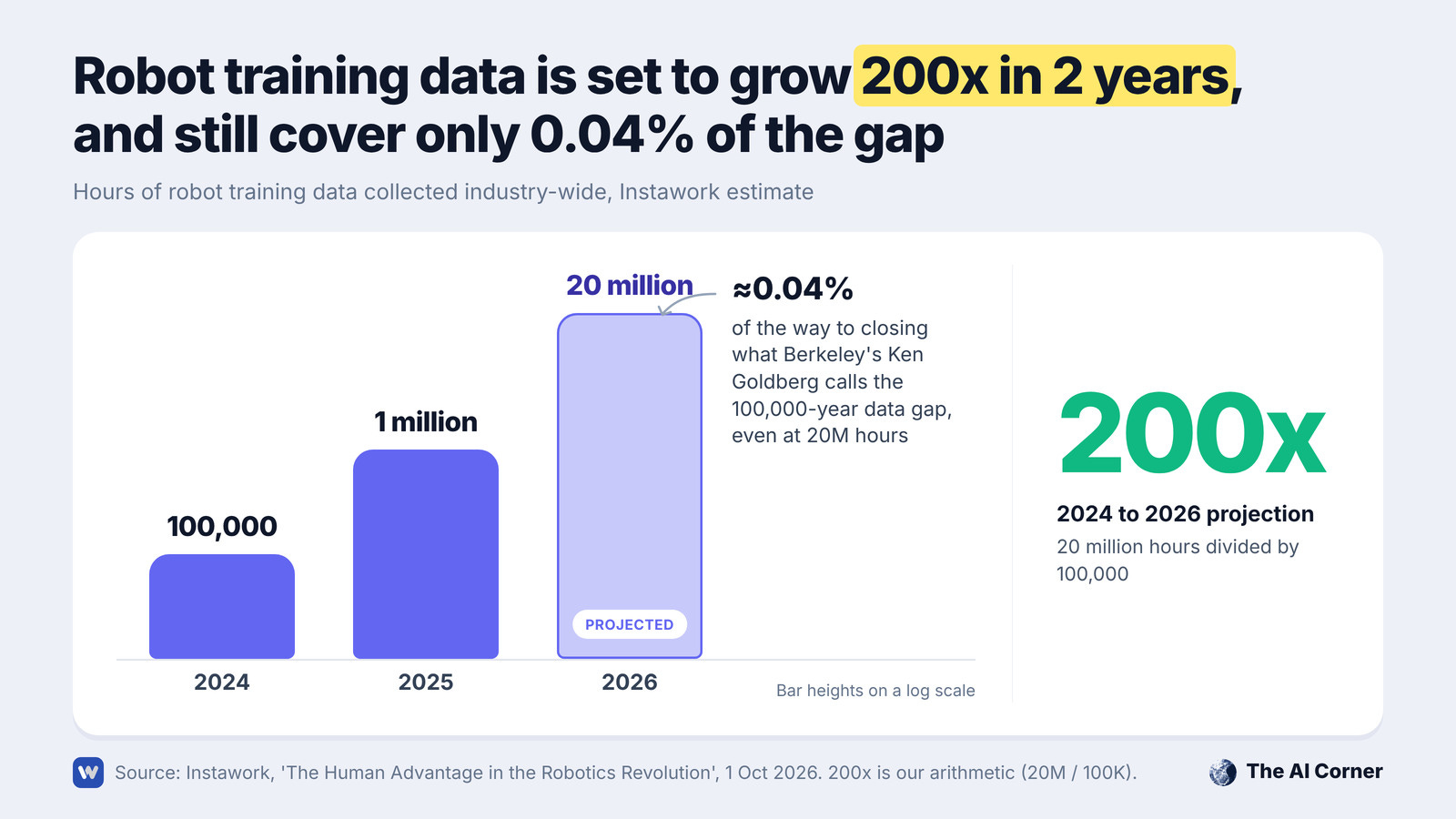
By Instawork’s own estimate, the industry collected roughly 100,000 hours of robot training data in 2024 and 1 million in 2025, with 20 million projected for 2026.
By Instawork’s own math, even that is only about 0.04% of the way to closing what Berkeley’s Ken Goldberg calls the 100,000-year data gap.
Buyers already feel it. Encord’s customers once asked for 1,000 hours of annotated data and now want 10,000 or even 100,000, its head of robot learning told Business Insider.
Why every dataset has a shelf life
The trap sits directly underneath the opportunity.
Value peaks the moment a dataset expands the buyer’s coverage, then falls as soon as that territory is filled.
Buyers also want exclusivity on specific task and environment pairs, because a lab funding a workflow in one factory wants to keep it from competitors.
And the buyer pool is thin. Mahid’s essay puts serious, procurement-capable buyers of high-quality physical data at around 10, with no source given for the number.
A thin buyer pool plus decay on delivery is a demanding setup for an independent operator, and it is why this business rewards range over one good contract.
It already has casualties. Sam Padilla shut down his robotics data startup, Eidon AI, earlier this year after struggling with upfront costs and thin margins. His verdict: “a technical bottleneck does not necessarily imply a good business.”
4. The Version Spreading Through Data Teams
The LinkedIn version has none of the above. It is the one most readers will have met first, and it has a real defect at its center.
5 income streams, 1 underlying skill
The script is familiar by now. Analysts who only run reports get automated away. Analysts who freelance, publish technical posts, sell a template pack and teach the occasional workshop stay safe.
It is presented as risk management. Look at what it is made of.
If a model can write the query, it can write the post explaining the query. If it can build the dashboard, it can generate the template pack that ships alongside it.
The workshop teaching intermediate SQL and pandas has a market for exactly as long as that skill stays scarce and expensive to acquire, which is the condition the advice itself says is ending. The freelance project is the same labor as the salaried one, on worse payment terms.
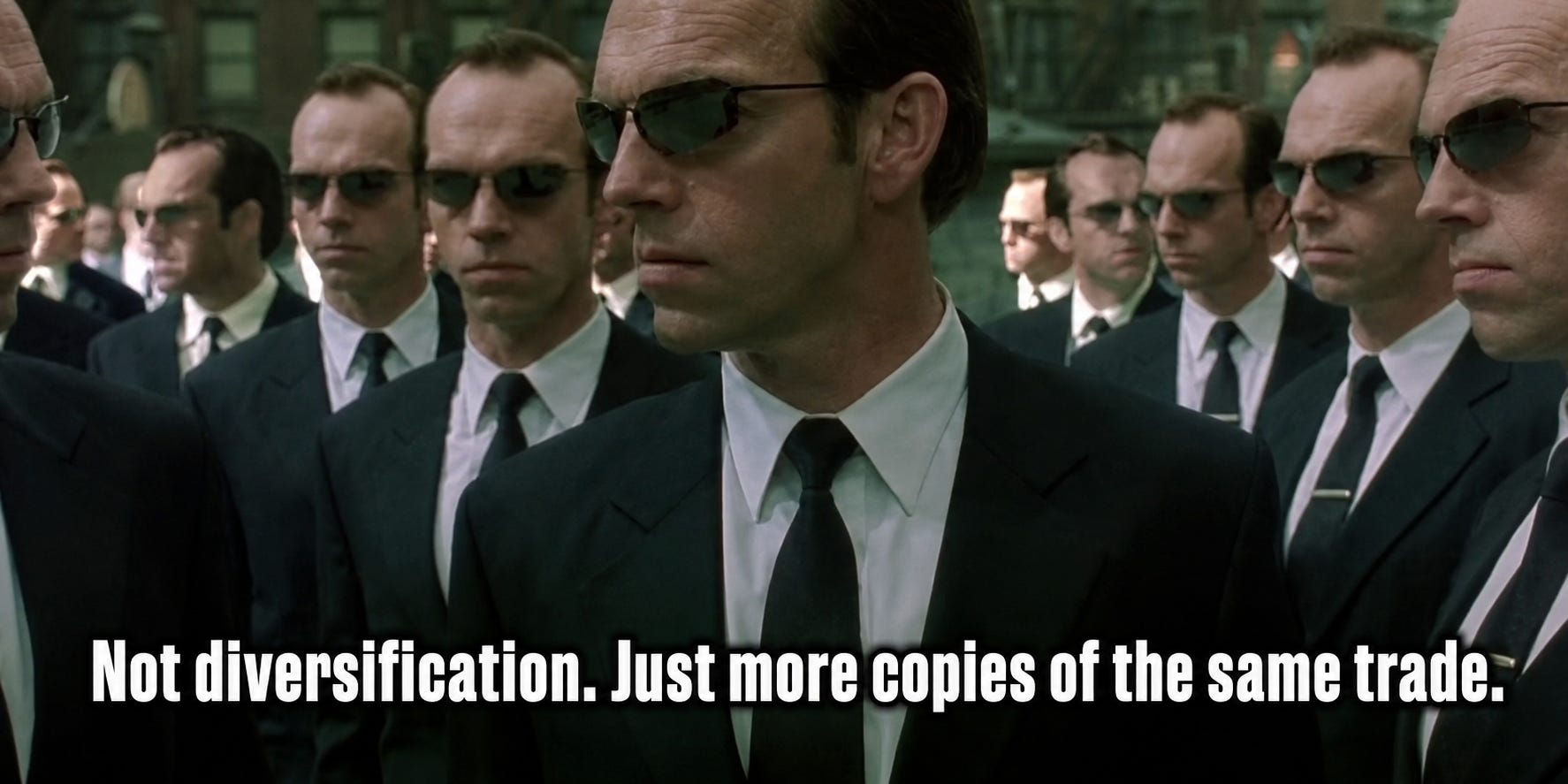
Diversification only reduces risk when the parts behave differently from each other. These 5 reprice on the same morning, for the same reason, because they are cut from the same material as the job.
An audience is rented
Every version of this advice ends at the same destination, which is building visibility.
Visibility is rented distribution. The landlord is a recommender system that changes its ranking whenever it likes, and the lease renews monthly on condition of producing more of whatever worked last quarter.
The particular patch being rented here is the most crowded ground in the field, because everyone receiving this advice gets the identical map.
Compare it with the physical operator, who at least owns the devices and the recordings. Those survive a platform update, while a following resets with every algorithm change.
5. What the Machines Are Doing to Both Sides
3 NVIDIA releases from 2026 set the boundary conditions for every version of this idea, starting with ASPIRE.
Software that finds its own skills
ASPIRE came out of NVIDIA GEAR with researchers from UMich, UIUC, UC Berkeley and CMU. It writes and repairs robot control programs from execution feedback and saves the fixes that work into a growing skill library.
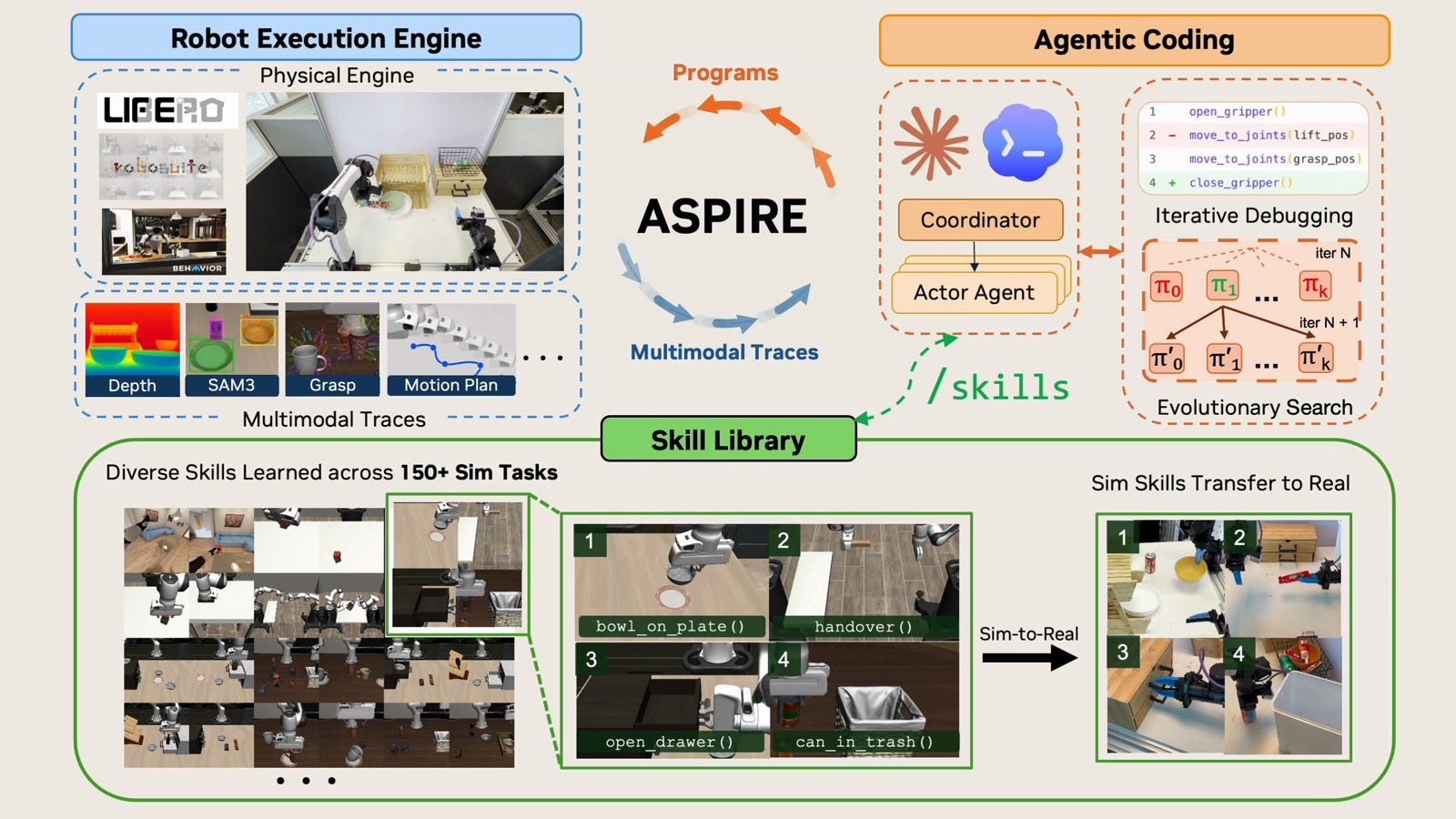
On unseen long-horizon tasks it reports 31% success against about 4% for the prior coding agent.
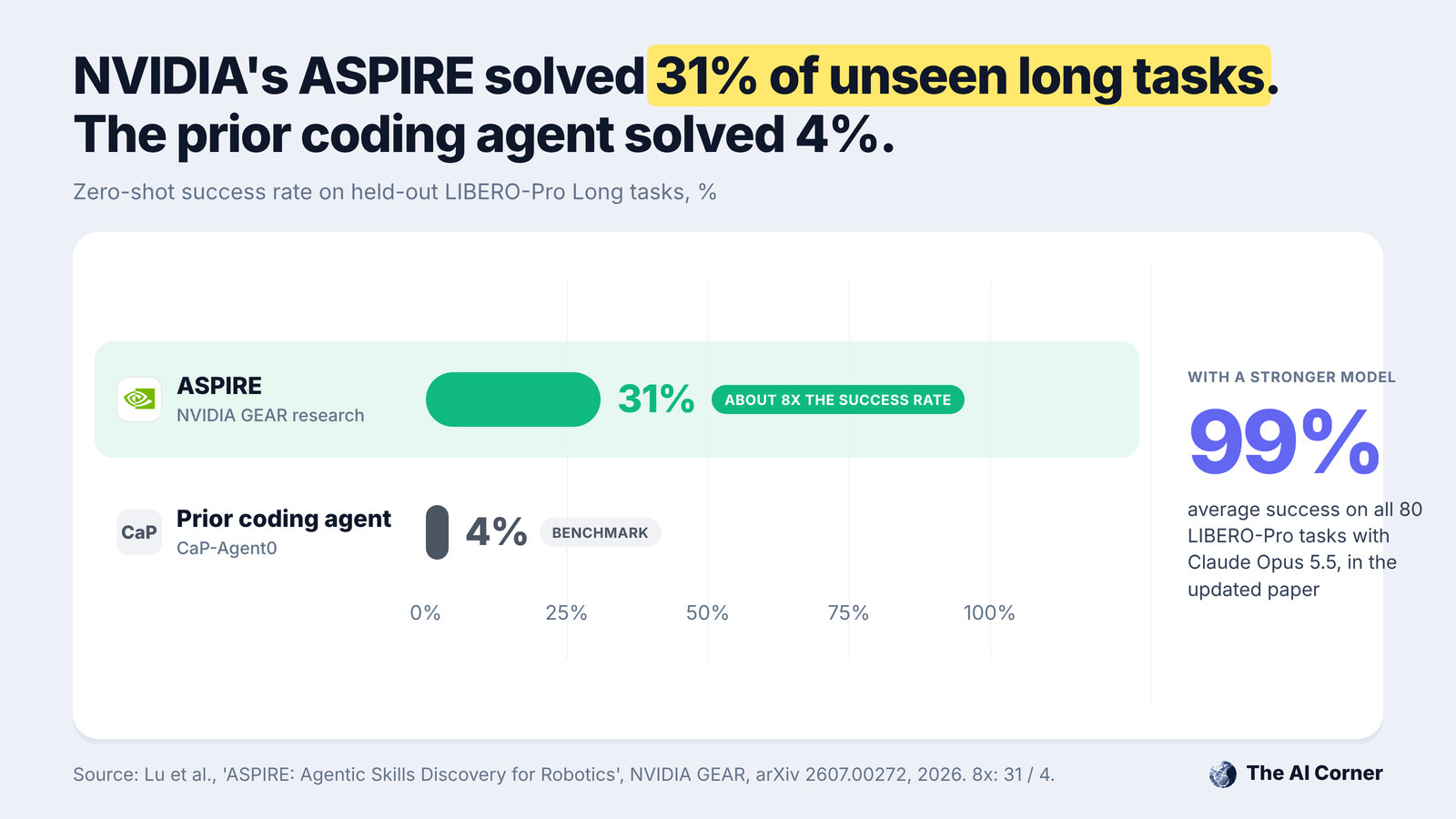
Most headline results are in simulation. The updated paper adds a sharper one: with Claude Opus 5.5, ASPIRE reaches 99% average success across all 80 LIBERO-Pro tasks. Our read: as the models get stronger, each skill needs less human input.
Its sibling project, ENPIRE, runs the same kind of loop on physical robots, and reports agents reaching a 99% success rate on dexterous real-world tasks such as cutting a zip tie.
Less data, in the vendor’s own words
Cosmos 3 launched at GTC Taipei on 1 June 2026, combining physical reasoning, world generation and action prediction in 1 model.
NVIDIA’s own announcement describes it as a foundation for building physical AI systems with less data and lower training costs, and markets it for synthetic data generation.
Both things can be true together. Frontier models can cut the demonstrations needed per skill while total demand for real capture still climbs, because the number of skills being attempted climbs faster.
That is a defensible position, and it rarely gets stated, because stating it honestly puts the substitution risk in the same paragraph as the opportunity.
The identical logic runs 1 layer up. The tools making an analyst’s output cheaper are the same tools making the analyst’s side products cheaper, on the same schedule.
6. The Only 2 Things That Have Ever Paid
Strip the 4 versions back and the ones with a business underneath share exactly 2 features.
Proprietary inputs and accountable outcomes
The first is a proprietary input. Something the buyer can get only from you, like Muglia’s semantic model of a business or the operator’s access to a factory floor.
The second is accountability for an outcome. Von Heydebrand named this in 2021, and it has held up well. Somebody has to own the return and carry the loss. That role is scarce because it is unpleasant.
The version circulating on LinkedIn substitutes visibility for both, which is why it feels like a plan and behaves like a hobby.
The 2-week test for automation
For anyone deciding what to defend, the useful cut is specification. Tasks with a clean specification and a verifiable output are the exposed ones, because that shape is precisely what a model can be trained and graded against.
Routine queries and recurring reports make up most of what juniors do to earn a seat.
What survives sits upstream or downstream of the specification: knowing which question is worth asking, which table lies and since when, and which stakeholder will kill a finding on sight.
One honest note belongs here. How fast analyst roles are being displaced is still unmeasured. The mechanism is strong, but nobody has a reliable number for the timeline yet.
Which leaves 1 test worth running, and it has nothing to do with counting income streams. What do you own that a competent stranger with a frontier model and 2 clear weeks would struggle to reproduce?
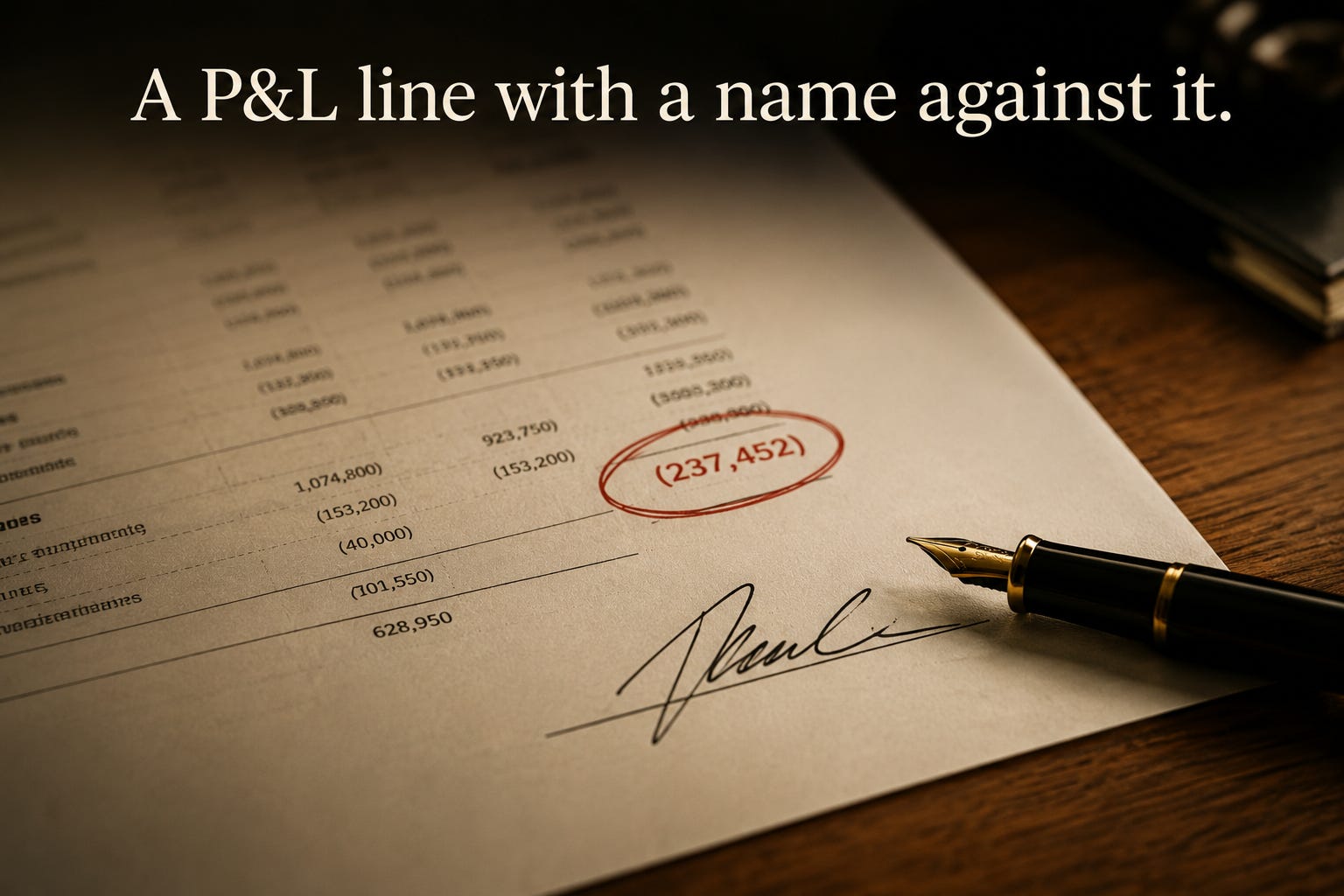
Ownership is the bar: proprietary access to a dataset, a domain everyone else avoids, operators who trust you, a P&L line with your name against it.
If the honest answer is nothing, the fix is to go and acquire one of those things, and for most people the fastest route runs straight through the job the advice keeps telling them to look beyond.
Run it tonight: write down 1 input you own and 1 outcome with your name on it. If both lines are empty, that is your next 90 days.
The word has been invented 4 times. It has only ever meant 1 thing that pays: own the input, or own the outcome. Everything else is packaging.
If this saved you a LinkedIn course, send it to 1 analyst friend who needs the test.
Which of the 4 are you? Drop your answer in the comments.
FAQ
What is a datapreneur?
A datapreneur is someone who builds a business from data they own or an outcome they are accountable for. The term was popularized by Nadiem von Heydebrand in Towards Data Science in March 2021.
Who coined the term datapreneur?
Nadiem von Heydebrand made the case for it in “Why the world needs datapreneurs” on 12 March 2021. Bob Muglia and Steve Hamm used it as the title of their 2023 book.
How do datapreneurs make money from robot training data?
They record real physical work in sites they control and sell it to robotics labs as training data. Shift, one supplier, pays more than 35,000 people to record tasks, according to Business Insider (15 Oct 2026).
How much robot training data exists?
Instawork estimates the industry collected about 1 million hours in 2025, with 20 million projected for 2026. Instawork puts that at about 0.04% of the way to closing the gap Ken Goldberg describes.
Is the datapreneur side hustle worth it for data analysts?
Rarely as a hedge, because every income stream rests on the same automatable skill. The durable versions own a proprietary input or an accountable outcome.