

On Thursday morning, Anicet Nougaret posted a Stripe screenshot. Gross volume for the last 30 days: $275,000, against $62,193 for the 30 days before. His caption put it as a $3.3M revenue run rate, up 4.4x in 30 days (the post).
The day before, he had shared the subscription view: $1.74M of ARR, up 30.92% from $1.33M in the previous 10-day period.
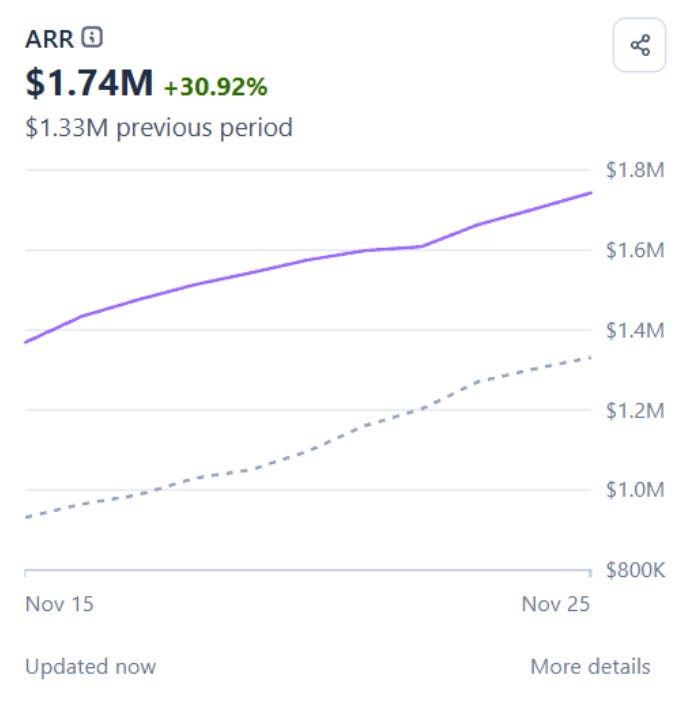
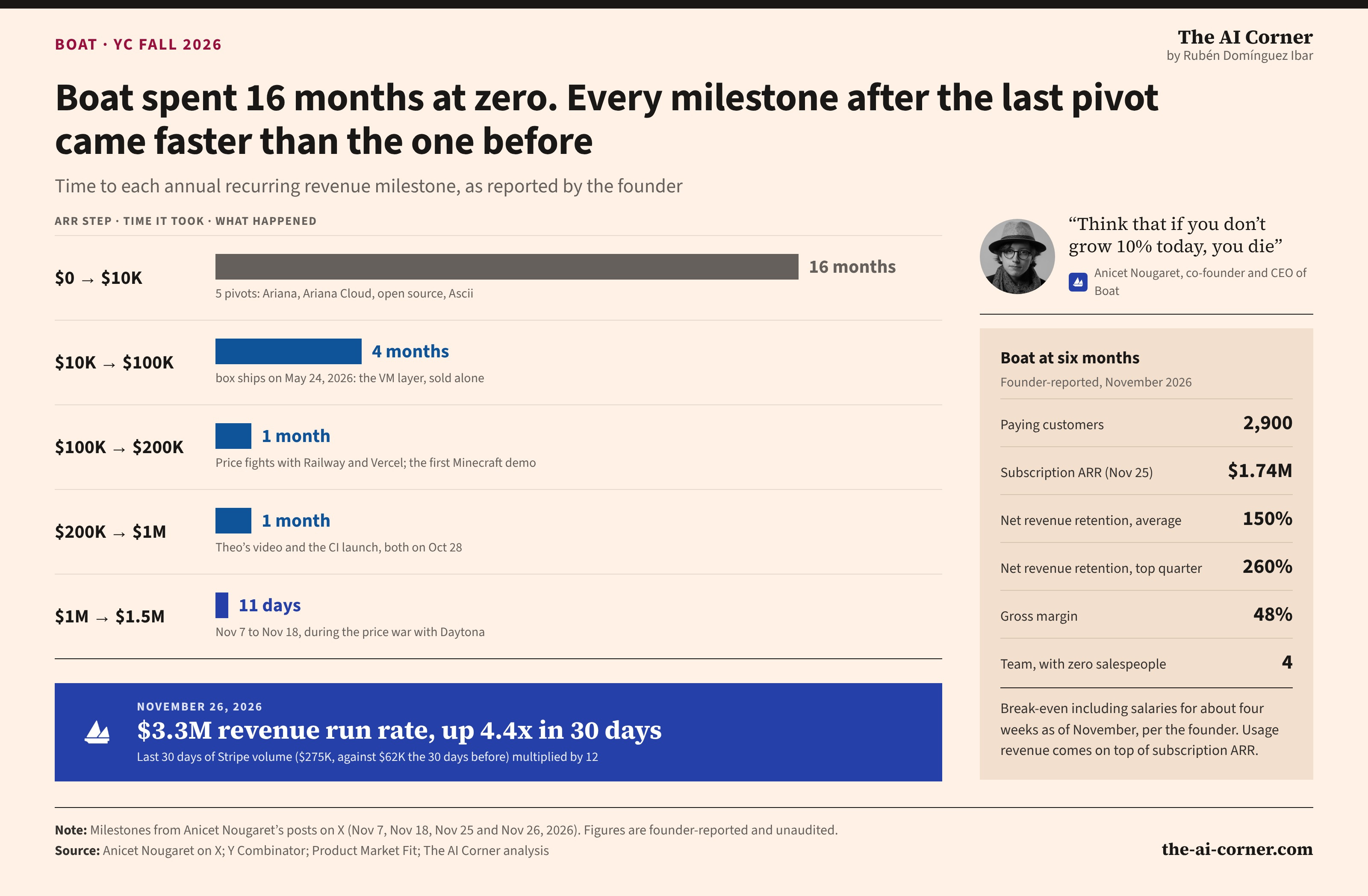
The company is Boat, a four-person startup from the Y Combinator Fall 2026 batch. Six months ago its product was a side feature inside another product that made almost nothing. For the 16 months before that, the founders sat at $0 through five pivots.
If you run AI agents, you already pay for their computers. Boat is the company betting that bill is 9x too high, and its growth says a lot of builders agree. I have read every growth story in the batch, and this is the one I would hand to an AI founder who is stuck: the tactics are cheap, the numbers are public, and almost every move can be copied by a team of two.
TL;DR
The company. Boat rents AI agents full Linux computers in the cloud, with a desktop, Chrome, Docker and files that persist between sessions. It charges by the second, at a fraction of what E2B, Daytona or Modal charge.
The numbers. $1.74M of subscription ARR on November 25 plus usage revenue of about the same size, and a $3.3M revenue run rate on November 26. 2,900 paying customers, 150% net revenue retention, 48% gross margin and break-even with four people (all founder-reported).
The pivot. Every failed product ran on the same piece of infrastructure. About 25 users asked to rent that piece on its own, and the team shipped it raw on May 24, 2026.
The price. A 4 vCPU, 8 GB machine costs $0.036 an hour, or about $26 a month running nonstop. The same machine costs $242 on E2B and Daytona and $347 on Modal at list price.
The channel. One founder account on X, five recurring post formats, roughly five minutes per post. ARR grew 3.4x in 30 days with zero ad spend and zero salespeople.
For builders. A team of 10 coding agents working office hours needs about 1,760 machine-hours a month: roughly $63 on Boat, $583 on E2B or Daytona and $838 on Modal at list price.
The risk. Europe-only regions, CPU-only machines, outages under growth and traction that nobody outside the company has audited yet.
My stake. We invested in Boat through GR Angel, our YC rolling fund. Read everything below with that in mind.
What Boat sells
An AI agent that does work needs a computer. It runs code, installs packages, opens a browser, spins up a database. Most agent builders rent that computer from a sandbox provider and pay per second while it runs.
Boat sells the same thing with three differences: each agent gets a full virtual machine with admin rights and its own IP address, the files stay on disk after the machine stops, and the hourly price sits roughly 9x to 13x below the category leaders for a busy machine.
A developer types boat new, connects over SSH and hands the machine to an agent. Many customers never open the website, because their coding agent picks the provider, starts the machines and reads the errors itself.
The people behind it
Anicet Nougaret (CEO, 25) grew up in France building Minecraft servers and indie games, studied computer science at INSA Lyon and made a black-hole detection pipeline 100x faster during an internship at the European Space Agency. Getting 42 CPU cores there took a month of tickets, which is the problem Boat sells against today.
Kirill Makarov (CTO, 23) speaks four languages and raised money at Founders Inc. for an earlier infrastructure company. He and Anicet met at university and failed their first startup together about five years ago.
They applied to YC four times before getting in. Boat's partner at YC is Andrew Miklas. The company posts as @boatdotdev and keeps its code on GitHub.
What you will learn
How to spot the product hiding inside a failing one, with a pivot signal scorecard
How Boat prices 9x below the leaders and still breaks even, with the cost stack behind it
The five-format posting system that replaced a sales team, with a weekly calendar you can copy
How to pick fights with bigger competitors, and the one line Boat refuses to cross
The $1M bounty that brought the biggest usage spike in Boat's history
How one creator video moved ARR from $200K to $1M in a month
How customer hacks became new products, and how Boat sells to agents directly
The market: Boat against Daytona's $100M and Modal's $1B run rates, plus a cost calculator for your own agent fleet
The team, the co-founder breakup and the $1M check written in 15 minutes
What could go wrong, with my own math on the $100M target
The Boat playbook on one page, plus a 10-point checklist for this week
1. The pivot signal
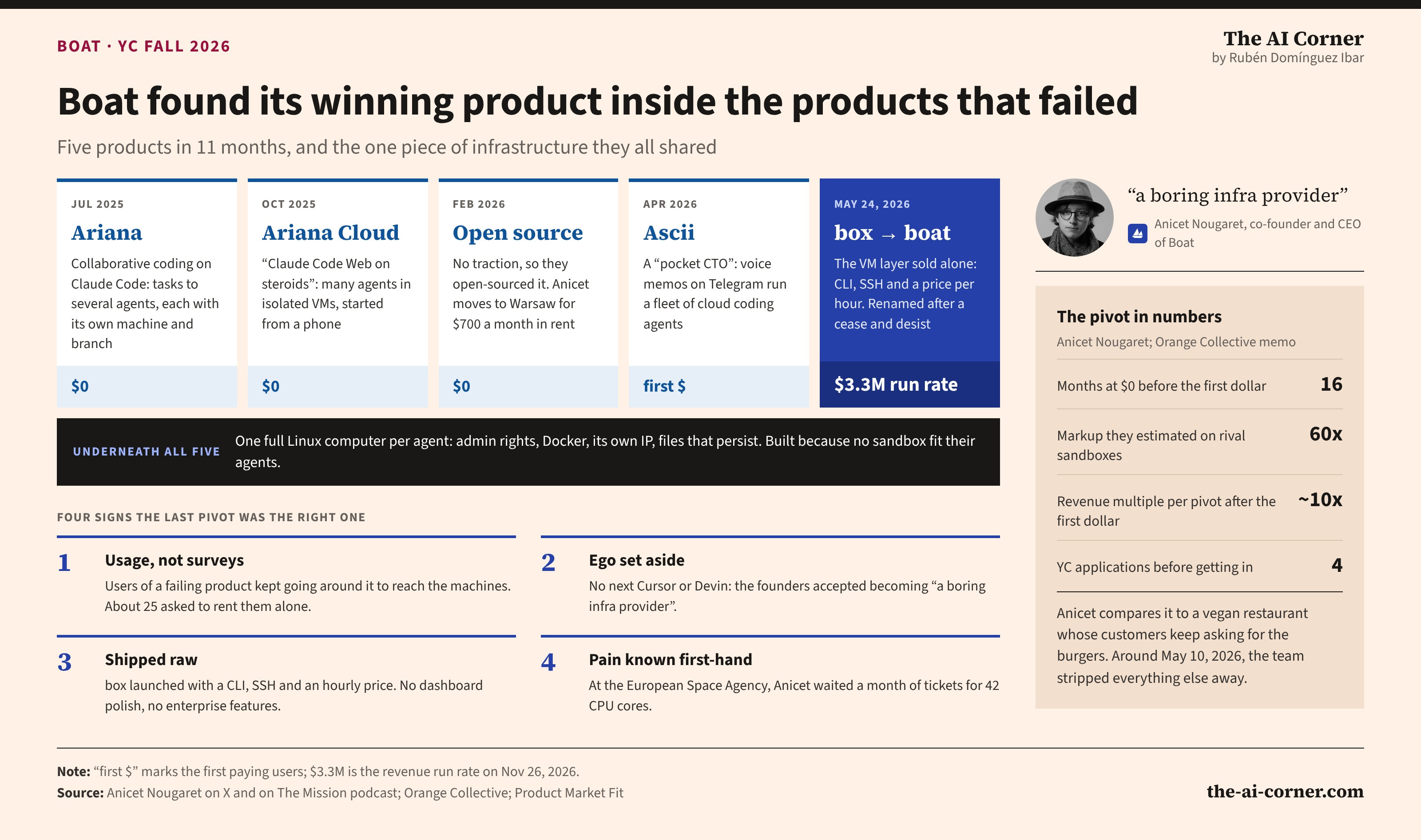
Boat is the company's fifth name. The first, from Greek mythology, died when someone pointed out that Americans could not pronounce it. Then came the products:
Ariana (July 2025). Collaborative coding on top of Claude Code, where a team handed tasks to several agents, each with its own machine and branch.
Ariana Cloud (October 2025). What Anicet called "Claude Code Web on steroids": many agents in isolated virtual machines, started from a phone and forked to try variants.
Ariana, open source (February 2026). Traction stayed flat, so they open-sourced it. Anicet moved to Warsaw, where rent cost $700 a month, to stretch the runway.
Ascii (April 2026). A "pocket CTO" that took voice memos on Telegram and ran a fleet of cloud coding agents in return. It made the company's first dollar.
box (May 24, 2026). The machines alone, sold with a command line, SSH access and a price per hour. A cease and desist later turned box into boat.
What they did
Every product had the same layer underneath: one full Linux computer per agent. The team built it because no sandbox on the market fit their coding agents, and because the prices they saw implied a 60x markup on the raw servers.
Customers found that layer before the founders accepted it. Anicet compares the period to running a vegan restaurant where diners read the menu, call it cardboard and ask for the burgers. Users kept going around the product to reach the machines, and around 25 of them asked to rent the machines on their own, according to Orange Collective's investment memo.
Around May 10 the team stripped everything else away. Anicet admits the first weeks of box went badly and they wondered whether the pivot was smart. Then usage started compounding. On October 31 he posted that the ARR of the pocket CTO product equals what Boat now adds every two hours.
Why it worked
Three things lined up, and each one is copyable.
The signal came from behavior. Nobody filled in a survey; users paid with effort, routing around the product to reach one part of it.
The founders accepted a smaller-sounding company. Anicet describes the choice as giving up on being the next Cursor or Devin to become "a boring infra provider". Infrastructure that agents consume all day turned out to be the bigger business.
They knew the pain first-hand. Anicet hit the compute wall at the European Space Agency, years before the market got hot, and he says that history separates Boat from rivals who arrived for the hype.
How to apply it
Run this scorecard on your own product every month. Give each question a 0, 1 or 2.
Workarounds. Do users bypass your main flow to reach one specific feature or layer? (0 = never, 2 = weekly)
Unprompted requests. Have 10 or more users asked to buy that piece on its own? (Boat had about 25.)
Cost insight. Do you know something about the cost of that piece that incumbents price badly? (Boat saw a 60x markup.)
Founder pain. Has someone on the team suffered from this problem as a customer?
Shipping speed. Can you ship the piece raw, with a CLI or an API and a price, in under three weeks?
A score of 7 or more means you should run the experiment. Ship the raw layer as a separate product, give it a price on day one and give it six weeks before you judge it.
Users of a failing product kept asking for the layer below it. That request is the strongest pivot signal a founder gets.
2. Pricing in a crowded market
Boat's own comparison site counts more than 360 providers of sandboxes and agent computers. Most of them win customers with free credits and recover the money as usage grows. Boat attacked the price per hour directly.
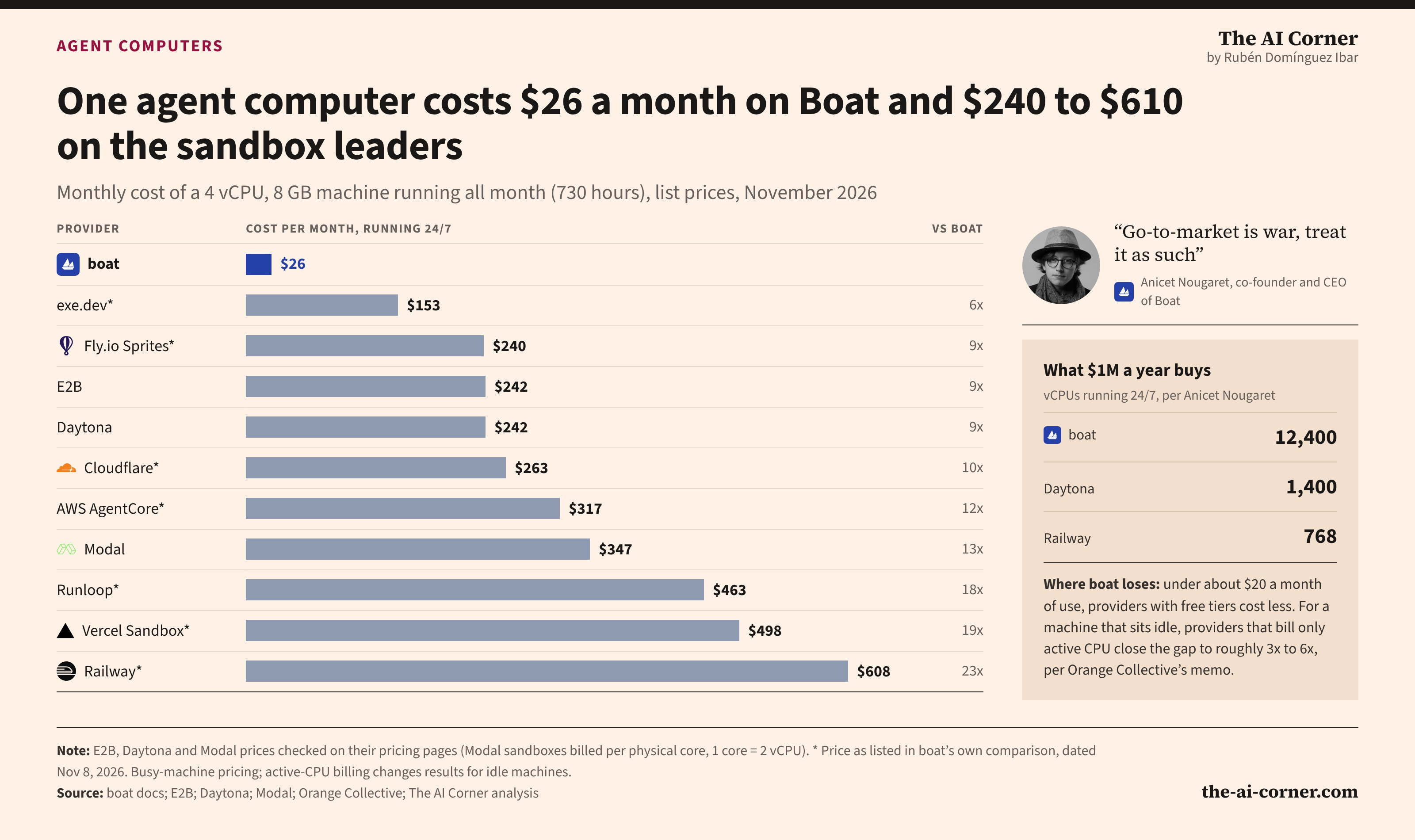
The cost stack
Boat got to that price in four steps.
American clouds first. The first version ran on Fly.io. Anicet says he was afraid to leave the machines on overnight because of the bill.
European budget servers next. Each sandbox became one Hetzner server, and the team built the layer that starts and stops them on demand. Anicet calls it the moment they made cheap cloud elastic.
Rented bare metal now. Boat rents large physical servers in Germany, Finland and France, splits them into many virtual machines and moves customers when a neighbor uses too much CPU. Anicet compares it to renting a building and cutting it into flats, and calls Boat a financial product as much as an infrastructure one.
Desktop chips. The servers run AMD Ryzen processors, which cost far less than server-grade CPUs and run single-threaded work fast. In an independent benchmark by StarSling in October, Boat placed second of 13 providers.
The price architecture
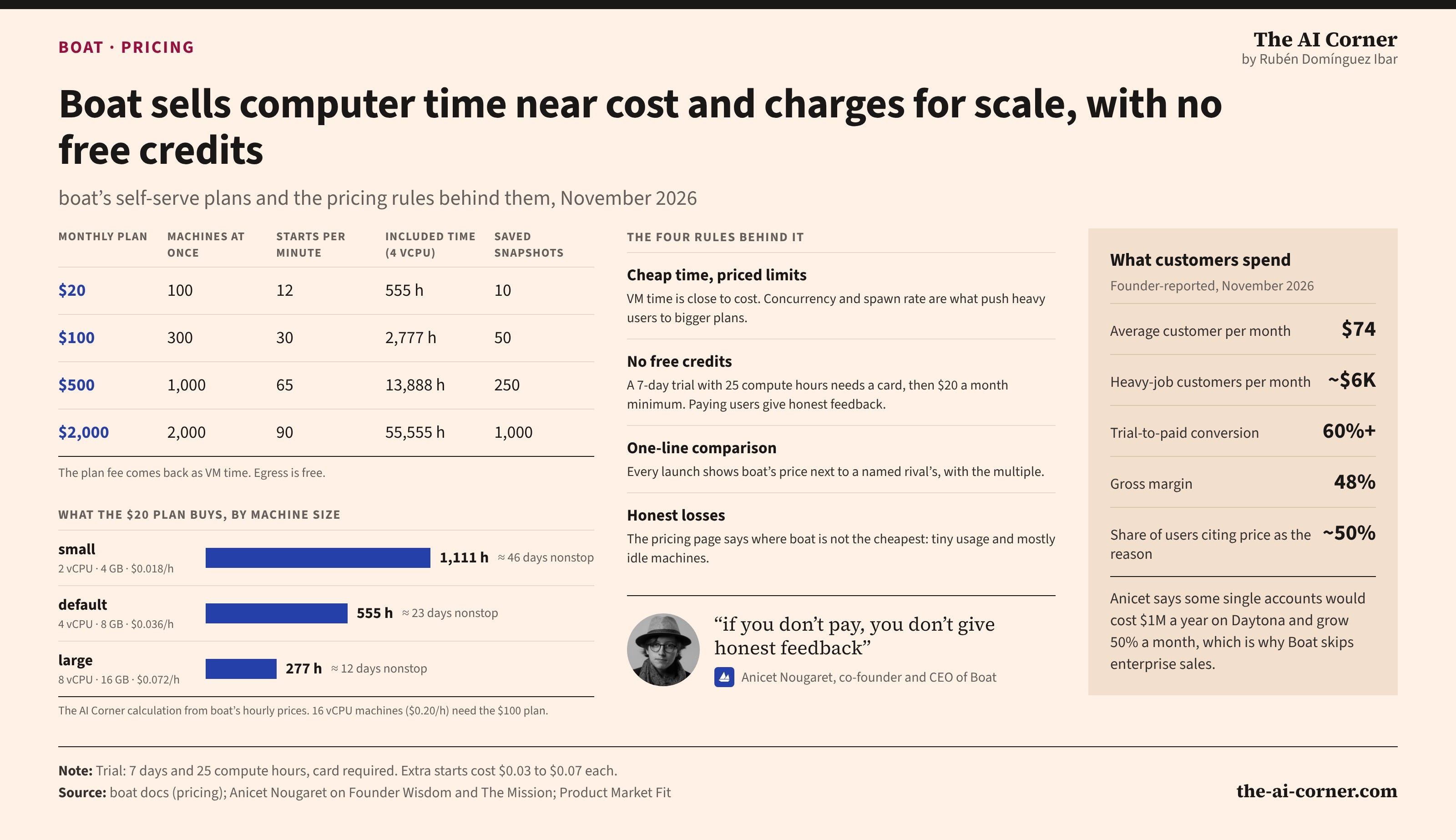
Machine time on Boat is close to cost. The margin sits in the limits: a customer who wants thousands of machines a minute reaches a higher plan faster than elsewhere. Anicet says that keeps Boat cheap for 99% of workflows while the margin holds at 48%.
The $20 plan buys 555 hours on the default 4 vCPU machine, about 23 days of nonstop use. Heavy customers spend around $6,000 a month, against an average of $74, and Anicet says some accounts would cost $1M a year on Daytona while growing 50% a month.
No free credits
Boat offers a 7-day trial with 25 compute hours, and it requires a card. After that the floor is $20 a month.
Anicet's reason fits in one line: if you don't pay, you don't give honest feedback. When a customer who spent $2,000 a month leaves, he learns exactly what broke. When someone leaves after burning free credits, he learns nothing. He prefers to charge and refund anyone unhappy.
The pricing page also says where Boat loses. Below about $20 of monthly use, a provider with a free plan costs less. For a machine that sits idle most of the day, providers that bill only active CPU close the gap to around 3x to 6x, according to the Orange Collective memo.
Profitable from the first machine
On July 3, five weeks after launch, Anicet posted that box machines had run for a combined 90 days in a single day. That day made $79, and the infrastructure already covered its cost. In November he said the whole company had been at break-even, salaries included, for about four weeks.
How to apply it
Price the unit your buyer compares. For Boat that is the hourly price of one machine. Find your equivalent and make it the cheapest in the category.
Move the margin to scale limits. Concurrency, throughput, seats or API rate: charge for the dimension that grows with your best customers.
Replace free credits with a paid trial and a refund. Track why paying users leave. Their reasons are your roadmap.
Write the one-line comparison. Format: "[Your unit] costs $X with us and $Y at [named rival], [multiple]x less." Put it in every launch post.
Publish where you lose. A pricing page that admits its weak spots earns trust from technical buyers who will check anyway.
For the wider menu of AI pricing models, see how AI startups price.
3. One X account instead of a sales team
On October 27 Anicet posted that Boat had grown ARR 3.4x in 30 days. He listed what they skipped: paid ads, events, big contracts, a sales motion. His word for the channel was "yapping on X".
It started with the name. Anicet wanted four letters or fewer, a word an 8-year-old knows and something he could photograph anywhere and post every day. When his co-founder suggested boat over lunch, Anicet was already dressed as a sailor, cap included.
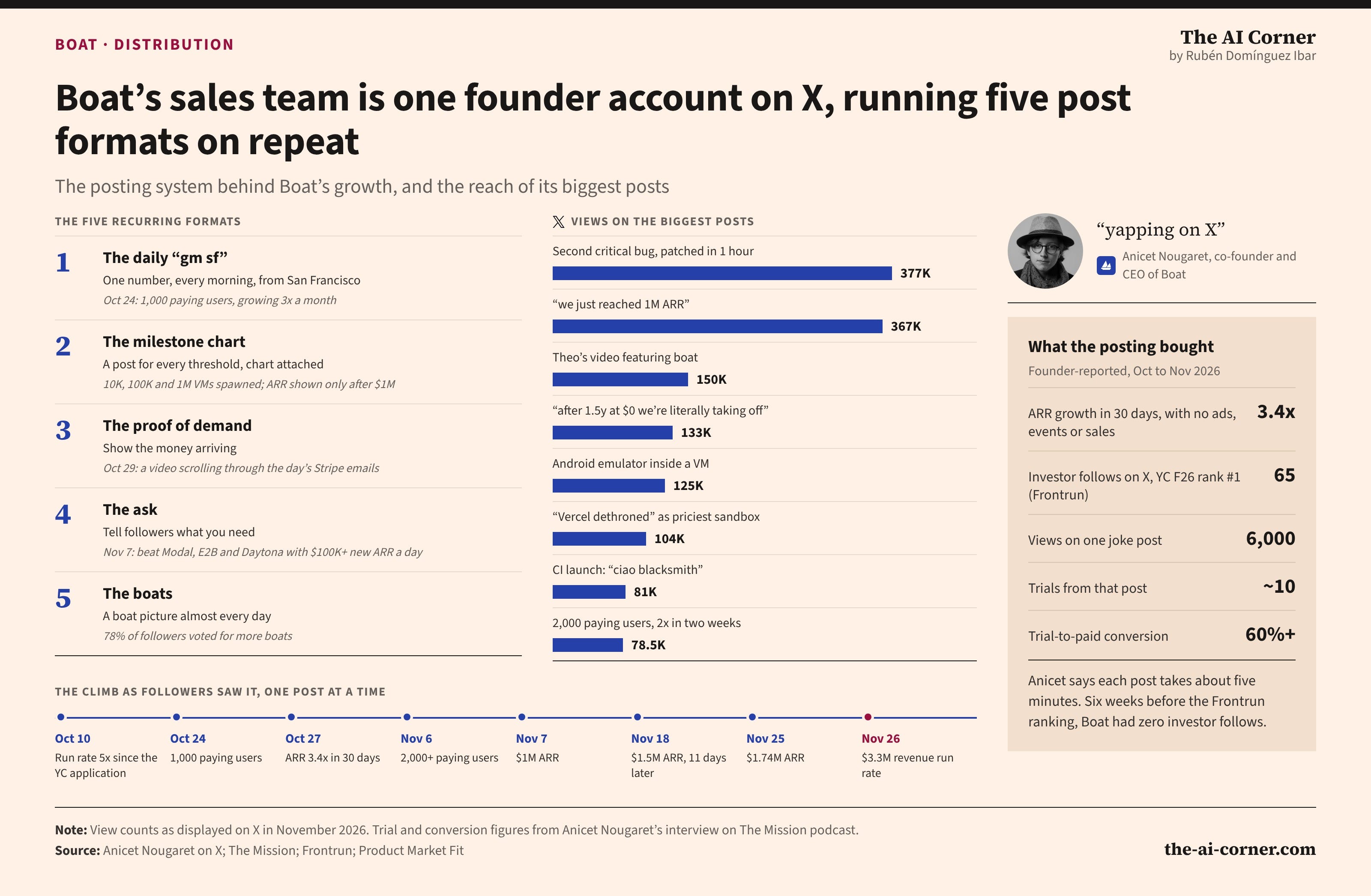
The five formats
The daily "gm sf". Almost every morning, one number from San Francisco. On October 24 it was 1,000 paying users, growing 3x a month.
The milestone chart. A post for every threshold: 10,000 machines started (July 11), 100,000 (September 10), 1,000,000 (November 1). He kept ARR off the chart until it crossed $1M, because a company at $100K ARR has little to show off.
Proof of demand. On October 29 he posted a video scrolling through the day's Stripe payment emails.
The ask. On November 7 he told followers that beating Modal, E2B and Daytona required more than $100K of new ARR per day, against the $40K to $50K Boat was adding, so fans should recommend it.
The boats. A boat picture almost every day. When he asked followers whether they were tired of them, 78% voted for more.
The math of one post
Anicet gave The Mission podcast the numbers on a joke post from his vacation. It reached 6,000 views and brought about 10 trials, and trials convert at more than 60%.
My math on that: 10 trials at 60% gives about 6 paying customers. At the $20 floor that is $1,440 of ARR; at the $74 average it is about $5,300 of ARR. He says each post takes about five minutes, so one joke paid more per minute than most sales calls.
The posts brought investors too. Frontrun, which tracks the accounts 5,000 investors follow, ranked Boat first in the YC Fall 2026 batch with 65 investor follows. Six weeks earlier it had zero.
When someone asked Anicet for go-to-market advice in November, he replied with a screenshot of four lines: psyop more, go-to-market is war, act as if you die without 10% growth today, and repeat things a lot.
How to apply it: a weekly calendar
Monday: your number of the week (customers, usage, revenue), with one sentence on why it moved.
Tuesday: a demo that fits in 30 seconds of video.
Wednesday: a comparison post that names a rival and a multiple.
Thursday: proof of demand, such as a payment notification, a customer message or a usage spike.
Friday: the ask, a single concrete request to your followers.
Every day: your recurring visual, the equivalent of Boat's boats.
Two rules make it work. The founder posts personally, and the post takes five minutes before the day goes back to customers. For another founder-led version of this playbook, see how Peter Steinberger made OpenClaw go viral.
4. Fights with bigger competitors
Boat's launches almost always name a rival.
Fly.io (July 4). Fly launched Sprites; Anicet replied that they cost 18x more than box.
Railway (September 17). Railway announced sandboxes; Anicet replied they cost 15x more. When Railway disclosed a security incident in October, he offered to migrate its users in a day.
A free 60-minute machine (September 26). He pointed out that after the hour it cost 23x more than Boat. 61K views.
Vercel (September 27). He declared Vercel's sandbox dethroned as the most expensive on the market. 104K views.
Blacksmith (October 28). The CI launch opened with "ciao blacksmith".
Modal (November 8). He posted that Modal hates Boat because Boat has something Modal can never get back: being new, shiny and cool.
The Minecraft wars
The fights that spread the most were demos. On October 9 Anicet posted 250 large Boat machines starting at once, each desktop recorded live: 2,000 CPU cores and 4,000 GB of memory for 10 cents. A week later it was 700 machines, each running an agent playing Minecraft multiplayer, for $6.45 in total.
Lovable then showed 100 agents playing Minecraft. Boat answered with 1,500, all in the game in under 30 seconds from a snapshot. Modal replied with 100,000. One founder summed up the scene as a bunch of Europeans in San Francisco fighting each other on Twitter with Minecraft demos.
The other side
The loudest critic is Ivan Burazin, CEO of Daytona. Through October and November he argued that competing on price is a death sentence and that someone will always be cheaper. Daytona also offered YC companies up to $200,000 in free credits.
Anicet answered almost every post, arguing that cheaper becomes a race to the bottom only when the product is also worse. Then he posted that Boat had grown from $1M to $1.5M ARR in 11 days thanks to Ivan picking fights with cheap providers.
How to apply it
Pick the leader with the highest price. Every comparison makes your number look better.
Show the result on video. A screen of 700 desktops beats a benchmark table.
Answer every reply. A rival who responds hands you their audience.
Punch up only. When a bigger company attacked a much smaller one over an outdated comparison page, Anicet posted that punching down on a company 1,000x smaller is a bad look. Keep that rule.
5. The $1M bounty
On August 18 Vercel announced a $1M hacker challenge to escape its sandbox. Within hours Anicet added his own: anyone who broke Vercel's sandbox using Boat machines would get $1M in Boat credits on top. Then he extended it to Boat itself, with the same credits plus $1,000 in cash for breaking into another user's machine.
The next day someone did. A security researcher who had used Boat since launch found a critical flaw; Boat patched it in five hours and paid. A second critical bug arrived the day after and was patched in one hour. That post reached 377K views, the most of any Boat post.
Anicet summed up the sequence in four steps: open a generous bounty almost as a joke, get humbled by a senior researcher, harden the code like crazy, then get the biggest usage spike of your life.
Why it worked
The prize cost Boat credits, which it produces at a fraction of list price. And the fix came fast and in public, which is the one thing infrastructure buyers need to see.
How to apply it
Pay bounties in your own product, priced at list, so the cost to you is a fraction of the headline.
Ride a bigger company's announcement on the same day, while attention is already there.
Post the fix with the time it took. Speed to patch is the story.
The researcher side of this story is in the AI bug bounty playbook.
6. One creator, one month
On October 14 Anicet posted that one of the biggest tech creators in the world had sent him a DM. The creator loved Boat's machines for agent fleets and asked a practical question: if he covered Boat in a few days, could it handle the load?
The creator was Theo Browne of t3.gg, who also builds T3 Code, an app for running many coding agents. On October 28 he published "How To Give Claude Unlimited Usage". Browserbase sponsored the video, so the Boat segment was unpaid. It has 238K views.
In the segment Theo calls Boat one of the coolest things he has used in years and walks through the flow live: install the command line tool, run boat new, connect over SSH, open a desktop. Before Boat his agents shared four slots on one server. He also sets the limits himself: Boat is for the machines agents need for work, and user traffic belongs elsewhere.
The second launch on the same day
The same afternoon Boat launched CI runners, the machines that test and build code on every push. The post opened with "ciao blacksmith", and setup took two lines. After moving their own CI from Blacksmith, Boat's runs were 1.6x faster and 13x cheaper per minute. The launch got 81K views.
Nine days later Boat crossed $1M ARR.
The cost of the spike
On November 9 Anicet apologized publicly: the spike, "notably thanks to Theo", caused speed and stability problems, even though machines stayed up more than 99.95% of the time. On November 18 a snapshot congestion took the API down for part of the day, and he promised a postmortem and credits.
How to apply it: the creator launch checklist
Pick the creator whose audience is your buyer. Theo's viewers run coding agents all day and hit compute limits.
Load-test before the video. Theo asked two weeks ahead, and it still was not enough.
Ship a second product the same day. CI gave new visitors a second reason to sign up.
Turn praise into a testimonial within hours. Theo's quote was on the homepage by the next day.
Apologize fast when things break. A public fix keeps the trust the video created.
7. Customer hacks became products
Boat's roadmap mostly copies what users already do with the machines.
CI
Developers moved CI jobs to Boat because the Ryzen chips were fast and cheap. They wrote their own guides, and one wrote a Claude skill that moves a project's CI to Boat. Anicet had agents read those threads and turn them into the official docs, then shipped CI as a product.
RL environments
AI labs train models by letting them practise tasks in thousands of environments at once, and each environment needs its own computer. Boat's AgentEnv integration runs up to 2,000 machines in parallel, each with 16 cores and 32 GB of memory. RL labs make up 60% of Daytona's revenue, according to Product Market Fit's Daytona playbook.
Android, rendering and big jobs
An Android emulator inside a machine (125K views), a launch video rendered on 138 machines in 20 minutes, and on-demand jobs of 2,000 vCPUs and 4,000 GB of memory for about $18 an hour.
The companies built on top
Squad.so launched on Boat and reached $10K MRR bootstrapped. Context.dev, which raised $9M led by General Catalyst, runs on it, and so does Invertix from the same YC batch.
Selling to the agents themselves
Boat treats the agent as a customer:
Most commands return JSON so agents can read the output.
More than half of the feedback emails come from users' agents through the command line, and Anicet answers them the same day.
battleships.dev compares more than 360 sandbox providers, with files written for agents to read.
Agents wrote more than 1,000 comparison pages, one per competitor, so AI search engines surface Boat when someone asks for an alternative.
The comparison pages drew pushback from a developer who called them disingenuous. The retention numbers are the better answer: 150% net revenue retention on average and 260% for the top quarter of customers.
How to apply it
Read your users' blog posts, scripts and support threads every week, and productize the most common hack.
Make every output machine-readable. Your next customer may be an agent.
Write one comparison page per competitor, accurate enough that the competitor cannot fault it.
8. The market, and what it means for your agent stack
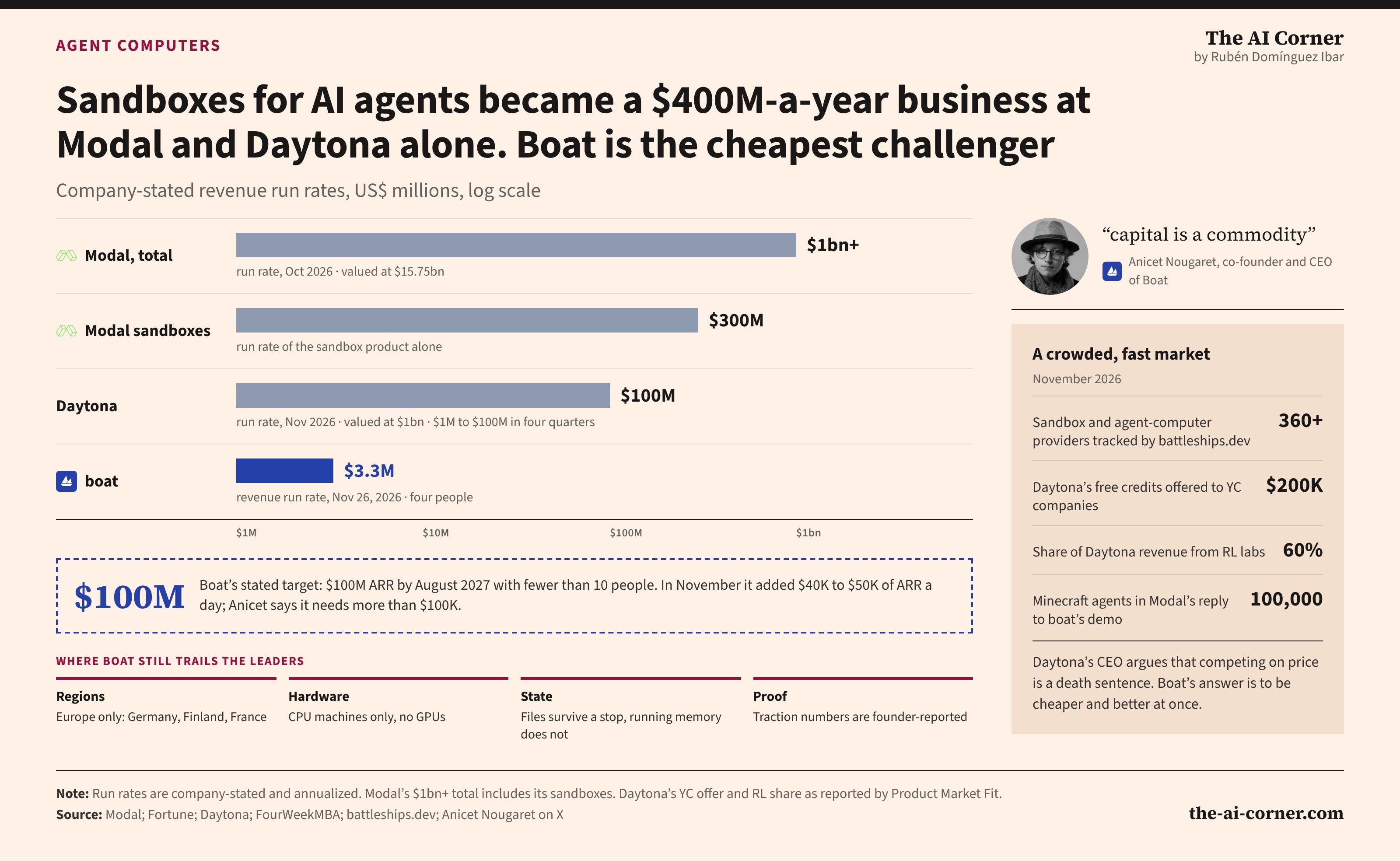
Sandboxes for agents became a large business in 2026. Daytona passed a $100M run rate in November after growing from $1M in four quarters, and raised a $60M Series B at a $1B valuation led by FirstMark, per Fortune. Modal reports more than $1B of run rate, with $300M from sandboxes, and raised at a $15.75B valuation.
Boat's run rate is about 3% of Daytona's. The bet is that agent compute behaves like electricity, where buyers move to the cheapest reliable supply, and that the incumbents' margins leave room underneath.
What this means for your agent stack
If you run agents, price your own workload before you pick a provider. Here is the calculation for three common setups.
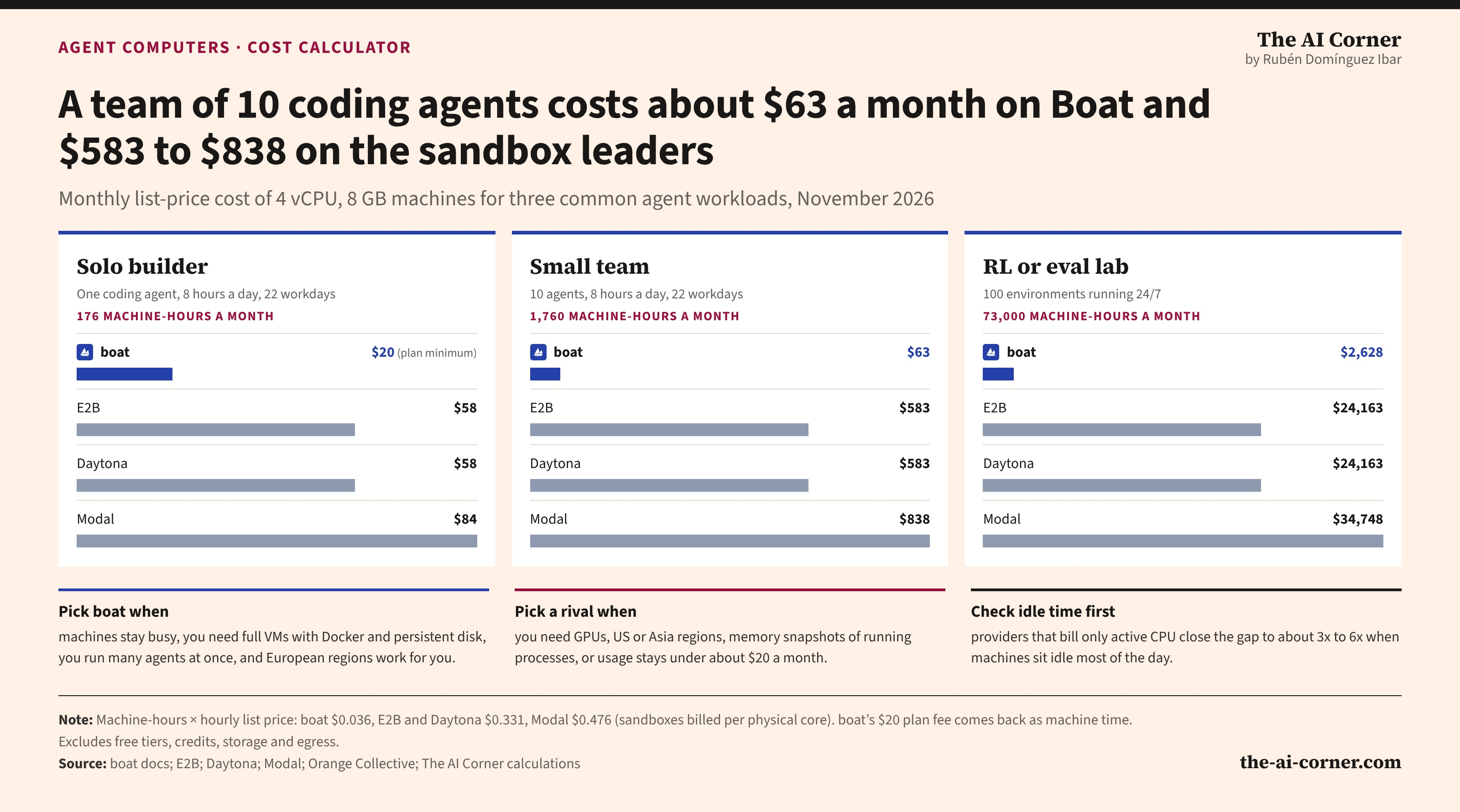
The rule of thumb I use with founders:
Count machine-hours first. Agents × hours a day × days a month. Most teams underestimate this by 3x once agents start running overnight.
Measure idle time. If machines sit idle most of the day, compare against providers that bill only active CPU, where the gap shrinks to about 3x to 6x.
Check the hard requirements. GPUs, US regions or saved memory of running processes rule Boat out today.
Run both for a week. Boat's trial gives 25 compute hours; route a slice of production jobs through it and compare the invoices.
Compute is one line of the bill; tokens are usually the bigger one. Pair this with how to cut AI agent costs without losing performance.
9. The team and the money
How Kirill became co-founder is the hardest part of the story. Anicet's previous co-founder was the CEO and he was the CTO. After several pivots he concluded she lacked the fit for developer tools and asked her to leave. He had just hired Kirill as founding engineer and chose to keep going with him. Anicet told The Mission that at that point nothing worked and he was applying to jobs.
He moved to Jyväskylä, a small city two hours from Helsinki, to join Kirill, and the first version of Boat was built there and in Poland.
The split today is strict. Anicet owns go-to-market, fundraising and the fast bug fixes; Kirill owns the infrastructure and the engineers, and Anicet talks to the engineers only through him. Boat is hiring a founding engineer on Pacific time at $260K in the Bay Area or New York, $190K elsewhere, plus 1.2% equity.
The money
In November Anicet said Boat had raised about $1.3M, mostly from angels after YC, with an agent handling the paperwork: sending the SAFE, filling in the details and chasing the wire. Orange Collective put in $1M after a 15-minute conversation, and Mispriced followed with a core check. Anicet's view: capital is a commodity, and a fund's only edge is being fast and easy to work with.
That is also how we got in through GR Angel. Speed decided the allocation.
10. What could go wrong
Here is the skeptical case, and I take it seriously.
Two metrics, two numbers. The $3.3M is 30 days of Stripe volume times 12, usage included. Subscription ARR was $1.74M the day before. Usage revenue swings with customers' workloads.
Reliability under growth. The November slowdowns and the API outage happened at 300% weekly growth. Enterprise buyers remember outages longer than prices.
Product gaps. European regions only, CPU machines only, and running memory is lost when a machine stops.
Price wars cut both ways. Daytona and Modal have far more capital, and $200K credit offers to YC companies are a direct response to cheap challengers.
My math on the $100M target
Anicet's goal is $100M ARR by August 2027 with fewer than 10 people. At the November pace of $40K to $50K of new ARR per day, linear growth reaches about $14M by the end of August 2027. Getting from $1.74M to $100M in nine months requires roughly 57% growth every month, compounded. Boat has grown faster than that since September; holding it for nine more months would make it one of the fastest infrastructure companies ever built.
The next step is hardware. Anicet plans to buy a few machines of Boat's own to learn before owning more of the stack. If owned servers push the gross margin well above 48%, the price gap with the leaders becomes durable.
The Boat playbook on one page
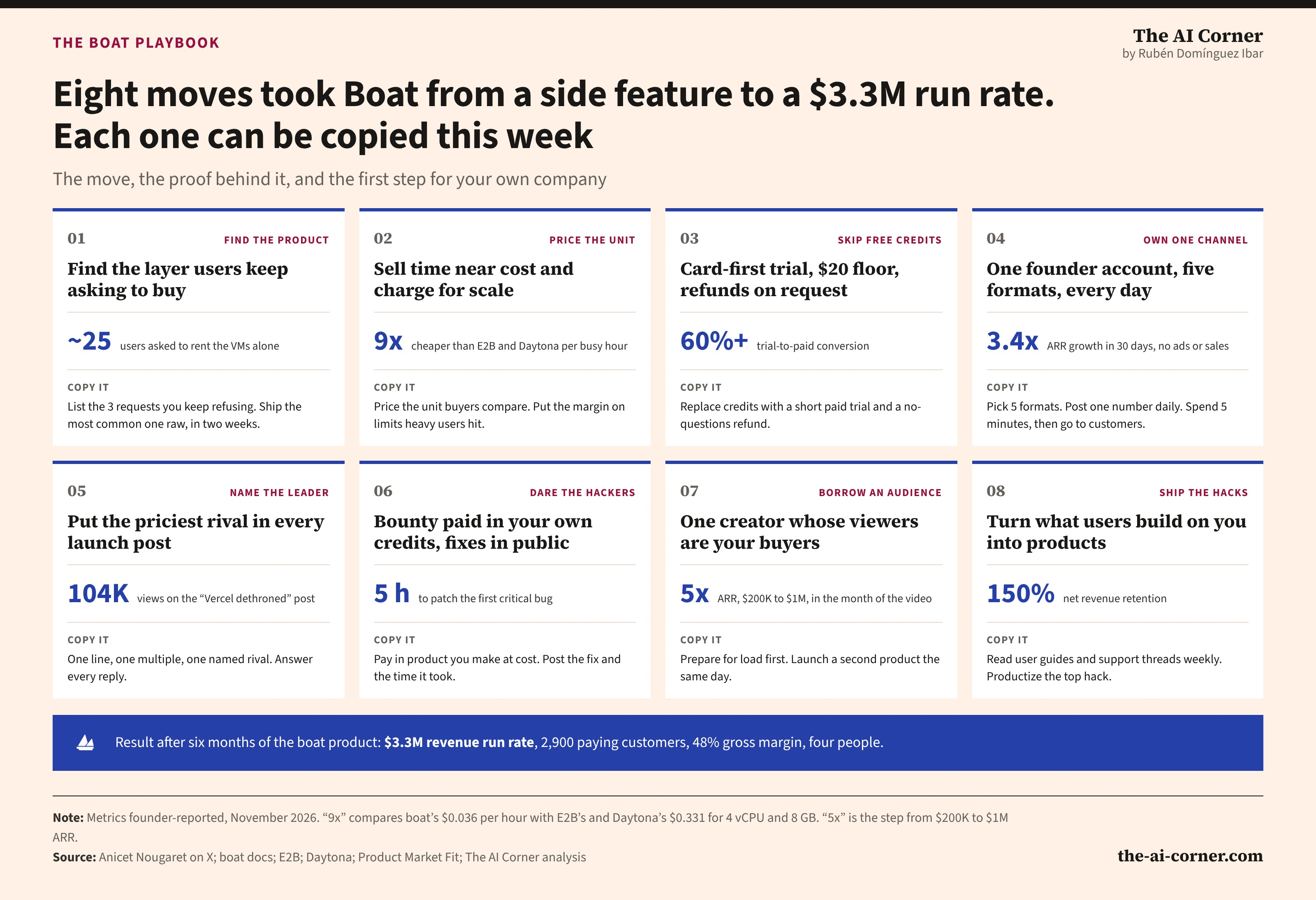
Your checklist for this week
Score your product on the five pivot signal questions.
List the three features users keep asking to buy separately.
Find the unit your buyers compare and price it against the most expensive leader.
Replace any free credit offer with a short paid trial and a refund policy.
Write your one-line comparison: your price, the rival's price, the multiple.
Pick five post formats and schedule a week of them from the founder's account.
Choose one creator whose audience is your buyer and prepare for the traffic before you write to them.
Read 20 support threads or user posts and circle the most common workaround.
Make your product's output readable by agents, starting with JSON responses, and price your own agent fleet in machine-hours.
Publish one comparison page against your biggest competitor, accurate to the line.
My take
Boat is the strongest proof in the batch that distribution can be built by one founder with a phone, provided the price gives every post something to say. The 16 months at zero matter as much as the six months after them: the team built the machine layer while failing, and the market arrived to meet it.
I have money in this company, so weigh my view accordingly. The next nine months will test reliability, margins and the founder's stamina more than the pricing. If Boat keeps the speed and closes the reliability gap, it becomes the default computer for agents built by small teams.
Want the next playbook? Paid subscribers get every premium agent playbook plus The AI Corner's subscriber perks page, with partner offers that include Claude for Startups, Perplexity API credits and up to $350,000 in Google Cloud credits:
Stop prompting. Start writing loops, the Claude Code loops library
Your AI bill is mostly wasted tokens, the token cost playbook
Cancel anytime. First subscribers get 50% off forever.
Boat FAQ
What is Boat?
Boat (boat.dev) is a Y Combinator Fall 2026 startup that rents full Linux virtual machines to AI agents, billed by the second, with Docker, a desktop, Chrome and files that persist between sessions.
How much does Boat cost?
A 4 vCPU, 8 GB machine costs $0.036 an hour, about $26 a month running nonstop. Plans start at $20 a month, and the plan fee comes back as machine time. The 7-day trial includes 25 compute hours and requires a card.
Is Boat cheaper than E2B, Daytona or Modal?
For busy machines, yes: about 9x cheaper than E2B and Daytona and 13x cheaper than Modal at November 2026 list prices. For machines that sit idle, providers that bill only active CPU narrow the gap to about 3x to 6x.
Who founded Boat?
Anicet Nougaret (CEO) and Kirill Makarov (CTO). The team of four works between San Francisco and Europe.
How big is Boat?
$1.74M of subscription ARR on November 25, 2026 and a $3.3M revenue run rate on November 26, with 2,900 paying customers. All figures are founder-reported.
Keep reading
The Boat Playbook on Product Market Fit, Guillermo Flor's chapter-by-chapter breakdown
The YC Fall 2026 Directory: all 235 startups and my 30 picks, on The VC Corner
Numbers as of November 26, 2026. All Boat metrics are founder-reported. GR Angel is an investor in Boat. This is not investment advice.