Garry Tan’s AI agent has read all of his email, his Dropbox, his Apple Notes and his therapy notes going back 20 years. About 15 minutes before he sat down with Walter Isaacson on The Builders on November 3, 2026, it downloaded and transcribed Isaacson’s top 10 podcasts so Tan could prep.
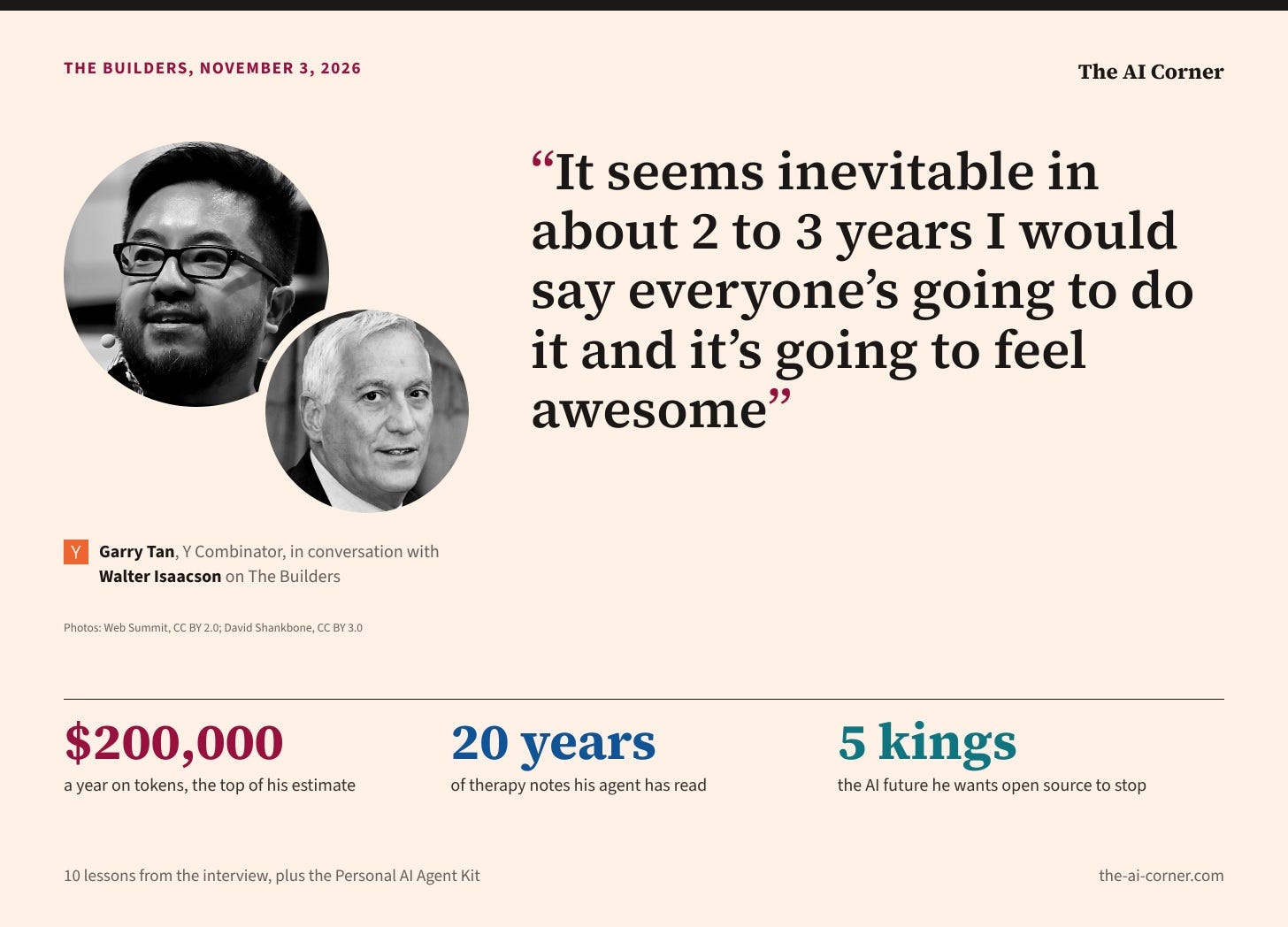
Tan puts the cost of that habit at about $100,000 to $200,000 a year in tokens, and he calls it “a crazy privilege that not everyone can do.” His forecast for everyone else: “it seems inevitable in about two to three years, I would say, everyone’s going to do it and it’s going to feel awesome.”
The full 36-minute interview is on YouTube. Tan, who runs Y Combinator, gave a concrete picture of a personal agent from an investor’s seat. Here are the 10 ideas that matter and the math on a version you can afford.
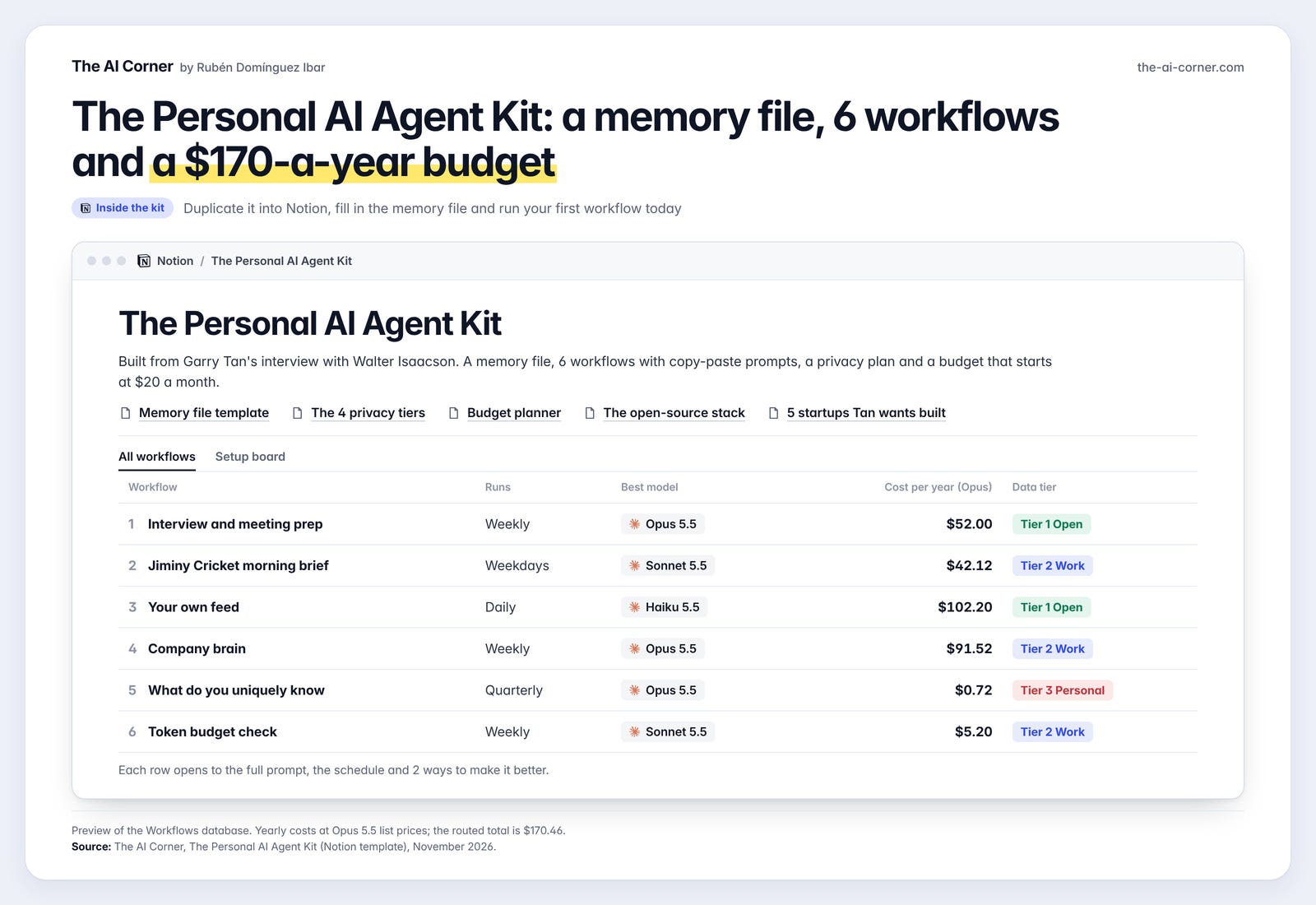
The short answer: Garry Tan’s personal AI agent reads his email and 20 years of notes, preps his meetings and flags what he might miss. He estimates it costs $100,000 to $200,000 a year in tokens. A lighter version with 6 everyday workflows costs about $170 a year at current Claude prices, by The AI Corner’s estimate.
Paid members get The Personal AI Agent Kit below the paywall: a Notion template with the memory file, 6 copy-paste agent workflows with Tan’s 15-minute interview prep included, and a budget planner that runs all 6 for $170.46 a year.
1. How Does YC’s AI Agent Straylight Work?
I think the number one thing that people get wrong is they just think that AI is just chat and then it is so much more than that.
YC runs an internal agent called Straylight, with a personality and a company brain that holds every founder YC has backed plus every application and email. That intake alone is 80,000 to 90,000 applications a year for about 800 spots, and Tan says YC is rebuilding how it operates around the agent.
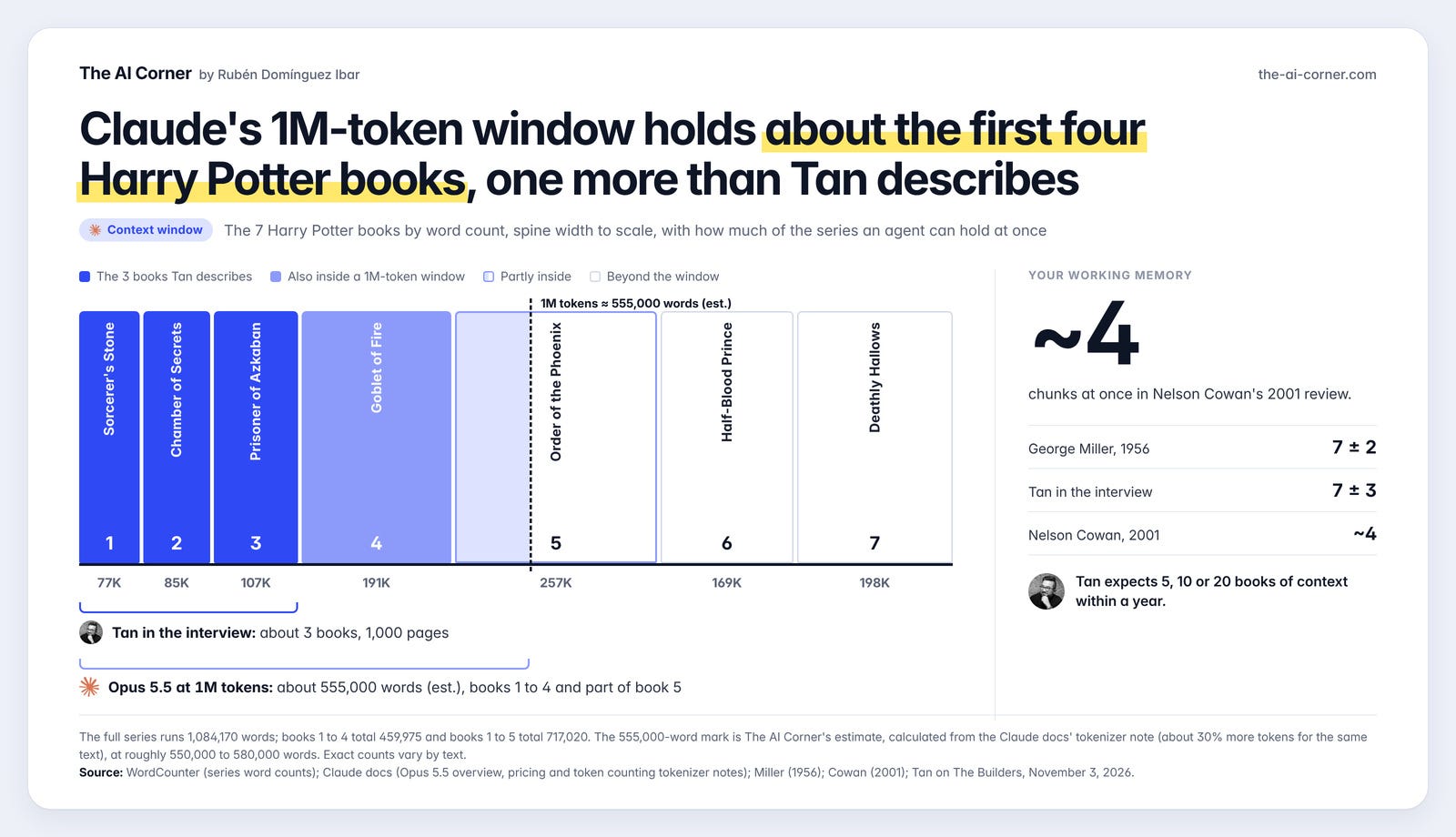
His case rests on working memory. A person tracks seven plus or minus three things at once, he says, while an agent holds about 1,000 pages, roughly three Harry Potter books. The research is harsher still: Nelson Cowan’s 2001 review puts the human number at about 4.
Claude Opus 5.5 shipped on September 22 with a 1 million token context window, which by our estimate holds roughly 550,000 to 580,000 words, around the first four Harry Potter books. Tan expects up to 20 books within a year.
Start where YC did and put every customer email and application your company has handled in one place your agent can read. See also: Your AI agent is going to hallucinate at scale, on agent memory that holds up as it grows.
2. What Makes an AI Agent More Than a Chatbot?
they're so worried about sort of repeatability and safety that they actually trade off all of the beautiful parts of working with an AI agent.
Isaacson pushed back that this is still data retrieval, so what makes something an agent? Tan pointed to Peter Steinberger of OpenClaw. In Tan’s telling, Claude Code and Codex focus so hard on repeatability and safety that they give up the best part: an agent so close to a person that it takes on human qualities.
OpenClaw now has about 394,000 GitHub stars, more than React, and Steinberger joined OpenAI in February 2026 as the project moved to a foundation. Decide on purpose where your setup sits: a coding agent for predictable output, or an assistant with memory that lives in your chat apps.
3. What Does Garry Tan’s Personal AI Agent Actually Do?
it's read all of my email and all of my Dropbox. It's read like all of my Apple notes like you know even my therapy notes going back 20 years.
Then, a bit meta, he used it to prep for this interview. The agent transcribed Isaacson’s top 10 podcasts and had a model go line by line, timestamp by timestamp, to pull out the major themes.
We ran the numbers on that prep. At this interview’s pace, 10 hour-long podcasts come to about 125,000 words, and reading them on Opus 5.5 costs about 90 cents, so a full prep run lands near $1.
Tan wants that help for almost anything in your day. His picture of the finished product is Jiminy Cricket on your shoulder, an agent that knows you, runs ahead and asks “what about this?”
Pick 1 meeting this week, hand your agent every document behind it, and compare its prep with yours.
4. How Much Does Garry Tan Spend on AI Tokens?
I spend about maybe a hundred to two hundred thousand dollars a year on tokens. And so, I realize that’s a crazy privilege that not everyone can do that.
Tan says it is simply too expensive today, and that many CEOs he knows spend the same way. That’s 417 to 833 times the $240 a year of Claude Pro.
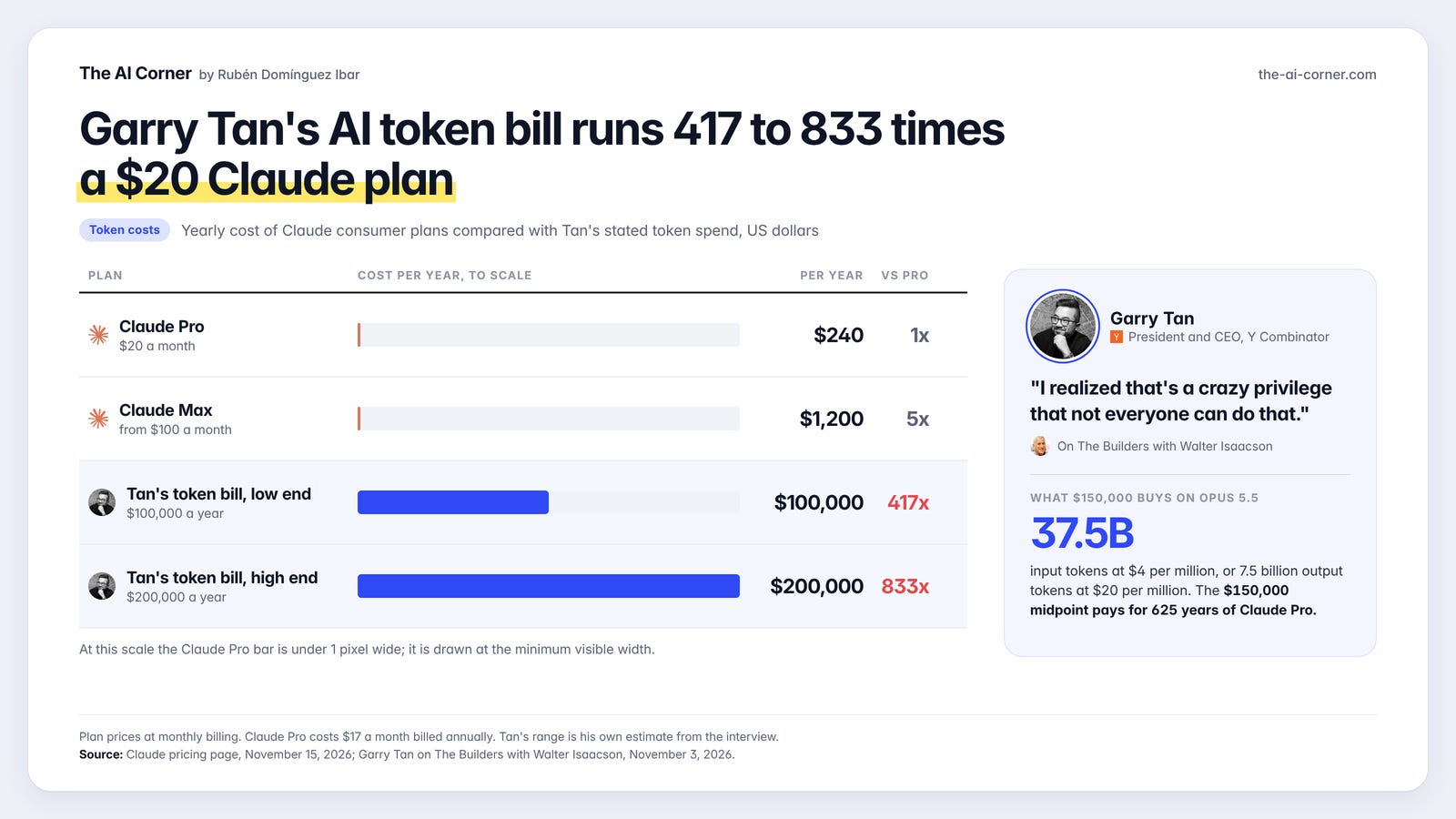
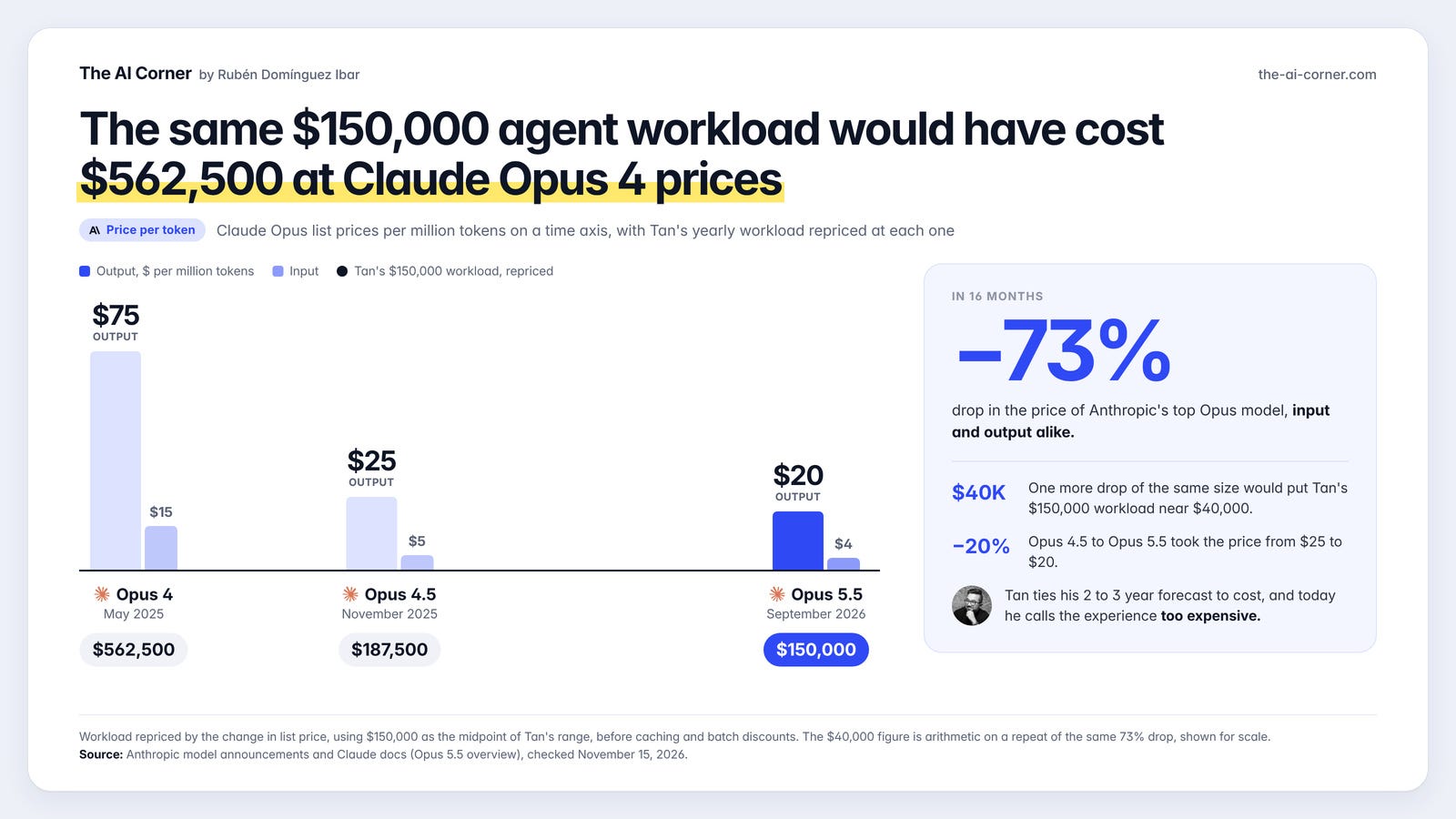
Cost is falling fast. Opus 4 launched in May 2025 at $75 per million output tokens, and Opus 5.5 costs $20, a 73% drop in 16 months. At May 2025 prices, $150,000 of Opus work would have cost $562,500.
See also: Your AI bill is mostly wasted tokens, the token cost playbook, and the system for never hitting Claude’s limits.
5. Will AI Agents Destroy Jobs? Tan’s Answer Is GStack
I want them to be able to start a company in that space. And maybe it's exactly what they did before. Maybe it's something two clicks away. But either way, it requires an increase in the amount of agency.
Will AI create more jobs? Tan calls that his hope, admits the short term may disappoint, and calls retraining a big issue.
His answer is GStack, the open-source skill pack he built by working backward from how he would teach YC founders to use Claude Code. It has about 141,000 GitHub stars, and Tan says it gets founders 400 times the output they had before.
Then he gets specific: pair a medical biller who knows the field inside out with a 22-year-old who ships software with agents, and they can start a company in that space.
See also: Stop prompting. Start writing loops, the Claude Code loops library.
6. What Should Founders Build With AI Agents?
what do you uniquely know? What life did you live? What obscure hobbies do you have? Like what have you seen that nobody else has seen?
Before the tools, Tan sends you into your own history, then pairs your answers with an agent that can code and reason. He calls that raising the floor. His warning goes to CEOs, who he says risk a dystopian moment where capital piles up wealth and nobody shares it.
“the responsibility for CEOs and people who have a lot of privilege is not to cost-cut. Like, that is the easy way.”
Answer his 4 questions about yourself before you open a tool. See also: 100 AI agent ideas you can build this weekend.
7. Are the AI Labs the New Big Tech?
I think you can fairly say that they are the new big tech.
Garry Tan, The Builders with Walter Isaacson
Isaacson pointed to newcomers like Anthropic and OpenAI doing well against Apple and Google. Tan agreed, then reclassified them as the new big tech, which he says gives him concerns too.
Should all frontier models be open? Tan says open models support startups and consumer choice, and he argues the US is handing Chinese labs a big lead in open-source AI, a gap you can see in Kimi K3’s Opus-level release. Count how many of your product’s features depend on a single closed model.
8. Can a Personal AI Agent Fix Your Social Media Feed?
you do have a social network but the social network is mediated through your own cognitive filter.
Isaacson offered a future worth funding: social media that makes us stronger as a society. Tan said personal agents are a very direct way to build it, since Meta controls the algorithm today.
His design treats the Facebook and Instagram apps as just an API. Your agent builds the feed from your goals, and the people closest to you can help program it. His own filter this year keeps self-improvement and city politics and drops national politics. A daily feed digest on Haiku 5.5 costs about $2.56 a year by our estimate.
9. What Is the “Linux for Personal AI”?
what I want is there to be Linux, right, for personal AI.
Garry Tan, The Builders with Walter Isaacson
Isaacson’s gloss was “basically, an open source operating system,” and Tan agreed. Tan wants personal AI to play out like the personal computer revolution, with Apple’s 1984 Mac and an IBM that never took the whole market. He calls next year one of the defining years of the next browser war, fought over which AI agent you use, and expects a Mac and a PC of its own.
Would 2 or 3 winning labs be horrible? Tan said we’re already there. Friends inside the labs talk about “the five kings”, a future where almost all commercial value collapses into 5 companies. His counter runs on policy, funding new talent, open markets and open source.
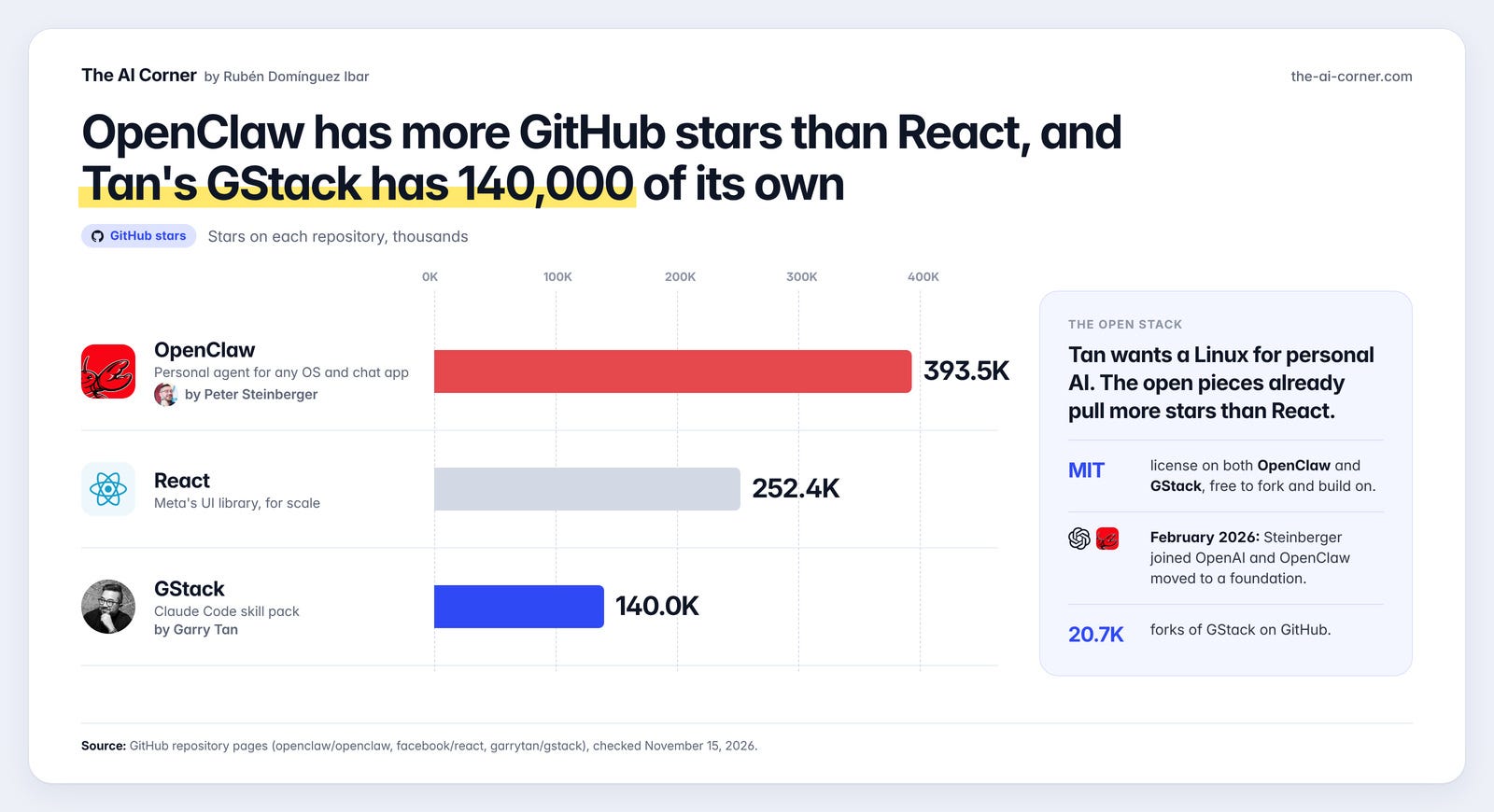
The open pieces already exist, and the star counts show developers want them. Tan’s bar for winning:
“it just has to be easy enough to use and cheap enough to use that everyone chooses it.”
See also: Nobody cares about the model now. It’s about the type of moat.
10. What Is the Open App Markets Act, and Why Does Tan Back It?
the next Apple can't emerge right if Google Apple and all the trillion dollar companies don't open a lane and create markets we will live in a world where there aren't startups.
Smart regulation, for Tan, looks like the Open App Markets Act. His example: AI apps can’t touch your iMessages, and Apple says only Apple can keep you safe enough. Tan calls that a smoke screen for Apple’s market power.
The bill, S.2153, was introduced on June 24, 2025 by Sen. Marsha Blackburn with bipartisan cosponsors and still sits in the Senate Judiciary Committee. Without open lanes, Tan says, we get his nightmare scenario, a world with no startups. If your product lives on Apple or Google, that lane decides what you can build.
Tan expects everyone to run a personal agent within a few years. The open question is who will own yours.
Below the paywall: The Personal AI Agent Kit. Paid members get the full setup today:
The memory file template (
ME.md) that a setup like Tan’s starts from6 agent workflows with copy-paste prompts, Tan’s 15-minute interview prep and the 7:00 Jiminy Cricket brief included
The 60-minute install with the exact GStack and OpenClaw commands
The budget planner that runs all 6 workflows for $170.46 a year
The caching math that takes an all-day coding loop from $51,100 a year to about $13,650
5 startups Tan wants built, each with a first test you can run in a week
The first locked prompt fixes a mistake we caught on this very interview: its transcript turned Claude Code into “cloud code” and GStack into “G stack”.
You also get the perks page, with 28 partner offers worth up to $350,000 in Google Cloud credits alone, and every playbook in the AI Agents and Claude & Anthropic libraries, from Claude Code as your Chief of Staff to The AI Product Shipping Kit.
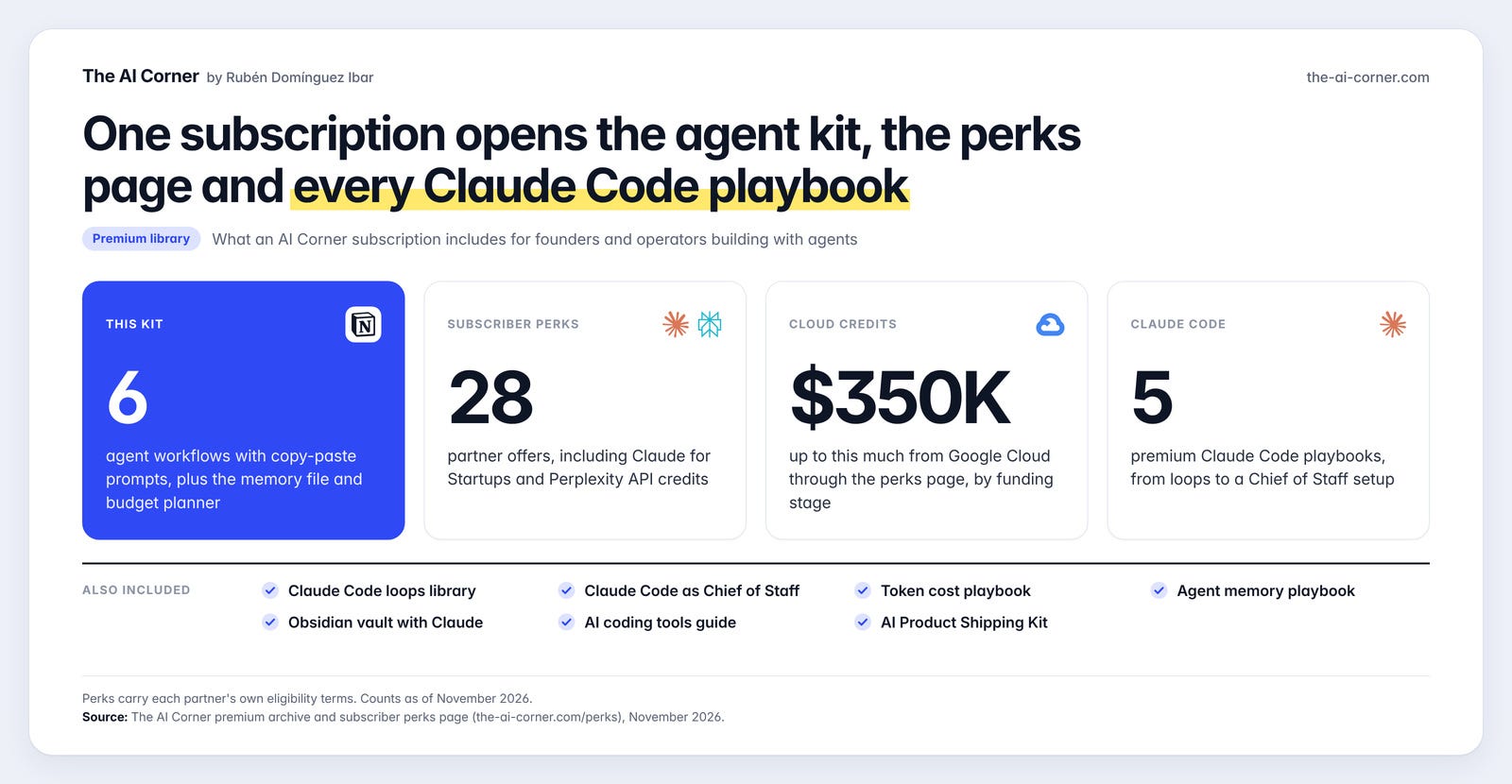
Premium costs $49 a month or $199 a year. The welcome offer takes 50% off your first year. You can also start with a 7-day free trial and cancel anytime.
Get the Personal AI Agent Kit