


Jan Oberhauser wrote n8n’s first pitch deck for its Series B in March 2025. Fourteen months later, the company was worth $5.2B.
Guillermo Flor and I sat down with him at Slush in Helsinki this week. n8n has passed $100M in annual recurring revenue, turns a profit and runs on about 430 people, he told us, and he wants to keep headcount close to 1,000 as it grows. He still blocks every Friday to use AI tools and watch the market himself.
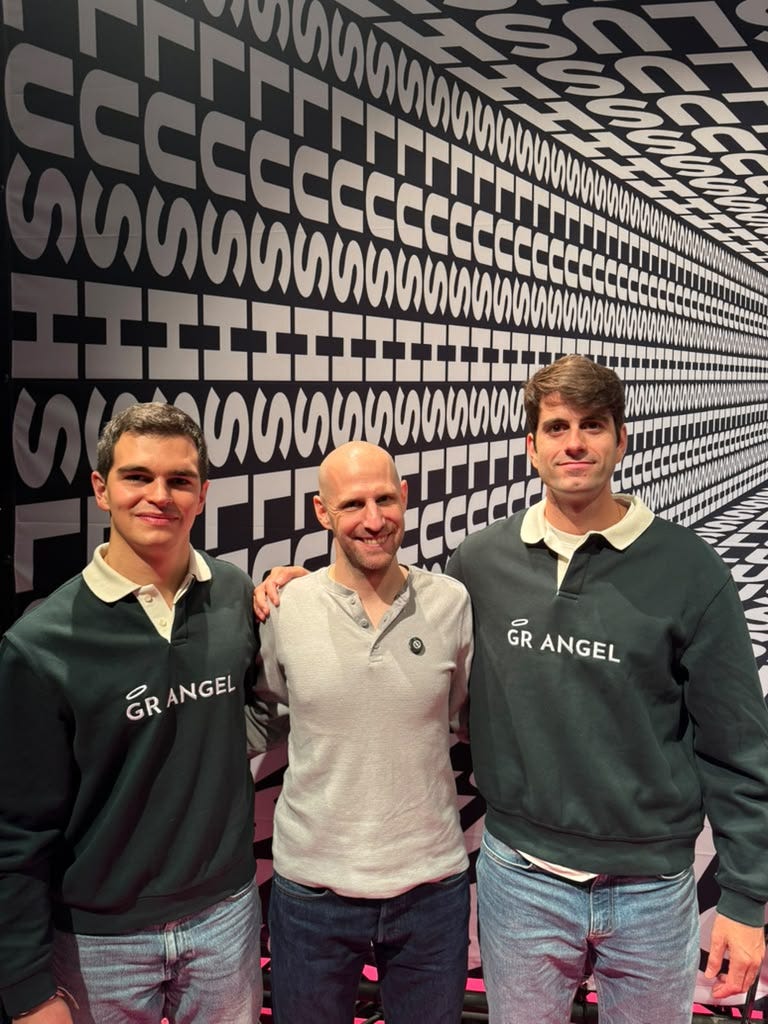
Asked how he keeps up with a sector that changes every month, Jan answered in one line: “I try to focus on the most important things, the most impactful ones.” The rest of the conversation showed what that looks like in practice.
n8n in 60 seconds
▫️ What it is: an AI orchestration platform where teams wire models, fixed logic and human approvals into workflows they can audit. Free to self-host.
▫️ Origin: a side project in Berlin. First code in early 2018, launch in 2019.
▫️ 2020 seed: $1.5M, with Sequoia backing it before seeing a deck.
▫️ 2021 Series A: led by Felicis.
▫️ March 2025 Series B: led by Highland Europe at a $270M valuation. The first round with a deck.
▫️ October 2025 Series C: $180M led by Accel at $2.5B.
▫️ May 2026: SAP buys in at $5.2B and puts n8n inside Joule Studio.
▫️ November 2026: n8n Labs ships Nod, a free, open source personal agent.
▫️ Today: about 430 people, offices in Berlin, London and Boston, past $100M ARR and profitable, per Jan.
Below are the 9 lessons from the conversation, each with the clip where Jan makes the point himself. Guillermo’s write-up, with more on the fundraising story, is on Product Market Fit.
1. Wrap the Model in Logic and a Human Checkpoint
A good demo and a dependable process are 2 different products, and n8n sells the second one.
If you actually want to bring it in your organization for your most basic critical use cases, AI alone isn’t enough.
Plenty of people built very nice AI demos and showed what’s possible. Putting AI inside an organization’s most critical use cases takes a different product, and that’s the job n8n took on.
n8n calls itself an AI orchestration platform. The bet: as models get commoditized, more of the value moves to the layer that decides what the model touches, which steps run as fixed logic, and who signs off. SAP bought into that argument in May 2026, taking a stake at a $5.2B valuation and putting n8n inside Joule Studio, its tool for building agents.
Jan’s recipe has 3 parts: AI, logic and a human in the loop. Logic protects the process and keeps speed and quality up. The human takes the decisions that turn expensive, or permanent, when a model gets them wrong.
Try it on your own stack. Find the step where a wrong answer becomes permanent, and put a person there before you choose a model.
Building AI workflows with checkpoints? The playbooks:
▫️ The Harness Is the Product: 6 Decisions That Turn an AI Agent Into a Worker You Can Leave Alone
▫️ Stop Blaming the Model. Fix the Architecture
▫️ Your AI agent is going to hallucinate at scale
▫️ No, You Don’t Need an AI Agent
2. Sequoia Backed the Seed Without Seeing a Deck
Jan gave up pitch decks after his previous startup and put the hours into the product.
I didn’t reach out to any investors. I didn’t build a pitch deck. All I did was actually building a product and launching it and building a community around it.
n8n came after several iterations. At the startup before it, Jan spent a lot of time on pitch decks and on working out how to get investors to invest, until he decided it was a big waste of time.
A great product with lots of users paid back far more, because it shows investors what you already built instead of what you plan to build.
So with n8n he built the product, launched it and grew a community around it, and the investors reached out. Sequoia backed the $1.5M seed in 2020 without seeing a deck. Felicis led the Series A in 2021. The first deck arrived with the Series B, led by Highland Europe in March 2025 at a $270M valuation, and seven months later Accel led a $180M Series C at $2.5B.
“It’s a very different conversation if I reach out to them or the other way around.”
Traction decides which side of that conversation you sit on. If you’re pre-launch and polishing slides, ask what a working version would prove that slides only promise.
Jan did write a deck eventually, for the Series B. When your round reaches that point, study the ones that worked:
▫️ 16 Unicorn Pitch Decks: Before the Billions
▫️ 26 Pitch Decks That Raised $400M in 2026
▫️ Peter Thiel Only Explained Once How to Raise Money. Here It Is
▫️ The AI-Era Fundraising Toolkit: 105 Verified Links, a Raise Command Center and 15 Claude Prompts
3. Jan Built n8n on Spare Hours. Today 1 Prompt Gets You a First Version
At seed, investors bet on the founder, so the first product doubles as proof that you deliver.
You can show people what’s possible and launch already there. That’s actually more important than ever.
Some founders skip the deck or let AI draft it. For Jan, the product and the founder behind it matter most: at the seed stage a lot of people are betting on you, and trust comes from delivery.
He earned his on spare hours. The first line of code came at the start of 2018 and the launch in 2019, while he worked part time at another company, ran a different startup and raised a family. n8n is his third company, after years in film visual effects.
Jan thinks it’s easier than ever now, since you can build things with 1 prompt.
Before your next investor meeting, decide what you’ll put in their hands instead of on a slide.
Ship the first version this month:
▫️ Ship your first AI agent in a day
▫️ The one-person company stopped being a meme. This is the operating system that runs it
▫️ Nobody Knows Your Startup Exists. Here Are 350+ Ways to Fix That
▫️ 50 Free Places to Launch Your Startup in 2026
4. The Community Carries Every Launch. Positioning Is the Open Problem
n8n has the reach. The category still needs work.
I think we are already very well known, but very often people don’t put us in the right bucket.
Asked how n8n puts a launch in front of the right people, Jan points to the community first. Many members already look for a solution, so a launch lands with an audience waiting for it. That’s the open source, bottom-up engine behind n8n.
Bottom-up growth scales, though it’s hard to steer. As revenue and adoption targets climb, the enterprise side adds the channels other companies use, from outbound to brand.
Positioning is the open problem. Some people file n8n under automation, others under agent builders. Jan wants them to see the orchestration layer that brings AI into an organization, and he treats the gap as a communication job: get n8n into the right bucket so it shows up in the right conversations.
Name your category before a buyer picks one for you.
Growth and positioning playbooks:
▫️ Why Your Cold Outreach Gets 8% Replies (And How to Get 45%)
▫️ Peter Steinberger Almost Deleted OpenClaw. Then 4.7 Million People Downloaded It.
▫️ Distribution Is the Final Moat
5. n8n Is Becoming a Multi-Product Company, Starting With Nod
The question was about the product. The answer was about the company.
We’re moving away from being the single product company into turning into a multi-product company.
I asked about the biggest change of the last year. Jan started with the organization: n8n is moving from a single product to several.
The first proof shipped on November 10, about a week before we sat down. Nod, built by a new team called n8n Labs, is a personal agent with its own sandboxed computer and browser on your Mac or Windows machine. It works across Gmail, Calendar, Drive and Slack, asks before it sends, pays, posts or deletes anything outside your request, and closes every task with a receipt showing the cost. The code is open source under Apache 2.0, the app is free, and you bring your own model or ChatGPT plan.
Nod runs on the same recipe as Lesson 1: the model does the work, a separate check guards the limits, and you approve anything permanent. Until now n8n has been the orchestration layer for teams, and Jan sees the next step as letting people do more with that layer and cover more ground.
Ask what he likes most about being a founder and the answer comes back to people. At community events he hears how n8n changed careers: some people moved up in their roles, others built agencies that now employ whole teams. That excitement is the best part, he says, because giving people the ability to do something was always the point.
Before you scope a second product, write down what users already do with the first.
Building a second product, or an agent with its own computer:
▫️ Clawdbot: The 24/7 AI Employee You Actually Own
▫️ Instinct Is the First AI Assistant You Employ Instead of Operate. Here Is the Playbook.
6. Three Buckets and a Blocked Friday: How the Founder of a $5.2B Company Splits His Week
Jan sorts his time into 3 buckets and guards 1 day a week for the tools.
I have every Friday blocked off just to kind of see what’s going on in the market and use AI tools and just make sure that I don’t lose the connection there.
There’s always more to do than hours in the week, so his filter asks 3 questions: what has the most impact on n8n, what is he good at, and what does he enjoy? He spends as much time as he can in the overlap, and admits the system slips.
Fridays sit right in that overlap. They help n8n, they play to his strengths, he enjoys them, and they pull him back toward building, the part of the job he misses most.
The logic comes from product-led companies. A founder who stays close to the tools sees where the market moves early enough for the company to evolve fast and in the right direction.
The block takes hits. Travel eats some Fridays, so he keeps work trips to a minimum: he prefers to travel privately and spend the time with his family. Every event could have impact, and attending all of them would leave his actual work undone.
Put tool time on the calendar before meetings fill the week.
Build your own Friday routine:
▫️ What actually moves the needle with Claude
▫️ Stop prompting. Start writing loops
▫️ The head of Claude Code stopped prompting Claude. Most builders missed why
▫️ The Single Best Productivity Decision You Can Make With Claude Right Now
7. 430 People and Too Many Meetings: n8n Is Planning a Full Reset
Even at 430 people, n8n’s team says it has too many meetings.
We actually right now think internally about a whole meeting reset, I think what some companies are doing.
I asked whether his focus filter applies to meetings. Jan said yes, and pointed to feedback from his own team: they have so many meetings that they struggle to handle them or find time for anything else.
He keeps meetings in the picture. They matter, he says, they can run shorter, and a reset in between is probably a good place to start.
His own week shows the load. n8n is remote-first, with offices in Berlin, London and Boston, and people come in whenever they like. Jan goes in every morning, works half a day, has lunch and heads home. Most of his day is meetings: half a day in a meeting booth works for him, a full day wears him out, so the afternoon calls happen from a nicer setup at home.
He calls that 50-50 split great, because the mornings keep him around people, and the talking and interacting in the office gives him energy.
If your team says the calendar is full, count the meetings before you count the tasks.
Run a tighter operating rhythm:
▫️ how to make Claude Code your Chief of Staff
▫️ Claude Dispatch: The AI That Keeps Working When You Don’t
8. n8n Hires Less on Purpose: About 430 People Now, a Ceiling Near 1,000
The old playbook says hire your way to scale. Jan runs the other way.
We want to build the most impactful company with the smallest headcount possible.
The job changed at every stage. At first he only wrote code, then came the first hires, then managing, and now n8n has about 430 people. The hardest part for him is drifting away from building, which is why the Fridays stay blocked.
AI changes an old assumption. A successful company used to mean a huge org chart, and n8n is testing the opposite, though Jan still sees a floor: you need a certain scale to win.
Staying lean pays twice. People have more impact, and they enjoy the work more, which shows up in the culture. n8n also sells the org of the future to its customers, so it has to run as one first.
“I don’t think you can do it with 50 people. I don’t think you can do it with 100 people. I think a scale around 1,000 people, you should be able to do that.”
Pick the scale you need, hire up to it, then stop.
Model your headcount and run lean:
▫️ The Headcount Planning Module (+ Excel Template)
▫️ The Claude Code system that replaces a 5-person team
▫️ The Agent Workforce Kit: Anthropic’s 8 Metrics, a Role Radar and 12 Claude Prompts
▫️ The AI CEO Dashboard Kit: An Excel Model, 14 Checks and 10 Claude Prompts
9. What Jan Looks for as an Angel: A Founder Who Already Built Something
Jan backs builders, and he expects to see the build.
In the end, you want to have a strong founder.
Jan is writing more angel checks than ever, at the seed stage. His main focus is European founders, the next generation he’s most excited to back, plus open source startups and deep tech. He’s open to a wide range of ideas, with one expectation: the founder arrives with something already built.
I framed it as idea versus founder, pointing to great companies that started with a different idea, sometimes in a different sector. For Jan it’s mainly the founder. A reasonable idea plus a proven ability to deliver de-risks the whole bet, and in those examples the idea changed while the founder stayed.
The signal cuts both ways. A founder who shows up with a weak idea and executes it poorly tells Jan the next idea will look similar, and he counts that as one more proof point.
His own path follows the same logic: he launched first, and investors came to him. It’s also the filter Guillermo and I use at GR Angel when we back founders out of YC.
Your last build is your best evidence.
Raising from investors who back builders:
▫️ 200+ US AI Angel Investors. All Builders. All Searchable
▫️ 80 Seed AI Funds That Invested in the Last 180 Days: The Scored Sheet and the Syndicate Map
▫️ Founder-Market Fit: The #1 VC Filter You Didn’t Know Was Judging You
▫️ What Top-Tier VCs Actually Look For in 2026
What This Means for You
Jan’s order holds across all 9 lessons: build, launch, let the community carry it, and hire only to the scale the work needs.
▫️ Founders: n8n launched in 2019 on spare hours, and the investors called once the product and the community existed. Build a first version this month, put it in front of users, and write the deck when a round asks for one. Then run it through the pitch deck review tool that reads it the way an investor’s first pass does.
▫️ Investors: Jan backs European, open source and deep tech founders who arrive with something built. Ask for the product and its shipping history before you ask for the deck.
▫️ Operators: list your most critical workflow and mark every decision that becomes permanent once it runs. Put a human checkpoint on each one and let AI plus logic handle the rest.
▫️ Everyone else: block a recurring slot each week to use new AI tools yourself, and defend it the way Jan defends his Fridays.
The 5 principles to steal
Wrap AI in logic and people. Put the model inside a process you can audit and hand to an owner.
Show before you pitch. Build, launch, grow a community, and let investors reach out.
Ship with what you can build this month. Jan had scarce hours in 2018. You have AI.
Protect your tool time. Block a day a week for the tools you talk about.
Hire to the minimum. Find the smallest team that reaches the scale you need. Jan puts his near 1,000.
n8n in quick answers
How much is n8n worth? $5.2B, the valuation SAP paid when it bought into a secondary share sale in May 2026. The Series B in March 2025 valued n8n at $270M, and the Series C in October 2025 at $2.5B.
How much revenue does n8n make? Jan told us at Slush that n8n has passed $100M in ARR and is profitable.
Who founded n8n? Jan Oberhauser, in Berlin. He wrote the first code in early 2018 and launched in 2019. It’s his third company, after years in film visual effects.
Did n8n raise without a pitch deck? Yes: Sequoia backed the $1.5M seed in 2020 without one, and Jan wrote his first n8n deck for the Series B.
How many people work at n8n? About 430 in November 2026, in a remote-first team with offices in Berlin, London and Boston. Jan plans to stay close to 1,000.
What is Nod? A free, open source personal agent from n8n Labs, released on November 10, 2026. It runs on your Mac or Windows machine with its own sandboxed computer and browser, and asks before it sends, pays, posts or deletes anything outside your request.
Know a founder still polishing slides before launch? Send them this.
Most links in this post open premium playbooks, pitch decks and investor lists. Upgrade to The AI Corner or The VC Corner to read all of them.
More founder breakdowns
▫️ How Lovable hit $400M ARR in 14 months with 146 people and almost zero paid ads
▫️ Luca Ferrari Runs Evernote With 20 People. Here Are His 10 Rules for Doing More With Less